
Whistlekleen is a national dry cleaning and laundry company with 50 shops. You are
conducting a surveillance audit of the Head Office and are sampling customer complaints.
80% of complaints originate from five shops in the same region. Most of these complaints
relate to customer laundry not being cleaned as customers require. The Quality Manager
tells you that these are the oldest shops in the company. The cleaning equipment needs
replacing but the company cannot afford it now. You learn that the shop managers were
told to dismiss most of the complaints because of the poor quality of the laundered
materials.
On raising the matter with senior management, you are told that there are plans to replace
the equipment in these shops over the next five years.
You raised a nonconformity against clause 8.5.1 of ISO 9001.
Based on the scenario, select the three options which best describe the evidence for
raising such a nonconformity.
A. Customer complaints are not taken seriously by the organisation.
B. Shop managers were told to make excuses to customers with complaints.
C. Some equipment used was not suitable for the laundry process.
D. The management failed in planning to replace obsolete equipment.
E. The operators did not check the condition of the customer's product upon receipt.
F. The operators did not check the laundry before release to the customer.
G. The organisation failed to control the laundry operations in 5 shops adequately.
H. The organisation failed to maintain all of its equipment to an adequate standard.
At the end of a second-party audit, the audit team enters the meeting room to hold the
closing meeting; only
two people are present and waiting for them: the Health and Safety supervisor and the
Administrative Officer.
Neither has participated in the audit. However, the team had previously agreed with the auditee Quality
Manager on two nonconformities identified during the audit (NC1 and NC2).
They said:
Health and Safety Supervisor: "Good evening. We are sorry to inform you that the general
manager was
involved in a serious car accident, and the other two managers have had to leave urgently
to attend to the
emergency."
The Administration Officer: "Concerning 'nonconformity 2', the General Manager left a
message asking us
to tell you that he does not accept it and requests you not to include it in the audit report.
Here is a note in
which he explains why."
Which one of the following would be your preferred answer (as team leader) to the General
Manager's request?
A. OK. I will get in contact with my company tomorrow to ask for instructions on what to do with this non-conformity.
B. OK. Please, let me review the message. I will try to see if I can change the text of the nonconformity if necessary. Let's take a 10-minute break, as I would like to discuss this issue with the audit team.
C. Please tell him that I will phone him in two days and will discuss the issue. Could you please give me his mobile phone number?
D. Please tell him that this nonconformity has been previously accepted by the quality manager during the audit and will stand. I will include it in the report, along with the concern of the General Manager about it.
During a second-party audit, the auditor examines the records that are available for the
external provider, ABC Forgings, to whom manufacturing has recently been outsourced.
There are standard external provider checklists for three competitors for the contract and
there are inspection records from the trial manufacturing batches produced by ABC
Forgings. There is no documented evidence of the criteria used to confirm the appointment
of ABC Forgings, and no contract or terms and conditions. Ongoing monitoring indicates
that external provider performance is satisfactory, but no documented information has been
retained.
Select two options for the evidence which demonstrates a nonconformity with clause 8.4 of
ISO 9001.
A. There was no documentation which provided evidence of any monitoring of the external provider.
B. The auditee required the outsourced products on an urgent basis before the completion of the paperwork.
C. The auditee did not retain documentation on the selection and evaluation of the external provider.
D. The external provider asked for the contract details to be verbal only.
E. There were no receipt inspection records of the incoming materials.
F. The auditee trusted the external provider because of a long-standing relationship with them.
Explanation:
According to clause 8.4 of ISO 9001:2015, the organization should ensure that externally
provided processes, products, and services conform to the specified requirements. To do
so, the organization should:
•Establish the criteria for the selection, evaluation, and re-evaluation of external providers,
based on their ability to provide processes, products, and services in accordance with the
requirements. The criteria should be documented and applied consistently.
•Evaluate the potential external providers before selecting them, using the established
criteria. The evaluation methods may include questionnaires, audits, references, samples,
etc. The results of the evaluation should be documented and reviewed.
•Select the external providers that have demonstrated their competence and conformity to
the requirements. The selection should be based on the evaluation results and the
organization’s needs. The selection should be documented and approved.
•Communicate the requirements for the processes, products, and services to be provided
by the external provider, including the verification and validation activities, the acceptance
criteria, the documentation requirements, the changes control, etc. The communication
methods may include purchase orders, contracts, agreements, etc. The communication should be clear, complete, and timely.
•Monitor the performance and conformity of the external provider, using the established
criteria and methods. The monitoring methods may include inspections, tests, audits,
feedback, complaints, etc. The monitoring results should be documented and analyzed.
In this case, the evidence statements that demonstrate a nonconformity with clause 8.4 are
A and C, because they show that the organization did not retain documented information of
the selection and evaluation of the external provider, and the monitoring of the external
provider’s performance. These are requirements of the standard and essential for ensuring
the quality of the externally provided processes, products, and services. The other options
are not directly related to clause 8.4, although they may indicate other nonconformities or
weaknesses in the organization’s QMS. For example, option B may relate to clause 7.1.3
on contingency planning, option D may relate to clause 8.2.3 on review of requirements,
option E may relate to clause 8.6 on release of products and services, and option F may
relate to clause 5.1.1 on leadership and commitment. References: ISO 9001:2015, [ISO
9001 Auditing Practices Group Guidance on Scope], Mastering the Scope of ISO 9001
Quality Management Systems
You, as auditor, are in dialogue with the quality lead and managing director of a small
business that supplies
specialist laboratory equipment and furniture.
You: "I'd like to look at how you manage change in the organisation. What changes have
you made as a
business, say, over the last 12 months?"
Auditee: "We have made some strategic changes, the main one being that we no longer
manufacture our
own products in house."
You: "That sounds like quite a significant change. What has been the impact of that?"
Auditee: "We now mainly sell other manufacturers' products, under their brand names, and
have outsourced
manufacture of our own brand products to one of our suppliers. Unfortunately, we had to
make six members
of our staff redundant. This represents about 20% of our workforce, so this has been quite
a challenging
time."
You: "I'm sure. What were the reasons for making the change?"
Auditee: "Our manufacturing section was a small operation, and we struggled to cope with
fluctuations in
demand. During busy periods, we found it hard to meet lead times, and in quiet periods we
had staff with
little to do. This was having an impact on customer satisfaction and meant we had to
charge premium prices
that made our product uncompetitive."
You: "How did you go about the change?"
In relation to the auditor's question about how the change was managed, the auditee
mentions the steps
listed below. Match the ISO 9001 clauses to the steps.
To complete the table, click on the blank section you want to complete so it is highlighted in
red and then
click on the ISO 9001 clauses listed below. Alternatively, drag and drop each clause to
show which step the
requirement applies to.
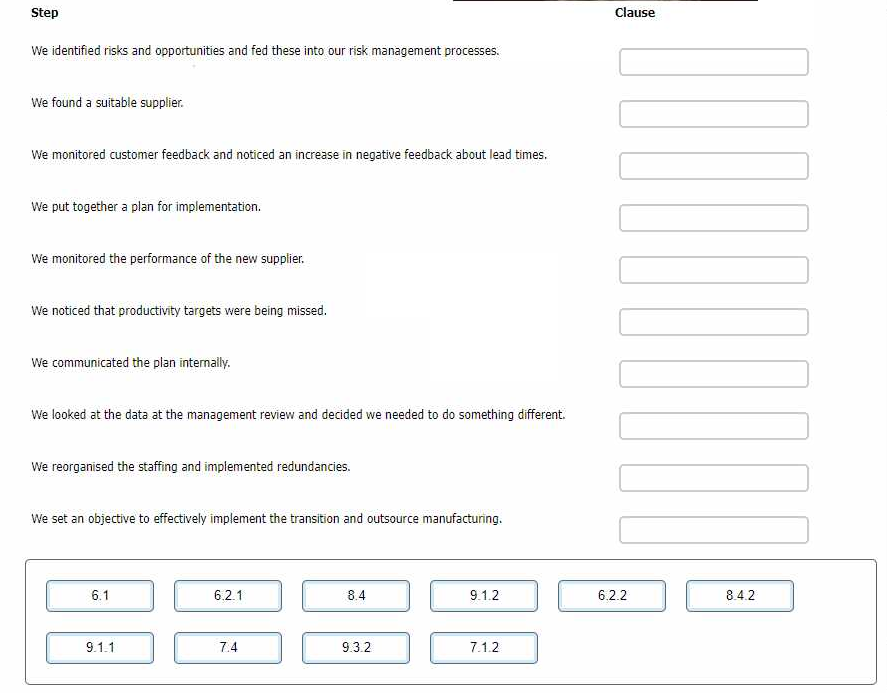
Explanation:
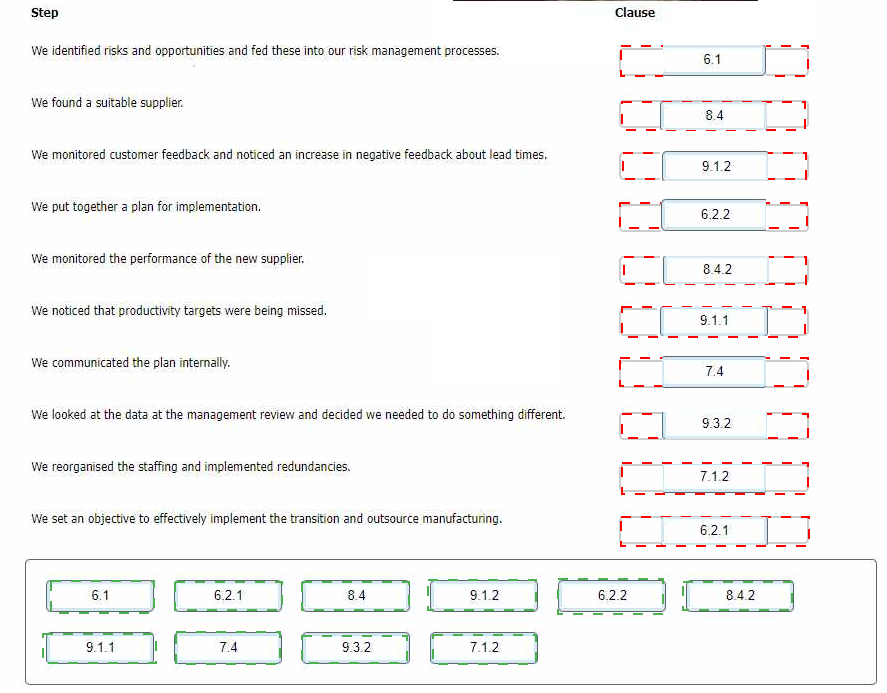
Here is the correct matching of ISO 9001:2015 clauses to the steps mentioned in the
change management process:
We identified risks and opportunities and fed these into our risk management
processes.
uk.co.certification.simulator.questionpool.PList@202706c
We found a suitable supplier.
We monitored customer feedback and noticed an increase in negative feedback
about lead times.
We put together a plan for implementation.
We monitored the performance of the new supplier.
We noticed that productivity targets were being missed.
We communicated the plan internally.
We looked at the data at the management review and decided we needed to do
something different.
We reorganised the staffing and implemented redundancies.
We set an objective to effectively implement the transition and outsource
manufacturing.
This aligns the steps of the change process with relevant ISO 9001:2015 clauses related to
risk, planning, communication, and monitoring.
You are carrying out an audit at a single-site organisation seeking certification to ISO 9001
for the first time. The organisation manufactures
cosmetics for major retailers.
You are interviewing the Manufacturing Manager (MM).
You: "I would like to begin by looking at the cleaning controls."
MM: "We record the cleaning of the equipment at the end of every batch. This document
details the minimum cleaning frequency and the
procedures to follow for all areas and each item of equipment. The person who carries out
the cleaning puts their initial on the document and records
the time and date alongside."
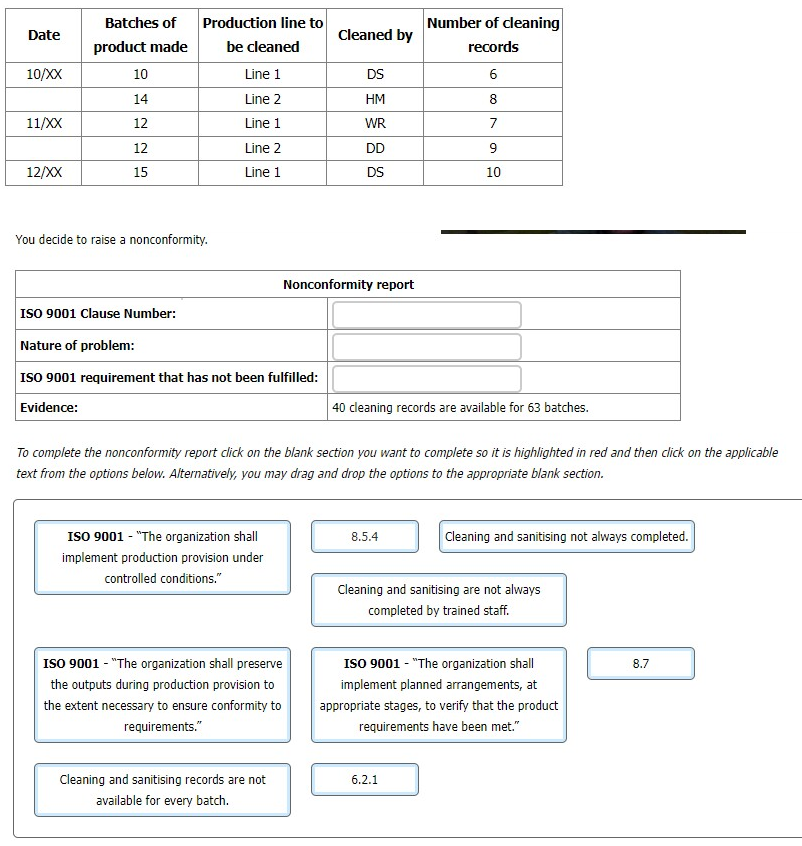
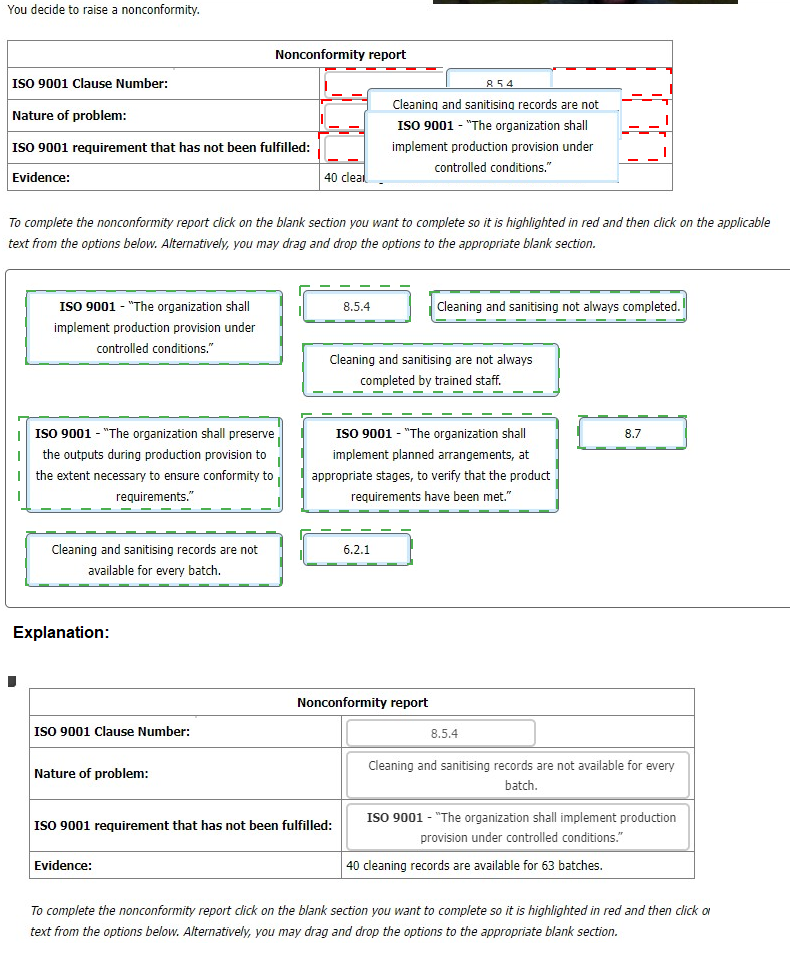
Narrative: You sample production records over 3-days and note down evidence of
nonconformity as per the table below.
You have been just hired as the Internal Lead Auditor of a large organisation, responsible
for internal audits. Your first job is to analyse the answers to nonconformities included in
the report of a recent internal audit to Top Management.
The report contained one nonconformity as follows:
There is no evidence of Top Management ensuring the availability of resources to operate
the QMS, the establishment of objectives, the promotion of continual improvement, and the promoting of the process approach.
Which four of the following Top Management actions can be considered 'corrections to the
nonconformity'?
A. Top Management appoints a senior manager to oversee the quality manangement system
B. Top Management completed a course on ISO 9001
C. All these actions will be reviewed during the Top Management meetings
D. Improvement action has been promoted
E. Objectives have been established
F. Process approach has been communicated to the personnel
G. Resources have been provided
H. Top Management review will be carried out every six months instead of annually
ABC is a service organisation that cleans and irons bed and table linen for four large
hospitals in the city centre. It claims to meet ISO 9001:2015 requirements. During an
internal audit, an auditor observes that
machine No. 4 is being operated with the three variables outside the limits established in
the applicable documented procedure SP-701. The auditor has decided to raise a
nonconformity.
Which six elements should be included in the nonconformity report?
A. Condition of the table linens upon receipt from the hospital
B. Applicable procedure: SP-701
C. Competence record of the machine operator
D. Identification number of the washing machine
E. Manufacturer of the washing machine
F. Name of the Quality Manager
G. Number of the production order
H. The concentration of the cleaning liquid used vs the concentration fixed in SP-701
I. The planned duration of the process vs the minimum time required in SP-701
J. Weight of linen being washed vs the maximum weight required in SP-701
Explanation:
B. Applicable procedure: SP-701
D. Identification number of the washing machine
H. The concentration of the cleaning liquid used vs the concentration fixed in SP-701
I. The planned duration of the process vs the minimum time required in SP-701
J. Weight of linen being washed vs the maximum weight required in SP-701
C. Competence record of the machine operator
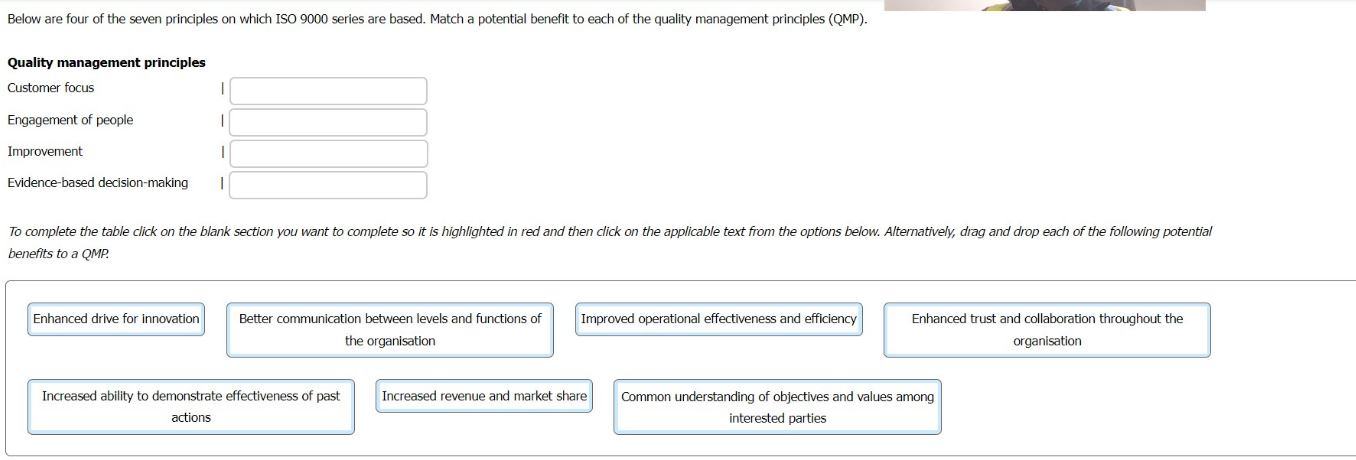
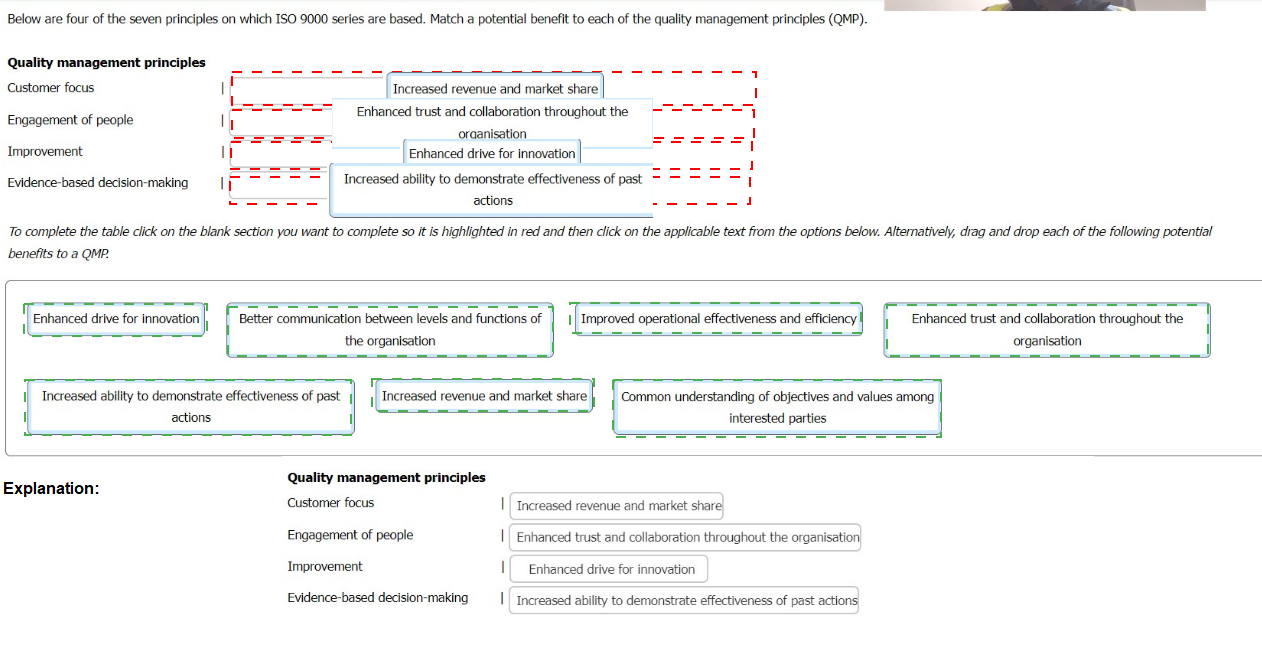
Below are four of the seven principles on which ISO 9000 series are based. Match a
potential benefit to each of the quality management principles (QMP).
A screenshot of
a chat Description automatically generated
According to the ISO 9000:2015 document, the seven quality management principles are:
Customer focus
Leadership
Engagement of people
Process approach
Improvement
Evidence-based decision making
Relationship management
For each principle, the document provides a statement, a rationale, key benefits, and
actions you can take to apply the principle in your organization.
Based on the document, here is a possible way to match a potential benefit to each of the
four quality management principles you mentioned:
Table
Quality management principle
Potential benefit
Customer focus
Increased revenue and market share
Engagement of people
Enhanced trust and collaboration throughout the organization
Improvement
Enhanced drive for innovation
Evidence-based decision making
Increased ability to demonstrate effectiveness of past actions
Which two of the following are the key expected results of a quality management system that conforms to the requirements of ISO 9001:2015?
A. Consistently provide products that meet customers' requirements
B. Decreased number of management system nonconformities
C. Decreased number of warranty claims
D. Decreased number of nonconforming products in all stages of the manufacturing cycle
E. Enhanced customer satisfaction
F. Increased profits
Explanation:
The key expected results of a quality management system that conforms to the
requirements of ISO 9001:2015 are stated in clause 0.1 of the standard, which says: “The
adoption of a quality management system is a strategic decision for an organization that
can help to improve its overall performance and provide a sound basis for sustainable
development initiatives. The potential benefits to an organization of implementing a quality
management system based on this International Standard are: a) the ability to consistently
provide products and services that meet customer and applicable statutory and regulatory
requirements; b) facilitating opportunities to enhance customer satisfaction; c) addressing
risks and opportunities associated with its context and objectives; d) the ability to
demonstrate conformity to specified quality management system requirements.” Therefore, the two options that best match these benefits are A and E, as they directly relate to
providing products and services that meet customer requirements and enhancing customer
satisfaction. The other options are not explicitly mentioned as key expected results,
although they may be possible outcomes of implementing a quality management system.
References: ISO 9001:2015 - Quality management systems — Requirements, Key
Elements of an ISO 9001:2015 Quality Management System, What is ISO 9001 2015 as a
Quality Management Systems?
You, as auditor, are in dialogue with the quality lead and managing director of a small
business that supplies specialist
laboratory equipment and furniture.
You: "I'd like to look at how you manage change in the organisation. What changes have
you made as a business, say,
over the last 12 months?"
Auditee: "We have made some strategic changes, the main one being that we no longer
manufacture our own products
in house."
You: "That sounds like quite a significant change. What has been the impact of that?"
Auditee: "We now mainly sell other manufacturers' products, under their brand names, and
have outsourced
manufacture of our own brand products to one of our suppliers. Unfortunately, we had to
make six members of our staff redundant. This represents about 20% of our workforce, so this has been quite a
challenging time."
This scenario presents a number of audit trails to different ISO 9001 requirements.
Which three of the following requirements would be relevant audit trails for this scenario?
A. Organisational knowledge
B. Control of externally provided processes, products, and services
C. Design and development of products and services
D. Documented information
E. Measurement traceability
F. Organisation roles and responsibilities
G. Preservation of product
H. Property belonging to customers or external providers
Explanation:
B. Control of externally provided processes, products, and services: This is relevant
because the organization has outsourced the manufacture of its own brand products to a
supplier. According to ISO 9001, the organization must ensure that externally provided
processes remain within the control of its quality management system.
C. Design and development of products and services: Even though the organization no
longer manufactures in-house, it still needs to control the design and development of its
products, especially since they are now being produced by an external provider.
F. Organisation roles and responsibilities: The change in strategy has led to a significant
reduction in staff, which would have an impact on the roles and responsibilities within the
organization. It is important to audit how these changes have been managed and
communicated within the organization to ensure continued effectiveness of the quality
management system.
These audit trails are aligned with the requirements of ISO 9001:2015, which emphasizes
the importance of controlling externally provided processes and products, managing design
and development, and clearly defining roles and responsibilities within the quality
management system.
Which one of the following is not an ISO 9000:2015 quality management principle?
A. Evidence-based decision-making
B. Leadership
C. Process approach
D. Risk-based approach
Explanation: According to the ISO 9000:2015 quality management principles document1,
risk-based approach is not one of the seven quality management principles that ISO 9000,
ISO 9001 and other related quality management standards are based on. The seven
quality management principles are:
Customer focus
Leadership
Engagement of people
Process approach
Improvement
Evidence-based decision making
Relationship management
Therefore, risk-based approach is not a quality management principle under ISO
9001:2015.
You are carrying out an audit at an organisation seeking certification to ISO 9001 for the
first time. The organisation offers health and safety training to customers. Training courses
are offered either as open courses, delivered at a public venue, or online, or as courses
that are tailored to meet specific requirements. The business operates from a single office
and those who deliver the training are either full-time employees or subcontractors.
You are interviewing the Training Manager (TM).
You: "What quality objectives apply to the training process?"
TM: "One of the quality objectives we aim for is a 90% minimum exam pass rate for all
open training courses."
You: "How do you measure this objective?"
The Training Manager shows you a record on her computer and you see the following:
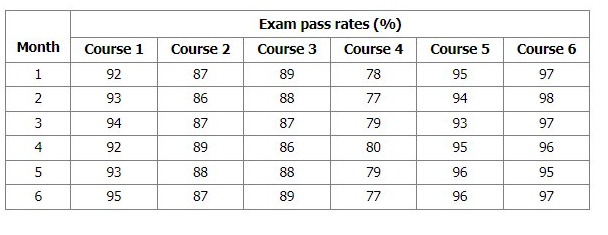
Which two of the following statements are true?
A. You would check the training of personnel.
B. You would determine how the exam pass rate figures were analysed.
C. You would determine the relative difficulty of each training course by reviewing them.
D. You would determine what corrective action was being taken to address the low pass rates.
E. You would raise a nonconformity as a requirement in clause 10.2 has not been fulfilled.
F. You would raise a nonconformity as a requirement in clause 8.7 has not been fulfilled.
Explanation: In this scenario, the organization has set a quality objective of achieving a
90% minimum exam pass rate for all courses. The auditor’s task is to assess whether this
objective is being monitored effectively and if appropriate actions are taken when the
objective is not met.
B. You would determine how the exam pass rate figures were analysed: ISO 9001:2015,
particularly Clause 9.1 (Monitoring, measurement, analysis, and evaluation), requires
organizations to evaluate performance data. The auditor should verify how the organization
analyses the pass rate data to ensure trends are identified, and corrective actions are
planned based on this analysis.
D. You would determine what corrective action was being taken to address the low pass
rates: When performance falls short of the objective, as seen with Course 4 (where the
pass rate is below 90% in all months), Clause 10.2 (Nonconformity and corrective action)
requires organizations to take corrective actions to address issues. The auditor would need
to check if corrective actions have been initiated to address consistently low pass rates.
Statements A, C, E, and F do not directly address the monitoring and corrective action
required under ISO 9001:2015 in this context.
| Page 1 out of 18 Pages |
| 123456 |
Real-World Scenario Mastery: Our ISO-9001-Lead-Auditor practice exam don't just test definitions. They present you with the same complex, scenario-based problems you'll encounter on the actual exam.
Strategic Weakness Identification: Each practice session reveals exactly where you stand. Discover which domains need more attention, before QMS ISO 9001:2015 Lead Auditor Exam exam day arrives.
Confidence Through Familiarity: There's no substitute for knowing what to expect. When you've worked through our comprehensive ISO-9001-Lead-Auditor practice exam questions pool covering all topics, the real exam feels like just another practice session.
Copyright © All Rights Reserved