
During an internal audit, it was discovered that the calibration of a spectrometer used daily
for production had expired, causing a nonconformance under Clause 7.1.5.2 of ISO
9001:2015. The root cause was the organization not considering the risk of the calibration
provider leaving the country.
Which corrective action is the best one?
A. We will select one sample, which we will send to an external laboratory and will use it as our internal standard.
B. We will look for a local company to provide this service.
C. We will have the results on one out of ten of our routine production samples doublechecked by an external local laboratory.
D. We will add this to our external issue register, assess its associated risk, and plan action to address that risk.
Explanation:
Understanding Clause 7.1.5.2 – Measurement Traceability:ISO 9001:2015
requires organizations to ensure that measuring equipment (e.g., spectrometers) is
calibrated and traceable to recognized standards. The failure to maintain
calibration within valid dates directly violates this clause and raises concerns about
the reliability of the measurement results.
Root Cause of the Nonconformity:The organization failed to plan for the possibility
that the calibration service provider (X-TECH) might become unavailable, leading
to expired calibration. This indicates inadequate risk-based thinking, which is
required under Clause 6.1 of ISO 9001:2015.
Option Analysis:
Why D is the Best Option:
ISO 9001 References:
Select one option that must be considered when determining the scope of a QMS to ISO 9001.
A. Business improvement
B. Performance of business processes
C. External issues of the organisation's context
D. Competence of top management
Explanation:
According to ISO 9001:2015, clause 4.3, the organization is required to determine the
scope of its quality management system (QMS) by considering the external and internal
issues referred to in clause 4.1. Clause 4.1 requires the organization to determine the
external and internal issues that are relevant to its purpose and strategic direction, and that
affect its ability to achieve the intended results of its QMS. These issues can include
positive and negative factors or conditions for consideration, such as legal, technological,
competitive, market, cultural, social, and economic environments, whether international,
national, regional, or local. The organization is also required to monitor and review these
issues.
Therefore, the correct answer is C, as external issues of the organization’s context are one
of the factors that must be considered when determining the scope of the QMS. The other
options are either not directly related to the scope of the QMS, or are not explicitly
mentioned in clause 4.3.
According to the ISO 9001 standard, which one of the following is a defined responsibility of top management?
A. Communicating the quality objectives needed for the Quality Management System.
B. Ensuring customer requirements are consistently met.
C. Establishing the Quality Management System quality policy.
D. Planning actions to address risks and opportunities.
Explanation: Top management is responsible for establishing, implementing, and maintaining the quality policy. The quality policy provides a framework for setting quality objectives and must be compatible with the context of the organization and support its strategic direction. It should also provide a commitment to satisfy applicable requirements and to continuous improvement.
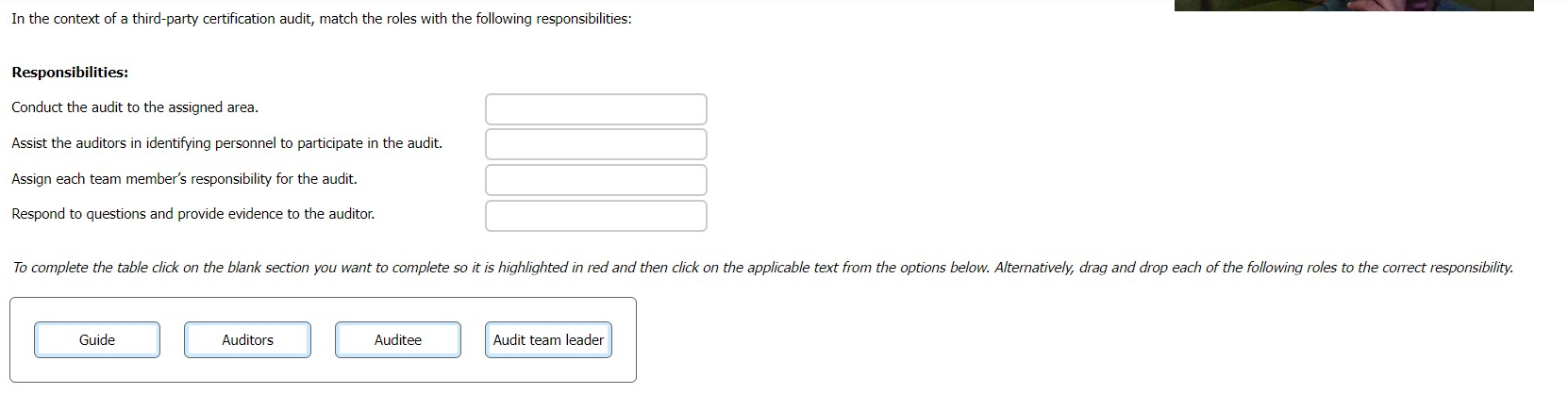
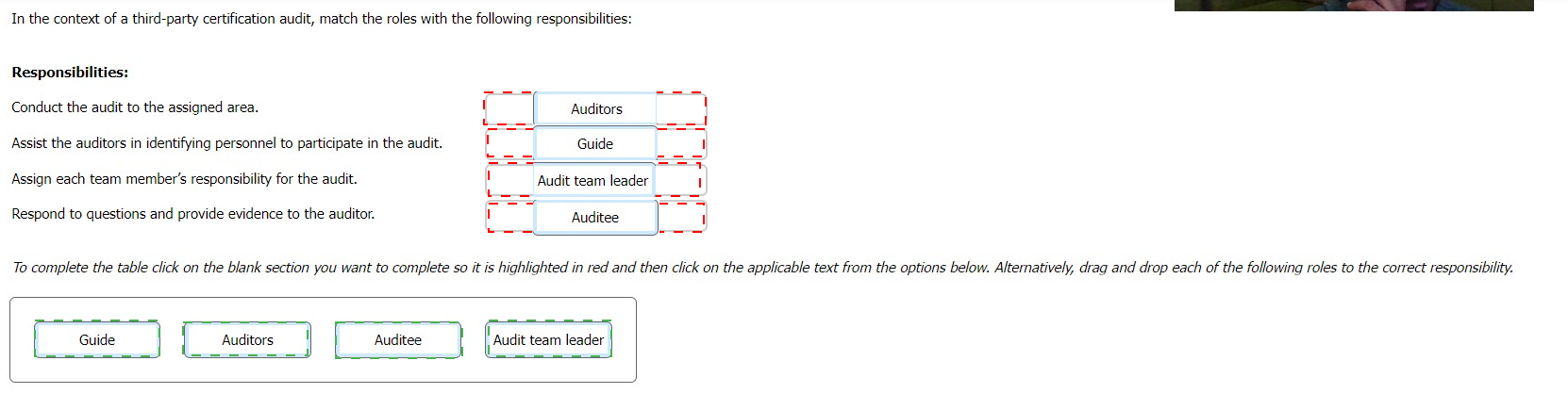
In the context of a third-party certification audit, match the roles with the following
responsibilities:
Explanation:
In the context of a third-party certification audit, match the roles with the following
responsibilities:
Responsibilities:
Conduct the audit to the assigned area.= Auditors
Assist the auditors in identifying personnel to participate in the audit.= Guide
Assign each team member’s responsibility for the audit.= Audit team leader
Respond to questions and provide evidence to the auditor.= Auditee
According to ISO 19011:2018, clause 3, the definitions of the roles are as follows1:
Auditors: persons with the competence to conduct an audit
Guide: person appointed by the auditee to assist the audit team
Auditee: organization being audited
Audit team leader: member of an audit team appointed to manage the audit or an audit
team
Therefore, the roles can be matched to the responsibilities based on these definitions and
the description of the audit process in clause 6 of the standard1.
An internal auditor of a manufacturer of polystyrene packaging products for the electronics
industry raised a nonconformity against section 10.3 of ISO 9001 in Report IA202. The
nonconformity (NC 3) stated:
"The reject rate of the finished product of 9.7% needs improvement as it doesn't meet the
stated objective of top management of 5%."
As the third-party auditor reviewing the internal audit process, you come across the
nonconformity. For corrective action, the Quality Manager conducted an investigation into
the reject rates. He reported that the collection baskets for products ejecting from the
moulding machines were not large enough. About 6% of products fell onto the wet and dirty
factory floor. Management stated that replacing the baskets was too costly and ordered the
Maintenance Manager to ensure that the floor was kept clean and dry to prevent rejects.
The auditor later checked the factory floor, which was wet and dirty in places.
From the following nonconformities, select three that the auditor could raise to ISO 9001.
A. 10.3 - The organisation did not continuously improve. Reject rates were unchanged.
B. 7.1.4 - The factory environment is not suitably maintained to prevent dirty products.
C. 7.1.1 - The organisation failed to provide the required resources to prevent nonconforming products.
D. 9.2.2 - Report IA202 contained a poorly worded nonconformity (NC 3).
E. 8.6 - Dirty products were released to the customer.
F. 7.3 - Staff were not aware that products were falling onto the factory floor.
G. 10.2.1 - Conduct of an investigation was not sufficient to understand the cause of the nonconformity.
H. 8.5.1 - Production operations were not properly controlled to avoid reject products.
Explanation:
The auditor could raise the following nonconformities to ISO 9001 based on the scenario:
•Option A: 10.3 - The organisation did not continuously improve. Reject rates were
unchanged. This option is correct because ISO 9001:2015 clause 10.3 requires the
organization to improve the suitability, adequacy and effectiveness of the quality
management system. The organization did not demonstrate any improvement in reducing
the reject rate of the finished product, which was a stated objective of top management.
The corrective action taken by the organization was not effective in addressing the root
cause of the problem and preventing its recurrence.
•Option B: 7.1.4 - The factory environment is not suitably maintained to prevent dirty
products. This option is correct because ISO 9001:2015 clause 7.1.4 requires the
organization to determine, provide and maintain the environment necessary for the operation of its processes and to achieve conformity of products and services. The
organization did not ensure that the factory floor was clean and dry, which affected the
quality of the products and increased the risk of nonconformity.
•Option C: 7.1.1 - The organization failed to provide the required resources to prevent
nonconforming products. This option is correct because ISO 9001:2015 clause 7.1.1
requires the organization to determine and provide the resources needed for the
establishment, implementation, maintenance and continual improvement of the quality
management system. The organization did not provide adequate collection baskets for the
products ejecting from the moulding machines, which resulted in products falling onto the
factory floor and becoming nonconforming.
The following options are not correct:
•Option D: 9.2.2 - Report IA202 contained a poorly worded nonconformity (NC 3). This
option is not correct because ISO 9001:2015 clause 9.2.2 does not specify the
requirements for the wording of nonconformities in internal audit reports. The
nonconformity (NC 3) stated by the internal auditor was clear and relevant to the audit
criteria and audit evidence. The issue is not with the report, but with the corrective action
taken by the organization.
•Option E: 8.6 - Dirty products were released to the customer. This option is not correct
because ISO 9001:2015 clause 8.6 requires the organization to implement planned
arrangements, at appropriate stages, to verify that the product and service requirements
have been met. The scenario does not indicate that the dirty products were released to the
customer, but that they were recalled and repaired then returned to the customers. The
issue is not with the release, but with the production process and the environment.
•Option F: 7.3 - Staff were not aware that products were falling onto the factory floor. This
option is not correct because ISO 9001:2015 clause 7.3 requires the organization to ensure
that the persons doing work under its control are aware of the quality policy, relevant
quality objectives, their contribution to the effectiveness of the quality management system,
and the implications of not conforming with the quality management system requirements.
The scenario does not indicate that the staff were not aware of these aspects, but that the
management did not provide adequate resources and environment for the staff to perform
their work. The issue is not with the awareness, but with the management responsibility
and resource provision.
•Option G: 10.2.1 - Conduct of an investigation was not sufficient to understand the cause
of the nonconformity. This option is not correct because ISO 9001:2015 clause 10.2.1
requires the organization to react to the nonconformity and, as applicable, take action to
control and correct it and deal with the consequences. The scenario indicates that the
Quality Manager conducted an investigation into the reject rates and identified the cause of
the nonconformity. The issue is not with the investigation, but with the corrective action
taken by the management.
•Option H: 8.5.1 - Production operations were not properly controlled to avoid reject products. This option is not correct because ISO 9001:2015 clause 8.5.1 requires the
organization to implement production and service provision under controlled conditions.
The scenario indicates that the production operations were controlled by the moulding
machines, which ejected the products into the collection baskets. The issue is not with the
production operations, but with the size of the collection baskets and the condition of the
factory floor.
You are conducting an ISO 9001 audit of a Materials Recycling Facility (MRF). The
organisation processes
waste plastics into raw materials for plastic bottle manufacturers. You reach the manual
picking line where operators are removing contaminant materials from incoming products,
such as plastic bags, plastic film and badly contaminated items that would compromise the
recycling process. You interview the line supervisor.
You: "Why are these plastic items being rejected at this stage?"
Auditee: "They do not meet our processing standards."
You: "What is the reason for that?"
Auditee: "These items are likely to damage the machinery down the line. They can also
compromise our
quality standards. We need to protect our reputation for good quality output materials."
You: "What happens to the rejected items?"
Auditee: "Some get melted down in another process later on and some are disposed of as
waste products that cannot be recycled."
You: "What happens to the waste products?"
Auditee: "I'm not sure. I suppose they go to landfill."
Which two. of the following actions would you take to investigate further?
A. Check the process for handling nonconforming items.
B. Ask to review the percentage of waste materials.
C. Find out if operators have regular hearing tests.
D. Determine what happens to the waste products.
E. Ask about operator PPE (Personal Protective Equipment).
F. Determine whether there are quality objectives for reducing rejected material.
Explanation:
According to the ISO 9001:2015 standard, clause 8.7 requires that an organization identify
and control any nonconforming outputs that do not conform to the requirements of the
customer or other relevant requirements. Nonconforming outputs are any outputs from the
process, product or service that do not meet the specified quality criteria. Nonconforming
outputs must be dealt with in one or more of the following ways:
Correction of the nonconformity
Segregation, containment, return or suspension of provision of products and services
Informing the customer
Authorisation for acceptance under concession
The organization must also retain documented information on the description of the
nonconformity, the actions taken, any concessions obtained, and the identification of the
authority deciding the action to resolve the nonconformity.
In this scenario, you have interviewed a line supervisor who is responsible for managing a
manual picking line where operators are removing contaminant materials from incoming
products. The supervisor has explained that these plastic items are rejected at this stage
because they do not meet their processing standards and they can damage their
machinery and compromise their quality standards. The supervisor has also mentioned that
some of these rejected items are melted down in another process later on and some are
disposed of as waste products that cannot be recycled.
Based on this information, you can investigate further by taking two actions:
A. Check the process for handling nonconforming items: You can verify whether there is a
documented procedure for identifying, segregating, containing, returning or suspending
provision of nonconforming items at this stage. You can also check whether there is a
system for informing customers about any nonconforming items that may affect their
satisfaction or expectations.
D. Determine what happens to the waste products: You can verify whether there is a
documented procedure for disposing of waste products that cannot be recycled as per
environmental regulations and customer requirements.
These two actions would help you to determine whether there are any nonconforming
outputs at this stage and how they are controlled by the organization.
You are carrying out an audit at a single-site organisation seeking certification to ISO 9001
for the first time. The organisation offers warehousing and export services to customers.
Customers are invoiced for the time stock items are stored in the warehouse. Transport to
and from the warehouse is controlled by the organisation and approved subcontract
transport services are used. The organization does not have its own transport vehicles.
Stock items are not purchased by the organisation.
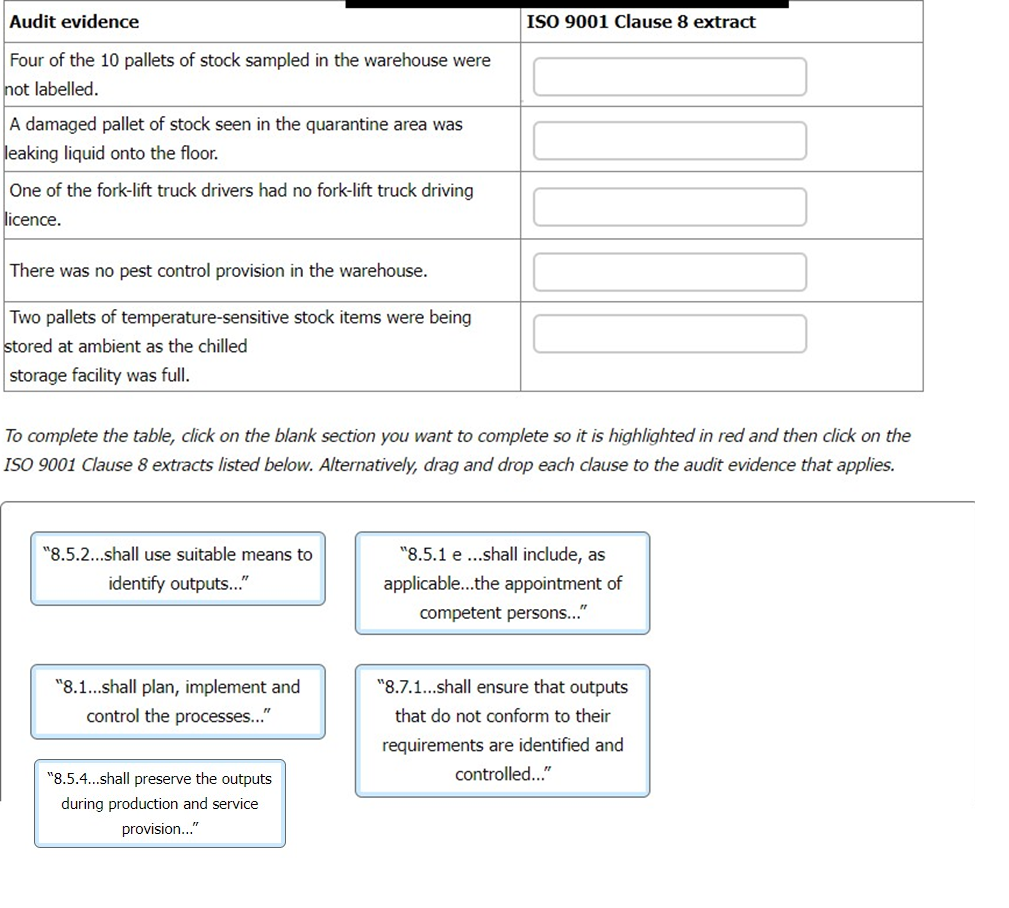
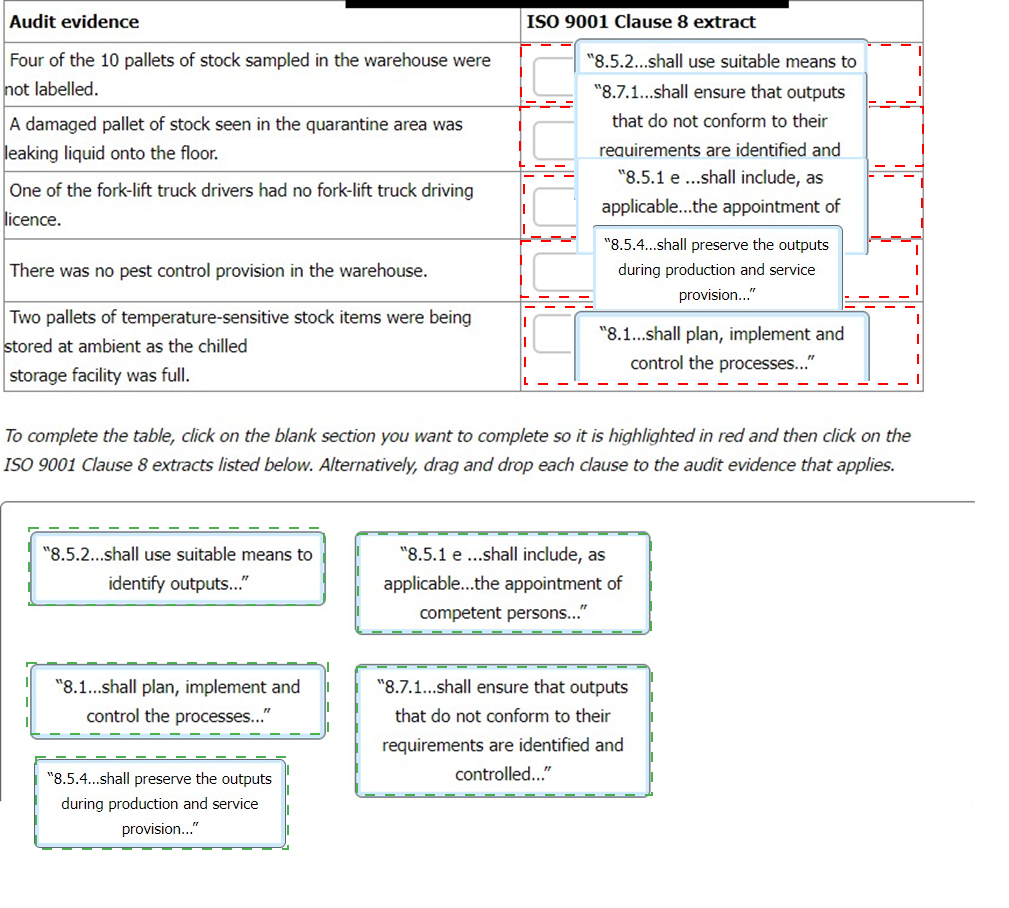
You have gathered audit evidence as outlined in the table. Match the ISO 9001 Clause 8
extract to the audit evidence.
Explanation:
The table below shows the possible matching of the ISO 9001 Clause 8 extract to the audit
evidence.
Table
Audit evidence
ISO 9001 Clause 8 extract
Four of the 10 pallets of stock sampled in the warehouse were not labelled.
“8.5.2 … shall use suitable means to identify outputs …”
A damaged pallet of stock seen in the quarantine area was leaking liquid onto the floor.
“8.7.1 … shall ensure that outputs that do not conform to their requirements are identified
and controlled …”
One of the fork-lift truck drivers had no fork-lift truck driving licence.
“8.5.1 e … shall include, as applicable … the appointment of competent persons …”
There was no pest control provision in the warehouse.
“8.5.4 … shall preserve the outputs during production and service provision …”
Two pallets of temperature-sensitive stock items were being stored at ambient as the
chilled storage facility was full.
“8.1 … shall plan, implement and control the processes …”
Which two of the following auditors would not participate in a first-party audit?
A. An auditor employed by an external consultancy organisation
B. An auditor from an interested party
C. An auditor trained in-house
D. An auditor trained in the IRCA scheme
E. An auditor certified by IRCA
F. An auditor from a customer
Explanation:
A first-party audit is an internal audit conducted by auditors who are employed by the
organization being audited but who have no vested interest in the audit results of the area
being audited1. The purpose of a first-party audit is to assess the conformity of the
organization’s quality management system to the requirements of ISO 9001 and to identify
opportunities for improvement2. Therefore, the two auditors who would not participate in a
first-party audit are:
•A. An auditor employed by an external consultancy organization: This auditor is not
employed by the organization being audited, and therefore does not qualify as a first-party
auditor. This auditor may be hired to conduct a second-party audit (if the external
consultancy organization is a customer or supplier of the organization being audited) or a
third-party audit (if the external consultancy organization is a certification body or registrar).
•F. An auditor from a customer: This auditor is not employed by the organization being
audited, and therefore does not qualify as a first-party auditor. This auditor may be hired to
conduct a second-party audit, as a customer is an interested party that has specific
requirements for the organization being audited.
The other options are not correct, as they could participate in a first-party audit, as long as
they are employed by the organization being audited and have no vested interest in the
audit results of the area being audited:
•B. An auditor from an interested party: This auditor could be a first-party auditor, as long as the interested party is within the organization being audited. For example, an auditor
from the finance department could audit the production department, as long as they are not
involved in the production process or affected by its outcomes.
•C. An auditor trained in-house: This auditor could be a first-party auditor, as long as they
are employed by the organization being audited and have no vested interest in the audit
results of the area being audited. The source of the auditor’s training is not relevant for determining the type of audit, as long as the auditor is competent and qualified to perform
the audit.
•D. An auditor trained in the IRCA scheme: This auditor could be a first-party auditor, as
long as they are employed by the organization being audited and have no vested interest in
the audit results of the area being audited. The IRCA scheme is a professional certification
scheme for auditors of management systems, which provides recognition of the auditor’s
competence and credibility3. However, being trained in the IRCA scheme does not
determine the type of audit, as long as the auditor is competent and qualified to perform the
audit.
•E. An auditor certified by IRCA: This auditor could be a first-party auditor, as long as they
are employed by the organization being audited and have no vested interest in the audit
results of the area being audited. Being certified by IRCA means that the auditor has met
the requirements of the IRCA scheme and has demonstrated their competence and
credibility as an auditor of management systems3. However, being certified by IRCA does
not determine the type of audit, as long as the auditor is competent and qualified to perform
the audit.
Read the following role descriptions. Select two roles that are not directly involved in the audit process.
A. An auditor-in-training - a person who accompanies the audit team leader or team members during the audit.
B. A technical expert - a person who provides specific knowledge or expertise to the audit team but is not normally an auditor.
C. An audit team leader - a person responsible for managing an audit until the audit is completed.
D. An interpreter - a person who witnesses the audit to assist the auditors with language issues.
E. An observer - a person who sees the performance of the audit team leader, audit team members and/or auditee.
F. A guide - a person who is appointed by the auditee to assist the audit team during the audit.
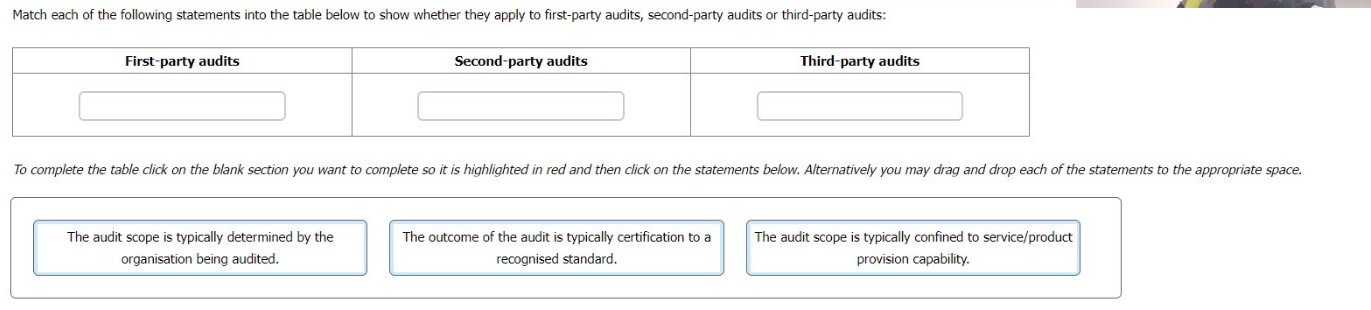
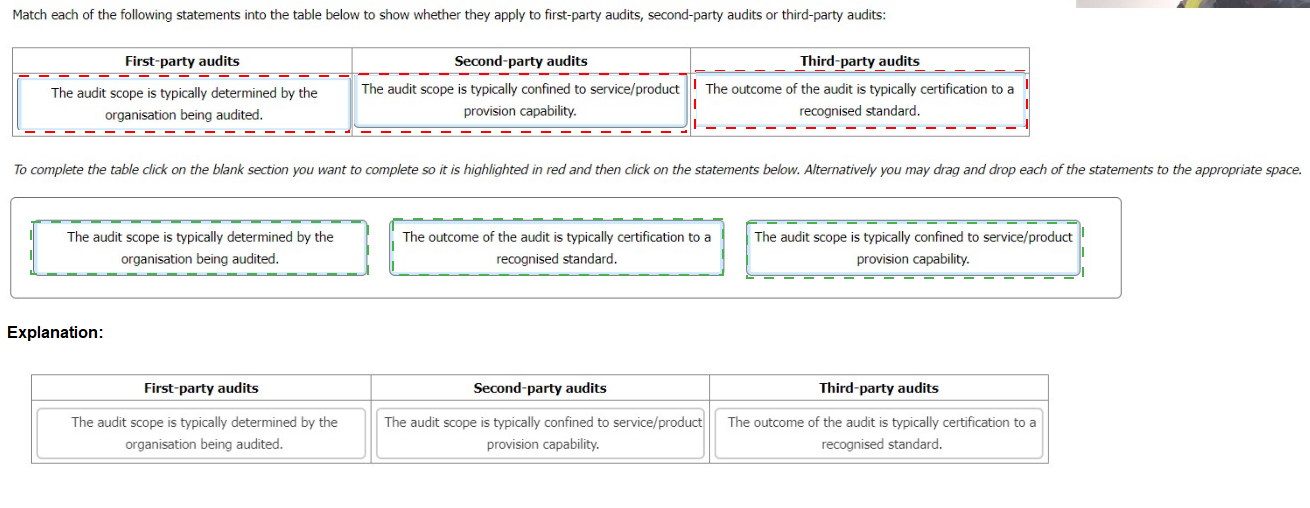
Match each of the following statements into the table below to show whether they apply to
first-party audits, second-party audits or third-party audits:
In the context of a third-party audit, select the issue which is not expected to be included in the audit plan.
A. Number of sites to be audited
B. Risk to achieving audit objectives
C. Expectations of the organisation's management
D. Scope of the audit
Explanation:
According to ISO 19011:2018, clause 6.3.2, the audit plan is a document that provides the
basis for agreement regarding the conduct of the audit. The audit plan should include the
following information1:
•the audit objectives, scope and criteria
•the audit team members and their roles and responsibilities
•the audit schedule, including the date, time and location of each audit activity
•the expected time and duration of meetings and interviews
•the allocation of appropriate resources to critical areas of the audit
•the identification of the audit client and the auditee
•the identification of the guides and observers, if any
•the documents and records to be reviewed before and during the audit
•the audit methods and tools to be used
•the audit language and terminology
•the audit report content, format, distribution and expected completion date
•the risk to achieving audit objectives and the contingency plan, if any
Therefore, the issue which is not expected to be included in the audit plan is C,
expectations of the organisation’s management. This issue is not relevant to the conduct of
the audit, as the audit is based on the audit criteria, not on the management’s expectations.
The management’s expectations may be considered during the audit initiation or the audit
programme management, but they are not part of the audit plan.
Audit criteria are a set of requirements used as a reference against which objective
evidence is compared.
Which two of the following are not potential audit criteria?
A. ISO management system standards
B. Verbal statements by the general manager
C. Verbal agreements with interested parties
D. Health and safety notices
E. Written agreements with interested parties
F. Commercial advertisements
G. Organisation's documented information
H. Claims made on the organisation's website
I. Commitment to follow principles issued by an NGO
J. Environmental aspects register
Explanation:
According to ISO 19011:2018, clause 3.2, audit criteria are a set of policies, procedures or
requirements used as a reference against which objective evidence is compared. Audit
criteria are usually selected by the audit client or by agreement between the audit client
and the auditee, and they should be appropriate for the audit scope and objectives1. Audit
criteria may include, but are not limited to, the following sources2:
•ISO management system standards, such as ISO 9001, ISO 14001, ISO 45001, etc.
•Verbal statements by the general manager or other top management, as long as they are
consistent with the documented policies and objectives of the organisation
•Verbal agreements with interested parties, such as customers, suppliers, regulators, etc.,
as long as they are documented and approved by the relevant authorities
•Health and safety notices, such as posters, signs, labels, etc., that communicate the
organisation’s legal obligations, policies, or procedures
•Written agreements with interested parties, such as contracts, orders, specifications, etc.,
that define the requirements and expectations of the parties involved
•Organisation’s documented information, such as policies, procedures, manuals, records,
etc., that describe the organisation’s management system and its processes
•Commitment to follow principles issued by an NGO, such as the United Nations Global
Compact, the International Labour Organization, etc., as long as they are relevant to the
organisation’s context and objectives
•Environmental aspects register, such as a list of the environmental impacts and risks
associated with the organisation’s activities, products, and services
Therefore, the two options that are not potential audit criteria are F and H, as they are not
reliable or verifiable sources of information, and they may not reflect the actual
performance or conformity of the organisation’s management system. Commercial
advertisements and claims made on the organisation’s website are forms of marketing
communication that may be exaggerated, misleading, or inaccurate, and they are not
subject to the same level of scrutiny or approval as the other sources of audit criteria.
| Page 4 out of 18 Pages |
| 123456 |
| ISO-9001-Lead-Auditor Practice Test Home |
Real-World Scenario Mastery: Our ISO-9001-Lead-Auditor practice exam don't just test definitions. They present you with the same complex, scenario-based problems you'll encounter on the actual exam.
Strategic Weakness Identification: Each practice session reveals exactly where you stand. Discover which domains need more attention, before QMS ISO 9001:2015 Lead Auditor Exam exam day arrives.
Confidence Through Familiarity: There's no substitute for knowing what to expect. When you've worked through our comprehensive ISO-9001-Lead-Auditor practice exam questions pool covering all topics, the real exam feels like just another practice session.
Copyright © All Rights Reserved