
Select which one of the following statements is true.
A. The team leader shall be an auditor that is qualified in the scheme.
B. An audit team can include non-qualified auditors.
C. A technical expert can replace a qualified auditor on an audit team.
D. Audits leading to auditor qualification are undertaken annually.
Explanation: According to the ISO 19011:2018 standard, which provides guidelines for auditing management systems, the team leader of an audit team should be an auditor who has demonstrated the competence to manage an audit of the relevant management system scheme. This means that the team leader should have the appropriate knowledge, skills, and experience to plan, conduct, report, and follow-up an audit of the specific management system, such as ISO 9001 for quality management systems. The other options are false because: B. An audit team can include non-qualified auditors, but only as observers or trainees who do not contribute to the audit findings or conclusions. C. A technical expert can assist a qualified auditor on an audit team, but cannot replace them, as a technical expert does not have the competence to perform audits. D. Audits leading to auditor qualification are not undertaken annually, but rather as part of a certification process that involves meeting certain criteria, such as education, work experience, audit experience, and examination. References: ISO 19011:2018, PECB Certified ISO 9001 Lead Auditor Exam Preparation Guide, ISO 9001:2015 Quality Management Systems Lead Auditor Training Course
Select the word that best completes the sentence:


You are carrying out an audit at a single-site organisation seeking certification to ISO 9001
for the first time. The organization manufactures cosmetics for major retailers.
You are interviewing the Manufacturing Manager (MM).
You: "I would like to begin by looking at the cleaning controls."
MM: "We record the cleaning of the equipment at the end of every batch. This document
details the minimum cleaning frequency and the procedures to follow for all areas and each
item of equipment. The person who carries out the cleaning puts their initial on the
document and records the time and date alongside."
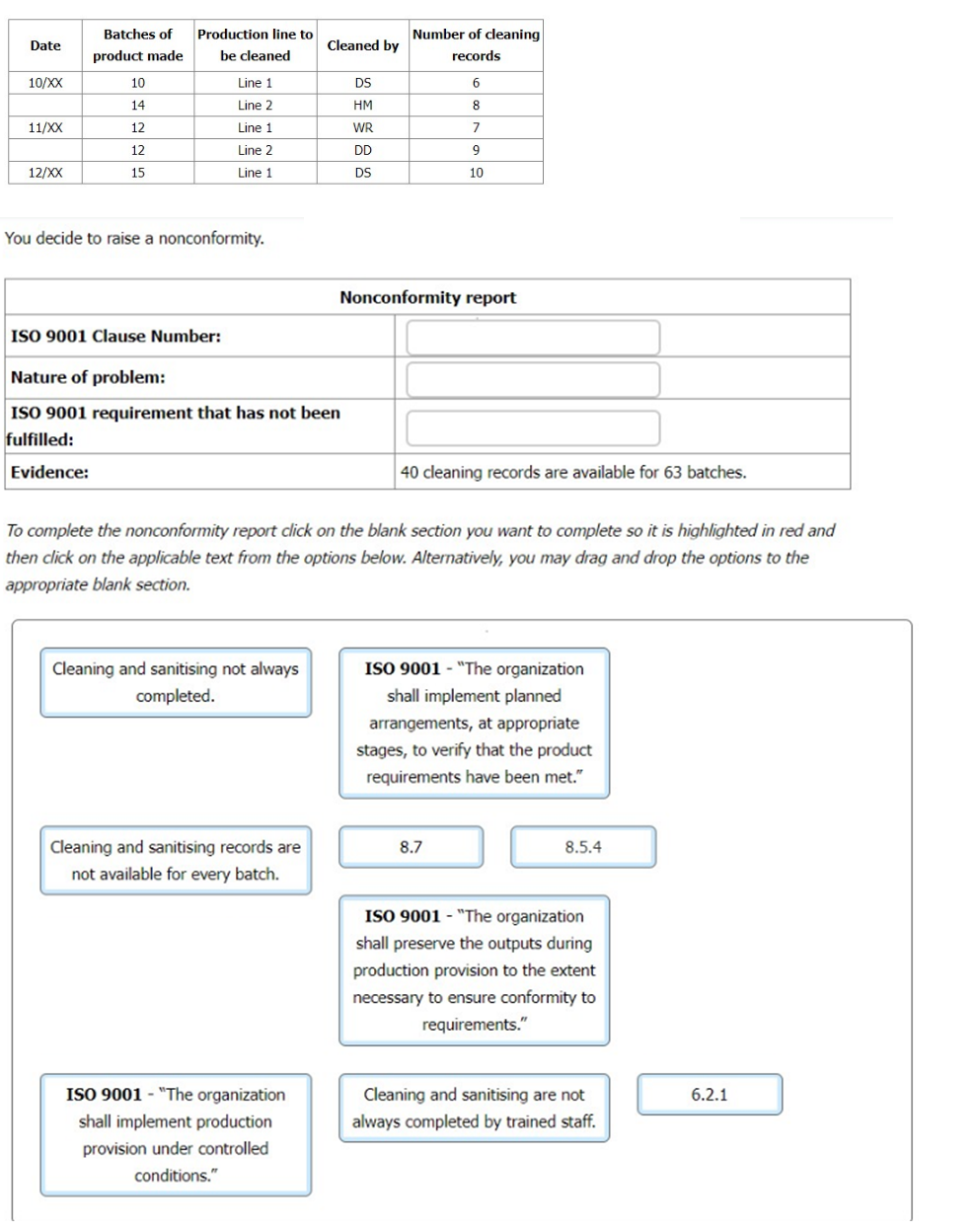
Narrative: You sample production records over 3-days and note down evidence of
nonconformity as per the table below.
Explanation:
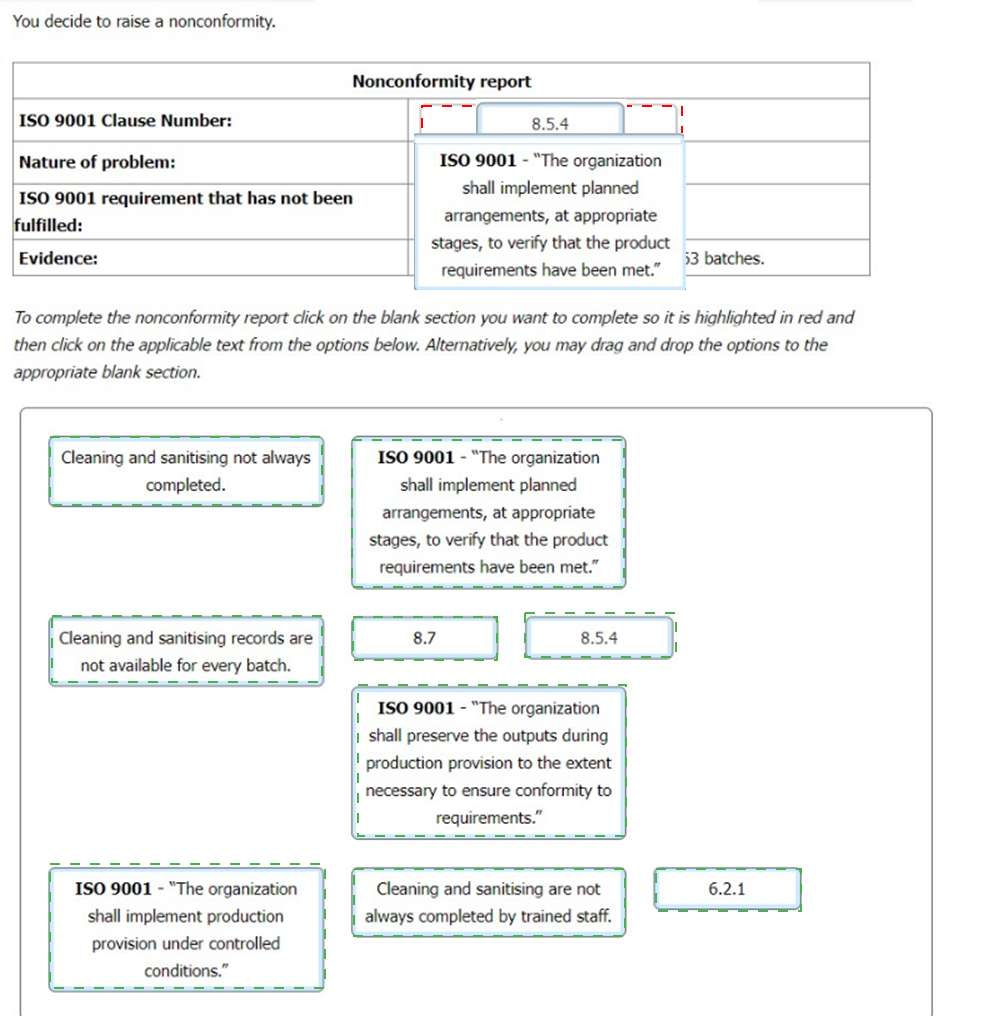
Nonconformity report
ISO 9001 Clause Number: 8.5.4 Nature of problem: Cleaning and sanitising records are not
available for every batch. ISO 9001 requirement that has not been fulfilled: ISO 9001 - “The
organization shall implement planned arrangements, at appropriate stages, to verify that
the product requirements have been met.” Evidence: 40 cleaning records are available for
63 batches.
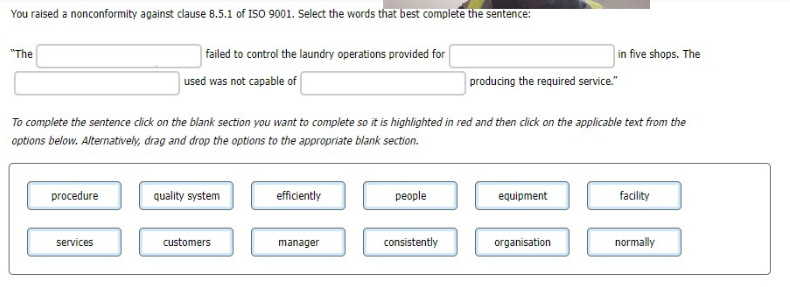
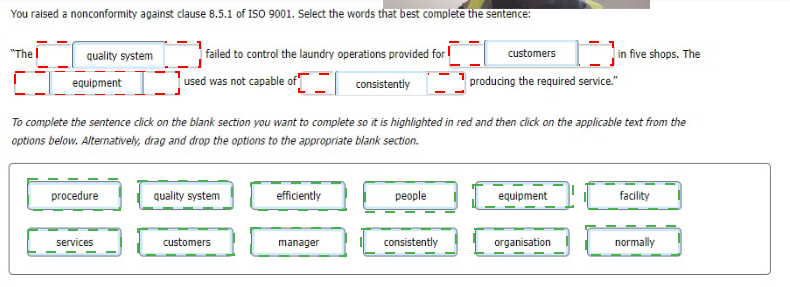
Whistlekleen is a national dry cleaning and laundry company with 50 shops. You are
conducting a surveillance audit of the Head Office and are sampling customer
complaints. You find that 80% of complaints originate from five shops in the same region.
Most of these complaints relate to damage to customer laundry. The Quality
Manager tells you that these are the oldest shops in the company. The cleaning equipment
needs replacing but the company cannot afford it at the moment. You learn
that the shop managers were told to dismiss most of the claims on the basis of the poor quality of the laundered materials.
On raising the matter with senior management, you are told that there are plans to replace
the equipment in these shops over the next five years.
Even though past audits have highlighted a consistently large number of nonconformities
within an organisation's design team, the organisation has not varied the frequency or
duration of audits on its audit plan.
The decision for whether this situation is acceptable or not should be governed by which of the following?
A. A risk-based approach to the audit programme
B. The authority of the audit team leader
C. The availability of competent internal auditors
D. The organisation's reasoning behind the lack of change to the audit plan
You are conducting an audit at an organisation seeking certification to ISO 9001 for the first
time. The organisation offers health and safety training to customers. Training courses are
offered either as open courses, delivered at a public venue, or online, or as courses that
are tailored to meet specific requirements. The business operates from a single office and
those who deliver the training are either full-time employees or subcontractors.
You have gathered audit evidence as outlined below. Match the ISO 9001 Clause 8 extract
to the audit evidence.
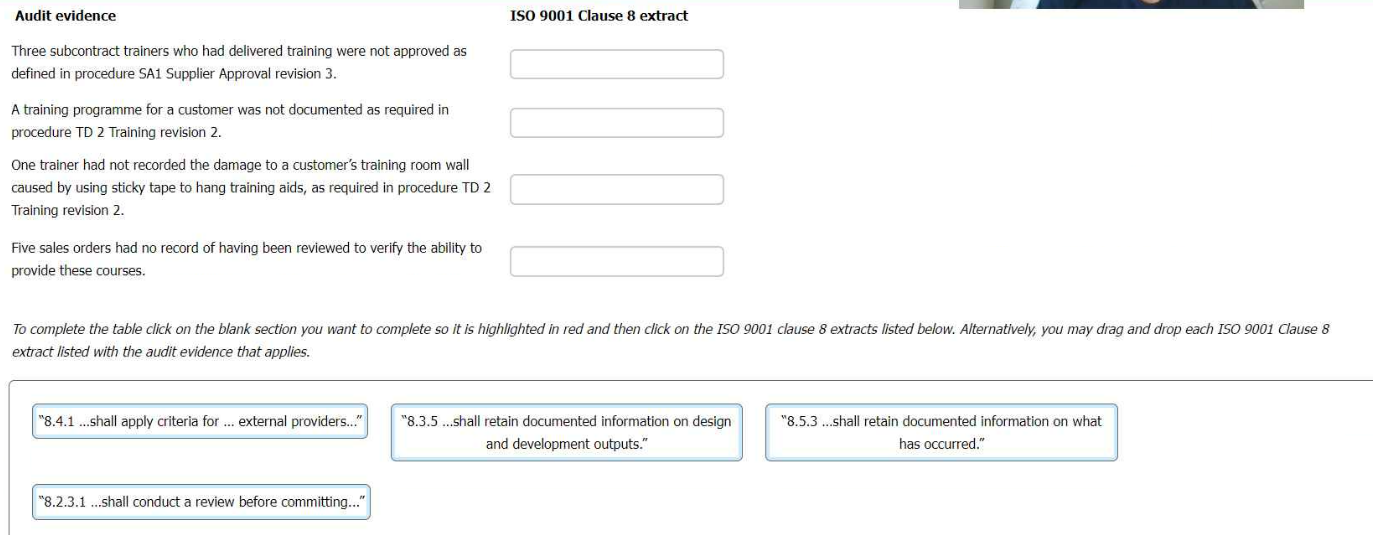
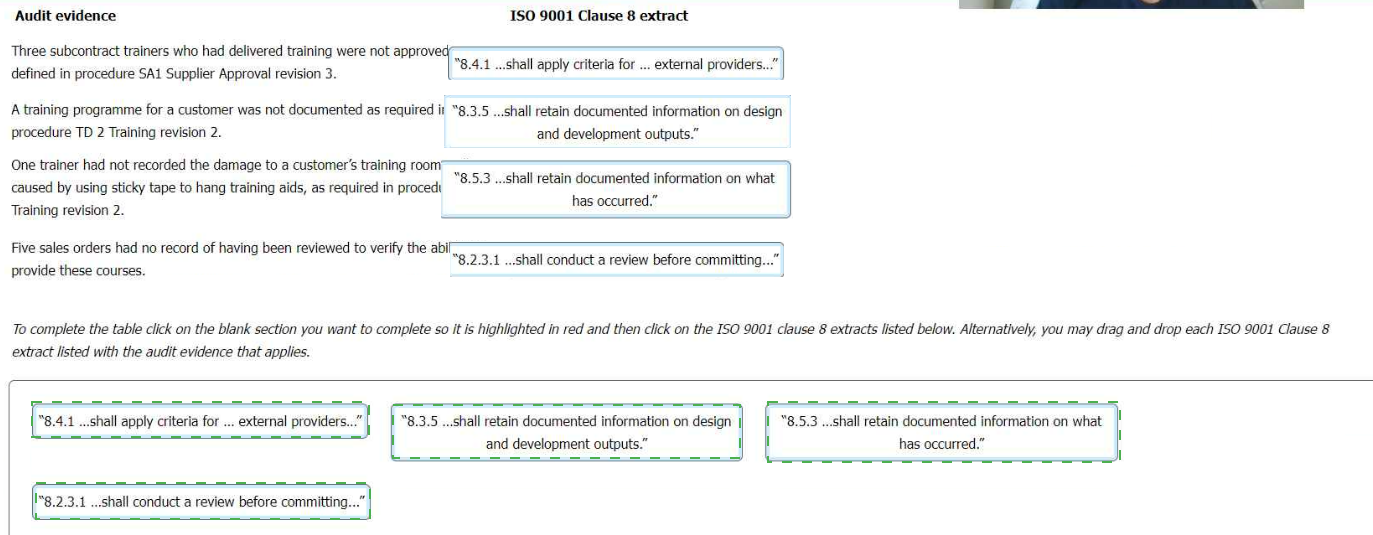
Explanation: Here is the correct matching of the ISO 9001 Clause 8 extracts to the audit
evidence:
Audit evidence: Three subcontract trainers who had delivered training were not
approved as defined in procedure SA1 Supplier Approval revision 3.ISO 9001
Clause 8 extract: 8.4.1 ...shall apply criteria for ... external providers...(This clause
requires the organization to control external providers, including ensuring their
approval and competence.)
Audit evidence: A training programme for a customer was not documented as
required in procedure TD 2 Training revision 2.ISO 9001 Clause 8 extract: 8.3.5
...shall retain documented information on design and development outputs.(This
clause addresses the need to retain documented information related to design and
development outputs, such as a training programme.)
Audit evidence: One trainer had not recorded the damage to a customer’s training
room wall caused by using sticky tape to hang training aids, as required in
procedure TD 2 Training revision 2.ISO 9001 Clause 8 extract: 8.5.3 ...shall retain
documented information on what has occurred.(This clause relates to retaining
documented information on activities and outcomes, including records of damage
or issues encountered.)
Audit evidence: Five sales orders had no record of having been reviewed to verify
the ability to provide these courses.ISO 9001 Clause 8 extract: 8.2.3.1 ...shall
conduct a review before committing...(This clause specifies the requirement to
review and verify the organization's ability to meet customer requirements before
accepting sales orders.)
These mappings reflect the specific requirements of ISO 9001:2015 for managing external
providers, retaining documented information, and reviewing contracts.
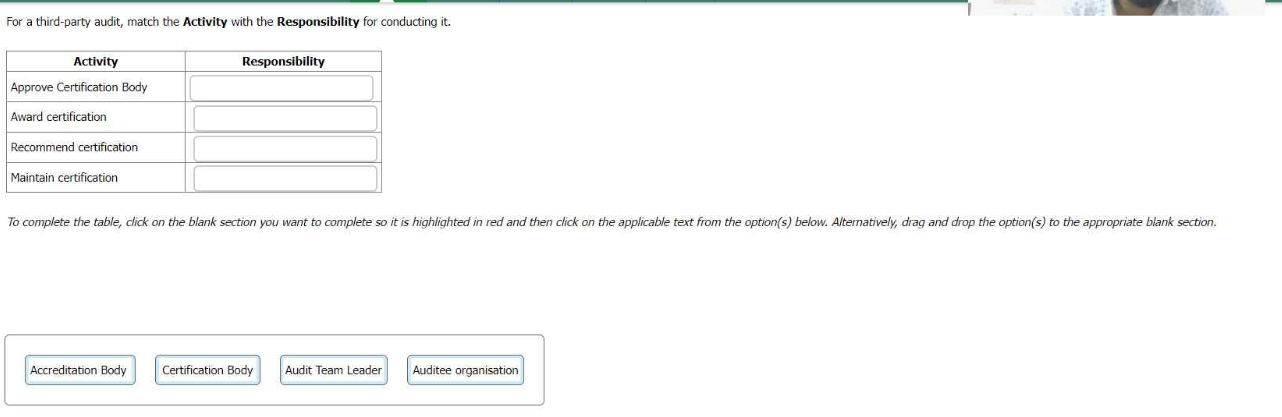
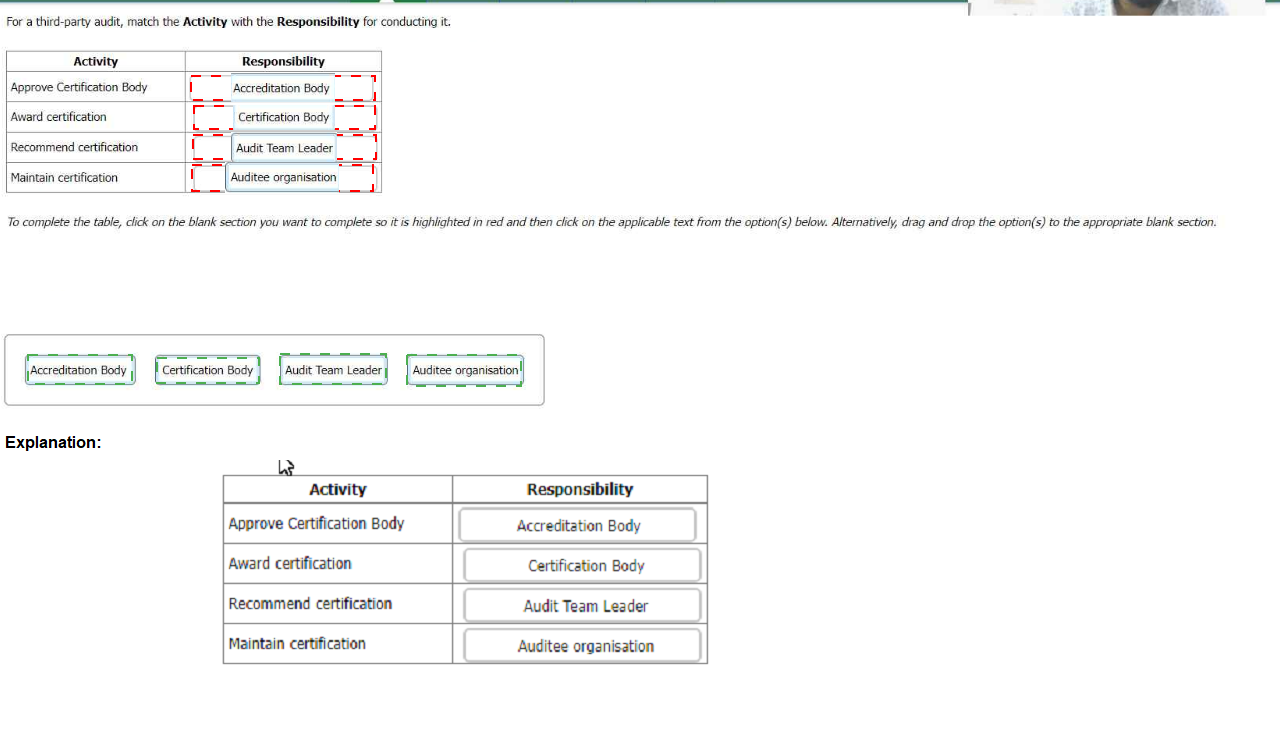
For a third-party, match the Activity with the Responsibility for conducting it.
You are a member of the audit team of a second-party audit of an organisation with 625
employees. The audit procedure recommends using sampling criteria which requires the
review of the documented competence for 25 personnel. The audit team leader developed
an audit plan allocating one hour to audit the Human Resources department (from 11:30
am to 12:30 pm). She told you that she could not allocate any additional time.
What would you do?
A. Extend the audit until 1.00pm and ask for a quick lunch later.
B. Plan to review less than 25 cases.
C. Plan to review as many as possible and see if you can extend the audit duration by one day.
D. Plan to miss lunch and review as many as possible.
Explanation: In this scenario, the time allocated by the audit team leader for the Human
Resources audit is fixed, and as an auditor, you must work within that constraint. Although
the sampling criteria suggests reviewing 25 personnel files, it is acceptable to adjust the
sample size based on time and resource limitations. ISO 9001:2015 emphasizes riskbased
thinking and practical resource management (Clause 7.1), so it is reasonable to review a smaller sample if the time is insufficient.
Option B is a pragmatic approach, allowing you to focus on quality over quantity by
reviewing as many cases as time allows without compromising the audit schedule.
Options like extending the audit (A, C, D) are impractical in a structured audit environment,
especially for second-party audits where maintaining the agreed schedule is important.
You are leading a Stage 2 certification audit of a multi-site organisation and have received
the audit schedule below;
Head Office and Site 1 - Day 1
Site 2 (150 Km from HQ) - Days 2 and 3
During Day 1 of the audit, the dient informs you that the laboratory at Site 2 has been
dosed for decontamination due to a serious outbreak of an infectious disease among
workers. In Site 2, all other functions could be audited as planned.
As the audit team leader, what would you do?
Choose the best acceptable action you could take:
® Ask the audit Programme Manager for direction.
Complete the audit on day 3 and report back to the certification body for a certification
decision.
Continue the audit on days 2 and 3 and return later to audit the Site 2 laboratory.
Immediately cancel the audit since the audit plan cannot be completed.
Who has the responsibility for assigning work to the audit team?
A. The audit team leader
B. The audit team member
C. The auditee organisation
D. The certification body
Explanation: In the context of ISO 9001:2015 audits, it is the audit team leader who holds the responsibility for assigning work to the audit team. According to ISO 19011:2018 (Guidelines for auditing management systems, which complements ISO 9001:2015), the audit team leader is responsible for the organization and direction of the audit, including assigning specific roles and responsibilities to audit team members. This includes preparation of the audit plan, leading the audit, and ensuring that each team member understands their tasks.
You are conducting a third-party audit to ISO 9001 and interviewing the Training Manager.
She explains that training is more
important than ever because the organisation has had to reduce the number of staff
employed. Many of the remaining staff
are now required to be 'multi-skilled'. You ask to see plans for the multi-skilling training and
are shown plans that look
comprehensive, and include both 'on the job" training and internal and external training
courses.
The records indicate that several staff required parts of their training to be repeated one
month after the first training was
provided. You ask why this was needed and are told that an investigation of customer
complaints identified that several staff
members did not complete certain tasks in the correct manner. The extra training was
therefore recommended as a
corrective action.
Based on this interview, which two of the tollowing audit trails would be the most
appropriate to follow?
Select the two most appropriate audit trails from the following.
A. Ask if customer complaints had ceased since the multi-skilled training finished.
B. Ask the members of staff whether they found the training received useful.
C. Assess whether Quality objectives are being met.
D. Determine whether customers were consulted about the risks associated with the multiskilling training.
E. Determine whether management has assessed the impact of staff reduction on the organisation's ability to meet its objectives.
F. Review records to assess if all planned training has been completed.
Explanation: When conducting a third-party audit to ISO 9001, especially in the context of
training and corrective actions taken due to customer complaints, the most appropriate
audit trails to follow would be:
A. Ask if customer complaints had ceased since the multi-skilled training finished. This
audit trail is relevant because it directly relates to the effectiveness of the corrective action
taken. If customer complaints have decreased or ceased, it could indicate that the
additional training was effective1.
F. Review records to assess if all planned training has been completed. This trail is
important to ensure that the training plan has been fully implemented and to verify that all
staff members have received the necessary training. It also helps in assessing the
adequacy of the training in terms of content, frequency, and outcomes1.
These two trails, A and F, are closely linked to the issue of customer complaints and the
organization’s response to them. They provide insight into whether the actions taken were
suitable and whether they have led to improvements in staff performance and customer
satisfaction1. The other options, while potentially useful, do not directly address the
immediate concern of the effectiveness of the corrective actions taken in response to the
customer complaints1.
A Health Trust has contracted with Servitup, a catering services organisation which has
been certified to ISO 9001 for 1 year. It provides services to ten, small rural hospitals in remote locations involving purchase and storage of dry goods and fresh
produce, preparing meals and loading heated trolleys for ward service by hospital
staff. An auditor is conducting the first sole surveillance audit at one site with the Deputy
Catering Manager (DCM).
At the closing meeting attended solely by the DCM, the auditor informs him that he has
found numerous gaps in the QMS processes which lead him to consider
recommending suspension of the organisation's certification. He is particularly concerned
with the evidence that patient health is being adversely affected by produce
stored beyond its safe consumption date, poor kitchen hygiene and undercooked meals.
The DCM says that he cannot make any decisions about these issues in the
absence of the Catering Manager due to illness but will write everything down and report to
the Catering Manager.
Which two actions should you take in the context of the audit?
A. Close the meeting immediately after the DCM's response and advise that the issues will be addressed at the next surveillance visit.
B. Call the individual(s) managing the audit programme to explain the situation and recommend immediate suspension of certification to protect the integrity of the Certification Body.
C. Continue with the meeting, present the audit conclusions and inform the DCM that the organisation will receive the audit report in due course.
D. Conclude the meeting early and advise that it will be rescheduled once the Catering Manager has returned to work.
E. Recommend that all personnel should be given urgent in-depth training in the QMS.
F. Thank the DCM for his time and express an expectation that improvements will be made in the QMS.
Explanation:
The actions that should be taken in the context of the audit are:
•Option B: Call the individual(s) managing the audit programme to explain the situation and
recommend immediate suspension of certification to protect the integrity of the Certification
Body. This option is correct because the auditor has found serious and significant gaps in
the QMS processes that affect the health and safety of the patients, which is a major
nonconformity that may warrant suspension of certification. The auditor should inform the
individual(s) managing the audit programme of the situation and the audit findings, and
recommend immediate suspension of certification to protect the integrity of the Certification Body and the credibility of the certification scheme. The auditor should also follow the
Certification Body’s procedures and rules for suspension of certification and communicate
the decision and the consequences to the auditee.
•Option C: Continue with the meeting, present the audit conclusions and inform the DCM
that the organisation will receive the audit report in due course. This option is correct
because the auditor should not terminate or postpone the closing meeting due to the
absence of the Catering Manager, as the DCM is the auditee’s nominated representative
for the audit. The auditor should continue with the meeting, present the audit conclusions
and the audit findings, and inform the DCM that the organisation will receive the audit
report in due course. The auditor should also explain the audit outcome recommendation
and the suspension of certification, and request the DCM to acknowledge the receipt and
understanding of the audit results.
The following options are not correct:
•Option A: Close the meeting immediately after the DCM’s response and advise that the
issues will be addressed at the next surveillance visit. This option is not correct because
the auditor should not close the meeting without presenting the audit conclusions and the
audit findings, as this would violate the audit principles of fairness and transparency. The
auditor should also not advise that the issues will be addressed at the next surveillance
visit, as this would imply that the auditor is accepting the auditee’s delay and inaction, and
that the auditor is not taking the major nonconformity seriously.
•Option D: Conclude the meeting early and advise that it will be rescheduled once the
Catering Manager has returned to work. This option is not correct because the auditor
should not conclude the meeting early or reschedule it due to the absence of the Catering
Manager, as this would disrupt the audit process and the audit schedule. The auditor
should also not wait for the Catering Manager to return to work, as this would delay the
communication and resolution of the major nonconformity, and potentially compromise the
health and safety of the patients.
•Option E: Recommend that all personnel should be given urgent in-depth training in the
QMS. This option is not correct because the auditor should not recommend or prescribe
specific corrective actions to the auditee, as this would violate the audit principles of
independence and objectivity. The auditor should only report the audit findings and the
audit outcome recommendation, and leave the responsibility and authority for determining
and implementing the corrective actions to the auditee.
•Option F: Thank the DCM for his time and express an expectation that improvements will
be made in the QMS. This option is not correct because the auditor should not thank the
DCM for his time and express an expectation that improvements will be made in the QMS,
as this would imply that the auditor is satisfied and optimistic with the auditee’s
performance and response, and that the auditor is not taking the major nonconformity
seriously. The auditor should instead express the concern and dissatisfaction with the
auditee’s QMS processes and the impact on the health and safety of the patients, and communicate the suspension of certification and the need for urgent and effective
corrective actions.
Select the term which best describes the quality management system process of modifying a non-conforming product to bring it within acceptance criteria.
A. Concession
B. Correction
C. Corrective action
D. Preventive action
Explanation:
According to the ISO 9000:2015 - Quality management systems — Fundamentals and
vocabulary, correction is defined as “action to eliminate a detected nonconformity”. A
nonconformity is defined as “non-fulfilment of a requirement”. Therefore, the process of
modifying a non-conforming product to bring it within acceptance criteria is a correction, as
it eliminates the non-fulfilment of the product specification. The other options are not
correct, as they have different definitions and purposes:
•Concession: permission to release or use a nonconforming product, service or process
•Corrective action: action to eliminate the cause of a nonconformity and to prevent
recurrence
•Preventive action: action to eliminate the cause of a potential nonconformity or other undesirable potential situation
| Page 2 out of 18 Pages |
| 123456 |
| ISO-9001-Lead-Auditor Practice Test Home |
Real-World Scenario Mastery: Our ISO-9001-Lead-Auditor practice exam don't just test definitions. They present you with the same complex, scenario-based problems you'll encounter on the actual exam.
Strategic Weakness Identification: Each practice session reveals exactly where you stand. Discover which domains need more attention, before QMS ISO 9001:2015 Lead Auditor Exam exam day arrives.
Confidence Through Familiarity: There's no substitute for knowing what to expect. When you've worked through our comprehensive ISO-9001-Lead-Auditor practice exam questions pool covering all topics, the real exam feels like just another practice session.
Copyright © All Rights Reserved