
XYZ Corporation is an organisation that employs 100 people. As the audit team leader, you
conduct a certification audit at Stage 1. When reviewing the quality management system
(QMS), you find that the objectives have been defined by an external consultant using
those of a competitor, but nothing is documented. The Quality Manager complains that this
has created a lot of resistance to the QMS, and the Chief Executive is asking questions
about how much it will cost.
Which two options describe the circumstances in which you could raise a nonconformity
against clause 6.2 of ISO 9001?
A. The consultant has not interpreted ISO 9001 correctly.
B. Quality objectives were not established in alignment with the organisation's quality policy.
C. Quality objectives are not maintained as documented information.
D. Establishing quality objectives did not include top management.
E. The organisation cannot afford to undertake quality objectives all at once.
F. Quality objectives are not being implemented by the organisations' personnel.
A small cleaning services organisation is about to start work on a hospital cleaning contract
for the local Health Trust. You,
as auditor, are conducting a Stage 2 audit to ISO 9001 and review the contract with the
Service Manager. The contract
requires that a cleaning plan is produced.
You: "How was the cleaning plan for the contract developed?"
Service Manager: "We have a basic template that covers the materials, labour
requirements and cleaning methods to be
employed. Some of that is specified by the customer."
You: "How does the plan deal with locations like the intensive care wards and the operating
theatres, which are included
in the contract?"
Service Manager: "The basic plan covers general wards, but we will do more frequent
cleaning in those areas if the
hospital requests it."
You: "Are you aware of the regulatory requirements for cleaning standards in hospitals?"
Service Manager: "No. We depend on the hospital to look after that side of things in the
contract."
You decide to raise a non-conformity against section 8.2.2.a.1 of ISO 9001.
You decide to raise another non-conformity against section 8.2.4 of ISO 9001 when finding
that the
cleaning plan was amended without the agreement of the Health Trust. A different cleaning
chemical was
substituted to that specified in the contract. At the follow-up audit, the corrective action
proposed was to
"obtain a concession from the Health Trust for use of the new chemical."
Which one of the following options is the reason why you did not accept this action taken?
A. Staff have not been trained in the use of the new chemical.
B. The action assumes that the Health Trust will agree to the change.
C. The process for making changes to the contract has not been addressed.
D. The substitute chemical has not been used before in the Health Trust.
E. The substitute chemical may not be as effective as the original.
Select the phrase that best describes the purpose of a quality management system to ISO 9001 in relation to the performance of an organization.
A. Manages the performance
B. Monitors the performance
C. Dictates the performance
D. Improves the performance
You work as an external quality consultant for an organisation, 'A', which provides
packaged food to the public. You are asked to lead a team (you as the leader and two
other auditors) to audit a supplier, 'B', to ISO 9001 which provides packaging materials to
your organisation. It is 4 pm and the audit is close to an end; you are having an internal
meeting with the team to decide what will be presented to the auditee during the Closing
meeting. The Closing meeting was scheduled at 5 pm.
You, as Audit Team Leader, audited top management. You explain to the audit team that
you identified two nonconformities:
a. There is no documented information on Top Management Reviews, as required in
clause 9.3 of ISO 9001:2015.
b. There is no evidence of Top Management Commitment as required in clause 5.1 of ISO
9001:2015. (e.g., not ensuring the availability of resources
to operate the QMS, not ensuring the establishment of objectives, no promotion of
improvement, no promotion of the process approach).
All agreed to present these two nonconformities. They went to meet the Top Management
of 'B' and noticed that the General Manager and three other managers (Production, Human
Resources, and Sales) were present in the meeting room.
Considering the seriousness of the two nonconformities to Top Management, as audit team
leader, from the following select the best option:
A. Present the nonconformities to the whole group and inform that you will recommend your company to remove them from the approved suppliers list.
B. Present the nonconformities to the managers, inform them that the report will be sent within 10 days, close the meeting and leave the site.
C. Ask the General Manager to have a private conversation in which you present the nonconformities only to him because of their sensitive nature.
D. Present the nonconformities to the whole group and analyse with them how to overcome this situation.
Explanation: According to the guidance on conducting the audit closing meeting1, the audit team leader should provide a summary of the audit findings and conclusions, invite discussions, and agree on timelines for any corrective actions. The audit team leader should also be respectful, constructive, and objective when presenting the nonconformities, and avoid any personal or emotional comments. The audit team leader should also consider the impact of the disruptive event (such as the Covid-19 pandemic) on the auditee’s context, interested parties, and risks2, and acknowledge any good practices or improvements observed during the audit. Therefore, option D is the best option, as it follows the best practices for the closing meeting and allows the auditee to understand the nonconformities and their implications, and to participate in the analysis and resolution of the issues. Option A is not correct, as it is not respectful, constructive, or objective, and it does not invite any discussion or feedback from the auditee. It also assumes that the audit team leader has the authority to recommend the removal of the supplier from the approved list, which may not be the case. Option B is not correct, as it does not provide enough information or explanation to the auditee, and it does not allow any discussion or feedback from the auditee. It also does not follow the best practices for the closing meeting, such as providing a summary of the audit, acknowledging any good practices, and agreeing on timelines for corrective actions. Option C is not correct, as it does not involve the other managers who are responsible for the functions or processes that were audited, and who may have valuable input or information to share. It also does not follow the best practices for the closing meeting, such as providing a summary of the audit, inviting discussions, and agreeing on timelines for corrective actions.
In the context of a third-party management system certification audit, which two of the following statements are correct?
A. The purpose of a Stage 2 audit is to certify an organisation to ISO 9001.
B. The Stage 2 audit must be conducted by auditors who have never worked for the auditee
C. The purpose of a Stage 2 audit is to evaluate the implementation of the auditee's management system.
D. A Stage 2 audit evaluates how efficiently the organisation is implementing its management system
E. The Stage 2 audit cannot include remote access to electronic site(s) that contain information relevant to the audit of the management system.
F. The Stage 2 audit should include an opening meeting at the start of the audit and a closing meeting at the conclusion of the audit.
The Closing meeting of a second-party audit was planned for 6 pm with the general
manager and the quality manager.
At 6 pm, when the audit team enters the meeting room, only the Quality Manager is present
and walting for them.
The dialogue among them is as follows:
Auditor team leader: "Good evening, could you please inform the general manager that we
are ready to start with the closing meeting?"
Quality manager: "Good evening. I am sorry to inform you that the general manager will not
be able to attend the meeting. He will try to
participate virtually to make some closing remarks."
Auditor team leader: "OK. We identified seven nonconformities - these are the reports.
Could you please review them and sign them?"
Quality manager: "OK. As you know, I reviewed them after yesterday's meeting and accept
of all them, where shall I sign?"
General manager (from speakers in the room and addressing the quality manager): "Hold
on! Do not sign the two nonconformities related to ABC
Bank! I have just checked, and we did not provide any services to ABC Bank during
September! You can sign the remaining five nonconformities."
How would you proceed with the audit? Select one.
A. I will discuss this issue with our corporate quality manager and will let you know what we will do
B. I will include the seven nonconformities in the report, considering that we identified objective evidence on which all these nonconformities are based
C. I will review this issue at length with the audit team tonight and will phone you tomorrow to let you know our decision
D. I withdraw the two nonconformities related to service to ABC and will present the report with the remaining five nonconformities
XYZ Corporation is an organisation that employs 100 people. As audit team leader, you are
conducting a
certification audit at Stage 1. When reviewing the quality management system (QMS)
documentation, you
find that quality objectives have been set for every employee in the organisation except top
management.
The Quality Manager complains that this has created a lot of resistance to the QMS, and
the Chief Executive
is asking questions about how much it will cost. He asks for your opinion on whether this is
the correct
method of setting objectives.
Three months after Stage 1, you return to XYZ Corporation to conduct a Stage 2
certification audit as Audit
Team Leader with one other auditor. You find that the Quality Manager has cancelled the
previous quality objectives for all employees and replaced them with a single objective for himself.
This
states that "The
Quality Manager will drive multiple improvements in the QMS in the next year". The Quality
Manager indicates
that this gives him the authority to issue instructions to department managers when quality
improvement is
needed. He says that this approach has the full backing of senior management. He shows
you the latest
Quality Improvement Request that was included in the last management review.
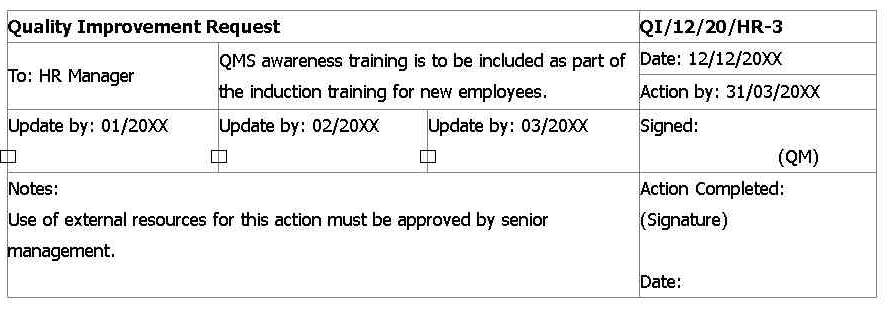
After further auditing, the issues below were found. Select two statements that apply to the
term
`nonconformity'.
A. No quality objectives planned for the top management team
B. Decisions on improvement action timescales not involving departmental managers.
C. Evaluation of the results of the improvement action not always documented by the Quality Manager.
D. Limited knowledge of the content of Quality Improvement Requests by departmental staff.
E. Quality improvements not aligning with the quality policy.
F. Top management claim not to be aware of the improvement request (QI/12/20/HR-3) initiated by the Quality Manager.
Explanation:
According to the ISO 9001:2015 standard, clause 10.2.1 defines nonconformity as the nonfulfilment
of a requirement. A requirement can be related to the quality management
system, the products and services, the customer expectations, or the applicable statutory
and regulatory requirements. Nonconformities can be detected through various sources,
such as audits, inspections, tests, customer complaints, or internal reviews.
Nonconformities must be addressed by taking appropriate actions to correct them and
prevent their recurrence.
In this scenario, the auditee has shown several issues that indicate nonconformities in their
quality management system. Two statements that apply to the term nonconformity are:
A. No quality objectives planned for the top management team: According to ISO 9001,
clause 6.2.1, the organization must establish quality objectives at relevant functions, levels,
and processes. The quality objectives must be consistent with the quality policy and the
strategic direction of the organization. The top management team is responsible for
providing leadership and direction for the quality management system and ensuring its
alignment with the organization’s purpose and context. Therefore, the absence of quality
objectives for the top management team is a nonconformity as it violates the requirement of clause 6.2.1.
E. Quality improvements not aligning with the quality policy: According to ISO 9001, clause
5.2.1, the quality policy is a statement of the organization’s intentions and direction
regarding quality, as formally expressed by top management. The quality policy must
provide a framework for setting quality objectives and be compatible with the context and
strategic direction of the organization. The quality policy must also be communicated,
understood, and applied within the organization. Therefore, if the quality improvements are
not aligned with the quality policy, it is a nonconformity as it violates the requirement of
clause 5.2.1.
An audit team leader arrives at a printing company to carry out a Stage 2 audit for a
certification body. At a meeting with the Quality Manager, she is told that they have won
their biggest contract from a computer manufacturer to print and compile computer
documentation packages. The Quality Manager wants the ISO 9001 certificate to cover the
new contract.
During the audit, a team member found that some print jobs had been rejected by several
clients over some months due to spelling errors in the print run. The Print Manager blames
the new employees they had to take on because of a big contract.
The auditor finds that the responsibility for checking spelling errors is placed on the printer
that sets up the print run.
In line with the policy of the certification body, the audit team raise improvement
opportunities in the audit report. Which
three of the following options would represent acceptable opportunities for improvement in
the report?
A. Operational planning activities may benefit from a clearer risk-based approach.
B. The organisation needs to delay its certification to gain more experience of the QMS.
C. The responsibility for checking printing needs to be independent of the operators.
D. A business consultant can be recommended for advice on improving operations.
E. A plan to determine why the errors occur and to prevent them.
F. An intensive training plan that involves all production personnel.
G. The recruitment process to include spelling tests to filter out unsuitable candidates.
H. More process time needs to be allocated to the new employees.
Explanation: According to the ISO 9001 Auditing Practices Group Guidance on Improvement Opportunities1, an improvement opportunity is a suggestion made by the auditor for the auditee to consider that, if implemented, may enhance the performance of the QMS. Improvement opportunities are not mandatory, but they should be based on objective evidence and aligned with the audit criteria and objectives. Improvement opportunities should also be realistic, feasible, and beneficial for the auditee. In this case, the evidence statements that represent acceptable improvement opportunities in the report are A, C, and E, because they address the potential causes and effects of the spelling errors in the print run, and propose possible actions that may improve the quality of the products and services, and the effectiveness of the QMS. These options are consistent with the requirements and principles of ISO 9001, such as clause 6.1 on actions to address risks and opportunities, clause 8.1 on operational planning and control, clause 8.5.1 on control of production and service provision, and clause 10.2 on nonconformity and corrective action. The other options are not appropriate improvement opportunities, because they are either irrelevant, unrealistic, or unhelpful for the auditee. For example, option B may contradict the audit objective and scope, option D may imply a lack of auditor competence or impartiality, option F may not address the root cause of the problem, option G may not be applicable or effective, and option H may not be feasible or justified.
You are carrying out an annual audit at an organisation that has been certificated to ISO
9001 for two years. The organisation offers home security
services. The scope of the quality management system covers alarm installation, alarm
servicing, alarm monitoring and response. The business
operates from a single office and employs subcontract installers and service technicians
across the country.
You have just completed the opening meeting. You are interviewing the Managing Director
(MD).
You: "I would like to gain an understanding of how the quality management system has
been supporting your business and its strategic direction."
MD: "We are continuing to face difficult times. The market is extremely competitive, and
customers typically look for the least expensive option when
choosing home security services. We have not yet seen any business benefit from our
quality management system."
You: "Tell me how you determine external and internal issues."
MD: "We use SWOT analysis (Strengths Weaknesses, Opportunities, Threats)."
You: "How have the outputs from your SWOT been used?"
Select two of the following audit trails would you take to explore the extent to which the
SWOT analysis and the outputs from this
have been used to enable the business to achieve the intended results(s) of its quality
management system according to ISO 9001.
A. Establish how many interested parties need to be consulted
B. Establish how the organisation reviews information about external and internal issues
C. Establish how the organisation shares information with external interested parties
D. Establish what actions were taken to improve the QMS
E. Establish whether the SWOT analysis has been reviewed by the procurement manager
F. Establish whether the SWOT analysis is focussed solely on the QMS
Explanation: According to ISO 9001:2015, clause 4.1, the organisation must determine
the external and internal issues that are relevant to its purpose and that affect its ability to
achieve the intended results of its quality management system. The organisation must also
monitor and review the information about these issues. SWOT analysis is a tool that can
help the organisation to identify its strengths, weaknesses, opportunities, and threats.
However, the SWOT analysis alone is not sufficient to comply with the requirement, as the
organisation also needs to review the information periodically and update it as necessary.
Therefore, one audit trail would be to establish how the organisation reviews information
about external and internal issues, such as how often, by whom, using what criteria, and
with what results. 123
According to ISO 9001:2015, clause 10.3, the organisation must continually improve the
suitability, adequacy, and effectiveness of the quality management system. The organisation must also consider the results of analysis and evaluation, and the outputs
from management review, to determine if there are any needs or opportunities for
improvement. SWOT analysis can help the organisation to identify the areas where
improvement is needed or possible, such as addressing the weaknesses and threats, or
exploiting the strengths and opportunities. However, the SWOT analysis alone is not
sufficient to comply with the requirement, as the organisation also needs to take actions to
implement the improvement, such as setting objectives, allocating resources, assigning
responsibilities, and evaluating the effectiveness. Therefore, another audit trail would be to
establish what actions were taken to improve the QMS, such as what, when, by whom,
how, and with what results.
'XYZ' has already sent to you a list with all documented procedures and work instructions
related to the services provided to 'ABC' (a quality manual is not included in the list).
To complete the audit planning which additional information would you ask to XYZ to
submit? Select four.
A. XYZ's organisational structure
B. The quality manual
C. A description of responsibilities and authorities of the key roles of XYZ
D. The number of personnel involved in activities related to the quality management system
E. Information to understand XYZ's operations
F. The results of XYZ's last internal audit
G. The results of the last two management reviews
H. The list of risks and opportunities determined by XYZ
Explanation: The ISO 9001 Lead Auditor exam requires the auditor to have a thorough
understanding of the ISO 9001:2015 standard and its requirements, as well as the
organization’s context, processes, risks, opportunities, and performance. Therefore, the
auditor needs to ask for additional information that can help them verify these aspects
during the audit planning stage. Some of the information that can be useful are:
A description of responsibilities and authorities of the key roles of XYZ: This can help the
auditor to identify who is accountable for what in the organization and how they
communicate with each other.
The number of personnel involved in activities related to the quality management system:
This can help the auditor to assess if there are enough resources and competencies to
support the QMS implementation and operation.
Information to understand XYZ’s operations: This can help the auditor to understand how
XYZ produces or delivers its products or services and what are its main processes and
inputs.
The results of XYZ’s last internal audit: This can help the auditor to evaluate if XYZ has
implemented corrective actions based on previous audit findings and if it has maintained its
QMS effectiveness.
The results of the last two management reviews: This can help the auditor to determine if
XYZ has monitored its QMS performance against its objectives and if it has identified any
significant changes or opportunities for improvement.
The quality manual (B) is not a required document for ISO 9001 certification, but it may be
useful for internal reference or training purposes. It is not necessary for audit planning.
Which two of the following statements related to Stage 1 of an initial certification audit against ISO 9001:2015 are true?
A. During the Stage 1 audit, the audit team:
B. Verifies the degrees of customer satisfaction
C. Evaluates the conditions of all sites
D. Reviews the client's management system documented information
E. Evaluates the results of the last management review
F. Verifies the compliance with legal requirements
G. Reviews the processes with high level of risk
You are conducting a Stage 1 audit at an organisation that services refrigeration equipment
for a large customer base.
The scope of certification is "Provision of refrigeration equipment maintenance and repair
services". You are interviewing
the Managing Director to learn more about the organisation and to explore how the
requirements for policy, objectives,
and risks and opportunities in ISO 9001 are addressed.
The Managing Director explains that they only use sub-contract refrigeration engineers and
do not have any full-time
refrigeration engineers, which helps to optimise overhead costs. The full-time staff employed are essentially a small team
of office staff who process customer enquiries, schedule jobs and process invoices.
The Managing Director adds that the ISO 9001 requirements for competence of personnel
extends to both sub-contract
and full-time staff. He also states that the full-time staff are aware of the Quality Policy,
objectives and plans to address
risk and opportunities.
You ask if the sub-contract engineers have been informed of the Quality Policy, objectives
and plans to address risks and
opportunities, to which the Managing Director replies that this is not applicable as they only
use sub-contractors who
operate ISO 9001 certificated quality management systems. The documented information
provided to the auditor
confirms this.
Which clause in ISO 9001 is most likely not to have been fulfilled in this instance?
A. 7.2 Competence
B. 7.3 Awareness
C. 7.4 Communication
D. 7.5 Documented information
Explanation: Questions no: 16 Verified Answer: = C. 7.4 Communication Comprehensive But Short Explanation: = Clause 7.4 of ISO 9001:2015 requires the organization to determine the internal and external communications relevant to the quality management system, including what will be communicated, when, with whom, and how. The scenario indicates a potential gap in communication with subcontractors regarding the Quality Policy, objectives, and plans to address risks and opportunities, which is a requirement even if the subcontractors have their own ISO 9001 certified systems123.
| Page 5 out of 18 Pages |
| 234567 |
| ISO-9001-Lead-Auditor Practice Test Home |
Real-World Scenario Mastery: Our ISO-9001-Lead-Auditor practice exam don't just test definitions. They present you with the same complex, scenario-based problems you'll encounter on the actual exam.
Strategic Weakness Identification: Each practice session reveals exactly where you stand. Discover which domains need more attention, before QMS ISO 9001:2015 Lead Auditor Exam exam day arrives.
Confidence Through Familiarity: There's no substitute for knowing what to expect. When you've worked through our comprehensive ISO-9001-Lead-Auditor practice exam questions pool covering all topics, the real exam feels like just another practice session.
Copyright © All Rights Reserved