
You are an auditor from a construction organisation who is conducting a second party audit
to ISO 9001 at a steel rolling mill producing
structural steelwork. When auditing the rolling process, you find that the operator who is
unloading the furnace does not use the
adjacent infrared pyrometer to measure the appropriate product temperature in readiness
for the next production stage.
You: "How do you tell when the billet is ready for the rolling stage?"
Operator: "I've done this job for 20 years. I can tell by the bright red colour."
You: "What happens if the colour is wrong?"
Operator: "The billet goes back into the furnace."
You: "Is the pyrometer ever used?"
Operator: "Only in borderline cases."
You continue to interview the operator and find that around 25% of the billets are sent back
to the furnace. This includes 80% of the borderline cases.
Select three options that would provide evidence of conformance with clause 9.1.1 of ISO
9001.
A. Periodic analysis of the results of temperature checks.
B. Certification of conformance to national standards from the manufacture of the pyrometer.
C. An increase in the use of the pyrometer by operators.
D. Maintenance plan for the furnace.
E. A procedure that provides instruction in taking billet temperature.
F. Planning for monitoring and measuring the billet temperature.
G. A quality objective to achieve lower recycle rates for billets.
H. Annual review records for furnace operators.
Which two of the following roles do not contribute to the audit outcomes?
A. Individual(s) managing the audit programme
B. Auditee
C. Guide
D. Consultant
E. Observer
F. Technical expert
Explanation: The individual(s) managing the audit programme and the auditee are both roles that contribute to the audit outcomes. The individual(s) managing the audit programme are responsible for planning, conducting, and reporting on the audit activities, as well as ensuring that they are aligned with the organization’s quality objectives and risk management processes1. The auditee is the person or entity that is subject to an audit, and their participation, cooperation, and feedback are essential for achieving a successful audit outcome2.
Takitup is a small fabrication organisation that manufactures steel fencing, stairs and
platforms for the construction sector. It has been certified to ISO 9001 for some time and
has appointed a new Quality Manager. The audit plan during a surveillance audit covers
the organisation's improvement actions and the auditor asks to see the most recent
management review meeting minutes.
The auditor finds that the management review report records that none of the improvement
actions set by the previous review has been realised for a second time. A new Quality
Manager has been brought in at the middle management level to rectify the situation as the
organisation is concerned that it might lose its certification.
Select three options that would provide evidence of conformance with clause 10.3 of ISO
9001.
A. Outsource more processes to external providers
B. Removing expensive external providers from the database.
C. An increase in the number of quality staff.
D. A quality objective to achieve lower reject rates by quality control.
E. Considering results from the analysis of the effectiveness of corrective actions to determine improvement opportunities.
F. The certification body auditor reporting fewer nonconformities.
G. An enhanced customer satisfaction survey score than in the previous year.
H. Automate the fabrication process to increase profitability.
During a Stage 1 audit, the Quality Manager asks that the audit includes coverage of a new
work area they have expanded into since the application was made.
Which of the following two actions should the auditor take?
A. Advise the Quality Manager that an extension of the scope is possible but will have to go through established procedures.
B. Advise the Quality Manager that the audit scope has been set and the audit will proceed as planned.
C. Advise the Quality Manager that, within the existing scope, the new work area can be included without any problem.
D. Determine whether the Quality Management System covers the new work area and, if so, proceed with the audit.
E. Suggest that she will advise the programme manager that the audit scope should be revised to include the new work area.
F. Suggest that the Quality Manager cancels the audit contract and reapplies for the new situation.
Explanation: A Stage 1 audit is a preliminary assessment to evaluate the readiness of the organisation for the Stage 2 certification audit. The audit scope is defined by the audit client and the certification body based on the application and the contract. If the organisation wants to include a new work area that was not part of the original scope, the auditor should advise the Quality Manager that an extension of the scope is possible but will have to go through established procedures, such as submitting a formal request, providing relevant information, and paying additional fees. The auditor should also suggest that the Quality Manager will advise the programme manager, who is responsible for managing the audit programme, that the audit scope should be revised to include the new work area. The programme manager will then decide whether to approve or reject the request, and communicate the decision to the auditor and the Quality Manager. The auditor should not proceed with the audit of the new work area without the approval of the programme manager and the confirmation of the audit scope.
Which one of the following options is the definition of the context of an organisation?
A. Combination of internal and external issues that can have an effect on an organisation's approach to developing and achieving its objectives.
B. Comparison of internal and external issues that can have an effect on an organisation's desire to achieve its objectives.
C. Complexity of internal and external issues that can have an effect on an organisation's approach to developing and achieving its purpose.
D. Coordination of internal and external issues that can have a positive or negative effect on an organisation's success.
Explanation: Understanding "Context of the Organization":The term "context of the
organization" is defined in ISO 9001:2015 Clause 4.1, which states:
"The organization shall determine external and internal issues that are relevant to its
purpose and its strategic direction and that affect its ability to achieve the intended result(s)
of its quality management system."
The definition emphasizes identifying both internal and external issues that influence the
organization's approach to developing and achieving its objectives.
Option Analysis:
Option A:Correct. This option aligns with the standard definition as it explicitly
mentions the combination of internal and external issues that affect the
organization’s approach to achieving its objectives, which is the essence of Clause
4.1.
Option B:Incorrect. The term "comparison of internal and external issues" does not
reflect the ISO 9001 requirements. The standard does not require a comparison
but rather an understanding of these issues.
Option C:Incorrect. Although it mentions "complexity," the focus of ISO 9001:2015
is on identifying relevant issues rather than the complexity of those issues.
Option D:Incorrect. This option mentions "coordination" and focuses only on the
positive or negative effects. ISO 9001 requires identifying issues but does not
emphasize coordination.
Clause Reference and Relevance:ISO 9001:2015 requires organizations to understand
their context because internal and external factors can influence the Quality Management
System's effectiveness. Understanding this context helps in:
Addressing risks and opportunities (Clause 6.1).
Aligning the QMS with the organization’s strategic direction.
Why A is Correct:"Combination of internal and external issues" captures the essence of
Clause 4.1, making it the accurate definition of the context of the organization.
Which two of the following should be included in an audit plan?
A. List of findings from the last audit
B. Name of the auditee general manager
C. Signature of Certification Body Technical Reviewer
D. Sequence and timings of audit activities
E. Date of next audit
F. Name of auditees and auditors
Explanation:
According to ISO 19011:2018, clause 6.3.2, an audit plan should include the following
information:
The audit objectives, scope, and criteria
The audit team members and their roles and responsibilities
The audit schedule, including the sequence and timings of audit activities, such as opening
meeting, document review, interviews, observations, closing meeting, etc.
The expected time and duration of each audit activity and location
The name and contact details of the auditee’s representative and other relevant parties
The allocation of appropriate resources to support the audit activities
The audit methods and techniques to be used, such as interviews, observations, sampling,
etc.
The audit documents and records to be prepared and retained
The audit language and communication methods
The audit risks and opportunities and how to address them
The audit follow-up arrangements, if applicable
Therefore, the correct answer is D and F, as they are essential elements of an audit plan.
The other options are either irrelevant or optional for an audit plan.
Select the term that best describes the purpose of retaining documented information in a quality management system to ISO 9001.
A. To facilitate auditing for proof of conformity to the standard.
B. To provide confidence in the effectiveness of the quality management system.
C. To safeguard the integrity of the quality management system.
D. To support the operation of the processes of the quality management system
Explanation: Documented information is a means by which an organization demonstrates compliance. It communicates what we do and how we do things, it communicates what happened and what results were achieved. It is, essentially, a tool for communication. ISO 9001:2015 allows an organization flexibility in the way it chooses to document its quality management system (QMS). This enables each individual organization to determine the correct amount of documented information needed in order to demonstrate the effective planning, operation and control of its processes and the implementation and continual improvement of the effectiveness of its QMS. The standard states that the organization shall maintain documented information to the extent necessary to support the operation of processes and retain documented information to the extent necessary to have confidence that the processes are being carried out as planned. Therefore, the purpose of retaining documented information is to support the operation of the processes of the QMS, not to facilitate auditing, provide confidence or safeguard integrity, which are secondary benefits of documented information.
You are conducting a third-party audit to ISO 9001 and the next item on your audit plan is
'internal auditing'.
When reviewing a sample of audit records up to 5 years previously, you find that many
contain non-conformance reports and no actions have been taken. You interview the
Quality Manager.
You: "I have noted that many of the older files contain non-conformances that have not had
any corrective action taken."
Quality Manager: "Because the business is always changing, the departmental managers tell me that the non-conformances are no longer applicable. I made a decision that any
non-conformance over 3 years old is automatically closed"
You: "Do you obtain any confirmation beforehand from the appropriate departments that
the non-conformances are no longer applicable."
Quality Manager: " No, because they are so old I consider that they are no longer
appropriate. Please remember that we take a risk-based approach which means we audit
where and when it is considered important to do so.
Select one course of action you would now take from the options.
A. Interview Top management to determine whether they were aware of and agreed the actions of the Quality Manager
B. Review all non-conformances reports related to clause 9.2 of ISO 9001
C. Interview relevant Departmental managers to assess whether the older nonconformances are still valid.
D. Raise a non-conformance report against clause 9.2.2.e of ISO 9001
Explanation:
According to ISO 9001:2015, clause 9.2.2.e, the organization is required to retain
documented information as evidence of the implementation of the audit programme and the
audit results. This includes the records of the nonconformities identified during the internal
audits and the corrective actions taken to address them. The organization is also required
to verify the effectiveness of the corrective actions, as per clause 10.2.2.
Therefore, in the scenario given, the Quality Manager’s decision to automatically close any
nonconformance over 3 years old without obtaining any confirmation from the relevant
departments or verifying the effectiveness of the corrective actions is a clear violation of the
requirements of clause 9.2.2.e. This indicates a lack of control and follow-up of the internal
audit process, as well as a potential risk of recurrence or occurrence of the nonconformities
in other areas. This also undermines the credibility and value of the internal audit
programme, as well as the risk-based approach claimed by the Quality Manager.
Hence, the best course of action to take is D, to raise a nonconformance report against
clause 9.2.2.e of ISO 9001, and to communicate the audit findings to the relevant
management. The other options are either insufficient or irrelevant to address the issue, as
they do not directly relate to the noncompliance with clause 9.2.2.e.
You work for an organisation, 'ABC', which provides packaged food to the public. You are
asked to lead a team (you as the leader and two other
auditors) to audit an external provider, 'XYZ', which provides packaging materials to your
organisation. It is 4 pm, and the audit is dlose to an end;
you are having an internal meeting with the team to decide what will be presented to the
auditee during the Closing meeting. The Closing meeting
was scheduled for 5 pm.
'XYZ' has two manufacturing lines: M1 is a clean room for primary packaging materials (i.e.
will be in direct contact with the food), and M2 is for
secondary materials (i.e. will not be in direct contact with food).
Auditor 1 audited the two manufacturing lines.
You: "What findings would you report?"
Auditor 1: "I have one issue. Earlier today in the morning I saw some secondary material
stocked in the clean room. I would propose raising a
nonconformity."
You: "How would you write the nonconformity?"
Auditor 1: "In the clean room, there was a pallet with secondary materials."
What additional information would you add to this text to complete the nonconformity
report? Select six.
A. Batch number of the secondary material
B. Description of any primary material close to this pallet
C. Description of the ISO 9001:2015 requirement not being complied with and the clause number
D. Description of the secondary material
E. Evidence that the secondary material was approved ready to be used
F. More information in the place within the clean room where secondary material was found
G. Name of the forklift driver that was moving the pallet
H. The date on which the evidence was identified
I. The signature of the clean room's supervisor accepting the nonconformity
J. The type of nonconformity (major or minor)
Select six of the activities that are specifically required by ISO 17021-1 as part third-party (Certification Body) surveillance audit processes.
A. Audit use of certification marks on marketing materials
B. Review changes to the QMS since last visit.
C. Confirm effectiveness of internal audit and management review.
D. Complete a full document review of the quality management system.
E. Failing to meet financial responsibilities.
F. Review the status of previously raised findings and audit effectiveness of any outstanding findings.
G. Review the calibration status of the instrumentation.
H. Verify legal compliance
I. Handling of customer complaints since last visit.
J. Conduct a minimum number of annual surveillance audits during the certification period.
Explanation:
The activities that are specifically required by ISO 17021-1 as part of third-party
(Certification Body) surveillance audit processes are:
•Option A: Audit use of certification marks on marketing materials. This option is correct
because ISO 17021-1:2015 clause 9.6.2.2 requires the certification body to audit the
client’s use of marks and/or any other reference to certification, as applicable, to ensure
conformity with the certification requirements.
•Option B: Review changes to the QMS since last visit. This option is correct because ISO
17021-1:2015 clause 9.6.2.2 requires the certification body to review any changes affecting the client’s quality management system and its ability to continue to fulfil the requirements
of the standard used for certification.
•Option C: Confirm effectiveness of internal audit and management review. This option is
correct because ISO 17021-1:2015 clause 9.6.2.2 requires the certification body to confirm
the continuing effectiveness of the client’s quality management system, including the
effectiveness of the internal audit and management review processes.
•Option F: Review the status of previously raised findings and audit effectiveness of any
outstanding findings. This option is correct because ISO 17021-1:2015 clause 9.6.2.2
requires the certification body to review the status of findings and any corrective actions
taken by the client in response to previous audits, and to verify the effectiveness of the
implemented corrective actions.
•Option H: Verify legal compliance. This option is correct because ISO 17021-1:2015
clause 9.6.2.2 requires the certification body to verify the client’s compliance with
applicable statutory and regulatory requirements related to the scope of certification.
•Option I: Handling of customer complaints since last visit. This option is correct because
ISO 17021-1:2015 clause 9.6.2.2 requires the certification body to review the client’s
handling of customer complaints related to the certified activities since the last audit.
The following options are not correct:
•Option D: Complete a full document review of the quality management system. This option
is not correct because ISO 17021-1:2015 clause 9.6.2.2 does not require the certification
body to complete a full document review of the quality management system during
surveillance audits. A full document review is only required during the initial certification
audit or when there are significant changes to the quality management system or the
certification requirements.
•Option E: Failing to meet financial responsibilities. This option is not correct because ISO
17021-1:2015 clause 9.6.2.2 does not require the certification body to audit the client’s
financial responsibilities during surveillance audits. The certification body may have
contractual arrangements with the client regarding the payment of fees, but this is not part
of the surveillance audit process.
•Option G: Review the calibration status of the instrumentation. This option is not correct
because ISO 17021-1:2015 clause 9.6.2.2 does not require the certification body to review
the calibration status of the instrumentation during surveillance audits. The certification
body may audit the client’s monitoring and measuring resources as part of the quality
management system requirements, but this is not a specific activity required by ISO 17021-
1.
•Option J: Conduct a minimum number of annual surveillance audits during the certification
period. This option is not correct because ISO 17021-1:2015 clause 9.6.2.2 does not
require the certification body to conduct a minimum number of annual surveillance audits
during the certification period. The certification body may determine the frequency and
duration of surveillance audits based on the risk and performance of the client, but this is not a specific activity required by ISO 17021-1.
At the end of a second-party audit, the audit team enters the meeting room to hold the
closing meeting; only two people
are present and waiting for them: the Health and Safety supervisor and the administrative
officer. Neither has participated in
the audit. However, the team had previously agreed with the auditee Quality Manager on
two nonconformities identified
during the audit (NC1 and NC2).
They said:
Health and Safety supervisor: "Good evening. We are sorry to inform you that the general
manager was involved in a
serious car accident, and the other two managers have had to leave urgently to attend to
the emergency."
Administration officer: "Our quality manager, before leaving, left a written message about
'NC2'. He declares that the correction and corrective action have been already implemented and has attached some
documents to the message as
evidence of these actions. Therefore, he expects that 'NC2' will not be included in the
report."
Which one of the following would be your preferred answer to the Quallty Manager's
request?
A. Let me review the message and documents, and I will give you my answer in a few minutes
B. OK. I will record in the audit report that 'nonconformity 2' was closed during the Closing meeting
C. OK. Let's all go to the workshop to see the supervisor. I hope he will be able to explain what they did to correct the nonconformity and prevent its recurrence
D. The scope of the audit does not allow auditors to review actions taken in response to the nonconformity. There would not be enough time for the full cycle of corrective action to take effect
XYZ Corporation is an organisation that employs 100 people. As audit team leader, you are
conducting a
certification audit at Stage 1. When reviewing the quality management system (QMS)
documentation, you
find that quality objectives have been set for every employee in the organisation except top
management.
The Quality Manager complains that this has created a lot of resistance to the QMS, and
the Chief Executive
is asking questions about how much it will cost. He asks for your opinion on whether this is
the correct
method of setting objectives.
Three months after Stage 1, you return to XYZ Corporation to conduct a Stage 2 certification audit as Audit
Team Leader with one other auditor. You find that the Quality Manager has cancelled the
previous quality
objectives for all employees and replaced them with a single objective for himself. This
states that "The
Quality Manager will drive multiple improvements in the QMS in the next year". The Quality
Manager indicates
that this gives him the authority to issue instructions to department managers when quality
improvement is
needed. He says that this approach has the full backing of senior management. He shows
you the latest
Quality Improvement Request that was included in the last management review.
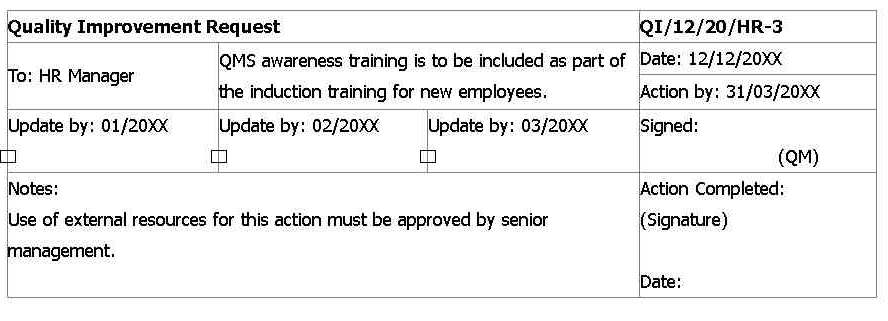
After further auditing, the issues below were found. Select three statements that apply to
the term 'audit trail'
A. Decisions on improvement action timescales not involving departmental managers.
B. Evaluation of the results of the improvement action not always documented by the Quality Manager.
C. Limited knowledge of the content of Quality Improvement Requests by departmental staff.
D. Quality improvements not aligning with the quality policy.
E. The single quality objective set for the organisation by the Quality Manager.
F. Top management claim not to be aware of the improvement request (QI/12/20/HR-3) initiated by the Quality Manager.
| Page 6 out of 18 Pages |
| 345678 |
| ISO-9001-Lead-Auditor Practice Test Home |
Real-World Scenario Mastery: Our ISO-9001-Lead-Auditor practice exam don't just test definitions. They present you with the same complex, scenario-based problems you'll encounter on the actual exam.
Strategic Weakness Identification: Each practice session reveals exactly where you stand. Discover which domains need more attention, before QMS ISO 9001:2015 Lead Auditor Exam exam day arrives.
Confidence Through Familiarity: There's no substitute for knowing what to expect. When you've worked through our comprehensive ISO-9001-Lead-Auditor practice exam questions pool covering all topics, the real exam feels like just another practice session.
Copyright © All Rights Reserved