
Topic 1: City Power and Light Case Study
This is a case study. Case studies are not timed separately. You can use as much exam
time as you would like to complete each case. However, there may be additional case
studies and sections on this exam. You must manage your time to ensure that you are able
to complete all questions included on this exam in the time provided.
To answer the questions included in a case study, you will need to reference information
that is provided in the case study. Case studies might contain exhibits and other resources
that provide more information about the scenario that is described in the case study. Each
question is independent of the other questions in this case study.
At the end of this case study, a review screen will appear. This screen allows you to review
your answers and to make changes before you move to the next section of the exam. After
you begin a new section, you cannot return to this section.
To start the case study
To display the first question in this case study, click the Next button. Use the buttons in the
left pane to explore the content of the case study before you answer the questions. Clicking
these buttons displays information such as business requirements, existing environment,
and problem statements. If the case study has an All Information tab, note that the
information displayed is identical to the information displayed on the subsequent tabs.
When you are ready to answer a question, click the Question button to return to the
question.
Background
City Power and Light is a publicly traded electric utility company. The company has a
corporate office, four regional field offices, two subsidiary companies that produce solar
energy, and one wind power subsidiary. City Power and Light has 50 percent ownership in
the solar energy company. The company fully owns the wind power company but operates
it separately from other businesses.
City Power and Light currently operates with varying integrated legacy systems and has
difficulty assembling company financials. Migrating these systems and workloads to a
common platform would improve visibility into the business and inform decision making.
The company plans to implement Dynamics 365.
Legacy systems
• The legacy system does not have audit capability of configurable workflow based on
business logic
• The legacy paper-based purchasing system does not allow parent-child relationships for
vendors. Two signatures are required for purchase requisitions.
• Purchase orders are entered into the system manually based on signed purchase
requisitions printed to PDF and then emailed to the vendor.
• The legacy procurement system does not have a parent-child relationship for master data
management.
Financials
• All financial consolidate up to City Power and Light Holding, LLC.
• The finance department employees are currently able to create as well as pay invoices.
Customers
Sales orders from the website are uploaded into the system manually once a day .
International and domestic customers currently post to the same receivable account. At the
end of the month, these have to be separated into domestic and international receivable
accounts.
Other information
• There are multiple active acquisitions expected during trie implementation timeline.
• The item master data for solar panel configurations has multiple variables and variants.
As a complex.
General
• Flexible implementation approach to support frequently changing business needs and
requirements.
• A phased roll-out is needed due to the complexity of the business.
• Any offsite Travel meals submitted on an expense report without corresponding flight and
hotel expenses need to be reviewed.
• Ten percent of vendor invoices should be reviewed to ensure they meet company policy.
• Testing of business processes needs to be automated.
• Customer surveys must be sent out after email customer service interactions. Surveys
must contain a rating system and a way for customers to add comments.
• Employees require one central tool for internal communication, phone calls, and file
sharing.
• Sales representatives need an enterprise quoting tool for solar panel customers.
Technical
• A cloud-based financial and operational system, accessible on mobile devices.
• The ability to keep a legacy meter reading application with the ability to use the data in
aggregated operating reports.
• Business processes should be tested with different variables for the same process as part
of the testing plan.
Functional
• Establish and document business processes to assist with on-boarding new employees
more efficiently.
• Parent-child relationships need to be established for vendors with regional offices.
Purchasing locations vary from invoicing locations.
• The ability to create automated wire payments.
Requisitions
• All purchase requisitions over $50 need to be approved by a manager.
• All purchase requisitions over $1,000 require senior manager approval.
• Multiple purchase requisitions to the same vendor should be combined.
Sales
The item master data for solar panel configurations have multiple variables and variants.
This leads to complex quoting and sales orders.
Sales representatives must be able to create automated wire payments.
Issues
• A limited number of users are available for testing.
• User1 reports that the date fields are not saving during formula entry with saved variables
functionality in the RSAT tool.
• The purchasing department is seeing duplicate vendor records during data conversion.
• Audit notes from the prior year indicate improvement is needed in roles and
responsibilities related to financial management and security roles.
• User2 reports that parts ordered on P0123 were never received and the vendor has said
they never received the PO.
• User3 provides feedback that important steps during journal entry are being forgotten and
new users need hands-on guidance.
• Service technicians report that they do not always have the appropriate tools or parts with
them requiring multiple service calls.
You need to manage the roles and responsibilities tor security and financial management to address concerns found in the prior year's audit. What should you do?
A. Use security roles with segregation of duties.
B. Implement a security group for all users in finance department.
C. Use security roles with audit workbench.
D. Grant multiple security roles per user.
Explanation:
This question addresses audit concerns regarding financial control and security governance. The key requirement is implementing proper internal controls to prevent fraud or errors by ensuring no single user has excessive system privileges that could compromise financial integrity.
Correct Option:
A. Use security roles with segregation of duties.
Segregation of Duties (SoD) is a fundamental internal control and compliance principle designed to prevent fraud and errors by dividing critical tasks among multiple users.
In Dynamics 365 Finance and Operations, this is achieved by defining duties within security roles and using the Segregation of Duties feature to create rules that prevent conflicting duties from being assigned to the same user.
This directly addresses audit findings by enforcing a control framework where, for example, the user who creates a vendor cannot also approve and process payments to that vendor.
Incorrect Options:
B. Implement a security group for all users in finance department.
While a security group helps manage user assignments, it does not inherently enforce controls or prevent conflicting permissions. Assigning all finance users to one group would likely grant excessive, overlapping access, worsening segregation of duties issues and failing the audit requirement.
C. Use security roles with audit workbench.
The Audit Workbench is a reporting and investigation tool used to view and analyze audit policies and their violations. It is for monitoring and reporting, not for implementing the security controls needed to address the audit concerns. The corrective action requires configuring security roles and SoD rules, not just reviewing audit logs.
D. Grant multiple security roles per user.
This is the opposite of a best practice for addressing audit concerns. Granting multiple roles to a user without analysis increases the risk of SoD violations by potentially combining conflicting duties. The solution requires structured, controlled role assignment, not simply adding more roles.
Reference:
Microsoft Learn: Segregation of duties and Configure segregation of duties.
You need to recommend solutions to streamline the business processes.
Which tool should you recommend for each requirement? To answer, select the appropriate options in the answer area. NOTE: Each correct selection is worth one point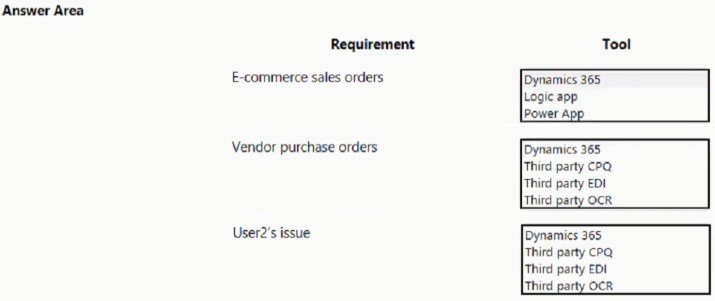
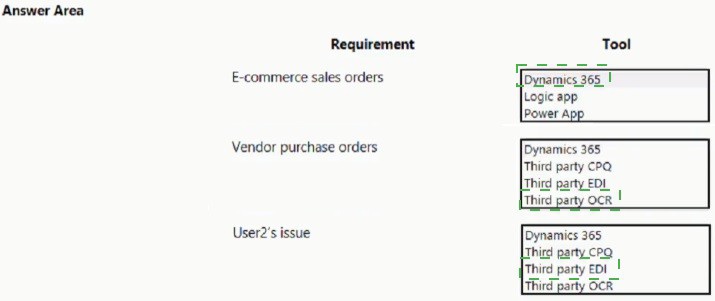
Explanation:
This question assesses your ability to map business process requirements to the most appropriate tool within the Microsoft ecosystem and its extensions. The goal is to streamline processes by selecting the tool that provides the most direct, integrated, and capable solution for each scenario, avoiding unnecessary third-party complexity.
Correct Options:
Based on the image content and the requirement to streamline business processes using the Microsoft stack, the correct mappings are:
E-commerce sales orders: Dynamics 365
Dynamics 365 Commerce natively supports B2C and B2B e-commerce scenarios, including online storefronts, order management, and customer service. It provides the most streamlined, integrated solution for managing e-commerce sales orders directly within the unified platform, eliminating data silos and complex integrations.
Vendor purchase orders: Third party EDI
Streamlining the exchange of structured purchase orders with vendors at scale is best achieved through Electronic Data Interchange (EDI). A third-party EDI solution specializes in secure, automated, and standards-based document exchange (like PO, ASN, invoice) with external trading partners, which is outside the core functionality of Dynamics 365.
User2's issue: Third party OCR
The requirement is likely related to digitizing paper-based documents (e.g., vendor invoices, purchase orders) that a user is manually handling. A third-party Optical Character Recognition (OCR) service can automate data extraction from scanned documents or images and feed it into Dynamics 365, streamlining data entry and reducing manual errors.
Incorrect Options for "Vendor purchase orders" and "User2's issue":
Third party CPQ:
CPQ (Configure, Price, Quote) tools are designed for complex product configuration and sales quoting, not for streamlining the exchange of standardized purchase orders with vendors.
Logic App / Power App:
For Vendor POs and User2's issue, these are integration/automation and low-code app tools, respectively. While they could be part of a solution, they are not the primary tool for EDI document exchange or automated data extraction from paper documents. They would require building the core EDI or OCR functionality from scratch, which is not streamlined.
Dynamics 365:
For the latter two requirements, while Dynamics 365 can record purchase orders and invoice data, it does not natively provide robust EDI exchange protocols or advanced OCR capabilities. Recommending it here would not address the core need to streamline the inbound/outbound process with external systems or paper.
Reference:
This aligns with solution architecture principles for selecting integrated vs. best-of-breed components. Microsoft Learn documentation on Dynamics 365 Commerce, Finance, and Supply Chain Management outlines native capabilities and common integration patterns for EDI and document automation.
You need to determine which system functionality meets the business requirement.
What should you recommend? To answer, drag the appropriate functionalities to the correct requirements. Each functionality may be used once, more than once, or not at all.
You may need to drag the split bar between panes or scroll to view content
NOTE: Each correct selection is worth one point.


Explanation:
This is a mapping question that tests your understanding of how specific D365 Finance & Operations features address fundamental procurement and compliance business needs. You must match the high-level business control requirement to the system functionality designed to enforce it.
Correct Mappings:
Based on standard D365 F&O capabilities:
Approve purchase requisitions over $50: Workflow
Workflow is the system functionality used to automate and manage business process approvals. You can configure a purchase requisition workflow with conditional rules (e.g., amount > $50) to route documents to the correct approvers, ensuring proper authorization before the requisition is converted to a purchase order.
Review offsite travel expenses: Audit Policy
Audit policies are designed to monitor user activity for specific, potentially high-risk events. You can create an audit policy to trigger a log or alert when users enter transactions that match certain criteria, such as expenses with an "Offsite Travel" category, enabling managers or auditors to review them for policy compliance.
Enforce vendor invoice compliance: Purchasing Policy
Purchasing policies are rule-based configurations that enforce organizational standards during procurement. You can use them to mandate requirements for vendor invoices, such as enforcing three-way matching (PO, receipt, invoice), blocking invoices without a purchase order, or setting tolerance limits, thereby ensuring compliance before payment is processed.
Incorrect Mappings / Reasoning:
Workflow is incorrect for reviewing expenses or enforcing invoice rules because it is a sequential approval tool, not a monitoring or rule-enforcement engine for transactions after they are posted.
Purchasing Policy is incorrect for requisition approvals or expense review because it governs the procurement rules and validations during the purchasing process, not the approval routing of documents or the auditing of posted transactions.
Audit Policy is incorrect for approving requisitions or enforcing invoice rules. It is a passive monitoring and logging tool for investigation, not an active enforcement mechanism that blocks transactions or routes them for approval.
Reference:
Microsoft Learn documentation on
Purchasing policies
You need to recommend a purchasing process based on the requirements.
Which three system capabilities should you recommend? Each correct answer presents part of the solution.
NOTE: Each correct selection is worth one point.
A. procurement categories
B. signing limits
C. workflow
D. purchasing policies
E. security roles
Explanation:
This scenario requires designing a controlled, rules-based purchasing process. The recommendation must provide the structural components to define purchasing rules, enforce approval hierarchies based on authority, and ensure users have the correct permissions to execute their part of the process within those controls.
Correct Options:
C. Workflow
Workflow automates the routing, task assignment, and approval of purchase documents (requisitions, orders) based on configurable conditions like amount, item, or requester. It is essential for enforcing a sequential approval process and ensuring proper authorization before commitments are made.
D. Purchasing Policies
Purchasing policies are the core rule engine that enforces organizational procurement standards. They define and automate compliance rules, such as requiring purchase orders for certain categories, enforcing vendor lists, or setting up validation for invoice matching, which standardizes the purchasing process.
E. Security Roles
Security roles grant users the specific permissions needed to perform their duties within the purchasing process (e.g., create a requisition, approve a PO, post an invoice). They are fundamental to implementing segregation of duties and ensuring users can only access the functions and data relevant to their role in the controlled process.
Incorrect Options:
A. Procurement Categories
While procurement categories are important for organizing spending and reporting, they are a classification tool, not a process control mechanism. Categories can be used within policies and workflows as criteria, but they do not, by themselves, define or enforce the purchasing process.
B. Signing Limits
Signing limits are a business concept for approval authority. In D365 F&O, this concept is implemented and automated through workflow configurations (e.g., approval thresholds based on amount) and purchasing policies, not as a standalone system capability. Recommending "signing limits" is redundant as it is encompassed by the recommended capabilities (C & D).
Reference:
The recommended triad forms the foundation of a controlled procure-to-pay cycle in Dynamics 365, as outlined in Microsoft Learn documentation on procurement and sourcing setup, which details the configuration of workflows, purchasing policies, and security.
You need to recommend a toolset to assist with User3 s feedback about the issues with journal entry and new user training. What should you recommend?
A. RSAT tool with LCS
B. Task Recorder with RSAT
C. Task Recorder with BPM library
D. RSAT tool with Asset library
Explanation:
This question addresses two distinct but related challenges: documenting/training on processes (journal entry) and testing system changes. The solution requires tools that work together to create reliable training materials and enable automated testing to ensure the documented processes remain functional after system updates, which directly addresses training continuity and quality.
Correct Option:
B. Task Recorder with RSAT
Task Recorder is used to capture precise, step-by-step recordings of business processes (like journal entry) directly within D365 F&O. These recordings can be saved as Word documents or interactive guides, providing perfect training materials for new users.
The Regression Suite Automation Tool (RSAT) can import these Task Recorder recordings and convert them into automated test scripts. This ensures that the core processes documented for training are consistently tested and remain functional after any system update, patch, or customization, preventing training materials from becoming obsolete due to broken processes.
Incorrect Options:
A. RSAT tool with LCS
Lifecycle Services (LCS) is for project management, environment deployment, and monitoring. While RSAT test results can be uploaded to LCS, the combination does not address the creation of training materials for the user's feedback about journal entry and new user training. It lacks the documentation capability of Task Recorder.
C. Task Recorder with BPM library
The Business Process Modeler (BPM) library in LCS is for high-level process mapping, design, and requirement tracking. While Task Recorder recordings can be linked to BPM elements, this combination is more suited for solution architects during the design phase, not for directly addressing end-user training needs and ensuring process reliability post-update.
D. RSAT tool with Asset library
The Asset library in LCS stores deployable packages, reports, and other assets. RSAT does not directly interact with the Asset library to create or manage training materials. This combination is for deployment and asset management, not for process documentation and training.
Reference:
Microsoft Learn documentation on using Task Recorder for training and RSAT for automated testing. The integration point is specifically that RSAT can consume Task Recorder recordings to create tests.
You need to recommend a solution for the business process testing plan. What should you recommend?
A. LCS Business process library
B. SysTest framework
C. Chain test cases
D. Derived test cases
Explanation:
This question focuses on strategic planning and management of business process testing, not on writing or executing low-level unit tests. The recommendation must provide a structured, visual, and collaborative framework for organizing test scenarios that map directly to business requirements and processes, ensuring comprehensive test coverage aligned with business needs.
Correct Option:
A. LCS Business process library
The Business Process Modeler (BPM) library within Lifecycle Services (LCS) is the strategic tool for designing, documenting, and organizing business processes and their associated test cases in a structured hierarchy (e.g., Procure-to-Pay, Order-to-Cash).
It allows you to link test cases (created with Task Recorder/RSAT) directly to process steps and requirements. This creates a formal, version-controlled testing plan that ensures critical business processes are validated. It provides the high-level plan and traceability needed for user acceptance testing (UAT).
Incorrect Options:
B. SysTest framework
SysTest is a development framework used by developers to write and run unit tests and integration tests at the code level in Visual Studio. It is technical and code-centric, not suitable for planning or managing a broad business process testing plan focused on end-to-end scenarios and user acceptance.
C. Chain test cases / D. Derived test cases
These are specific types of test cases within the RSAT/functional testing toolset, not a solution for the overall testing plan.
Chain Tests: Group multiple individual test cases into a specific execution sequence.
Derived Tests: Create variations of a base test case with different data parameters.
While used during test execution, they are tactical components, not the strategic planning tool requested.
Reference:
Microsoft Learn documentation on using the Business Process Modeler (BPM) in Lifecycle Services to structure requirements and manage acceptance testing. It explicitly describes creating a business process library, importing standard processes, and linking test cases to process steps to prepare for testing.
You need to recommend a performance and load testing strategy for the requirement. What should you recommend? To answer, select the appropriate options in the answer area. NOTE: Each correct selection is worth one point.
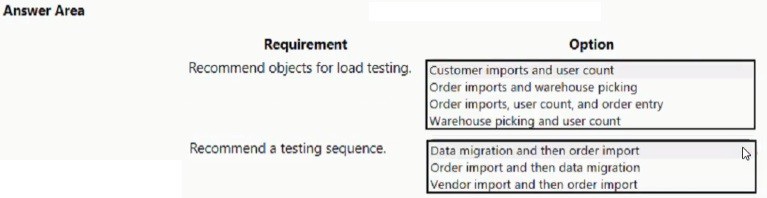
Explanation:
This question tests knowledge of effective performance and load testing strategies for Dynamics 365 Finance & Operations. The goal is to simulate realistic, high-volume production scenarios that stress critical transactional and user concurrency components. The testing sequence must reflect a logical data dependency to ensure tests are valid.
Correct Options:
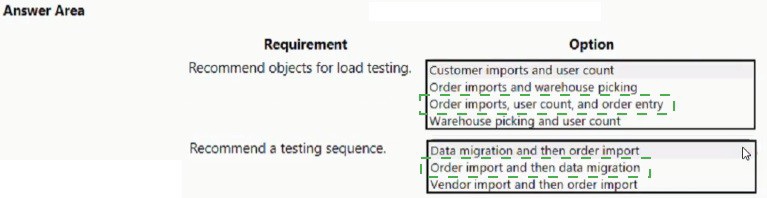
Recommend objects for load testing: Order imports, user count, and order entry
A comprehensive load test must simulate a realistic production mix. Order imports test batch/data pipeline performance. User count (or user concurrency) tests the system's ability to handle many simultaneous active users. Order entry tests the performance of the core transactional UI/APIs. This combination covers integration, concurrency, and key transaction processing—the primary bottlenecks.
Recommend a testing sequence: Data migration and then order import
Performance tests require a realistic, volume-loaded database to be meaningful. Data migration (or master data import) must occur first to populate the system with necessary reference data (items, customers, vendors) and historical transactions to mimic production data volume. Only then can a subsequent order import test operate against a realistic database state and provide valid performance metrics.
Incorrect Options for Load Test Objects:
Customer imports and user count:
Misses testing critical transactional processes (order entry, picking) and focuses too much on data setup.
Order imports and warehouse picking:
Omits testing user concurrency (user count), which is a fundamental aspect of load testing for system responsiveness under multiple user sessions.
Warehouse picking and user count:
Omits testing the integration/data pipeline performance (order imports), which is crucial for overall system throughput.
Incorrect Options for Testing Sequence:
Order import and then data migration:
Logically incorrect. You cannot import orders if the master data (customers, items) does not yet exist in the system. This sequence would fail.
Vendor import and then order import:
Too narrow. While vendor data is part of master data, "vendor import" is just a subset of the required initial data migration step. The recommendation should state the broader prerequisite phase.
Reference:
This aligns with Microsoft's performance testing guidance, which emphasizes testing under production-like data volumes and user loads. The recommended approach is standard for validating go-live readiness, ensuring the system can handle peak transactional and user concurrency loads after all master and historical data is in place.
You need to recommend a solution tor tracking business process test steps. What should you recommend?
A. Microsoft Azure DevOps
B. Data Migration Framework
C. Selenium Automation Framework
D. Microsoft SharePoint
Explanation:
This question asks for a tool to track the detailed steps, status, and results of business process tests. The solution must support comprehensive test management features, including creating test cases, linking them to requirements, planning test suites, recording execution results (pass/fail), and managing defects—all within a collaborative lifecycle management platform.
Correct Option:
A. Microsoft Azure DevOps
Azure DevOps provides a dedicated Test Plans module that is purpose-built for managing manual and automated testing. It allows you to create test cases with detailed step-by-step instructions, organize them into test suites, assign testers, log results, and directly file bugs linked to failing tests.
This creates full traceability from business requirements to test execution, which is essential for tracking business process validation. It is the primary integrated tool for managing testing activities within the Microsoft ecosystem for D365 projects.
Incorrect Options:
B. Data Migration Framework
This is a toolset and methodology for importing legacy data into Dynamics 365. It is focused on data extraction, transformation, and loading (ETL) processes, not on tracking the testing of business processes.
C. Selenium Automation Framework
Selenium is an open-source framework for automating web browser interactions. While it can be used to execute automated UI tests, it is not a test management tool. It lacks native features for planning test cases, tracking manual test steps, logging results, and managing the overall testing lifecycle.
D. Microsoft SharePoint
SharePoint can be used as a document repository to store test plans and results in Word or Excel files. However, it is not a structured test management solution. Tracking test steps, execution status, and defects in SharePoint would be a manual, inefficient process without integration or specialized workflows, leading to poor traceability and collaboration.
Reference:
Microsoft Learn documentation on using Azure DevOps for testing Dynamics 365 solutions describes its role in manual and exploratory testing, test case management, and linking to user stories. For D365 projects, Azure DevOps is the standard tool for managing the entire application lifecycle, including test tracking.
You need to recommend the appropriate number of production instances and the hosting location. What should you recommend?
A. One production instance in China.
B. Two on-premises production instances hosted in both China and the United States.
C. One on-premises production instance hosted in United States and one cloud production instance hosted in China.
D. Two production instances hosted in China and the United States.
E. One production instance hosted in the United States.
Explanation:
This question is a classic scenario testing knowledge of legal and operational requirements for multinational deployments. The core principle is that data sovereignty laws in China mandate that data for Chinese operations must reside on servers physically located within China. A standard cloud (Microsoft-managed) instance cannot serve this need, requiring a special hosting model.
Correct Option:
C. One on-premises production instance hosted in United States and one cloud production instance hosted in China.
This recommendation correctly addresses the two key constraints.
First, it satisfies China's data residency laws by having a dedicated instance for Chinese operations. However, because Microsoft's standard global cloud does not operate in mainland China, the instance must be hosted on-premises or in a partner-hosted Azure environment that complies with local regulations.
Second, it provides a standard, optimized cloud production instance in the United States for the rest of the global operations, leveraging the benefits of the Microsoft-managed service.
Incorrect Options:
A. One production instance in China.
This would force all global users, including those in the US, to connect to an instance in China, leading to severe performance (latency) issues for non-Asian users and failing to provide a localized solution for the US business.
B. Two on-premises production instances hosted in both China and the United States.
While this ensures data residency, it is unnecessarily costly and complex. The US operations do not have a legal requirement for on-premises hosting and would benefit more from a cloud instance (lower TCO, automatic updates, scalability).
D. Two production instances hosted in China and the United States.
This is incorrect because it implies both are standard cloud instances. Microsoft does not operate its global Dynamics 365 cloud services from within mainland China. A standard "cloud instance hosted in China" for regulatory compliance is not an available option.
E. One production instance hosted in the United States.
This directly violates China's data residency laws, as the data for Chinese business entities would be stored outside the country.
Reference:
This aligns with Microsoft's documented deployment models for Dynamics 365 in regulated markets. The need for a separate, locally-hosted instance for China is a fundamental constraint discussed in architecture planning guides, due to the unique sovereign cloud landscape operated by 21Vianet, which is distinct from the global Azure/Dynamics 365 cloud.
You need to recommend a solution to manage the wine bottle label requirements for the private brand. What should you recommend?
A. Use an add-on solution for barcode and label report printing.
B. Create notes on the item and print for the customers.
C. Implement Advanced Warehouse label printing.
D. Recommend Dynamics 365 Retail.
Explanation:
This question addresses a specialized requirement for printing custom labels (likely with barcodes, logos, batch details) for a private-brand product. The need is for precise, formatted, and automated label generation tied to warehouse or production processes, which goes beyond standard reporting or simple notes.
Correct Option:
A. Use an add-on solution for barcode and label report printing.
Dynamics 365 Supply Chain Management's native reporting and document handling is not designed for specialized, formatted label printing (e.g., Zebra labels) with specific barcode standards, logos, and variable data.
A purpose-built add-on solution from ISV partners (available via AppSource) integrates directly with D365 to handle complex label design, data mapping, and direct printing to label printers. This is the standard, scalable approach for managing custom private-brand labeling requirements in a production or warehouse environment.
Incorrect Options:
B. Create notes on the item and print for the customers.
This is a completely manual and non-scalable workaround. Item notes are for informational text and are not suitable for generating formatted, scannable barcode labels. It lacks automation, consistency, and professional presentation required for a private brand.
C. Implement Advanced Warehouse label printing.
The Advanced Warehouse Management (WHS) module includes basic functionality for printing license plate and location labels, but it is not designed for custom, customer-facing product labels with branding and specific barcodes. It serves internal warehouse operations, not private-brand packaging requirements.
D. Recommend Dynamics 365 Retail.
Dynamics 365 Retail (now part of Commerce) manages point-of-sale, merchandising, and omnichannel commerce. It does not include functionality for designing and printing physical product labels for inventory items or production batches. This recommendation is for the wrong product family and does not solve the label printing need.
Reference:
The need for specialized label printing is commonly addressed via the ISV ecosystem. Microsoft AppSource lists multiple third-party label design and printing solutions that integrate with Dynamics 365 Finance & Supply Chain Management to fulfill this exact business requirement.
You need to create a plan that meets the following requirements:
Migrate the data to the new system.
• Implement a standardized method for creating items.
• Prevent items from being created in different ways going forward.
Which two actions should you recommend? Each correct answer presents a complete answer. NOTE: Each correct selection is worth one point.
A. Migrate item data in the cutover plan after the annual updates of items,
B. Suggest creating a Power Bl report to identify like-items after migration.
C. Migrate items in the cutover plan before the annual update of items.
D. Suggest a Master Data Management team who standardizes the item master.
E. Migrate existing items as-is.
Explanation:
This question requires a two-part solution: (1) address legacy data quality by identifying duplicates post-migration, and (2) establish a future-proof governance process to maintain item master data integrity. The plan must both clean up the historical problem and implement a permanent control to prevent its recurrence.
Correct Options:
B. Suggest creating a Power BI report to identify like-items after migration.
This action directly addresses the goal of standardizing existing data from the legacy system. Migrating data "as-is" will bring over duplicate and inconsistent items. A Power BI report using data cleansing and matching logic (e.g., on name, attributes) can identify "like-items" for consolidation after they are in the new system, enabling a cleanup effort.
D. Suggest a Master Data Management team who standardizes the item master.
This action addresses the future-state control requirement to "prevent items from being created in different ways going forward." A dedicated MDM team establishes governance, defines creation policies and approval workflows, and owns the item master data lifecycle. This is the organizational solution to enforce standardization permanently.
Incorrect Options:
A. Migrate item data in the cutover plan after the annual updates of items. / C. Migrate items in the cutover plan before the annual update of items.
The timing of migration relative to an "annual update" is a tactical cutover detail, not a strategic action to meet the stated requirements of standardization and future prevention. Both options focus on when to move data, not how to clean it or govern it. The annual update cycle is irrelevant to the core governance problem.
E. Migrate existing items as-is.
This is the opposite of what is needed. Migrating items as-is directly contradicts the requirement to "implement a standardized method for creating items," as it perpetuates all existing inconsistencies and duplicates from the legacy system into the new environment.
Reference:
These recommendations align with data management best practices for ERP implementations: using analytics (Power BI) for data quality assessment and remediation, and establishing master data governance as a critical success factor for maintaining system integrity, as emphasized in Microsoft's solution architecture guidance.
You need to determine an infrastructure for the solution.
What should you recommend? To answer, select the appropriate options in the answer area. NOTE: Each correct selection is worth one point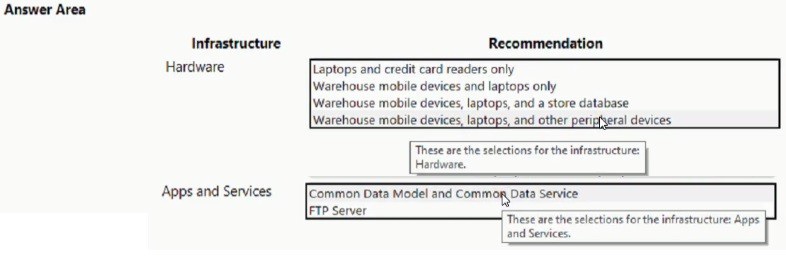
Explanation:
This question requires designing an infrastructure for a likely retail/warehouse solution. The hardware must support modern operations: warehouse staff need mobile devices for scanning and tasks; management and office staff need laptops for the full D365 client. "Other peripheral devices" (printers, scales, etc.) are also essential. For apps and services, the Common Data Service/Model is the core integration platform for data sharing across D365 and Power Platform apps, which is critical for a unified solution.
Correct Options:
Based on the need for a comprehensive operational infrastructure:
Hardware: Warehouse mobile devices, laptops, and other peripheral devices
This selection provides a complete ecosystem. Warehouse mobile devices (e.g., handheld scanners) are non-negotiable for inventory picking, receiving, and cycle counting. Laptops are required for supervisors, buyers, and managers to run the full D365 Finance & Operations client for complex tasks. Other peripheral devices (label printers, payment terminals, scales) are necessary to support end-to-end physical logistics and transactions.
Apps and Services: Common Data Model and Common Data Service
This is the strategic choice for application integration and data flow. The Common Data Service (CDS, now Dataverse) provides a unified, secure data storage service, and the Common Data Model (CDM) provides standardized, shared data schemas. Using CDS/CDM enables seamless integration and data sharing between D365 apps (like Finance, Commerce) and Power Platform apps (like Power Apps, Power Automate), which is foundational for a modern, extensible solution.
Incorrect Options for Hardware:
Laptops and credit card readers only: Lacks critical warehouse operational hardware (mobile scanners), making warehouse management inefficient or impossible.
Warehouse mobile devices and laptops only: While covering core user devices, it omits necessary supporting hardware (peripheral devices) required for printing, weighing, and other physical processes.
Warehouse mobile devices, laptops, and a store database: The inclusion of a separate "store database" is an anti-pattern. In a D365 architecture, data should be centralized in the application database (or via CDS), not siloed in a separate store-level database, which would create major integration and consistency challenges.
Incorrect Options for Apps and Services:
FTP Server:
This represents an outdated, point-to-point integration method. While an FTP server might be used for specific file transfers (e.g., with a third-party EDI provider), it is not the primary apps and services infrastructure for a modern D365 solution. It does not provide the real-time data integration, security, or unified platform capabilities that CDS/CDM offers.
Reference:
The recommendation aligns with Microsoft's approach for a unified operations infrastructure, leveraging mobile devices in the warehouse (via the Warehouse Management mobile app) and using the Power Platform (Common Data Service) as the central data hub for application integration, as described in Dynamics 365 architecture documentation.
| Page 1 out of 9 Pages |