
PCF Reusable InputSets
An insurer requires a single column of information to be displayed in several places in the application. The insurer anticipates that fields may be added to or removed from this column in the future and wants to do this without making changes in multiple places. Which container meets this requirement?
A. Input column
B. InputSet
C. ListView Panel
D. Wizard
Answer Option (Which option is correct) B. InputSet
Explanation:
An InputSet PCF file centralizes a reusable group of input fields. Referencing that file from multiple containers allows one change to update every use of the shared layout.
Verification note: The exact option selection could not be independently verified from accessible official documentation. Relevant official topic links are provided, but some exact configuration or training rules require the product Configuration Guide or Cloud Standards behind sign-in. The source key is retained.
Why the other options are incorrect:
A. Input column:
An InputColumn arranges fields inside a detail view. It does not identify the shared reusable file requested here. The layout needs an InputSet reference.
C. ListView Panel:
A ListView displays repeated records. The requirement describes one column of inputs. Introducing a row-based panel changes the requested structure.
D. Wizard:
A Wizard organizes a sequence of pages. It is intended for a multistep workflow. The insurer needs reusable fields rather than sequential navigation.
References:
Guidewire product documentation - Configuration Guide access
What configuration item is needed to add ABContact.Notes to PendingContactChangeView following best practices?
Visual content transcription:
The screenshot shows PendingContactChangeView and its existing view-entity fields. Small field details remain in the original image.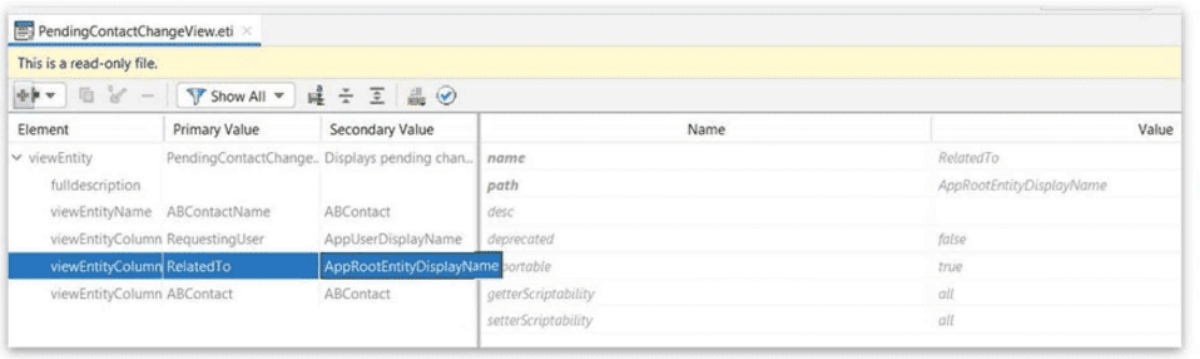
A. Add a viewEntityType for Note to PendingContactChangeView.etx
B. Add a viewEntityType for Note to PendingContactChangeView.eti
C. Set the value on the input widget to PendingContactChangeView.ABContact.Note
D. Create a viewEntity that includes Note
Answer Option (Which option is correct) A. Add a viewEntityType for Note to PendingContactChangeView.etx
Explanation:
A query-backed list view should read projected fields from its view entity. Extending the existing view entity in its .etx file preserves the base definition and avoids navigating back to the full underlying entity for each row.
Verification note: The exact option selection could not be independently verified from accessible official documentation. Relevant official topic links are provided, but some exact configuration or training rules require the product Configuration Guide or Cloud Standards behind sign-in. The source key is retained.
Why the other options are incorrect:
B. Add a viewEntityType for Note to PendingContactChangeView.eti:
Editing the delivered eti file changes the base definition. That bypasses the extension file selected by the source. The existing view should be customized through etx metadata.
C. Set the value on the input widget to PendingContactChangeView.ABContact.Note:
Navigating to ABContact reads through the underlying entity relationship. That does not add Notes to the view projection. The question asks for view-entity configuration.
D. Create a viewEntity that includes Note:
Creating a separate view duplicates the existing projection. The requirement is to add information to PendingContactChangeView. An extension targets that existing view directly.
References:
Guidewire product documentation - Configuration Guide access
What is a benefit of archiving?
A. Reorganizes and compresses the contents of the database to conserve space
B. Improves application performance by reducing the size of the database
C. Reindexes the contents of the database to increase data retrieval speed
D. Reduces database size by permanently removing data marked for purge
Answer Option (Which option is correct) B. Improves application performance by reducing the size of the database
Explanation:
Archiving moves eligible older business data out of the active database while retaining it for retrieval. A smaller active dataset can reduce the work involved in routine application operations; archiving is different from permanent purging, compression, or index rebuilding.
Why the other options are incorrect:
A. Reorganizes and compresses the contents of the database to conserve space:
Compression changes physical storage representation. Archiving instead removes eligible records from the active dataset. These are different database operations.
C. Reindexes the contents of the database to increase data retrieval speed:
Reindexing rebuilds an access structure. It does not transfer old business records into an archive. Index maintenance is not the benefit asked about.
D. Reduces database size by permanently removing data marked for purge:
Purging permanently removes data. Archiving retains data outside the active store. The two lifecycle operations should not be equated.
References:
Guidewire - Archiving and active database performance
A developer is creating an entity for home inspections that contains a field for the inspection date. Which configuration of the file name and the field name fulfills the requirement and follows best practices?
A. HomeInspection.etx, InspectionDate.Ext
B. HomeInspection_Ext.eti, InspectionDate.Ext
C. HomeInspection_Ext.etx, InspectionDate
D. HomeInspection.eti, InspectionDate.Ext
E. HomeInspection.Ext.eti, InspectionDate
Answer Option (Which option is correct) B. HomeInspection_Ext.eti, InspectionDate.Ext
Explanation:
A new custom entity is defined in an .eti file with a customer suffix on the entity name. A field belonging exclusively to that new custom entity generally does not need a second extension suffix. An .etx file instead extends an entity that already exists.
Verification note: The supplied key selects InspectionDate.Ext although Q53 uses an unsuffixed field on a new custom entity. The dot suffix appears malformed; retained verbatim for review.
Why the other options are incorrect:
A. HomeInspection.etx, InspectionDate.Ext:
An etx file extends an existing entity. The stem asks for a new HomeInspection entity. The field suffix also appears malformed.
C. HomeInspection_Ext.etx, InspectionDate:
This still uses an extension file rather than an entity definition. The custom name alone does not change the file purpose. Creating the new entity requires an eti definition.
D. HomeInspection.eti, InspectionDate.Ext:
The entity name has no custom suffix. That can collide with delivered entity names. The dot in the field suffix also needs source review.
E. HomeInspection.Ext.eti, InspectionDate:
The name uses a dot before Ext. Other questions use an underscore in custom entity names. The source does not explain this spelling difference.
References:
Guidewire - Custom entity and subtype data model examples
Succeed Insurance needs to modify the ClaimCenter data model to add a new column to indicate the date and time that a contact on a claim was interviewed about the loss. This new field will be added to the existing Person entity. Following best practices, which of the following options satisfies this requirement?
A. Modify the out-of-the-box Person.eti file and add a datetime field called InterviewDate.
B. Extend the out-of-the-box Person.eti file by creating a Person_Ext.etx file and add a datetime field called InterviewDate_Ext.
C. Extend the out-of-the-box Person.eti file by creating a Person.etx file and add a datetime field called InterviewDate.
D. Extend the out-of-the-box Person.eti file by creating a Person.etx file and add a datetime field called InterviewDate_Ext.
Answer Option (Which option is correct) D. Extend the out-of-the-box Person.eti file by creating a Person.etx file and add a datetime field called InterviewDate_Ext.
Explanation:
Add a simple new value to the narrowest existing entity to which it applies. Use an entity extension rather than editing the delivered entity definition, choose an appropriate scalar data type, and distinguish the custom field with the extension suffix.
Why the other options are incorrect:
A. Modify the out-of-the-box Person.eti file and add a datetime field called InterviewDate:
Changing Person eti modifies a delivered definition. The new interview date belongs in an entity extension. The unsuffixed field also risks a future naming collision.
B. Extend the out-of-the-box Person.eti file by creating a Person_Ext.etx file and add a datetime field called InterviewDate_Ext:
Person_Ext etx does not match the existing Person entity name. The extension should retain the base entity name. The field suffix does not repair the mismatched file name.
C. Extend the out-of-the-box Person.eti file by creating a Person.etx file and add a datetime field called InterviewDate:
Person etx is the appropriate extension file. The field name still lacks the custom suffix. The selected configuration distinguishes InterviewDate_Ext from future base fields.
References:
Guidewire-authored PolicyCenter 10.1.2 - Extending a base entity
Guidewire - Custom entity and subtype data model examples
An insurer wants to add a new typecode for an alternate address to a base typelist EmployeeAddress that has not been extended.
A. Following best practices, which step must a developer take to perform this task?
B. Create an EmployeeAddress_Ext.tti file and add a new typecode alternate
C. Open the EmployeeAddress.tti and add a new typecode alternate
D. Create an EmployeeAddress.ttx file and add a new typecode alternate_Ext
E. Create an EmployeeAddress.tix file and add a new typecode alternate_Ext
Answer Option (Which option is correct) D. Create an EmployeeAddress.ttx file and add a new typecode alternate_Ext
Explanation:
An existing typelist is extended through its .ttx file, creating that extension file when necessary. A new standalone typelist uses .tti instead. Updating the delivered .tti file or generated Java code is not the extension mechanism.
Verification note: The PDF places part of the question stem in option A and duplicates the scenario in Q147 with different option letters. Original options and key D are retained to avoid changing the answer mapping.
Why the other options are incorrect:
A. Following best practices, which step must a developer take to perform this task?:
This text is part of the question rather than an answer proposal. Its placement in option A is a source defect. It is retained so the original letter mapping is not silently shifted.
B. Create an EmployeeAddress_Ext.tti file and add a new typecode alternate:
An eti-style standalone naming pattern does not extend this typelist. The proposed tti file would define a separate list. EmployeeAddress already exists.
C. Open the EmployeeAddress.tti and add a new typecode alternate:
Editing the delivered tti file bypasses an extension. The question requests a change to a base typelist. The source selects EmployeeAddress ttx instead.
E. Create an EmployeeAddress.tix file and add a new typecode alternate_Ext:
A tix file is not the ttx extension selected for this change. Typelist file kinds have different purposes. The unfamiliar suffix is retained for review.
References:
Guidewire - Typelist definition file kinds
Guidewire Cloud Standards - Sign-in required
A developer needs to prepare their local configuration changes for inclusion in the shared Bitbucket repository. According to the training, which actions, performed using Git-based commands in a GWCP context, are essential for this process? (Choose 3)
A. Pulling the latest changes from the remote repository and rebasing the developer's commit(s).
B. Committing the changes locally.
C. Deploying the application to a development planet.
D. Creating a new build schedule in TeamCity.
E. Pushing the finished branch to the remote Bitbucket repository.
F. Configuring pre-promotion quality gates.
Answer Option (Which option is correct) A. Pulling the latest changes from the remote repository and rebasing the developer's commit(s).
Answer Option (Which option is correct) B. Committing the changes locally.
Answer Option (Which option is correct) E. Pushing the finished branch to the remote Bitbucket repository.
Explanation:
Local changes must be committed and synchronized with the shared repository before the shared build pipeline can use them. Integrating the parent branch exposes conflicts before merging, while pushing makes the completed work available to the remote repository and subsequent builds.
Why the other options are incorrect:
C. Deploying the application to a development planet:
Deploying an application does not record local source changes. Git preparation occurs before the deployment stage. The finished branch still needs to be shared.
D. Creating a new build schedule in TeamCity:
A build schedule determines when builds run. It does not commit configuration changes. Repository synchronization is the task in this question.
F. Configuring pre-promotion quality gates:
A quality gate controls progression through the pipeline. It does not save or upload the local edits. Commit and push actions perform that source-control work.
References:
Guidewire - Source repository and build promotion
Git project - Commits and branch references
Guidewire - TeamCity builds and dependencies
A developer has added multiple related features in an implementation that needs to be tested. For efficiency, all those features need to be tested at the same time. Which two statements are true about including multiple tests? (Select two)
A. They must use the assertTrue() function.
B. They must be based on the same GUnit base class.
C. They must set TestResultsDir property.
D. They must be in the same GUnit class.
E. They must have the same @Suite annotation.
Answer Option (Which option is correct) B. They must be based on the same GUnit base class.
Answer Option (Which option is correct) E. They must have the same @Suite annotation.
Explanation:
The suite example groups test classes sharing a compatible base class and suite annotation. It does not require those tests to be in a single GUnit class. The PDF key D,E is corrected to B,E, and both selected option values are synchronized with the new letters.
Why the other options are incorrect:
A. They must use the assertTrue() function:
assertTrue is only one assertion method. A suite can contain tests using other assertions. Assertion choice does not determine suite membership.
C. They must set TestResultsDir property:
A results directory controls output location. It does not group tests for execution. Suite construction is a separate concern.
D. They must be in the same GUnit class:
Tests in different classes can belong to one suite. The official testing example builds a suite from annotated test classes. Requiring one class defeats that grouping mechanism.
References:
Guidewire-authored PolicyCenter 10.1.2 - GUnit Testing Guide
Guidewire Home provides self-service capabilities for managing storage access permissions for InsuranceSuite. According to the training, which app in Guidewire Home is used for this purpose?
A. The Storage Access app
B. The Quality Gates app
C. The Lifecycle Manager app
D. The Build Promotion app
E. The Planets app
Answer Option (Which option is correct) A. The Storage Access app
Explanation:
The Storage Access app is the source-selected tool for administering storage access permissions. Build, quality-gate, and planet-management tools address different parts of the deployment environment.
Why the other options are incorrect:
B. The Quality Gates app:
Quality Gates evaluates pipeline requirements. Storage permissions are a different responsibility. It is not the storage-administration app.
C. The Lifecycle Manager app:
Lifecycle Manager manages application configuration resources. It does not name the storage-access tool in the prompt. The source selects Storage Access.
D. The Build Promotion app:
Build Promotion moves artifacts between environments. It does not grant bucket or storage-user access. The permission-management task belongs elsewhere.
E. The Planets app:
Planets manages application environments. A planet deployment does not itself configure storage credentials. Use the storage-specific app for this requirement.
References:
Guidewire - Storage Access API overview
Which statements describe best practices when using bundles in Gosu to save new entities/edit existing entities? (Select Two)
A. Commit changes individually for each entity.
B. Create a new bundle using gw.transaction.Transaction.runWithNewBundle().
C. Explicitly call the commit() method on the bundle outside of a managed block.
D. Add all entities to the bundle, not just those which will be edited.
E. Obtain a bundle using gw.transaction.Transaction.getCurrent().
F. Never call commit() within a runWithNewBundle() statement.
Answer Option (Which option is correct) B. Create a new bundle using gw.transaction.Transaction.runWithNewBundle().
Answer Option (Which option is correct) F. Never call commit() within a runWithNewBundle() statement.
Explanation:
A queried entity must be placed in a writable bundle before it is modified. Add the entity rather than the Query object or an individual property. A managed runWithNewBundle block handles its transaction boundary; a manually created bundle requires an explicit commit after the intended changes.
Why the other options are incorrect:
A. Commit changes individually for each entity:
Committing each entity separately fragments related changes. A failure can leave only part of the intended update saved. Related work should share a deliberate transaction boundary.
C. Explicitly call the commit() method on the bundle outside of a managed block:
A manually managed commit can be valid in some contexts. It is not the managed-block approach selected here. The blanket best-practice claim needs that context.
D. Add all entities to the bundle, not just those which will be edited:
Adding every entity increases the writable bundle unnecessarily. Entities that are merely read need not all be moved. Limit writable state to the transaction work.
E. Obtain a bundle using gw.transaction.Transaction.getCurrent():
getCurrent can be appropriate when a writable current bundle exists. The prompt instead selects an isolated managed transaction. The available context does not justify treating all current bundles as wrong.
References:
Guidewire-authored PolicyCenter 10.1.2 - Bundle transactions
You have created a list view file BankAccountsLV that will display a list of bank accounts. You have added a Toolbar and Iterator Buttons, but when you try to select the Iterator related to the Iterator Buttons, the list of available Iterators is empty. What is needed to fix this problem?
A. In the BankAccountsLV file, click on the Row, select the "Exposes" tab, click the "+", select 'Expose Iterator', and select the iterator defined in BankAccountsLV.
B. Manually enter the Iterator name of BankAccountsLV, and Studio will find the file.
C. In the BankAccountsLV file, click on the Row Iterator, select the "Exposes" tab, click the "+", select "Expose Iterator", and select the iterator defined in BankAccountsLV.
D. In the BankAccountsLV file -> "Exposes" tab, click the "+", select "Expose Iterator", and select the iterator defined in BankAccountsLV.
E. Replace the Iterator Buttons with separate Toolbar Buttons to "Add" and "Remove" rows from the Iterator.
F. Open the BankAccountsLV file and from the top menu select "Build -> Recompile BankAccountsLV"
Answer Option (Which option is correct) C. In the BankAccountsLV file, click on the Row Iterator, select the "Exposes" tab, click the "+", select "Expose Iterator", and select the iterator defined in BankAccountsLV.
Explanation:
Add and Remove iterator buttons must reference the row iterator that owns the collection. When the iterator is inside a reusable ListView, expose that iterator so the referencing container can bind its buttons to it. Changing visibility or recompiling does not supply the missing iterator binding.
Verification note: The exact option selection could not be independently verified from accessible official documentation. Relevant official topic links are provided, but some exact configuration or training rules require the product Configuration Guide or Cloud Standards behind sign-in. The source key is retained.
Why the other options are incorrect:
A. In the BankAccountsLV file, click on the Row, select the "Exposes" tab, click the "+", select 'Expose Iterator', and select the iterator defined in BankAccountsLV:
A Row is different from its RowIterator. The toolbar needs the iterator object exposed. Exposing the wrong element leaves that binding unresolved.
B. Manually enter the Iterator name of BankAccountsLV, and Studio will find the file:
Typing an iterator name does not expose it from a reusable file. The parent container must be able to resolve the iterator. The missing exposure is the underlying configuration issue.
D. In the BankAccountsLV file -> "Exposes" tab, click the "+", select "Expose Iterator", and select the iterator defined in BankAccountsLV:
The proposal targets the file-level selection rather than the iterator. The source specifically exposes the RowIterator. Review the selected element before configuring the Exposes tab.
E. Replace the Iterator Buttons with separate Toolbar Buttons to "Add" and "Remove" rows from the Iterator:
Replacing buttons changes the implementation. It avoids diagnosing the missing iterator exposure. The existing toolbar can be repaired directly.
F. Open the BankAccountsLV file and from the top menu select "Build -> Recompile BankAccountsLV":
Recompiling does not add missing metadata. Studio still needs a resolvable iterator reference. The exposure must be configured before compilation can help.
References:
Guidewire product documentation - Configuration Guide access
Succeed Insurance needs to modify an existing PolicyCenter typelist called PreferredContactMethod with the following options: Social Media, Work Phone, and Work Email. Following best practices, which of the following options would a developer use to implement these requirements?
A. The code value for each option should be: SocialMedia_Ext, WorkPhone_Ext, WorkEmail_Ext
B. The code value for each option should be: social_media, work_phone, work_email
C. The code value for each option should be: social_media_Ext, work_phone_Ext, work_email_Ext
D. The code value for each option should be: SocialMedia, WorkPhone, WorkEmail
Answer Option (Which option is correct) C. The code value for each option should be: social_media_Ext, work_phone_Ext, work_email_Ext
Explanation:
The source selects lowercase, underscore-separated typecode names with an _Ext suffix for additions to an existing base typelist. This distinguishes custom codes and keeps the naming convention consistent across the new contact methods.
Verification note: The exact option selection could not be independently verified from accessible official documentation. Relevant official topic links are provided, but some exact configuration or training rules require the product Configuration Guide or Cloud Standards behind sign-in. The source key is retained.
Why the other options are incorrect:
A. The code value for each option should be: SocialMedia_Ext, WorkPhone_Ext, WorkEmail_Ext:
The typecodes use mixed-case words. The source selects lowercase words separated by underscores. Keeping the suffix alone does not match that convention.
B. The code value for each option should be: social_media, work_phone, work_email:
These codes follow the lowercase word pattern. They omit the custom extension suffix selected in the source. The missing distinction matters for a base typelist.
D. The code value for each option should be: SocialMedia, WorkPhone, WorkEmail:
These names omit both the source-selected suffix and word style. They do not match the supplied best-practice pattern. The code naming should be consistent across all three values.
References:
Guidewire - Typelist definition file kinds
Guidewire Cloud Standards - Sign-in required
| Page 1 out of 13 Pages |
| 1234 |
Real-World Scenario Mastery: Our InsuranceSuite-Developer practice exam don't just test definitions. They present you with the same complex, scenario-based problems you'll encounter on the actual exam.
Strategic Weakness Identification: Each practice session reveals exactly where you stand. Discover which domains need more attention, before Associate Certification - InsuranceSuite Developer - Mammoth Proctored Exam exam day arrives.
Confidence Through Familiarity: There's no substitute for knowing what to expect. When you've worked through our comprehensive InsuranceSuite-Developer practice exam questions pool covering all topics, the real exam feels like just another practice session.
Copyright © All Rights Reserved