
You are carrying out an audit at an organisation seeking certification to ISO 9001 for the
first time. The organisation offers regulatory consultancy services to manufacturers of
cosmetics. The business operates from ten regional offices.
You are nearing the end of the audit and need to decide if sufficient evidence of top
management leadership and commitment with respect to the quality management system
has been gathered.
Which four of the following would demonstrate top management leadership and
commitment with respect to the quality management system?
A. Approving company car budgets for the fiscal year
B. Briefing staff on the development of an improvement culture
C. Chairing management review meetings
D. Conducting staff disciplinary meetings
E. Investing time and money in corrective actions arising from nonconformities
F. Not attending audit closing meeting
G. Promoting the importance of following procedures
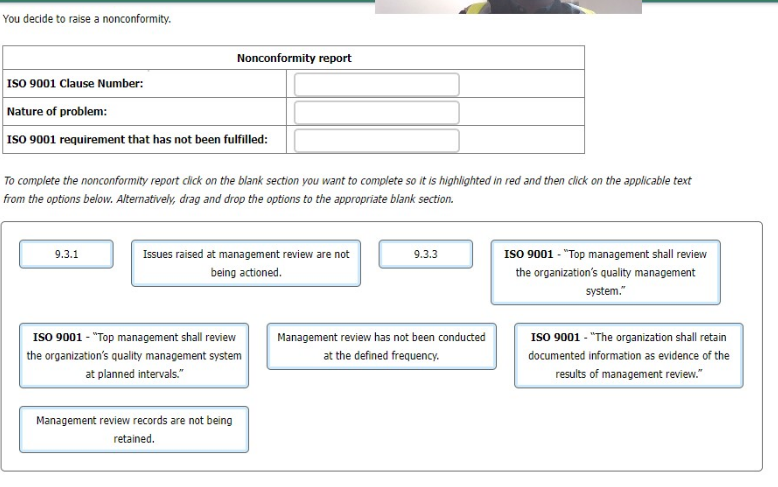
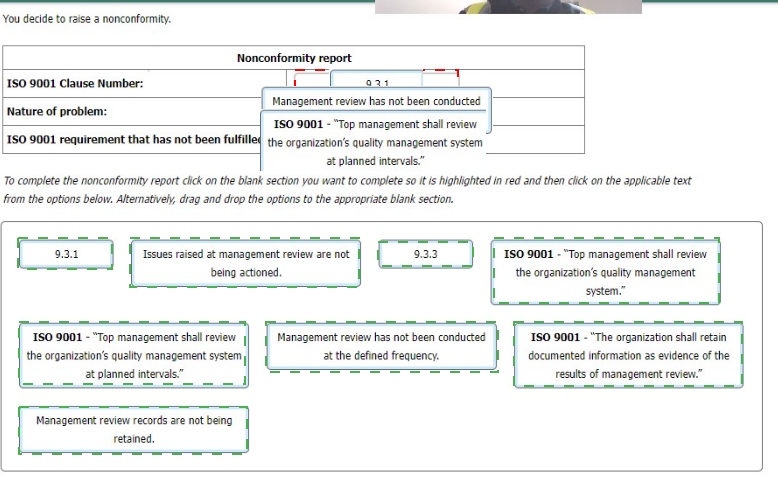
You are carrying out an annual audit at an organisation that offers home security services.
You are interviewing the Quality Manager (QM) You: "Would you tell me about your management review process?"
QM: "The senior management team plans to review the management system every six
months. The review follows a set agenda and records are maintained."
You: "May I see the records from the last two management reviews?"
Narrative: The Quality Manager gives you the latest record, which shows the last
management review took place nine months ago.
The Quality Manager then gives you the previous management review record, which took
place one year before the latest review.
You: "Are there any other review reports in the last two years?
QM: "No, these are the only ones."
The following actions need to be carried out during a third-party audit planning stage.
Which two actions correspond to the individual(s) managing the audit program before the
involvement of the audit team leader’
A. Prepare the audit plan
B. Assign responsibilities within the audit team
C. Prepare the checklists
D. Provide the resources needed
E. Review the reports of previous audits
F. Select the audit team members
Explanation:
In ISO 9001:2015, the responsibility for managing the audit program lies with those
overseeing the entire audit process rather than the Audit Team Leader. During the planning
stage, before involving the Audit Team Leader, key actions for managing the audit program
include:
1. Providing the Resources Needed: According to clause 7.1 (Resources), the audit
program manager must ensure that the necessary resources are in place to conduct the
audit effectively. This encompasses logistical support, personnel, and other required
resources for the audit to proceed smoothly.
2. Reviewing Reports of Previous Audits: As per clause 9.2.2 (Internal Audit), it is essential
to consider the results of previous audits to plan effectively for the upcoming audit. This
helps identify areas that require particular attention, ensuring continuity and focusing on
recurring issues or improvements since the last audit.
These actions ensure that the audit is thoroughly prepared and that there is continuity and
focus on any areas that might need closer inspection. The other options, such as preparing
the audit plan, assigning responsibilities, preparing checklists, and selecting the audit team
members, generally fall under the duties of the Audit Team Leader once they are appointed
and engaged in the planning process.
You are carrying out an audit at a single-site organisation seeking certification to ISO 9001
for the first time. The
organisation manufactures cosmetics for major retailers and the name of the retailer
supplied appears on the product
packaging. Sales turnover has increased significantly over the past five years. The
organisation uses a software programme called SWIFT, which is used to record sales, plan
production, purchase supplies, print despatch notes, track new product development, perform traceability exercises, carry out mass balance checks, raise invoices, create
budgets, and support financial control.
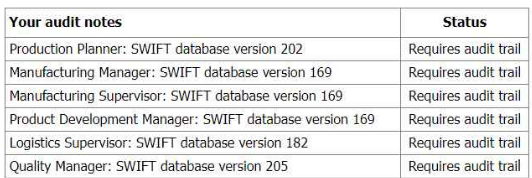
You are nearing the end of the audit and you are reviewing your audit notes. You notice a
recurring trend concerning the SWIFT database as shown below:
You ask the Quality Manager to explain how the SWIFT database is controlled. You learn
that the Operations Director is
responsible for determining and progressing SWIFT software updates. You decide to meet
the Operations Director (OD).
You: "Good afternoon."
OD: "Good afternoon."
You: "What responsibility do you have concerning the SWIFT database?"
OD: "I maintain it. If anyone wishes to propose an update to the database, they send me an
email with
details of their proposal. I then either process the database update myself, or I send the
request to the
consultant who designed the database 20 years ago. The necessary software changes are
made, and the
amended software is immediately released to users."
You: "Would you explain how the software amendments are controlled?"
OD: "Of course. I personally update every computer myself."
You: "Do you inform the database users of the changes?"
OD: "No I don't. They find out for themselves by using the software, or they come to see
me if they have any questions."
You: "How do you ensure that the database users use the latest version?"
OD: "That's easy, I update every computer myself."
You: "During the audit, I noted there were several versions of SWIFT in use (you refer to
your audit
notes)."
OD: "I know. That's because some versions work better than others, and depending on
user needs and
experiences, we allow users to revert to using an earlier version if they find it works better
for them."
Based on the scenario, which two of the following statements are true? There is evidence
of
nonconformity with a requirement defined in ...
A. clause 7.1.3 Infrastructure
B. ... clause 7.1.4 Environment for the operation of processes
C. clause 7.5.1 Documented information - General
D. ... clause 7.5.2 Documented information - Creating and updating
E. ... clause 7.5.3 Control of documented information
Explanation: Based on the scenario provided, there is evidence of nonconformity with the
requirements defined in:
C. Clause 7.5.1 Documented information - General: The scenario indicates that there is no
formal process for informing users about updates to the SWIFT database, which suggests
a lack of control over documented information. This could lead to users being unaware of
important changes and not using the latest version of the software, which is required by the
quality management system1.
E. Clause 7.5.3 Control of documented information: The Operations Director’s approach to
updating the SWIFT database and the lack of communication to users about these updates
indicate that the documented information is not adequately controlled. Allowing users to
revert to earlier versions of the software at their discretion further suggests that the
organization does not have a proper mechanism in place to ensure the integrity and
suitability of documented information2.
These clauses are part of the ISO 9001:2015 standard, which requires organizations to
have a systematic approach to controlling and managing documented information as part of their quality management system. The scenario described shows a casual approach to
managing critical software updates, which could affect the organization’s ability to
consistently meet customer and regulatory requirements.
You are carrying out an audit at a single-site organisation seeking certification to ISO 9001
for the first time. The organization manufactures cosmetics for major retailers and the name
of the retailer supplied appears on the product packaging. Sales turnover has increased
significantly over the past five years.
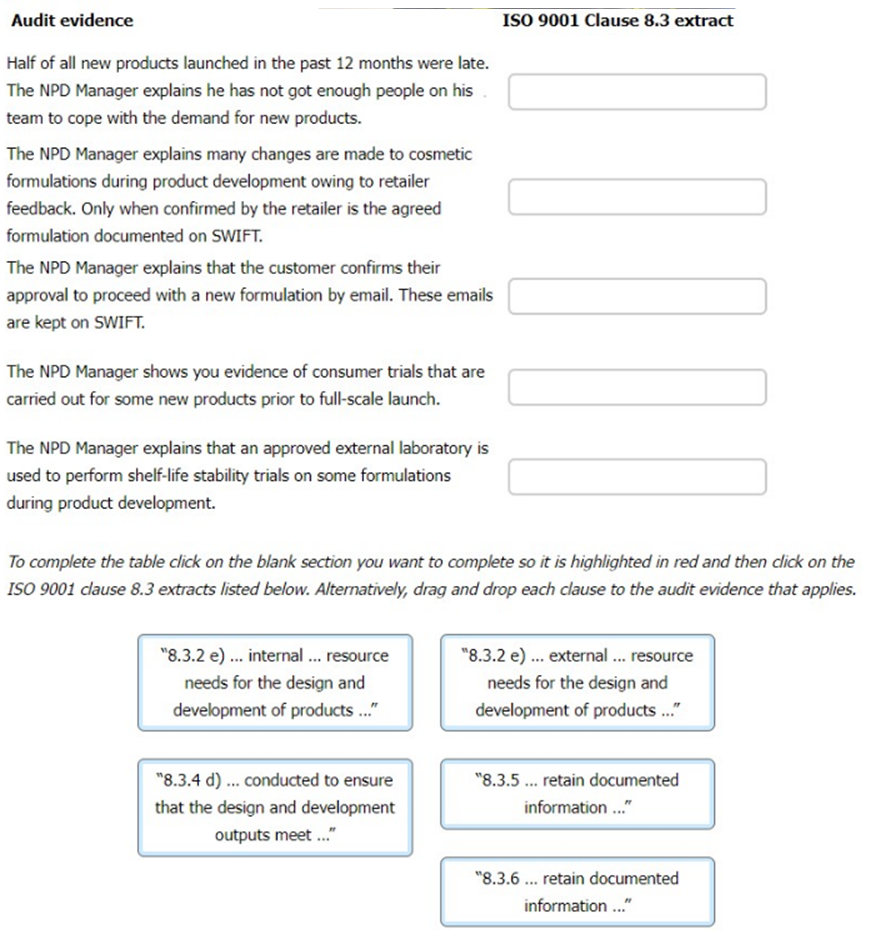
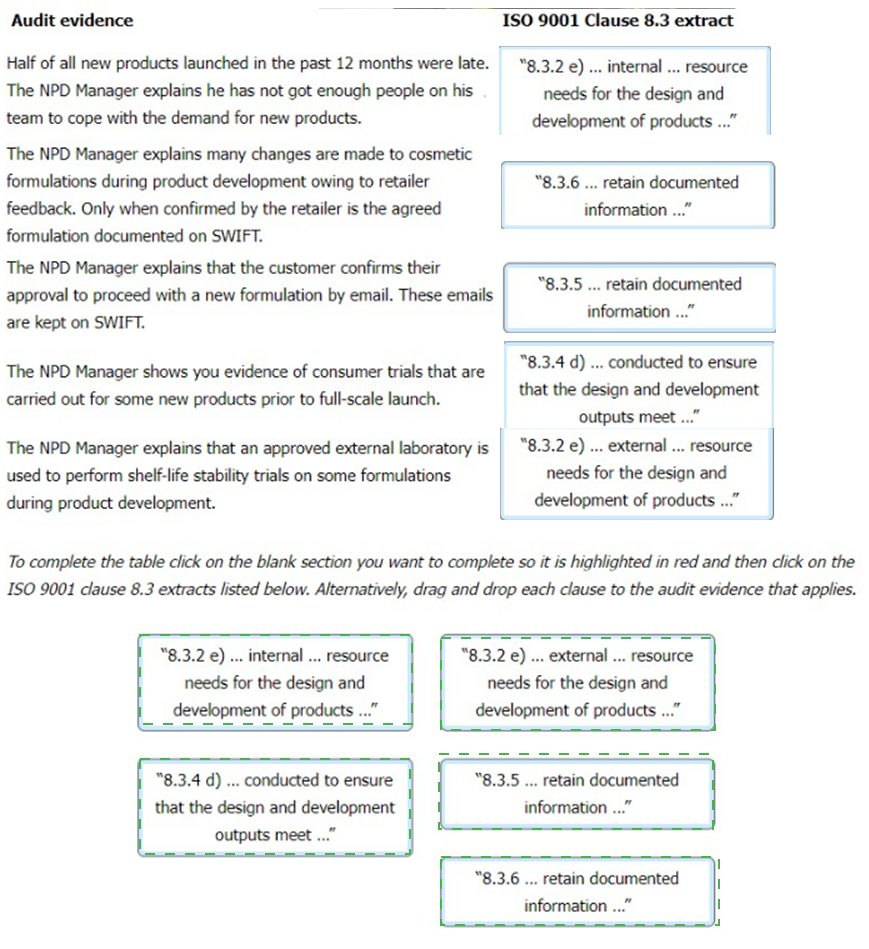
You are interviewing the new Product Development Manager. You note that a software
application called SWIFT is used to help control the product development process.
You have gathered audit evidence as outlined in the table. Match the ISO 9001 clause 8.3
extracts to the audit evidence.
Whistlekleen is a national dry cleaning and laundry company with 50 shops. You are
conducting a surveillance audit of the Head Office and are sampling customer complaints.
You find that 80% of complaints originate from five shops in the same region. Most of these
complaints relate to damage to customer laundry. The Quality Manager tells you that these
are the oldest shops in the company. The cleaning equipment needs replacing but the
company cannot afford it at the moment. You learn
that the shop managers were told to dismiss most of the claims on the basis of the poor
quality of the laundered materials.
On raising the matter with senior management, you are told that there are plans to replace
the equipment in these shops over the next five years.
When reviewing the customer complaint file, you find that the organisation is facing a legal
dispute with a customer over damage to an expensive cashmere coat.
Select the best option for how this should be handled by the Quality Management System.
A. Settle the court case by negotiation with the customer.
B. Report the situation to the customer with suggested remedial action.
C. Make an offer to replace the coat with a new one.
D. Give an explanation to the customer of what went wrong.
Explanation:
According to the ISO 9001:2015 standard, clause 10.2 requires organizations to review
nonconformities, including any arising from customer complaints, and to take appropriate
actions to determine the cause, implement corrections and preventive actions, and verify
their effectiveness. The organization must also monitor the effectiveness of the actions
taken and make changes if necessary.
In this scenario, the auditee is facing a legal dispute with a customer over damage to an
expensive cashmere coat. This is a nonconformity that arises from customer complaint and
has a significant impact on customer satisfaction and reputation. Therefore, clause 10.2
applies to this situation.
The best option for how this should be handled by the Quality Management System is B.
B means that the organization should report the situation to the customer with suggested
remedial action. This option follows the principle of transparency and accountability, as well
as respecting the customer’s rights and expectations. The organization should also
investigate the root cause of the damage and prevent it from happening again in other
shops or products.
The other options are not appropriate because:
A means that the organization should settle the court case by negotiation with the
customer. This option may not be feasible or satisfactory for both parties, especially if there
is a large amount of compensation involved or if there are legal implications for other
customers.
C means that the organization should make an offer to replace the coat with a new one.
This option may not be sufficient or acceptable for both parties, especially if there is
evidence of negligence or poor quality on behalf of the organization.
D means that the organization should give an explanation to the customer of what went
wrong. This option may not be enough or convincing for both parties, especially if there is
no evidence of negligence or poor quality on behalf of the organization.
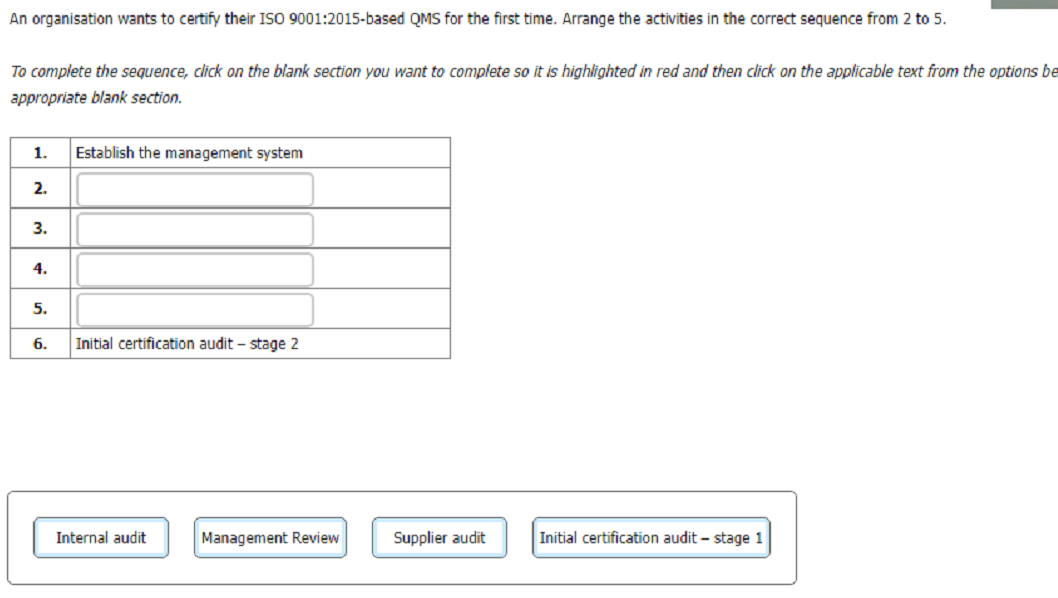
An organisation wants to certify their ISO 9001:2015-based QMS for the first time. Arrange
the activities in the correct sequence from 2 to 5.
To complete the sequence, click on the blank section you want to complete so it is
highlighted in red and then click on the applicable text from the options below. Alternatively,
drag and drop the
options to the appropriate blank section.
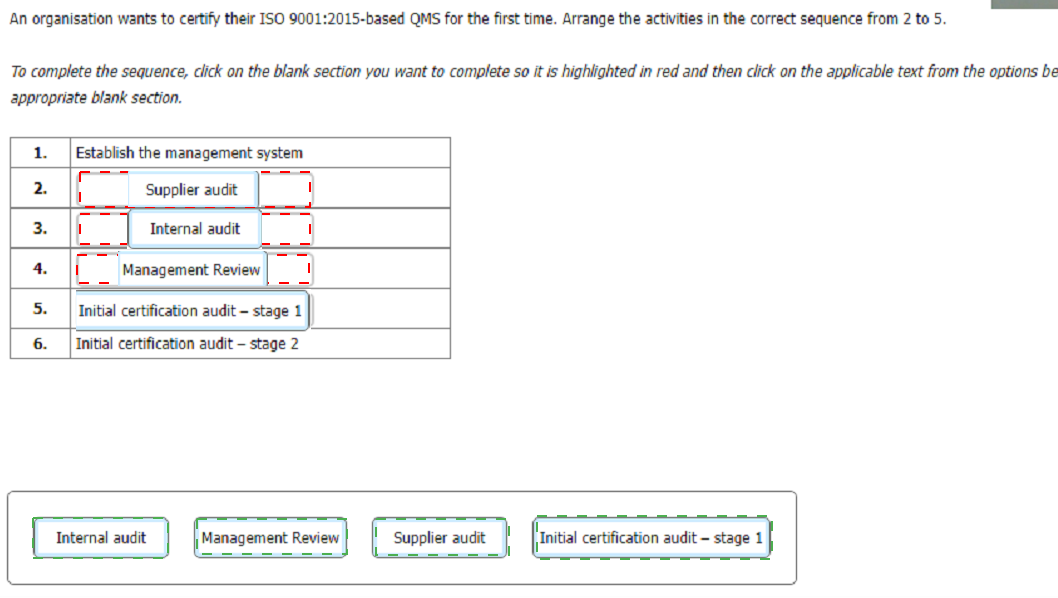
Explanation:
To certify an organization's ISO 9001:2015-based Quality Management System (QMS) for
the first time, the correct sequence of activities would be:
Establish the management system (already in place).
Supplier audit
Internal audit
Management review
Initial certification audit – stage 1
Initial certification audit – stage 2 (already in place).
This sequence follows the typical path for preparing and ensuring that a QMS is functioning
as required, leading up to certification.
You work for an organisation, 'A', which provides packaged food to the public. You are
asked to lead a team (you as the leader and two other
auditors) to audit a supplier, 'B', which provides packaging materials to your organisation. It
is 4 p.m. and the audit is close to an end; you are having
an internal meeting with the team to decide what will be presented to the auditee during the
Closing meeting. The Closing meeting was scheduled
for 5 p.m.
You, as audit team leader, audited top management, the laboratory, and the storage of raw
materials.
Auditor 1 audited the two manufacturing lines and dispatch areas.
You to Auditor 1: "What findings would you report?"
Auditor 1: "When reviewing the Dispatch records, I noticed that during the morning two
different trucks (Number 011 and 025) delivered the same
batch number of the product (Batch 33555). Truck 011 left the plant at 9.15 am and Truck
025 left the plant at 11.30 am. Procedure P-02 Rev.3 says
that trucks should carry a complete batch. The batch number, once on the truck, is
captured using a QR device."
You: "OK, what do you think?"
Auditor 2: "I think that this is a nonconformity."
You: "OK. How would you describe the evidence on which the nonconformity will be
based"?
Identify which one of the following statements best describes the identified nonconformity.
A. Dispatch personnel are not fully aware of the need to conform to written procedures.
B. Dispatch personnel do not always carry out its activities in conformance with Procedure P-02 rev 3.
C. The batch 33555 was delivered split in two different trucks (011 and 025).
D. A product delivered to the client was not identified as required in P-02 Rev 3.
Explanation: According to the definition in ISO 9000, a nonconformity is “non-fulfillment of a requirement”. There are three parts to a well-documented nonconformity: the audit evidence to support auditor findings; a record of the requirement against which the nonconformity is detected; and the statement of nonconformity1. In this case, the audit evidence is the dispatch records that show the same batch number of the product being delivered by two different trucks at different times. The requirement is the procedure P-02 Rev.3 that says that trucks should carry a complete batch. The statement of nonconformity is that the batch 33555 was delivered split in two different trucks (011 and 025), which does not conform to the procedure. Therefore, option C best describes the identified nonconformity, as it includes all three parts of a well-documented nonconformity. Option A is not correct, as it does not state the audit evidence or the requirement. Option B is not correct, as it does not specify the audit evidence or the statement of nonconformity. Option D is not correct, as it does not match the audit evidence or the requirement.
An audit team of three people is conducting a Stage 2 audit to ISO 9001 of an engineering
organisation that manufactures sacrificial anodes for the oll and gas industry in marine
environments. These are aluminium products designed to prevent corrosion of submerged
steel structures. You, as one of the auditors, find that the organisation has shipped anodes
for Project DK in the Gulf of Mexico before the galvanic efficiency test results for the
anodes have been fully analysed and reported as required by the customer. The Quality
Manager explains that the Managing Director authorised release of the anodes to avoid
late delivery as penalties would be imposed. The customer was not informed since the
tests very rarely fall below the required efficiency. You raise a nonconformity against clause
8.6 of ISO 9001.
Which of the following options for the best description of the nonconformity?
A. A retrospective concession was not sought from the customer once the test results had been approved by the Quality Manager.
B. Release of the product without acceptable test results has been accepted by the customer for Project DK.
C. Products for Project DK have been released before product approval through the quality control process.
D. The untested product was not recalled until the galvanic efficiency of the anodes was verified.
An audit team leader arrives at a printing organisation to carry out a Stage 2 audit for a
certification body. At a meeting with the Quality Manager, she is told that they have won
their biggest contract from a computer manufacturer to print and compile computer
documentation packages. They have leased the unit next door for space reasons but have
never worked in this sector before. The Quality Manager wants the ISO 9001 certificate to
cover the new contract.
During the audit, a team member finds that a number of print jobs have been rejected by
several clients over a number of months due to spelling errors in the print run. The Print
Manager blames the new employees they had to take on because of a big contract. The
auditor raises a nonconformance against clause 10.2.1.b of ISO 9001.
Which one of the evidence statements would support this finding?
A. There was no record that the organisation evaluated the effectiveness of the training given to new employees.
B. There was no evidence that a check of spelling took place before the release of printing to the client.
C. The actions taken to deal with customer complaints did not prevent recurrence of the problem.
D. The organisation did not provide the correct resources to prevent nonconformity.
Explanation: According to clause 10.2.1.b of ISO 9001:2015, the organization should evaluate the need for action to eliminate the causes of nonconformities, in order to prevent their recurrence. This means that the organization should identify and address the root causes and contributing factors of the nonconformities, and implement appropriate corrective actions that are effective and proportional to the impact of the nonconformities. In this case, the evidence statement that supports the finding of nonconformance is C, because it shows that the organization did not take effective actions to prevent the recurrence of the spelling errors in the print run, which resulted in repeated customer rejections and dissatisfaction. The other options are not directly related to clause 10.2.1.b, although they may indicate other nonconformities or weaknesses in the organization’s QMS. For example, option A may relate to clause 7.2 on competence, option B may relate to clause 8.6 on release of products and services, and option D may relate to clause 7.1 on resources.
In the context of a management system audit, identify the sequence of a typical process for collecting and verifying information. The first one has been done for you.
To complete the sequence click on the blank section you want to complete so it is
highlighted in red and then click on the applicable text from the options below. Alternatively,
drag and drop the options to the appropriate blank section.
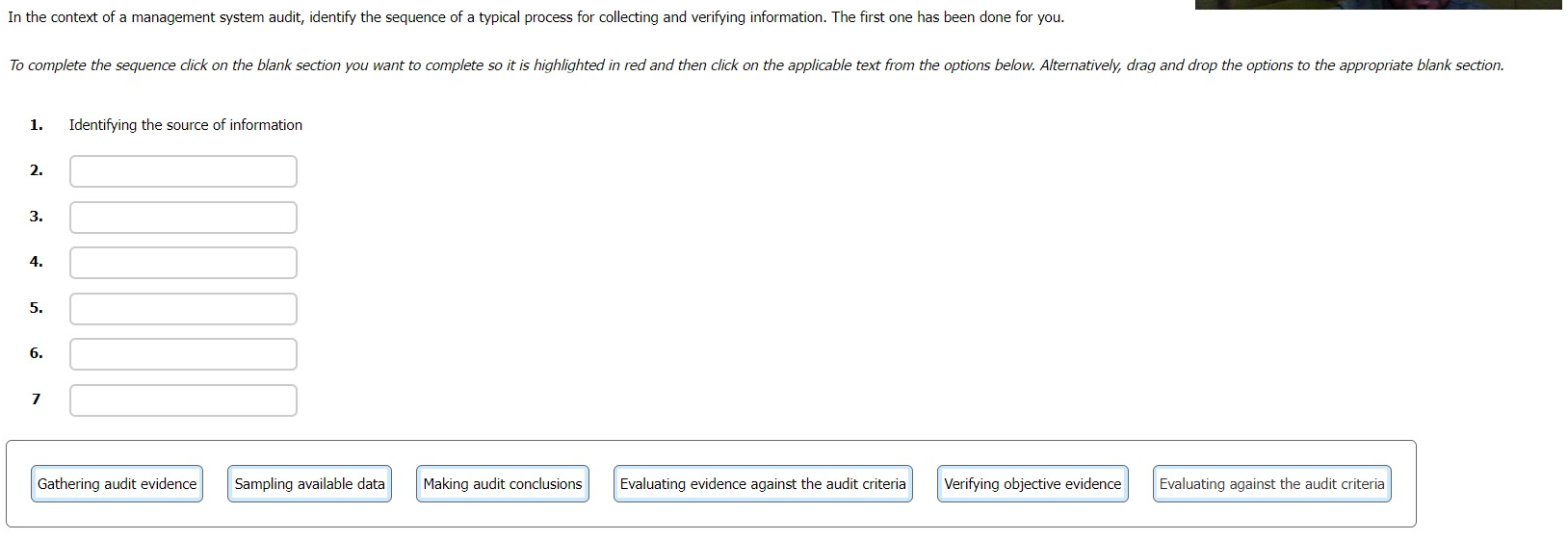
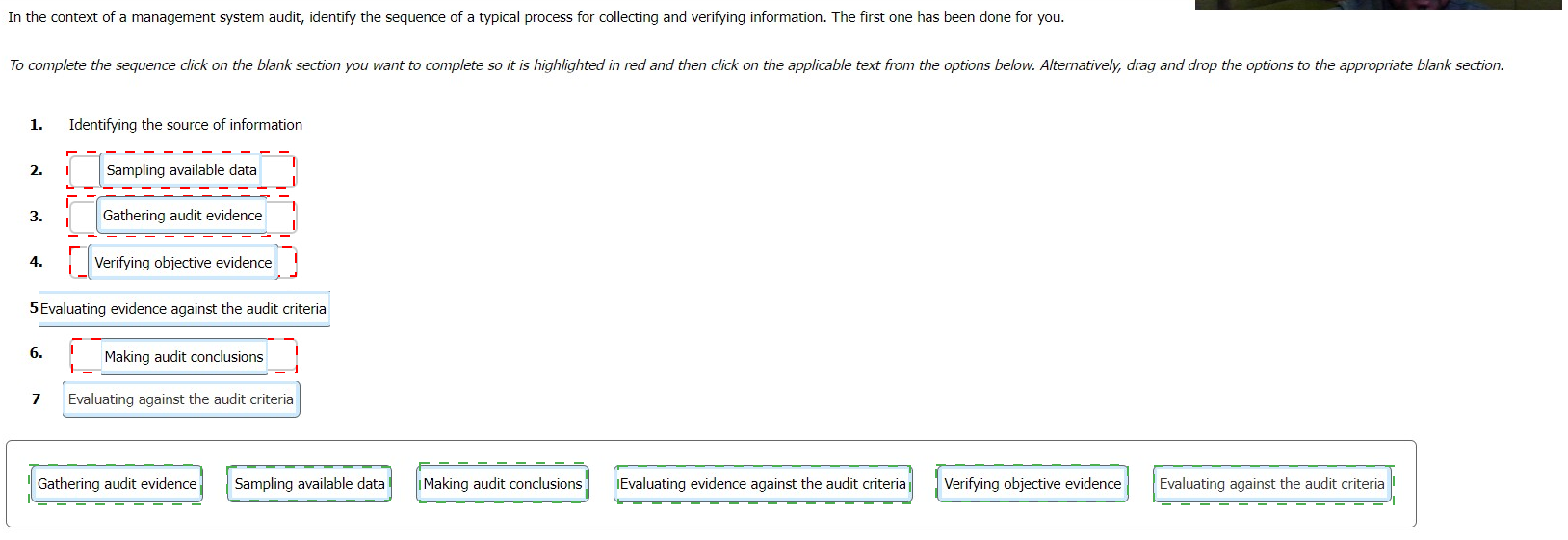
Explanation:
Identifying the source of information
Sampling available data
Gathering audit evidence
Verifying objective evidence
Evaluating evidence against the audit criteria
Making audit conclusions
Evaluating against the audit criteria
According to ISO 19011:2018, clause 6.4, the process of collecting and verifying
information during an audit involves the following steps1:
Identifying the source of information: The audit team should identify the sources of
information that are relevant to the audit objectives, scope and criteria. These sources may
include documents, records, personnel, processes, activities, facilities, equipment, etc. The
audit team should also determine the methods and tools for accessing and collecting the information, such as interviews, observations, document review, sampling, etc.
Sampling available data: The audit team should select a representative sample of the
available data to verify the conformity and effectiveness of the management system. The
sample size and selection method should be based on the audit objectives, scope and
criteria, as well as the level of confidence and risk. The audit team should also consider the
validity, reliability, relevance and sufficiency of the data.
Gathering audit evidence: The audit team should use the methods and tools identified in
the previous step to collect audit evidence, which is the records, statements of fact or other
information that are relevant to the audit criteria and verifiable. The audit team should
record the audit evidence in a clear, concise and objective manner, using notes, checklists,
photographs, audio or video recordings, etc.
Verifying objective evidence: The audit team should verify the accuracy, completeness and
authenticity of the audit evidence collected. This may involve cross-checking different
sources of information, confirming the identity and authority of the persons providing the
information, examining the original documents or records, etc. The audit team should also
identify any discrepancies, inconsistencies or gaps in the audit evidence.
Evaluating evidence against the audit criteria: The audit team should compare the audit
evidence with the audit criteria to determine the extent of conformity and nonconformity.
The audit team should also identify any opportunities for improvement, best practices,
positive aspects or potential risks. The audit team should use professional judgement and
apply the principles of auditing when evaluating the audit evidence.
Making audit conclusions: The audit team should consolidate the audit findings and
evaluate the overall performance and effectiveness of the management system. The audit
team should also consider the audit objectives, scope and criteria, as well as the context
and expectations of the auditee and other interested parties. The audit team should provide
a clear, concise and objective statement of the audit conclusions, which may include the
degree of conformity, the achievement of the intended outcomes, the need for corrective
actions, the suitability for certification, etc.
Evaluating against the audit criteria: The audit team should review the audit conclusions
and ensure that they are consistent with the audit criteria and supported by sufficient and
appropriate audit evidence. The audit team should also ensure that the audit conclusions
are communicated to the auditee and other relevant parties in a timely and effective
manner, using the agreed audit report format and distribution method.
Which two of the following are included in the objectives of the 'Stage 1 initial certification audit'?
A. To evaluate the performance of monitoring and reviewing activities.
B. To evaluate the preparedness of the organisation for a Stage 2 audit.
C. To evaluate the internal audit and management review processes.
D. To review the quality manual.
E. To make a decision on certification to ISO 9001:2015.
F. To evaluate the operational processes of the organisation.
Explanation:
•To evaluate the preparedness of the organisation for a Stage 2 audit: This objective
involves assessing the readiness of the organisation to undergo the Stage 2 audit, where
the conformity and effectiveness of the quality management system will be verified123. The
audit team will check the level of implementation and understanding of the quality
management system, identify any major gaps or nonconformities, and confirm the audit
scope, criteria, and plan123.
•To review the quality manual: This objective involves reviewing the documented
information of the quality management system, such as the quality policy, the quality
objectives, the scope, the processes, and the procedures, to ensure that they meet the
requirements of ISO 9001:2015123. The audit team will also evaluate the organisation’s
understanding and application of the standard, and identify any areas of improvement or
concern123.
The other options are not included in the objectives of the Stage 1 initial certification audit,
according to the web search results from my internal tool. They may be related to other
stages or types of audits, but they are not the focus of the Stage 1 audit.
Therefore, the correct answer is B and D.
| Page 8 out of 18 Pages |
| 5678910 |
| ISO-9001-Lead-Auditor Practice Test Home |
Real-World Scenario Mastery: Our ISO-9001-Lead-Auditor practice exam don't just test definitions. They present you with the same complex, scenario-based problems you'll encounter on the actual exam.
Strategic Weakness Identification: Each practice session reveals exactly where you stand. Discover which domains need more attention, before QMS ISO 9001:2015 Lead Auditor Exam exam day arrives.
Confidence Through Familiarity: There's no substitute for knowing what to expect. When you've worked through our comprehensive ISO-9001-Lead-Auditor practice exam questions pool covering all topics, the real exam feels like just another practice session.
Copyright © All Rights Reserved