
Last year, a hedge fund had a gross return of 22%. The hurdle rate was 5%, and the incentive fee was 20%. What percentage compensation would the fund manager earn for this strategy, assuming no other fees exist?
A. 3.4%
B. 5.4%
C. 4.4%
D. 3.0%
Explanation:
The hedge fund earned a gross return of 22%, but the manager only earns the incentive fee on returns above the 5% hurdle rate.
22% - 5% = 17%
The incentive fee is 20% of the 17% excess return:
17% × 20% = 3.4%
Therefore, the fund manager would earn 3.4% as compensation.
Why the Other Options Are Incorrect:
B. 5.4%
This overstates the incentive fee.
C. 4.4%
This does not result from applying the 20% fee to the return above the hurdle rate.
D. 3.0%
This is also below the correct calculation.
How is a $10,000 withdrawal from a registered retirement savings plan (RRSP) taxed?
A. As regular income
B. As a deduction against other income
C. At a set rate of 30%
D. Based on the type of investment income type
Explanation:
Withdrawals from an RRSP are fully taxable and added to the individual's income for the year in which they are withdrawn. The amount is taxed at the individual's marginal tax rate, just like employment income, interest income, or any other ordinary income — regardless of what the money was originally invested in (stocks, bonds, mutual funds, etc.).
Why the Other Options Are Incorrect:
B. As a deduction against other income — Incorrect
This confuses withdrawals with contributions. RRSP contributions are tax-deductible (reducing taxable income), but withdrawals work the opposite way — they are added to income, not deducted from it.
C. At a set rate of 30% — Incorrect
This mistakes the withholding tax (the amount the financial institution holds back and remits to the CRA at the time of withdrawal) for the actual tax owed. Withholding tax rates are tiered based on the withdrawal amount (e.g., roughly 10% on amounts up to $5,000, 20% on $5,001–$15,000, and 30% on amounts over $15,000, outside Quebec), but this is just a prepayment — the actual tax liability is calculated based on the individual's total income and marginal rate when they file their return.
D. Based on the type of investment income type — Incorrect
RRSPs are tax-sheltered; the character of the investment income (dividend, interest, capital gain) is not preserved. All withdrawals are treated uniformly as ordinary income, regardless of how the funds inside the plan were earned.
Key Concept (IFC — Taxation and Retirement Savings Plans):
RRSPs use "tax-deferred" treatment — you get a deduction going in, tax-free growth while invested, and full taxation as ordinary income coming out. This is different from a TFSA, where withdrawals are completely tax-free since contributions were made with after-tax dollars.
What is the level of risk associated with a mortgage fund compared to other types of funds?
A. More risk than a precious metals fund, but less risk than a specialty fund
B. More risk than a money market fund, but less risk than a bond fund
C. More risk than a balanced fund, but less risk than a real estate fund
D. More risk than a dividend fund, but less risk than an equity fund
Explanation:
A mortgage fund primarily invests in residential and commercial mortgages and other mortgage-related fixed-income securities. In the IFC framework, mortgage funds fall between money market funds and bond funds on the risk spectrum.
The typical order is:
Money Market Fund → Mortgage Fund → Bond Fund
Mortgage funds are riskier than money market funds because mortgages have longer maturities and expose the fund to greater interest-rate risk and default/credit risk. Money market funds invest mainly in short-term, high-quality debt instruments and are generally among the lowest-risk mutual funds. CIRO likewise describes money market mutual funds as relatively safe investments with very low risk of losing the initial investment.
However, mortgage funds generally have less risk than bond funds. Mortgage rates tend to change less frequently than market bond yields, and mortgages typically have shorter effective terms than many bonds. As a result, mortgage funds are generally less sensitive to changing interest rates and historically exhibit less volatility than bond funds. IFC educational material specifically places mortgage funds above money market funds but below bond funds in terms of both default and interest-rate risk.
Why the other options are incorrect
A. More risk than a precious metals fund, but less risk than a specialty fund – Incorrect. Precious metals and specialty funds are generally much more volatile than conservative mortgage funds.
C. More risk than a balanced fund, but less risk than a real estate fund – Incorrect. Mortgage funds are generally considered more conservative than balanced funds.
D. More risk than a dividend fund, but less risk than an equity fund – Incorrect. This does not reflect the IFC's comparative risk classification for mortgage funds. The relevant comparison is with money market and bond funds.
IFC Exam Tip
Remember the conservative fixed-income risk progression:
Money Market → Mortgage → Bond
As you move to the right, interest-rate sensitivity and overall volatility generally increase.
Answer: B. More risk than a money market fund, but less risk than a bond fund.
Julia invested in ERF energy mutual fund three years ago. At that time, the price of the fund was $25.44 per unit. Over time, the unit price has dropped to $19.72, however Julia does not want to consider selling her investment until it returns to $25.44. What bias is she demonstrating?
A. Availability
B. Anchoring
C. Representativeness
D. Hindsight
Explanation:
B. Anchoring (Correct):
Why it's right: Anchoring is a cognitive bias where an individual fixates on a specific number or initial reference point—in this case, her initial purchase price of $25.44—and uses it as the absolute benchmark for future decisions, regardless of changing market fundamentals or whether the asset's recovery is realistic.
A. Availability (Incorrect):
Why it's wrong: Availability bias occurs when investors make decisions based on information that is most easily recalled or recent (such as sensationalized news headlines), rather than objective data.
C. Representativeness (Incorrect):
Why it's wrong: Representativeness is a mental shortcut where people mistakenly classify a new situation or investment based on past classifications or small-sample stereotypes (e.g., assuming a great company will always be a great stock).
D. Hindsight (Incorrect):
Why it's wrong: Hindsight bias is the tendency of people to believe, after an event has occurred, that they predicted or expected it all along ("I knew it all along").
Reference:
Investment Funds in Canada (IFC) Course, Chapter: Behavioral Finance (Module covering investor psychology, cognitive errors, and behavioral biases).
Which of the following money market securities have the highest degree of risk for the investor?
A. Bankers' Acceptances
B. Commercial Paper
C. Treasury Bills
D. Municipal Short-Term Paper
Explanation:
Among common money market securities, commercial paper carries the highest degree of risk to the investor because it is an unsecured promissory note issued by corporations to meet short-term financing needs. Its safety depends entirely on the creditworthiness of the issuing corporation — there is no government backing, no bank guarantee, and no collateral behind it.
Comparing the options (lowest to highest risk):
C. Treasury Bills — Issued by the federal government, backed by the full faith and credit of the Government of Canada. Considered virtually risk-free (lowest risk of all money market instruments).
D. Municipal Short-Term Paper — Issued by municipal/provincial governments. Slightly more risk than T-bills since municipalities don't have the same taxing/borrowing power as the federal government, but still relatively low risk given government backing.
A. Bankers' Acceptances — A short-term debt instrument issued by a corporation but guaranteed (backed) by a chartered bank. Because a major bank stands behind the payment, the risk is tied to the bank's creditworthiness rather than the underlying corporation, making it quite safe.
B. Commercial Paper — Issued directly by corporations with no bank guarantee or government backing. Repayment depends solely on the financial health of the issuing company, making it the riskiest of the group.
Key concept (IFC — Money Market Securities section):
The exam often tests the relative credit risk of money market instruments, which comes down to who or what stands behind the security:
Government backing (T-Bills, Municipal Paper) = lower risk
Bank guarantee (Bankers' Acceptances) = low-moderate risk
Corporate-only backing (Commercial Paper) = highest risk
Barend is a Dealing Representative with Planvest Group Inc., a mutual fund dealer and member of the Mutual Fund Dealers Association of Canada (MFDA). Which of the following CORRECTLY describes Barend's obligation for conflicts of interest?
A. Barend must identify material conflicts of interest and implement controls on behalf of the firm.
B. Barend must disclose material conflicts of interest that cannot be addressed in the best interest of the client.
C. Barend must avoid material conflicts of interest that cannot be addressed in the best interest of the client.
D. Barend must identify material conflicts of interest and promptly report the conflicts of interest to clients.
Explanation:
Under the CSA's Client Focused Reforms (CFRs), which apply to MFDA members and their registered individuals, there's a specific hierarchy for handling conflicts of interest:
Identify — the registrant (both the firm and the individual dealing representative) must identify existing and reasonably foreseeable material conflicts of interest.
Address in the client's best interest — material conflicts must be addressed using controls, disclosure, or other means, always prioritizing the client's best interest.
Avoid — if a material conflict of interest cannot be addressed in the best interest of the client, the registrant must avoid it altogether.
So for a Dealing Representative like Barend, the obligation isn't just to disclose or report — disclosure alone is only sufficient when the conflict can be adequately addressed that way. When it cannot be resolved in the client's favor, the conflict must be avoided entirely, not merely disclosed or reported.
Why the other options are wrong:
A — Implementing firm-wide controls is primarily a firm-level obligation (Planvest Group Inc.), not something an individual Dealing Representative does on the firm's behalf.
B — Disclosure is part of "addressing" a conflict, but it's not the correct answer when a conflict cannot be addressed in the client's best interest — in that case, the standard escalates to avoidance, not just disclosure.
D — "Promptly report to clients" isn't the standard used in the CFR framework; reporting alone doesn't satisfy the requirement when a conflict can't be resolved in the client's favor.
Reference:
CSI IFC Course — Module on Regulatory Framework / Client Relationship Model (CRM2) and Client Focused Reforms; conflicts of interest obligations for individual registrants.
You have been researching Canadian equity mutual funds for a new client. You come
across the following information.
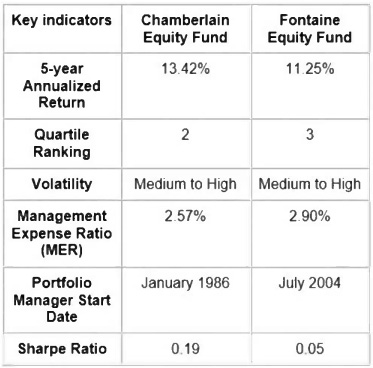
What can you conclude from this information?
A. Chamberlain Equity Fund has lower volatility since its 5-year annualized return is higher.
B. Fontaine Equity Fund is a better fund because it has a higher quartile ranking.
C. Fontaine Equity Fund has a lower risk level since its Sharpe Ratio is lower.
D. Fontaine Equity Fund's higher MER contributes to its lower 5-year annualized return.
Explanation
Why D is correct:
The Management Expense Ratio (MER) is the annual fee charged to unitholders to cover management, administrative, and operating costs. It is directly deducted from the fund's net asset value (NAV) before returns are reported. Therefore, a higher MER will reduce the net return delivered to investors. Since all other factors being equal, a fund with a higher MER will have a lower net return than a comparable fund with a lower MER. In the data provided, Fontaine Equity Fund has a lower 5-year return (11.25%) than Chamberlain (13.42%), and a higher MER is a plausible and correct contributing factor to that underperformance. The IFC curriculum explicitly teaches that MER is a key determinant of net fund performance.
Why the other options are wrong:
A. "Chamberlain Equity Fund has lower volatility since its 5-year annualized return is higher."
Wrong. Return and volatility are not directly correlated in this manner. A higher return does not imply lower volatility—in fact, higher returns often come with higher volatility. The table explicitly shows both funds have "Medium to High" volatility, so no conclusion about lower volatility can be drawn from return data alone. You need standard deviation or beta to assess volatility.
B. "Fontaine Equity Fund is a better fund because it has a higher quartile ranking."
Wrong. A lower quartile ranking number is better (Quartile 1 = top 25%, Quartile 4 = bottom 25%). Fontaine has a Quartile Ranking of 3, which is worse than Chamberlain's 2. A higher number means worse relative performance within its peer group. This option incorrectly interprets the quartile ranking.
C. "Fontaine Equity Fund has a lower risk level since its Sharpe Ratio is lower."
Wrong. The Sharpe Ratio measures risk-adjusted return—it is calculated as (Fund Return − Risk-Free Rate) ÷ Standard Deviation. A higher Sharpe Ratio indicates better risk-adjusted performance (more return per unit of risk). Chamberlain's Sharpe Ratio (0.19) is higher than Fontaine's (0.05), meaning Chamberlain delivers superior return for the risk taken. A lower Sharpe Ratio does not mean lower risk—it means worse risk-adjusted return, which could be due to lower returns, higher volatility, or both.
What is a common characteristic of mutual funds?
A. Each investor owns a portion of the fund’s portfolio.
B. A mutual fund can only hold securities from certain companies.
C. Most mutual funds can only be purchased by sophisticated investors.
D. Investors can only purchase whole units in the fund.
Explanation:
A mutual fund pools money from many investors and invests it in a diversified portfolio of securities according to the fund’s stated objectives.
Each investor purchases units (or shares) of the fund. These units represent a proportional ownership interest in the fund’s entire portfolio. The value of each unit is the fund’s Net Asset Value (NAV) per unit.
This is a core structural characteristic of mutual funds covered in the IFC curriculum (The Modern Mutual Fund / Understanding Investment Products).
Why the other options are incorrect
B: Mutual funds are not restricted to holding securities from only certain companies. The securities a fund may hold are determined by its investment objectives and strategies (e.g., equity, fixed-income, balanced, sector, etc.). There is no general limitation of this type.
C: Mutual funds are designed for, and widely available to, retail (ordinary) investors. They do not require investors to be sophisticated or accredited (unlike some alternative investments or exempt products).
D: Investors can (and routinely do) purchase fractional units. You can invest almost any dollar amount (subject to the fund’s minimum), and the number of units issued is calculated by dividing the investment amount by the current NAV per unit.
Key IFC takeaway: The defining feature of a mutual fund is that investors own units that give them a pro-rata share of the fund’s portfolio, rather than direct ownership of the underlying securities.
A sample of four portfolios is given below, with an even split between allocations 1 and 2.
Portfolios | Allocation #1 | Allocation #2
Portfolio A
Preferred shares
Common shares
Portfolio B
Treasury bills
Debentures
Portfolio C
Debentures
Common shares
Portfolio D
Treasury bills
Preferred shares
Which portfolio carries the greatest amount of risk?
A. Portfolio B
B. Portfolio A
C. Portfolio D
D. Portfolio C
Explanation:
✅ Why This Answer Is Correct
Common shares are the riskiest type of security in this list. They represent ownership in a company and are subject to market volatility, dividend uncertainty, and potential capital loss.
Preferred shares are less risky than common shares but still carry equity-market risk. They are subordinate to bonds and debentures in the capital structure.
A portfolio combining two equity instruments (preferred + common shares) has the highest overall risk profile compared to portfolios that include fixed-income securities like treasury bills or debentures.
Reference: CSI Investment Funds in Canada (IFC), Chapter 6 “Types of Securities” — common shares are highest risk, followed by preferred shares, then debentures, with treasury bills being lowest risk.
❌ Why the Other Options Are Incorrect
A. Portfolio B (Treasury bills + Debentures)
Treasury bills are government-backed short-term instruments with virtually no default risk.
Debentures are corporate debt instruments, riskier than T-bills but still lower risk than equities.
Overall, this portfolio is low to moderate risk, not the highest.
C. Portfolio D (Treasury bills + Preferred shares)
Treasury bills offset much of the risk of preferred shares.
This mix is moderate risk, not the highest.
D. Portfolio C (Debentures + Common shares)
Debentures provide fixed-income stability, reducing the risk compared to a portfolio of only equities.
While common shares add volatility, the presence of debentures makes this portfolio less risky than Portfolio A.
📘 Exam Domain References
Types of Securities — hierarchy of risk (T-bills < debentures < preferred shares < common shares)
What variable needs to decrease on a company's statement of changes in equity for its retained earnings to increase?
A. Cost of sales.
B. Dividends paid.
C. Taxes paid.
D. Interest expenses.
Explanation
A company’s retained earnings represent the cumulative profits that have been kept in the business rather than distributed to shareholders.
The basic relationship is:
Ending Retained Earnings = Beginning Retained Earnings + Net Income − Dividends
Therefore, if dividends paid decrease, more of the company’s earnings remain in the business, causing retained earnings to increase.
For example, if a company earns $100,000 in net income:
If it pays $40,000 in dividends, retained earnings increase by $60,000.
If dividends decrease to $20,000, retained earnings increase by $80,000.
So, reducing dividends directly increases the amount added to retained earnings.
Why the Other Options Are Incorrect
A. Cost of sales: A decrease in cost of sales can increase gross profit and ultimately net income, but it appears on the income statement, not directly on the statement of changes in equity.
C. Taxes paid: Lower taxes can increase net income, but taxes are also an income statement item rather than a direct adjustment to retained earnings.
D. Interest expenses: Lower interest expense can increase net income, but again, this affects retained earnings indirectly through net income.
IFC Exam Tip
Remember the retained earnings formula:
Beginning Retained Earnings + Net Income − Dividends = Ending Retained Earnings
Of the choices given, dividends are the item that directly reduces retained earnings.
Answer: B. Dividends paid.
What type of mutual fund can invest in specified derivatives and forward contracts for grains, meats, metals, energy products, and coffee?
A. global equity fund
B. commodity pool
C. labour-sponsored investment fund
D. specialty fund
Explanation:
A commodity pool is a type of investment fund that can invest in commodities and commodity-related derivatives, including specified derivatives and forward contracts involving products such as:
🌾 Grains
🥩 Meats
⚙️ Metals
⛽ Energy products
☕ Coffee
These investments allow the fund to gain exposure to commodity prices without investors necessarily having to purchase and store the physical commodities themselves.
Why the other answers are incorrect
A. Global equity fund: Primarily invests in shares of companies from different countries and is not specifically designed for direct commodity derivative exposure.
B. Commodity pool: ✅ Correct. Specifically structured to invest in commodities and commodity-related investments, including futures, forwards, and other derivatives.
C. Labour-sponsored investment fund: Designed to provide financing to qualifying small and medium-sized businesses and offers specific tax-related features; it is not a commodity-focused fund.
D. Specialty fund: A broad category that may focus on a particular sector or investment theme, but the description in the question specifically identifies a commodity pool.
Exam Tip
When you see grains + meats + metals + energy + coffee + futures/forwards/derivatives, think:
➡️ Commodity pool
Answer: B. Commodity pool
Sven owns preferred shares that give him the option to sell his holdings back to the issuing company at a predetermined price and within a specified time. What type of preferred shares does Sven own?
A. retractable
B. participating
C. convertible
D. redeemable
Explanation:
A. Retractable (Correct):
Why it's right: Retractable preferred shares give the holder (the investor) the option or right to sell the shares back to the issuing company at a predetermined price on a specified date or within a specified time frame. This feature provides a built-in downside floor and liquidity option for the investor.
B. Participating (Incorrect):
Why it's wrong: Participating preferred shares give the holder the right to receive additional dividends beyond the fixed dividend rate if the common share dividends exceed a specified threshold, rather than giving the holder the option to sell the shares back to the issuer.
C. Convertible (Incorrect):
Why it's wrong: Convertible preferred shares give the investor the option to exchange their preferred shares for a specified number of common shares of the same company, not the right to sell them back for cash.
D. Redeemable (Incorrect):
Why it's wrong: Redeemable (or callable) preferred shares give the issuing company the right—not the investor—to buy back or redeem the shares at a predetermined price after a certain date.
Reference:
Investment Funds in Canada (IFC) Course, Chapter: Fixed-Income and Equity Securities / Types of Preferred Shares.
| Page 1 out of 41 Pages |
| 12345678910111213 |
Real-World Scenario Mastery: Our IFC practice exam don't just test definitions. They present you with the same complex, scenario-based problems you'll encounter on the actual exam.
Strategic Weakness Identification: Each practice session reveals exactly where you stand. Discover which domains need more attention, before Investment Funds in Canada (IFC) exam day arrives.
Confidence Through Familiarity: There's no substitute for knowing what to expect. When you've worked through our comprehensive IFC practice exam questions pool covering all topics, the real exam feels like just another practice session.
Copyright © All Rights Reserved