
Topic 1: Litware, Inc
Case Study
This is a case study. Case studies are not timed separately. You can use as much exam time as you would like to complete each case. However, there may be additional case studies and sections on this exam. You must manage your time to ensure that you are able to complete all questions included on this exam in the time provided.
To answer the questions included in a case study, you will need to reference information that is provided in the case study. Case studies might contain exhibits and other resources that provide more information about the scenario that is described in the case study. Each question is independent of the other questions in this case study.
At the end of this case study, a review screen will appear. This screen allows you to review your answers and to make changes before you move to the next section of the exam. After you begin a new section, you cannot return to this section.
To start the case study
To display the first question in this case study, click the Next button. Use the buttons in the left pane to explore the content of the case study before you answer the questions. Clicking these buttons displays information such as business requirements, existing environment, and problem statements. If the case study has an All Information tab, note that the information displayed is identical to the information displayed on the subsequent tabs. When you are ready to answer a question, click the Question button to return to the question.
Overview. General Overview
Litware, Inc. is a medium-sized finance company.
Overview. Physical Locations
Litware has a main office in Boston.
Existing Environment. Identity Environment
The network contains an Active Directory forest named Litware.com that is linked to an Azure Active Directory (Azure AD) tenant named Litware.com. All users have Azure Active Directory Premium P2 licenses.
Litware has a second Azure AD tenant named dev.Litware.com that is used as a development environment. The Litware.com tenant has a conditional acess policy named capolicy1. Capolicy1 requires that when users manage the Azure subscription for a production environment by using the Azure portal, they must connect from a hybrid Azure AD-joined device.
Existing Environment. Azure Environment
Litware has 10 Azure subscriptions that are linked to the Litware.com tenant and five Azure subscriptions that are linked to the dev.Litware.com tenant. All the subscriptions are in an Enterprise Agreement (EA).
The Litware.com tenant contains a custom Azure role-based access control (Azure RBAC) role named Role1 that grants the DataActions read permission to the blobs and files in Azure Storage.
Existing Environment. On-premises Environment
The on-premises network of Litware contains the resources shown in the following table.

Existing Environment. Network Environment
Litware has ExpressRoute connectivity to Azure.
Planned Changes and Requirements. Planned Changes
Litware plans to implement the following changes:
Migrate DB1 and DB2 to Azure.
Migrate App1 to Azure virtual machines.
Deploy the Azure virtual machines that will host App1 to Azure dedicated hosts.
Planned Changes and Requirements. Authentication and Authorization
Requirements
Litware identifies the following authentication and authorization requirements:
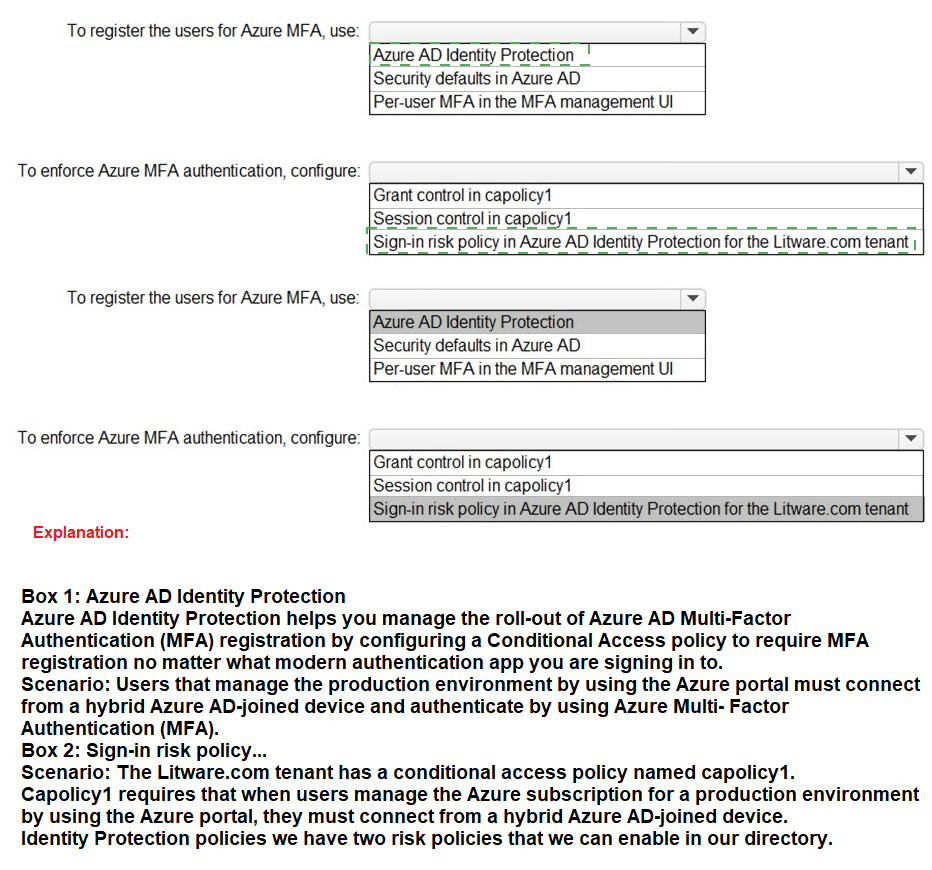
Users that manage the production environment by using the Azure portal must connect from a hybrid Azure AD-joined device and authenticate by using Azure Multi-Factor Authentication (MFA). The Network Contributor built-in RBAC role must be used to grant permission to all the virtual networks in all the Azure subscriptions.
To access the resources in Azure, App1 must use the managed identity of the virtual machines that will host the app.
Role1 must be used to assign permissions to the storage accounts of all the Azure subscriptions.
RBAC roles must be applied at the highest level possible.
Planned Changes and Requirements. Resiliency Requirements
Litware identifies the following resiliency requirements:
Once migrated to Azure, DB1 and DB2 must meet the following requirements:
- Maintain availability if two availability zones in the local Azure region fail.
- Fail over automatically.
- Minimize I/O latency.
App1 must meet the following requirements:
- Be hosted in an Azure region that supports availability zones.
- Be hosted on Azure virtual machines that support automatic scaling.
- Maintain availability if two availability zones in the local Azure region fail.
Planned Changes and Requirements. Security and Compliance Requirements
Litware identifies the following security and compliance requirements:
Once App1 is migrated to Azure, you must ensure that new data can be written to the app, and the modification of new and existing data is prevented for a period of three years. On-premises users and services must be able to access the Azure Storage account that will host the data in App1.
Access to the public endpoint of the Azure Storage account that will host the App1 data must be prevented.
All Azure SQL databases in the production environment must have Transparent Data Encryption (TDE) enabled.
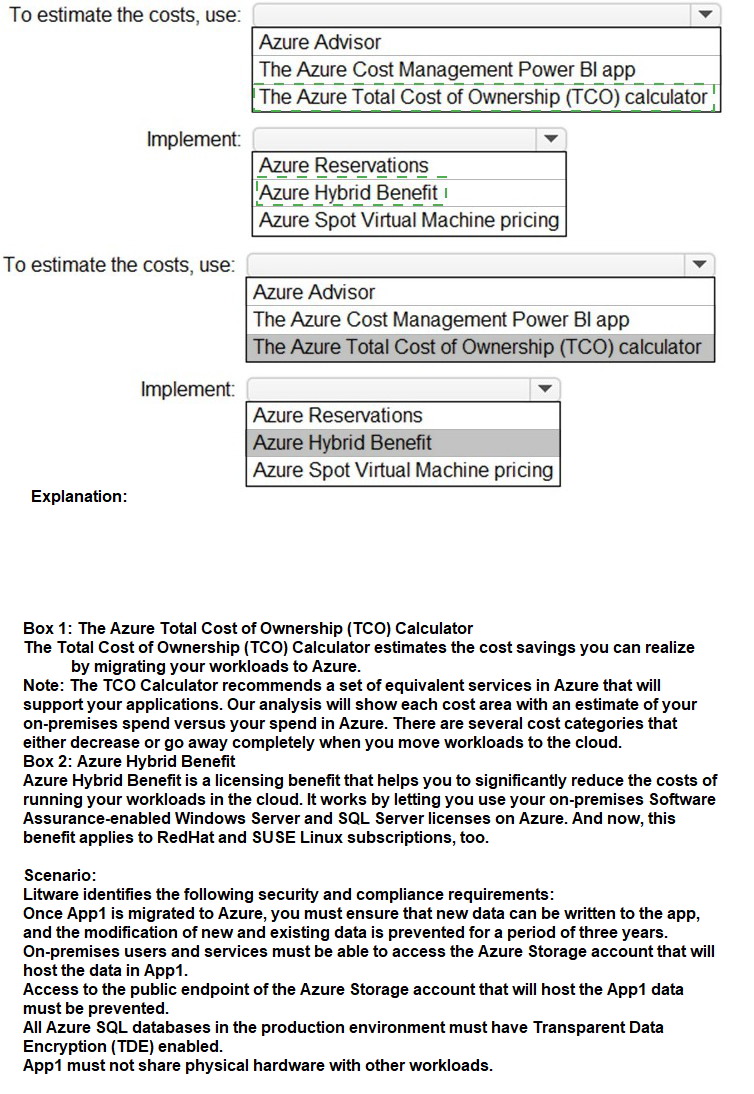
App1 must not share physical hardware with other workloads.
Planned Changes and Requirements. Business Requirements
Litware identifies the following business requirements:
Minimize administrative effort.
Minimize costs.
You migrate App1 to Azure. You need to ensure that the data storage for App1 meets the security and compliance requirement
What should you do?
A.
Create an access policy for the blob
B.
Modify the access level of the blob service.
C.
Implement Azure resource locks.
D.
Create Azure RBAC assignments.
Create an access policy for the blob
You have an Azure subscription. The subscription contains an app that is hosted in the East US, Central Europe, and East Asia regions.
You need to recommend a data-tier solution for the app. The solution must meet the following requirements:
Support multiple consistency levels.
Be able to store at least 1 TB of data.
Be able to perform read and write operations in the Azure region that is local to the app instance.
What should you include in the recommendation?
A.
an Azure Cosmos DB database
B.
a Microsoft SQL Server Always On availability group on Azure virtual machines
C.
an Azure SQL database in an elastic pool
D.
Azure Table storage that uses geo-redundant storage (GRS) replication
an Azure Cosmos DB database
Azure Cosmos DB approaches data consistency as a spectrum of choices. This approach includes more options than the two extremes of strong and eventual consistency. You can choose from five well-defined levels on the consistency spectrum. With Cosmos DB any write into any region must be replicated and committed to all configured regions within the account.
Reference:
https://docs.microsoft.com/en-us/azure/cosmos-db/consistency-levels-tradeoffs
You need to deploy resources to host a stateless web app in an Azure subscription. The solution must meet the following requirements:
• Provide access to the full .NET framework.
• Provide redundancy if an Azure region fails.
• Grant administrators access to the operating system to install custom application dependencies.
Solution: You deploy a web app in an Isolated App Service plan.
Does this meet the goal?
A.
Yes
B.
No
No
Explanation:
Instead, you should deploy an Azure virtual machine to two Azure regions, and you creat a Traffic Manager profile.
You need to ensure that users managing the production environment are registered for Azure MFA and must authenticate by using Azure MFA when they sign in to the Azure portal. The solution must meet the authentication and authorization requirements.
What should you do? To answer, select the appropriate options in the answer area.
NOTE: Each correct selection is worth one point.

You plan to deploy an application named App1 that will run on five Azure virtual machines.
Additional virtual machines will be deployed later to run App1.
You need to recommend a solution to meet the following requirements for the virtual machines that will run App1:
Ensure that the virtual machines can authenticate to Azure Active Directory (Azure AD) to gain access to an Azure key vault, Azure Logic Apps instances, and an Azure SQL database.
Avoid assigning new roles and permissions for Azure services when you deploy additional virtual machines.
Avoid storing secrets and certificates on the virtual machines.
Which type of identity should you include in the recommendation?
A.
a service principal that is configured to use a certificate
B.
a system-assigned managed identity
C.
a service principal that is configured to use a client secret
D.
a user-assigned managed identity
a user-assigned managed identity
Explanation:
Managed identities for Azure resources is a feature of Azure Active Directory. User-assigned managed identity can be shared. The same user-assigned managed identity can be associated with more than one Azure resource.
Reference:
https://docs.microsoft.com/en-us/azure/active-directory/managed-identities-azureresources/overview
You plan to migrate App1 to Azure. The solution must meet the authentication and authorization requirements.
Which type of endpoint should App1 use to obtain an access token?
A.
Azure Instance Metadata Service (IMDS)
B.
Azure AD
C.
Azure Service Management
D.
Microsoft identity platform
Microsoft identity platform
Explanation:
Scenario: To access the resources in Azure, App1 must use the managed identity of the virtual machines that will host the app.
Managed identities provide an identity for applications to use when connecting to resources that support Azure Active Directory (Azure AD) authentication. Applications may use the managed identity to obtain Azure AD tokens.
Reference:
https://docs.microsoft.com/en-us/azure/active-directory/managed-identities-azureresources/overview
You need to recommend a solution to deploy containers that run an application. The application has two tiers.
Each tier is implemented as a separate Docker Linux-based image. The solution must meet the following requirements:
The front-end tier must be accessible by using a public IP address on port 80.
The backend tier must be accessible by using port 8080 from the front-end tier only.
Both containers must be able to access the same Azure file share.
If a container fails, the application must restart automatically.
Costs must be minimized.
What should you recommend using to host the application?
A.
Azure Kubernetes Service (AKS)
B.
Azure Service Fabric
C.
Azure Container instances
D.
Azure Container registries
Azure Container instances
Explanation:
Azure Container Instances enables a layered approach to orchestration, providing all of the scheduling and management capabilities required to run a single container, while allowing orchestrator platforms to manage multi-container tasks on top of it.
Because the underlying infrastructure for container instances is managed by Azure, an orchestrator platform does not need to concern itself with finding an appropriate host machine on which to run a single container.
Azure Container Instances can schedule both Windows and Linux containers with the same API.
Orchestration of container instances exclusively
Because they start quickly and bill by the second, an environment based exclusively on Azure Container Instances offers the fastest way to get started and to deal with highly variable workloads.
You are designing an app that will include two components. The components will communicate by sending messages via a queue. You need to recommend a solution to process the messages by using a First in. First out (FIFO) pattern. What should you include in the recommendation?
A.
storage queues with a custom metadata setting
B.
Azure Service Bus queues with sessions enabled
C.
Azure Service Bus queues with partitioning enabled
D.
storage queues with a stored access policy
Azure Service Bus queues with sessions enabled
You plan to migrate App1 to Azure.
You need to estimate the compute costs for App1 in Azure. The solution must meet the security and compliance requirements.
What should you use to estimate the costs, and what should you implement to minimize the costs? To answer, select the appropriate options in the answer area.
NOTE: Each correct selection is worth one point.

You have an Azure subscription.
You need to deploy an Azure Kubernetes Service (AKS) solution that will use Windows Server 2019 nodes. The solution must meet the following requirements:
• Minimize the time it takes to provision compute resources during scale-out operations.
• Support autoscaling of Windows Server containers.
Which scaling option should you recommend?
A.
horizontal pod autoscaler
B.
Kubernetes version 1.20.2 or newer
C.
cluster autoscaler
D.
Virtual nodes
E.
with Virtual Kubelet ACI
cluster autoscaler
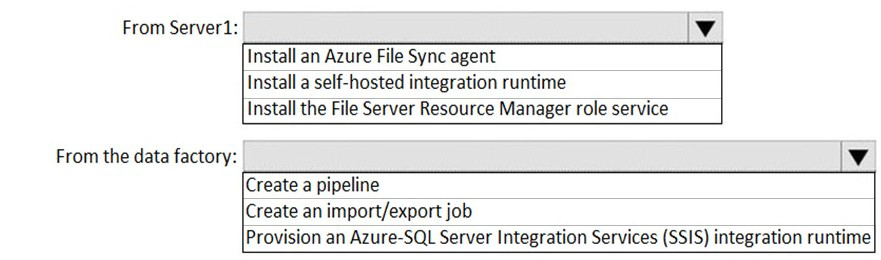
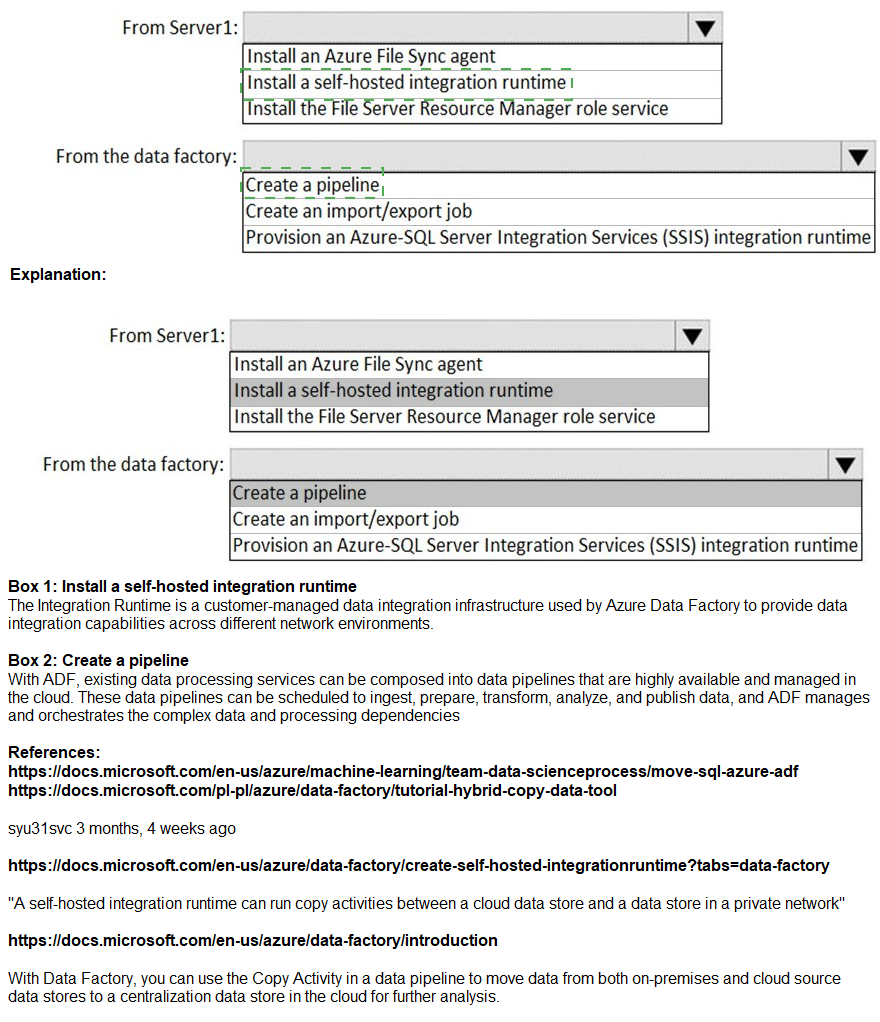
Your on-premises network contains a file server named Server1 that stores 500 GB of data.
You need to use Azure Data Factory to copy the data from Server1 to Azure Storage.
You add a new data factory.
What should you do next? To answer, select the appropriate options in the answer area.
NOTE: Each correct selection is worth one point.
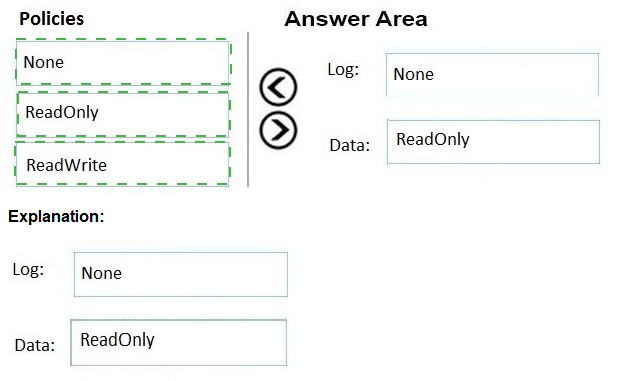
You are designing a virtual machine that will run Microsoft SQL Server and will contain two data disks. The first data disk will store log files, and the second data disk will store data. Both disks are P40 managed disks. You need to recommend a caching policy for each disk. The policy must provide the best overall performance for the virtual machine.
Which caching policy should you recommend for each disk? To answer, drag the appropriate policies to the correct disks. Each policy may be used once, more than once, or not at all. You may need to drag the split bar between panes or scroll to view content.
NOTE: Each correct selection is worth one point.

| Page 14 out of 30 Pages |
| 101112131415161718 |
| AZ-305 Practice Test Home |
Real-World Scenario Mastery: Our AZ-305 practice exam don't just test definitions. They present you with the same complex, scenario-based problems you'll encounter on the actual exam.
Strategic Weakness Identification: Each practice session reveals exactly where you stand. Discover which domains need more attention, before Designing Microsoft Azure Infrastructure Solutions exam day arrives.
Confidence Through Familiarity: There's no substitute for knowing what to expect. When you've worked through our comprehensive AZ-305 practice exam questions pool covering all topics, the real exam feels like just another practice session.
Copyright © All Rights Reserved