
An administrator is troubleshooting BGP flapping in a VMware Cloud Foundation (VCF) 9
environment. A Tier-0 Gateway is running in Active/Active mode with two Edge nodes. BFD
is enabled on the eBGP sessions to the upstream routers. Each Edge node uses its own
uplink IP for BGP. After some network maintenance, one BGP session starts flapping every
few minutes. The other BGP sessions stay stable. On the affected Edge node, the
command get bfd-sessions shows:
• State: Down
• Diag: Detect Time Expired
Symptoms:
• The upstream router also shows the BFD session as Down with control Detection Time
Expired.
• There are no interface errors, no packet loss for normal traffic, and clearing the BFD
session temporarily brings it back up - but it flaps again after few minutes.
What is the root cause?
A. BFD timers are mismatched between Tier-0 Gateway and the upstream routers.
B. The MTU does not match on the end-to-end between Tier-0 Gateway and upstream routers.
C. BFD is configured in echo mode on the upstream routers.
D. The Edge nodes are undersized and are experiencing high contention on CPU and drops BFD packets.
Explanation:
The BFD session is flapping only on one Edge node, not both, despite:
No interface errors
No general packet loss
BFD state Down / Diag: Detect Time Expired
Detect Time Expired means BFD control packets were not received within the negotiated detection interval. In VCF 9 with eBGP + BFD, each Edge node independently negotiates BFD timers with its upstream router.
If BFD timers are mismatched between the upstream router and one Edge node (e.g., due to a stale configuration or asymmetric policy after maintenance), BFD can fail while BGP stays partially up. Clearing it temporarily resets negotiation, but continued mismatch causes re-flapping.
Why not the others?
B. MTU mismatch→ Would cause fragmentation issues or black holes for large packets, not a clean BFD Detect Time Expired only on BFD but not other traffic. Also affects both Edge nodes equally if end-to-end path changed.
C. Echo mode on upstream → VCF Tier-0 Gateway BFD (typically asynchronous mode) works fine with echo mode as long as echo function is disabled or supported. Echo mode alone does not cause Detection Time Expired unless timers are wrong, and it wouldn’t affect only one node.
D. CPU contention
→ This would affect both BFD sessions or all traffic, not a single session, and show other symptoms (high latency, drops in other protocols). No packet loss is reported.
Reference
VMware NSX-T / VCF Documentation: BFD Timer Configuration for BGP
VMware Knowledge Base: BGP Flapping with BFD Detect Time Expired — Timer Mismatch
Relevant standard: RFC 5880 (BFD) – Detection Time = Required RX interval × Detection multiplier
An administrator is investigating packet loss reported by workloads connected to VLAN
segments in an NSX environment. Initial checks confirm:
• All VMs are powered on
• VLAN segment IDs are consistent across transport nodes
• Physical switch configurations are correct.
Which two NSX tools can be used to troubleshoot packet loss on VLAN Segments?
(Choose two.)
A. Flow Monitoring
B. Traceflow
C. Packet Capture
D. Activity Monitoring
E. Live Flow
Explanation:
When troubleshooting packet loss specifically on VLAN segments (which are backed by the physical network infrastructure rather than an overlay), the goal is to determine where the packet is being dropped—either within the virtual switch (N-VDS/Open vSwitch), at the physical uplink, or between the VM and the segment.
B. Traceflow:
This is the primary diagnostic tool within NSX. It allows an administrator to inject a synthetic packet into the data plane from a source (like a VM or a logical port) to a destination. Traceflow provides a step-by-step "hop" analysis, showing exactly which component (e.g., Firewall, Switch, or Uplink) received or dropped the packet. Even for VLAN segments, Traceflow identifies if the packet successfully reached the physical NIC.
C. Packet Capture:
NSX provides a built-in CLI and UI-based packet capture utility. This is essential for confirming if packets are physically arriving at or leaving an interface. Administrators can capture traffic at various points: the VM vNIC, the logical port, or the physical uplink (vmnic). Seeing the actual traffic (or lack thereof) is the definitive way to identify silent drops or checksum errors that other tools might miss.
Why other options are incorrect:
Flow Monitoring (A):
Part of NSX Intelligence/AppDefense, this is used for visualizing traffic patterns and creating firewall rules based on observed flows, rather than real-time packet-level troubleshooting.
Activity Monitoring (D):
This generally refers to endpoint-level monitoring (often associated with legacy VMware tools or specific security features) and does not provide data-plane path analysis.
Live Flow (E):
While related to IPFIX/NetFlow, it provides metadata about flows (IPs, ports, byte counts) but does not show the "path" or specific drop points required to solve packet loss issues.
References
VMware NSX Administration Guide: Troubleshooting Tools – Traceflow Operations.
VMware Cloud Foundation 9.0 Networking: Data Plane Troubleshooting and Packet Capture Utilities.
The administrator must configure Border Gateway Protocol (BGP) on the Tier-0 Gateway to establish neighbor relationships with upstream routers. Which two statements describe the Border Gateway Routing Protocol (BGP) configuration on a Tier-0 Gateway? (Choose two.)
A. EIGRP is configured by default.
B. Can be used as an Exterior Gateway Protocol.
C. The network is divided into areas that are logical groups.
D. It supports a 4-byte autonomous system number.
Explanation:
On a VMware NSX Tier-0 Gateway, BGP is the primary routing protocol used to exchange routing information between the NSX SDN environment and the physical top-of-rack (ToR) switches.
B. Can be used as an Exterior Gateway Protocol:
BGP is by definition an Exterior Gateway Protocol (EGP). In the context of NSX, it is used to establish peering relationships with upstream physical routers. It can be configured as eBGP (External BGP) when the Tier-0 Gateway and the physical routers are in different Autonomous Systems (AS), or iBGP (Internal BGP) when they share the same AS. This allows the Tier-0 to advertise NSX segments and VIPs to the rest of the enterprise network.
D. It supports a 4-byte autonomous system number:
Modern NSX versions, including those within VCF 9.0, fully support 4-byte (32-bit) AS numbers, which range from 1 to 4,294,967,295. This is essential for modern data centers where the traditional 2-byte (16-bit) range (1–65,535) has been exhausted or where specific private AS ranges are required for complex multi-tenancy.
Why other options are incorrect:
A. EIGRP is configured by default:
NSX does not support EIGRP (Enhanced Interior Gateway Routing Protocol), as it is a Cisco-proprietary protocol. The primary dynamic routing protocol supported for North-South traffic in NSX is BGP.
C. The network is divided into areas that are logical groups:
This statement describes OSPF (Open Shortest Path First), which uses Areas (e.g., Area 0) to organize its link-state database. While NSX supports OSPF on Tier-0 Gateways in certain configurations, BGP uses Autonomous Systems and Peer Groups rather than Areas.
References
VMware NSX Administration Guide: Configuring BGP on Tier-0 Gateways.
VMware Cloud Foundation 9.0 Design Guide: NSX Edge Node Routing Design.
Exam Objective 2.1: Configure and manage advanced routing components in an NSX environment.
In an NSX environment, an administrator is observing low throughput and intermittent congestion between the Tier-0 Gateway and the upstream physical routers. The environment was designed for high availability and load balancing, using two Edge Nodes deployed in Active/Active mode. The administrator enables ECMP on the Tier-0 gateway, but the issues persist. Which action would address low throughput and congestion?
A. Convert Tier-1 gateways to be edgeless.
B. Disable NAT on the Tier-0 gateway.
C. Add an additional vNIC to the NSX Edge node.
D. Deploy additional Edge nodes.
Explanation:
The administrator has two Active/Active Edge nodes with ECMP enabled, yet low throughput and congestion persist. This indicates the two nodes have reached their north-south bandwidth capacity. ECMP distributes traffic via a 5-tuple hash, not per-packet round-robin. With only two nodes, even balanced hashing can saturate both uplinks under high load.
Deploying additionalEdge nodes increases the total ECMP path count (up to 8 paths max), distributes traffic across more active nodes, and directly scales aggregate bandwidth. This resolves congestion without changing routing or NAT behavior.
Why other options are incorrect:
A. Convert Tier-1 to edgeless– Moves Tier-1 routing to hosts but does not add Tier-0 uplink capacity; bottleneck remains.
B. Disable NAT on Tier-0 – Reduces CPU state only; irrelevant for physical link congestion or ECMP path exhaustion.
C. Add an additional vNIC to Edge node – Adds an interface but does not automatically create a new ECMP route; uplinks must be explicitly configured. Even then, only two nodes still limit total bandwidth.
References
VMware NSX Documentation: *ECMP on Tier-0 Gateway* – Maximum 8 paths, hashing behavior, and scaling via additional Edge nodes.
VMware Blog: Enhanced NSX Edge and Networking Services in NSX 4.0.1.1 – Scaling north-south performance by adding Edge nodes.
Which two requirements are part of the registration process for Local Manager (LM) to a Global Manager (GM) in NSX for centralized management of network and security services across different workload domains deployed in separate locations? (Choose two.)
A. The LM will validate the GM license to perform the GM registration.
B. The external load balancer VIP is used for NSX Managers without requiring node API certificate updates.
C. The LM Cluster VIP / FQDN is provided for GM-LM communication.
D. The IP / FQDN of any of the 3 LM must be used for registration.
E. The GM-Active requests the LM IP / FQDN and admin credentials for registration.
Explanation:
In an NSX Federation deployment, the registration process is the mechanism that establishes the trust and communication channel between the regional/site-level Local Managers and the centralized Global Managers.
C. The LM Cluster VIP / FQDN is provided for GM-LM communication:
To ensure high availability and a stable communication endpoint, you must use the Cluster Virtual IP (VIP) or the Fully Qualified Domain Name (FQDN) assigned to the LM cluster. If the GM were to point to an individual node's IP and that node failed, Federation synchronization would break. By using the VIP/FQDN, the GM always communicates with whichever LM node is currently the cluster leader.
E. The GM-Active requests the LM IP / FQDN and admin credentials for registration:
The registration is initiated from the Global Manager interface. To add a "Location" (which is how an LM site is represented in the GM), the administrator must provide the connection details of the LM (the VIP/FQDN mentioned above) and the administrative credentials (typically the admin user) to authenticate the handshake and establish the secure certificate-based trust.
Why other options are incorrect:
A. The LM will validate the GM license:
Licensing is managed centrally. While a valid license is required for Federation features, the registration process itself is a management plane handshake; the LM does not act as the "validator" for the GM's licensing status during this step.
B. The external load balancer VIP is used... without requiring node API certificate updates:
While an external load balancer can be used in some NSX designs, the standard Federation registration process relies on the built-in NSX Cluster VIP. Additionally, certificate management (trusting the GM/LM certificates) is a fundamental part of the registration.
D. The IP / FQDN of any of the 3 LM must be used:As noted in the explanation for choice C, using a single node's IP is not recommended for production Federation environments because it creates a single point of failure for the management sync. The Cluster VIP is the requirement for a resilient configuration.
References
VMware NSX Administration Guide: NSX Federation – Registering a Local Manager.
VMware Cloud Foundation 9.0 Networking: Configuring Multi-Instance NSX Federation.
Exam Objective 4.1: Configure and manage NSX Federation components.
An administrator is enabling IPv6-to-IPv4 communication for workloads hosted in an NSX environment. The workloads use IPv6-only addressing, but the external systems they must reach are IPv4-only. To provide this translation service, the administrator decides to configure NAT64. Which two following characteristics about NAT64 are true? (Choose two.)
A. NAT64 is stateless and requires gateways to be deployed in active-standby mode.
B. NAT64 requires the Tier-1 gateway to be configured in active-standby mode
C. NAT64 is supported on Tier-1 gateways only.
D. NAT64 is supported on Tier-0 and Tier-1 gateways.
E. NAT64 requires the Tier-1 gateway to be configured in active-active mode.
Explanation:
NAT64 is a transition mechanism that allows IPv6-only hosts to communicate with IPv4-only servers by translating the packet headers. In VMware NSX, this is a stateful service implemented on the logical gateways.
B. NAT64 requires the Tier-1 gateway to be configured in active-standby mode:
Because NAT64 is a stateful service (it must maintain a translation table of which internal IPv6 address maps to which external IPv4 address/port), it cannot run in an Active-Active high availability mode. State must be synchronized between the active and standby nodes to ensure that if a failover occurs, the existing translation sessions are not dropped.
D. NAT64 is supported on Tier-0 and Tier-1 gateways:
NSX provides flexibility in where translation occurs. You can configure NAT64 on a Tier-0 Gateway (often used for centralized translation for the entire SDDC) or on a Tier-1 Gateway (useful for multi-tenancy where individual departments or applications require their own translation rules).
Why other options are incorrect:
A. NAT64 is stateless...:
This is incorrect. NAT64 in NSX is stateful. While stateless NAT64 exists in general networking theory, NSX implements stateful NAT64 to provide better security and manageability of the translation pool.
C. NAT64 is supported on Tier-1 gateways only:
This is too restrictive. As mentioned above, it is also supported on Tier-0 gateways.
E. NAT64 requires the Tier-1 gateway to be configured in active-active mode:
This is technically impossible for stateful services in NSX. Active-Active mode is typically reserved for stateless routing to maximize throughput, but any service requiring a state table (like NAT64, Stateful Firewall, or LB) requires Active-Standby.
References
VMware NSX Administration Guide: Configuring NAT64 on Tier-0 and Tier-1 Gateways.
VMware Cloud Foundation 9.0 Networking: IPv6 Transition Mechanisms and Stateful Services.
When using a DHCP Relay on a segment, which design restriction must be considered?
A. DHCP settings, DHCP options, and static bindings cannot be configured on the segment.
B. DHCP client requests cannot be relayed to the external DHCP servers.
C. DHCP settings, DHCP options, and static bindings can be configured on the segment.
D. DHCP Relay service is available to all the other segments in the network.
Explanation:
When a segment uses a DHCP Relay, the segment forwards DHCP requests to an external DHCP server outside NSX. In this mode, the NSX native DHCP server is not active on that segment. Therefore, any NSX-local DHCP configuration—such as DHCP settings (e.g., lease time), DHCP options (e.g., DNS, domain), or static IP bindings—is unavailable because the segment does not serve DHCP locally. The external DHCP server must provide all DHCP configuration instead.
Why other options are incorrect:
B. DHCP client requests cannot be relayed– False. The entire purpose of DHCP Relay is to forward requests to external servers. Relay works normally.
C. Settings, options, and static bindings can be configured – False. These are mutually exclusive with relay mode on the same segment.
D. Relay service is available to all other segments – False. Relay is configured per segment; it does not automatically apply to all segments.
Reference
VMware NSX Documentation: DHCP for Segments – DHCP Relay vs. Local DHCP Server.
An administrator is troubleshooting why workloads in NSX cannot reach the external
network 10.100.0.0/16. The Tier-0 Gateway is in Active/Active mode and has the following
configuration:
• Uplink-1 (VLAN 100): 192.168.100.0/24 -> router R1 at 192.168.100.1
• Uplink-2 (VLAN 101): 192.168.101.0/24 -> router R2 at 192.168.101.1
• A static route for 10.100.0.0/16 was added with both next-hops (192.168.100.1 and
192.168.101.1).
• The Scope of this route is set to Uplink-1.
Symptoms:
• Virtual Machines (VMs) cannot reach 10.100.0.0/16
• Traceroute from the VM stops at the Tier-0 gateway with "Destination Net Unreachable"
• Pings from the Edge nodes to both 192.168.100.1 and 192.168.101.1 are success
What explains why workloads in NSX cannot reach the external network?
A. Static routes do not support Equal Cost Multi-Pathing (ECMP) in NSX.
B. The static route Scope is set to only one uplink interface, but the next-hops are on two different VLANs.
C. The next-hops should have been configured as the Tier-0's own uplink IPs instead of the routers IPs.
D. The physical routers are missing return routes.
Explanation:
The static route for 10.100.0.0/16 has two next-hops (192.168.100.1 on VLAN 100, and 192.168.101.1 on VLAN 101). However, the Scope is set to only Uplink-1. Scope defines which uplink interface the route is active on. When Scope is restricted to Uplink-1, the Tier-0 Gateway will only use next-hops reachable via Uplink-1. The next-hop 192.168.101.1 is on VLAN 101 (Uplink-2) and thus becomes unreachable from the perspective of Uplink-1. This causes route inconsistency—only one next-hop is valid, but the route may fail to install properly in the forwarding table, or traffic may be blackholed. For multiple next-hops on different uplinks, the Scope must be set to all uplinks or use ECMP with proper interface affinity.
Why other options are incorrect:
A. Static routes do not support ECMP
– False. NSX supports ECMP on Tier-0 static routes when multiple next-hops are specified with proper scope.
C. *Next-hops should be Tier-0's own uplink IPs*
– False. Next-hops must be upstream router IPs, not the Edge node's own IP.
D. Physical routers missing return routes
– False. Pings from Edge to routers succeed, and traceroute stops at Tier-0, indicating the failure is outbound from NSX, not return path.
Reference
VMware NSX Documentation: *Static Routes on Tier-0 Gateway* – Scope affects which uplink interfaces a route applies to; multiple next-hops require appropriate scoping.
An administrator is tasked to create a development environment with a Tier-1 gateway to host overlay segments for only East/West workload communication. North/South communication is also required. The solution will not include the following services: NAT, DHCP, VPN. Which step must the administrator take when creating the Tier-1 gateway?
A. Configure a Service Interface on the Tier-1 gateway to connect each overlay segment to provide the East/West communication.
B. Enable route advertisement and connect the Tier-1 gateway to the Tier-0 gateway.
C. Assign the Tier-1 gateway to an Edge Cluster before any segments are created.
D. Keep route advertisement disabled and leave the Tier-1 gateway disconnected from any Tier-0 gateway.
Explanation|:
The requirement includes both East/West communication (between overlay segments) and North/South communication (to external networks). A Tier-1 gateway alone can handle East/West traffic between its connected overlay segments. However, to reach external networks (North/South), the Tier-1 must be connected to a Tier-0 gateway and must advertise its routes (connected segments and any learned routes) to the Tier-0. Without route advertisement, the Tier-0 has no knowledge of the Tier-1's segments, and return traffic from external networks cannot reach the workloads. Enabling route advertisement does not require NAT, DHCP, or VPN—those are optional and not needed here.
Why other options are incorrect:
A. Configure a Service Interface
– Service interfaces are for connecting to physical networks or services, not for connecting overlay segments. Overlay segments attach directly to the Tier-1 gateway via router ports, not service interfaces.
C. *Assign Tier-1 to an Edge Cluster before segments are created*
– Tier-1 gateways are assigned to an Edge Cluster only if they require stateful services (e.g., NAT, VPN, load balancing). This environment explicitly excludes those services, so the Tier-1 can run in edgeless mode (distributed routing only) without an Edge Cluster assignment.
D. *Keep route advertisement disabled and disconnected from Tier-0*
– This would isolate the Tier-1 completely, allowing East/West only but blocking all North/South communication, violating the requirement.
Reference
VMware NSX Documentation: *Tier-1 Gateways – Route Advertisement* – Route advertisement must be enabled and Tier-1 connected to Tier-0 for North/South traffic.
An administrator is upgrading an existing VMware Cloud Foundation (VCF) environment. An NSX Edge Cluster is required to support north-south traffic for a workload domain. How would the administrator initiate the edge cluster deployment?
A. From the VCF Installer.
B. Through VCF Operations Fleet Manager.
C. From vCenter Network Connectivity wizard.
D. From the vCenter Server Appliance Management Interface (VAMI).
Explanation:
In a VMware Cloud Foundation (VCF) architecture, the lifecycle management of the entire stack—including the automated deployment of NSX Edge Clusters—is centralized.
B. Through VCF Operations (SDDC Manager / Fleet Management):The SDDC Manager (now often referred to in broader operations contexts as part of the VCF Operations suite) is the primary engine used to automate the deployment of NSX Edge Clusters. The administrator initiates this process by navigating to the specific Workload Domain, selecting Add Edge Cluster, and providing the necessary parameters (such as TEP IPs, VLAN IDs, and BGP peering info). SDDC Manager then communicates with the underlying NSX Manager and vCenter to deploy the Edge VMs and configure the cluster automatically.
Why other options are incorrect:
A. From the VCF Installer:
The VCF Installer (Cloud Builder) is used exclusively for the initial bring-up of the Management Domain. It is not used for ongoing operational tasks like adding Edge Clusters to existing workload domains.
C. From vCenter Network Connectivity wizard: While vCenter manages the compute and storage of the Edge VMs, it does not have a native "VCF Edge Cluster" wizard that handles the specific integration, licensing, and management plane registration required by VCF.
D. From the vCenter Server Appliance Management Interface (VAMI):
The VAMI (port 5480) is used for appliance-level management, such as updates, backups, and network configuration of the vCenter Server itself. It has no role in deploying NSX networking components.
References
VMware Cloud Foundation Operations Guide: Deploying an NSX Edge Cluster in a Workload Domain.
VMware SDDC Manager Administration:Managing Networking and Security.
An administrator needs to prevent the datacenter from advertising any internal prefixes toward a new VPC, while still ensuring the VPC receives a default route learned from the datacenter's upstream network. Where should the routing policy be applied?
A. On each segment default gateway.
B. On the Tier-1 gateway.
C. On the VPC transit gateway.
D. On the provider Tier-0 neighbor.
Explanation:
In VMware Cloud Foundation (VCF) and NSX environments utilizing VPC-based architectures, the VPC Transit Gateway acts as the crucial demarcation point between the VPC's internal environment and the external (provider) network.
C. On the VPC transit gateway:
The VPC Transit Gateway is responsible for route aggregation and filtering between the VPC segments and the Tier-0 or Tier-1 provider gateways. By applying a routing policy (such as a Prefix List or Route Map) on the Transit Gateway, the administrator can explicitly filter out specific internal data center prefixes. At the same time, the policy can be configured to permit the default route ($0.0.0.0/0$) propagated from the upstream physical routers. This ensures the VPC remains isolated from internal network topology while maintaining internet or external connectivity.
Why other options are incorrect:
A. On each segment default gateway:
Applying policies at the segment level is highly inefficient and difficult to manage. Segment gateways handle local routing but are not the primary point for governing route advertisements to external entities or VPCs.
B. On the Tier-1 gateway:
While a Tier-1 gateway can perform NAT and routing, in a VPC model, the specific "Transit" logic and the boundary for VPC route leaking are handled by the Transit Gateway designed for that purpose.
D. On the provider Tier-0 neighbor:
Applying this on the Tier-0 neighbor (upstream physical router) would affect the entire SDDC, not just the specific VPC. The goal is to isolate the VPC, which requires a policy closer to the VPC's own entry point.
References
VMware Cloud Foundation 9.0 Networking Guide: VPC Networking and Transit Gateway Configuration.
NSX Administration Guide: Implementing Route Filtering and Prefix Lists.
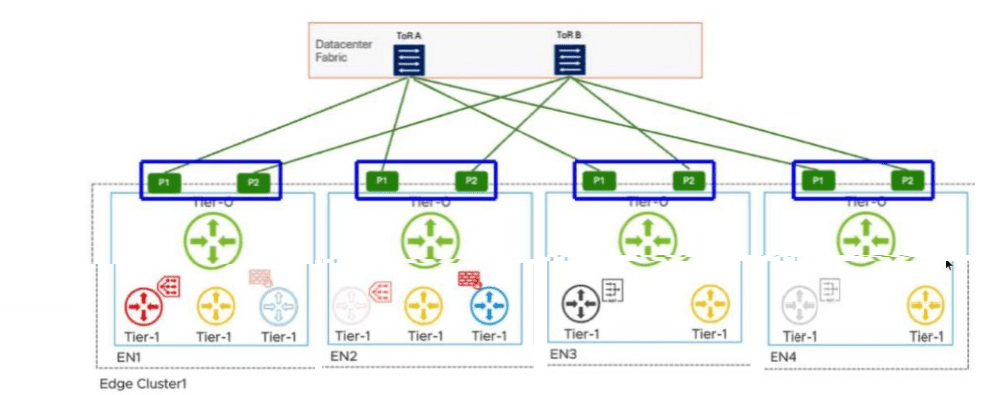
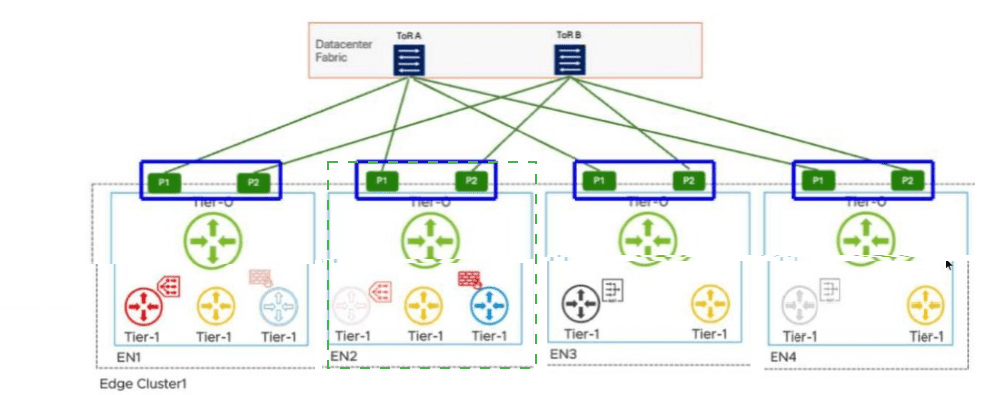
The network team has decided to use a single Edge Cluster to provide Tier-0 A/A Gateway
routing and Tier-1 Gateway A/S services.
The active Tier-1 with a Gateway Firewall service is on EN2.
Which highlighted options will show the ECMP paths used by that Tier-1 GFW?
 Explanation:
In an NSX environment where a Tier-0 Gateway is in Active-Active (A/A) mode and a Tier-1 Gateway is in Active-Standby (A/S) mode with stateful services (like a Gateway Firewall), the traffic flow follows specific deterministic paths:
Stateful Service Constraints: When a Gateway Firewall is enabled on a Tier-1 gateway, it becomes a stateful entity. To maintain the integrity of the state table, all traffic for that Tier-1 gateway must process through the Active node for that specific Tier-1 instance.
Locality of Traffic: In the scenario provided, the Active Tier-1 gateway is hosted on EN2.
ECMP to the Tier-0: While the Tier-0 gateway itself uses ECMP (Equal-Cost Multi-Path) to reach the physical ToR (Top of Rack) switches (ToR A and ToR B), the Tier-1 gateway only leverages the paths available on the specific Edge Node where its Active instance resides.
Resultant Path: Therefore, the Tier-1 GFW on EN2 will use the specific uplinks (P1 and P2) connected to the Tier-0 instance running on EN2 to communicate with the physical fabric. It does not use the uplinks on EN1, EN3, or EN4, as doing so would require "punting" traffic across the fabric to a different node, breaking the stateful flow efficiency.
References
VMware NSX Design Guide: Section on Stateful Services and Edge Node Locality.
VMware Cloud Foundation 9.0 Networking: Tier-0 and Tier-1 Gateway Placement Strategies.
| Page 1 out of 5 Pages |
| 12 |
Real-World Scenario Mastery: Our 3V0-25.25 practice exam don't just test definitions. They present you with the same complex, scenario-based problems you'll encounter on the actual exam.
Strategic Weakness Identification: Each practice session reveals exactly where you stand. Discover which domains need more attention, before Advanced VMware Cloud Foundation 9.0 Networking exam day arrives.
Confidence Through Familiarity: There's no substitute for knowing what to expect. When you've worked through our comprehensive 3V0-25.25 practice exam questions pool covering all topics, the real exam feels like just another practice session.
Copyright © All Rights Reserved