
What three components run in a VMware vSphere Kubernetes Service (VKS) cluster? (Choose three.)
A. Cloud Provider Implementation
B. Container Network Implementation
C. Cloud Provider Interface
D. Container Storage Interface
E. Cloud Storage Implementation
F. Container Network Interface
Explanation:
A. Cloud Provider Implementation
– The vSphere Cloud Provider runs in the VKS cluster as a controller (e.g., vsphere-cloud-controller-manager). It integrates the cluster with the underlying vSphere infrastructure, enabling node lifecycle management, load balancer services (Type LoadBalancer), and storage placement.
B. Container Network Implementation
– A concrete networking implementation (e.g., Antrea, Calico) runs inside the VKS cluster as agent pods (daemonsets). These enforce network policies and enable pod-to-pod communication across nodes.
D. Container Storage Interface (CSI)
– The vSphere CSI driver (e.g., vsphere-csi-controller, vsphere-csi-node) runs in the VKS cluster as pods. It provisions persistent volumes (PVs) from vSphere datastores and attaches them to pods.
Why other options are incorrect
C. Cloud Provider Interface
– Not a standard Kubernetes term. The correct term is Cloud Provider Implementation (the actual controller running in the cluster).
E. Cloud Storage Implementation
– Not a standard term. Kubernetes uses CSI as the standard interface; there is no separate "Cloud Storage Implementation" component.
F. Container Network Interface (CNI)
– This is a specification/interface, not a runnable component. The implementation of CNI runs in the cluster (which is Option B), not the interface itself.
Reference:
VMware TechDocs – "VKS Cluster Components" – A VKS cluster runs the Cloud Provider implementation, a CNI implementation, and the CSI driver as in-cluster controllers and agents.
What component is used to provision VMware vSphere Kubernetes Service (VKS) service mesh workload clusters?
A. Harbor
B. Cert-manager
C. Carvel
D. Cluster API
Explanation:
The component used to provision VMware vSphere Kubernetes Service (VKS) workload clusters—including those that host a service mesh like Istio—is Cluster API. VKS exposes Cluster API (CAPI) as a foundational lifecycle management layer, providing declarative, Kubernetes-style APIs for cluster creation, configuration, scaling, and management .
The CAPV (Cluster API Provider vSphere) controller, which is enabled through the Supervisor, is specifically responsible for managing the lifecycle of VKS clusters. It handles the provisioning of control plane and worker node VMs, ensuring the cluster matches the desired state defined in the YAML manifest .
Why other options are incorrect
A. Harbor:
A private container image registry. It stores container images but does not provision infrastructure or Kubernetes clusters.
B. Cert-manager:
A certificate management controller for issuing and renewing TLS certificates inside a cluster. It operates within an existing cluster and does not provision the cluster itself.
C. Carvel:
A suite of tools for building and deploying applications (e.g., imgpkg for relocating images). It is used for packaging and installation but not as the core provisioning engine for VKS workload clusters.
Reference:
Broadcom TechDocs: "The Cluster API provides declarative, Kubernetes-style APIs for cluster creation, configuration, and management... CAPV is a component of VKS and is responsible for managing the life cycle of VKS clusters"
An administrator is tasked with enabling a Supervisor cluster in VMware Cloud Foundation (VCF).
Arrange the steps below In the correct order to complete the process of enabling a Supervisor In the environment.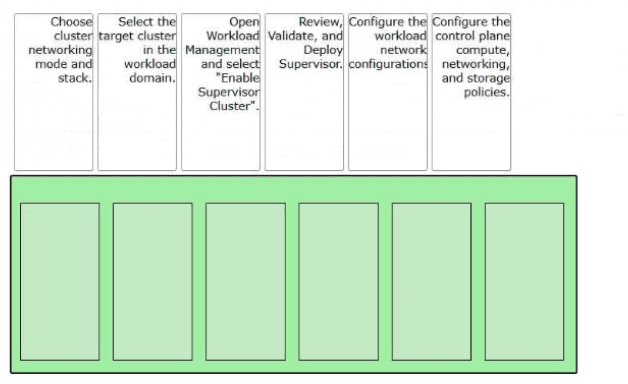
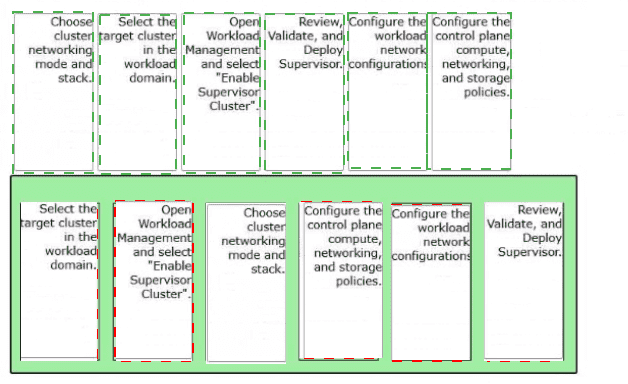
Explanation:
Technical Breakdown/B>
Resource Selection:
Before any configuration occurs, the administrator must identify the specific vSphere cluster within a VCF workload domain that has the necessary resources (CPU, RAM, and storage) to host the Supervisor.
Networking Mode & Stack:
This is a critical early step where you determine if the Supervisor will use NSX (common in VCF) or vSphere Distributed Switch (vDS) networking, which dictates how Load Balancers and Pod networking are handled.
Control Plane Configuration:
This defines the "size" of the three Supervisor Control Plane VMs (Tiny, Small, Medium, or Large) and assigns the storage policies that ensure the control plane remains highly available.
Workload Network:
This step configures the IP address ranges (CIDRs) for the services and pods that will run on the cluster, ensuring no overlap with the existing management or corporate network.
Final Validation:
VCF performs a series of automated checks to ensure that the MTU settings, load balancer reachability, and storage permissions are correct before the automated deployment of the Control Plane VMs begins.
References
VMware Cloud Foundation 9.0 Guide: Enabling Workload Management on a Workload Domain Cluster.
vSphere with Tanzu Configuration Guide: Workflow for Setting Up a Supervisor.
How should an administrator enable autoscaling for a vSphere Kubernetes Service (VKS) cluster?
A. Update the NodePool YAML to enable the autoscaling feature.
B. Create a VKS cluster with autoscaler annotations.
C. Create a NodePool with autoscaling enabled.
D. Install the Cluster Autoscaler (standard package) for the cluster environment.
Explanation:
In VMware vSphere Kubernetes Service (VKS), autoscaling is not enabled by default and is not configured directly on a NodePool or via cluster creation parameters alone. The correct workflow involves two distinct steps:
1.Configure the cluster for autoscaling by adding annotations to the machineDeployments section in the cluster YAML specification. The annotations are cluster.x-k8s.io/cluster-api-autoscaler-node-group-min-size and cluster.x-k8s.io/cluster-api-autoscaler-node-group-max-size .
2.Install the Cluster Autoscaler standard package on the VKS cluster using either kubectl or VCF CLI. The cluster autoscaler is a standard package provided by VMware that runs as a deployment in the kube-system namespace and manages node scaling based on pod scheduling demands .
The question asks "How should an administrator enable autoscaling" — the enabling action is installing the Cluster Autoscaler package.
Why other options are incorrect:
A. Update the NodePool YAML to enable the autoscaling feature
— There is no autoscaling: enabled field on a NodePool. Annotations configure min/max size, but do not enable autoscaling by themselves .
B. Create a VKS cluster with autoscaler annotations
— Annotations alone do not enable autoscaling. They define the scaling range, but the Cluster Autoscaler controller must still be installed to act on those annotations .
C. Create a NodePool with autoscaling enabled
— VKS does not have a native "autoscaling enabled" flag on NodePools. The Cluster Autoscaler package is the required component .
References:
VMware TechDocs: "Standard Packages for VKS Clusters" — Cluster Autoscaler is listed as a supported package that must be installed .
VMware TechDocs: "Install Cluster Autoscaler Using Kubectl" — Complete workflow: annotate cluster, then install the package
A remote site has a requirement for VMware vSphere Kubernetes Service (VKS). The environment has minimal storage available. Which action ensures the Content Library does not consume all available space on the datastore?
A. Select theDownload contentoption and chooseWhen needed.
B. Use a local datastore on one of the ESXi hosts.
C. Create a scheduled task to download the images that are needed.
D. Select theDownload contentoption and chooseImmediately.
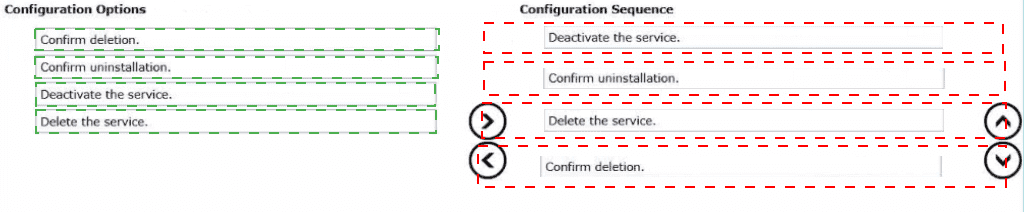
The administrator has completed a proof of concept for using Harbor as a container registry part of the Supervisor services and you are tasked for cleaning up the environment, starting with the unlnstall of the Harbor Supervisor service.
Drag and drop the four tasks into the correct order from Configuration Options on the left and place them into the Configuration Sequence on the right. (Choose four)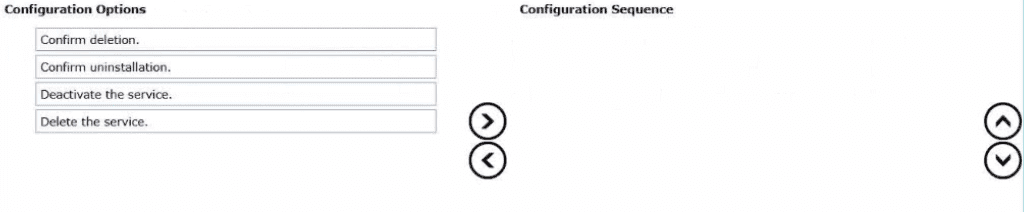
What is the purpose of the VMware vSphere Kubernetes Service (VKS) Service Mesh?
A. Provides service discovery across multiple clusters.
B. Provides an infrastructure layer that makes communication between applications possible, structured, and observable.
C. Provides dynamic application load balancing and autoscaling across multiple clusters and multiple sites.
D. Provides a centralized, global routing table to simplify and optimize traffic management.
A VKS administrator is tasked to leverage day-2 controls to monitor, scale, and optimize Kubernetes clusters across multiple operating systems and workload characteristics.
What two steps should the administrator take? (Choose two.)
A. Configure namespace quotas to set resource limits for CPU, memory, and storage.
B. Disable Cluster Autoscaler to ensure resources in the pool are not depleted.
C. Deploy Prometheus and Grafana to collect and display scrapeable metrics on nodes, pods, and applications.
D. Set all VM Class limits to Compute Heavy to ensure worker nodes get all the resources needed.
E. Ensure all node pools use the same Machine Deployment configuration for different workload characteristics.
An administrator is upgrading an existing VMware vSphere Kubernetes Service (VKS) cluster and receives the following errors:
kubectl get nodes fails with memcache.go and “server is currently unable to handle the request”
couldn't get resource list for stats.antrea.tanzu.vmware.com/v1alpha1
yaml: mapping values are not allowed in this context
The administrator successfully updated the Supervisor, but an attempt to update the VKS cluster failed. Based on the scenario, what is the cause of the problem?
A. The administrator is in the wrong cluster context.
B. The Kubernetes version being upgraded is no longer supported.
C. There was an error pulling the update image from the catalog.
D. The administrator does not have the appropriate permissions to upgrade the cluster.
An administrator is tasked with making an existing vSphere Supervisor highly available by adding two additional vSphere Zones. How should the administrator perform this task?
A. You cannot add an existing Supervisor to a new vSphere Zone.
B. Create a new multi-zone deployment and assign an existing vSphere cluster to it.
C. Create a new vSphere Zone and add the Supervisor to the new vSphere Zone.
D. Select Configure, select vSphere Zones, and click Add New vSphere Zone.
Which type of storage is used by VMware vSphere Kubernetes Service (VKS) pods to store non-persistent data?
A. Container image storage
B. Ephemeral storage
C. Object storage
D. vSphere local storage
An architect is working on the data protection design for a VMware Cloud Foundation (VCF) solution. The solution consists of a single Workload Domain that has vSphere Supervisor activated. During a customer workshop, the customer requested thatvSphere Podsmust be used for a number of third-party applications that have to be protected via backup.
Which backup method or tool should be proposed by the architect to satisfy this requirement?
A. Standalone Velero with Restic.
B. vCenter file-based backup.
C. Velero Plugin for vSphere.
D. vSAN Snapshots.
| Page 2 out of 7 Pages |
| 123 |
| 3V0-24.25 Practice Test Home |
Real-World Scenario Mastery: Our 3V0-24.25 practice exam don't just test definitions. They present you with the same complex, scenario-based problems you'll encounter on the actual exam.
Strategic Weakness Identification: Each practice session reveals exactly where you stand. Discover which domains need more attention, before Advanced VMware Cloud Foundation 9.0 vSphere Kubernetes Service exam day arrives.
Confidence Through Familiarity: There's no substitute for knowing what to expect. When you've worked through our comprehensive 3V0-24.25 practice exam questions pool covering all topics, the real exam feels like just another practice session.
Copyright © All Rights Reserved