
Refer to the exhibit.
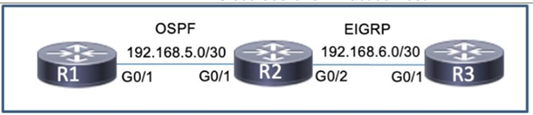
A company has been running OSPF and EIGRP on two separate portions of the network
To allow communication flow between these previously isolated parts of the business the
networking team just configured R2 to mutually redistribute routes between EIGRP and
OSPF R3 has the OSPF routes in its routing table but R1 is failing to receive EIGRP routes
for the link between R2 and R3 Which action must the team take to resolve the issue?
A. Configure EIGRP on R1
B. Configure the redistribution statement with the subnets keyword under the R2 OSPF configuration
C. Configure a virtual link between R1 and R2 to handle traffic without an assigned area
D. Configure R1 with a static route with the next hop set to R3 with the vrf keyword to avo»d the global routing table
Refer to the exhibit Dedicated MPLS Layer 3 services for VRF customer A are configured on the MPLS network for FTP access OSPF with area 0 configuration is used as the interior routing protocol between the routers, and LDP is up and running on the MPLS network. After recent maintenance work on the MPLS network. IP address 172.16 100 1 cannot access the FTP server with IP address 172.16 192.21 All loopbacks are reachable on the network Which configuration must the engineer apply to correct the problem?
A. Configure passive-interface under the Gi0/2 interface on R22
B. Configure ip ospf network point-to-point under the Lo0 interface on R33
C. Configure network 33.33.10.1 0.0.0.255 area 0 under the OSPF configuration on R33
D. Configure ip cef under the global configuration on R22
Refer to the exhibit.
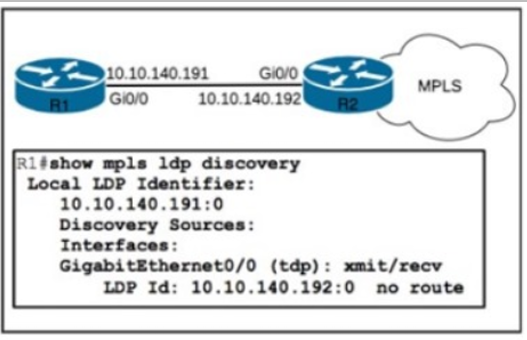
Routers R1 and R2 are RFC 5036-based MPLS-enabled core routers MPLS IP is enabled
globally on both routers OSPF with area 0 configuration is used as an interior routing
protocol between the routers After new services were enabled on the MPLS network, LDP
connectivity failed on R1 TCP/UDP port 711 is confirmed to be open Which two actions
must the engineer take to correct the problem? (Choose two.)
A. Configure network 10.10.140.192 0.0.0.0 arta 0 under the OSPF configuration on R2
B. Configure mpls label protocol Idp under the Gi0/0 interface on R
C. Configure mpls ip under the Gi0'0 interface on R1
D. Configure network 10.10.140.192 0.0.0.255 arta 0 under the OSPF configuration on R2
E. Configure labtl mpls ip protocol tdp under the Gi0 0 interface on R1
Which difference should be considered when intradomain or interdomain multicast routing is implemented?
A. Interdomain multicast routing requires an IS-IS or OSPF neighbor relationship between the domains but intradomain multicast routing requires only BGP
B. Interdomain multicast routing relies on PIM-DM and intradomain multicast routing relies on PIM-SM.
C. interdomain multicast routing uses BIDR-PIM to establish neighbor relationships between AS and interdomain multicast routing uses MSDP
D. A network uses intradomain multicast routing without interdomain routing but networks that use interdomain multicast routing must also apply intradomain routing
Which two differences should be considered when deciding whether to implement to implement routing policies or route maps? (Choose two.)
A. Sequences are added after implementing a route map, but routing policies must be reconfigured when change is needed.
B. Route maps are implemented using hierarchical policies, but routing policies must be implemented sequentially.
C. Route maps require an explicit deny at the end of the sequence, but routing policies have an implicit deny at the end of the program.
D. Route policies require sequence numbers, but route maps are implemented without sequencing.
E. Route maps are supported in Cisco 10S Software and routing policies are supported in Cisco IOS XR Software.
Refer to the exhibit.
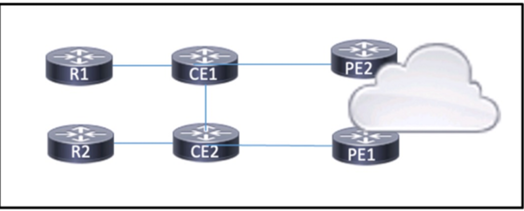
BGP is running on the network, and CE1 currently prefers routes to the internet via PE 1 A
network engineer must manipulate the BGP routes that CE1 receives from PE2 to be more
desirable The engineer configured a route map using MED and applied it on CE1 outbound
from PE2. However, after a BGP soft reset. PE1 is still preferred. Which action must the
engineer take so that PE2 is chosen as the next hop?
A. Update the route map to use only weight to manipulate the path.
B. Configure the route map with MED and local preference to manipulate the route outbound
C. Apply the route map on CE1 In the inbound direction.
D. Configure the route map with AS path prepend to manipulate the AS path to exit the autonomous system
What is one of the purposes of a default Multicast Distribution Tree?
A. to offload traffic from data MDT
B. to define the RP for PIM sparse mode and the different leafs
C. to support control traffic between different VRFs
D. to handle high-bandwidth source streams
Which feature is used in multicast routing to prevent loops?
A. STP
B. inverse ARP
C. RPF
D. split horizon
Refer to the exhibit.
MPLS traffic from 192.168.4.0/24 to 192.168.5.0/24 is failing to pass
over the link from R4 to R2. The engineer verified that:
Cisco Express Forwarding Is enabled on all routers.
All routers reach all networks via OSPF.
MPLS traffic from 192.168.1.0/24 to 192.168.3.0/24 is passing normally over the
link from R1 to R2.
Which action resolves the issue?
A. On router R4, remove the mpls ip command on the s/O/O/2 interface.
B. On router R2, configure the mpls ip command on the SIO/O/4 interface.
C. On router R4, configure the mpls label protocol Idp command on all serial interfaces.
D. On router R2, configure the mpls label protocol Idp command on the interface.
What are two features of dual-stack? (Choose two.)
A. It is implemented without excessive processing power.
B. It supports IPv4 and IPv6 traffic on the same infrastructure.
C. It allows an engineer to stack multiple Layer 2 switches to serve as a single switching unit.
D. It requires tunneling IPv6 traffic over an IPv4 infrastructure.
E. It securely routes and tunnels traffic between separate sites over the Internet.
Refer to the exhibit.
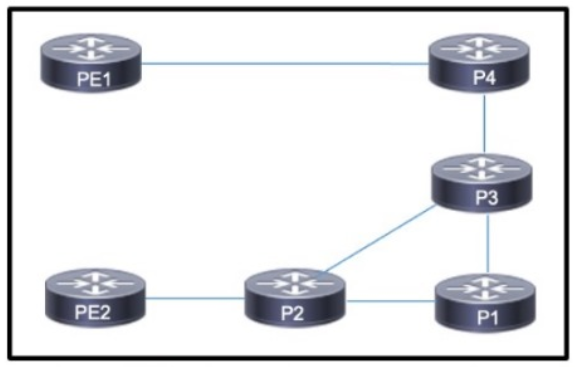
A regional service provider provides connectivity for several midsize businesses that run
mission-critical applications between multiple offices connected via PE 1 and PE2 Links
throughout the service provider network are connected using shared resources and an SRTE
tunnel is in use to route traffic over different paths depending on congestion policies
The networking team must implement SR updates to reduce downtime in the event of a link
failure. Which action must the team take to meet the requirements?
A. Implement SRLG protection to identify a post-convergence backup path
B. Implement BGP timers to support immediate reconvergence when the BGP neighbor relationship status changes.
C. Implement targeted LDP neighbors to prevent unwanted LDP relationships from forming
D. Implement VRFs to segment the network and avoid large-scale network outages when a link fails
Refer to the exhibit.
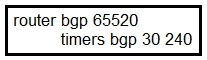
Which effect of this configuration is true?
A. It sets the keepalive timer to 30 seconds and the hold timer to 240 seconds.
B. It sets the keepalive timer to 30 milliseconds and the hold timer to 240 milliseconds
C. It sets the hold timer to 30 milliseconds and the keepalive timer to 240 milliseconds
D. It sets the hold timer to 30 seconds and the keepalive timer to 240 seconds
| Page 9 out of 23 Pages |
| 6789101112 |
| 300-510 Practice Test Home |
Real-World Scenario Mastery: Our 300-510 practice exam don't just test definitions. They present you with the same complex, scenario-based problems you'll encounter on the actual exam.
Strategic Weakness Identification: Each practice session reveals exactly where you stand. Discover which domains need more attention, before 300-510 exam day arrives.
Confidence Through Familiarity: There's no substitute for knowing what to expect. When you've worked through our comprehensive 300-510 practice exam questions pool covering all topics, the real exam feels like just another practice session.
Copyright © All Rights Reserved