
What are three requirements for a static IPv6-in-IPv4 tunnel? (Choose three.)
A. A static IPv6 address must be configured.
B. A dynamic IPv6 address must be configured.
C. Cisco Express Forwarding must be enabled.
D. Each tunnel endpoint must support IPv4 and IPv6.
E. A static IPv4 address must be configured.
F. A dynamic IPv4 address must be configured.
Refer to the exhibit.
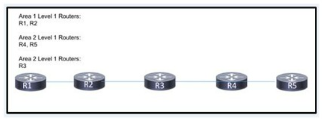
This network is deployed with all connected links configured to run ISIS.
The routing protocol is enacted globally on each router, and the network engineer
expects full routing Information to be shared among all routers. R5 is receiving routes from
R4 but is missing routes from R1. Which action corrects the issue so that all routes are
shared among the routers?
A. Configure all routers to reside in toe area.
B. Configure RI and RS as Level 1"Level 2
C. Configure R3 as a Level 2 we.
D. Configure R5 in the same as RI,
Refer to the exhibit.
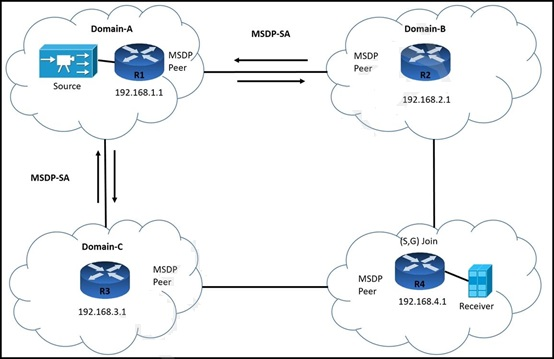
R3 is:
Which command must the engineer implement to resolve the issue?
A R3# ip msdp sa-filter in 192.168.3.1
B. R3# no ip msap sa-filter in 192.168.1.1
C R3# no ip msdp peer 192.168.1.1
D. R3# ip msdp sa-filter out 192.168.1.1
A. failing to accept multicast RP information from Domain-A
B. advertising MSDP SA messages to R1 and R4
C. receiving SA messages only from R4
Refer to the exhibit.
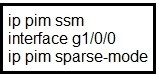
Which task must be performed on interface g1/0/0 to complete the SSM implementation?
A. configure OSPFv3
B. enable CDP
C. disable IGMP
D. configure IGMPv3
What is the role of a segment routing mapping server?
A. It advertises a local SID mapping policy to all of the mapping clients
B. It works with IGP instances to calculate the prefix-SIDs in the absence of a mapping policy
C. It selects multiple mapping entries to create overlapping active mapping policies
D. It reads and translates remotely received SIDs from other mapping servers to create SID mapping entries
Refer to the exhibit.
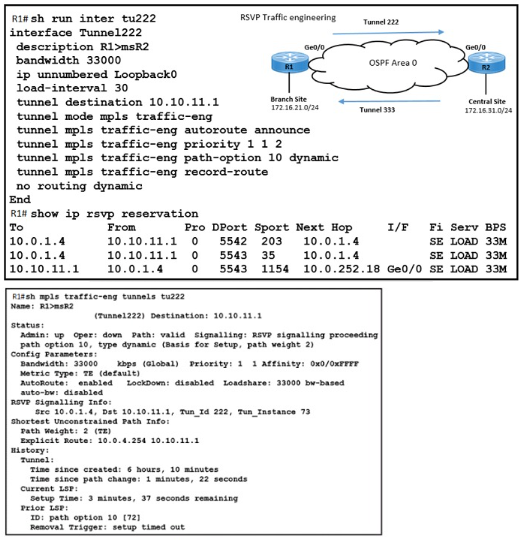
A network engineer is investigating a report of packet drops between
the branch site and the central site.
The two sites are connected via OSPF and RSVP-TE tunnels.
Traffic from the central site to the branch site is passing normally.
Technicians at both sites successfully ping the loopback IP addresses on routers
R1 and R2.
Which configuration corrects the packet-drop problem?.png)
A. Option A
B. Option B
C. Option C
D. Option D
Refer to the exhibit
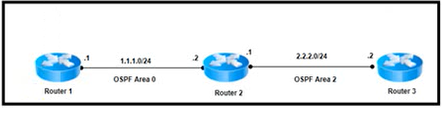
A network engineer installed a new router (router 3) at the regional hub
running MPLS services for scalability Router 3 is connected to the 10.44 4.0,'24. 10.44
5.024. 10 44.6.0/24. and 10 44 7 0/24 subnets The new router has been configured for
OSPF area 2. and it is advertising the four connected networks. The engineer noticed that
the same networks are listed as interarea summary routes, and they are being flooded into
each area on the area borders Which action resolves the issue?
A. On router 3, configure an access list to filter the networks.
B. On router 2, configure a route map to filter the networks.
C. Under the OSPF configuration on router 3. add area 2 range 10.44.4.0 255.255.252.0.
D. Under the OSPF configuration on router 2, add area 2 range 10.44.4.0 255.255.252.0.
Refer to the exhibit.
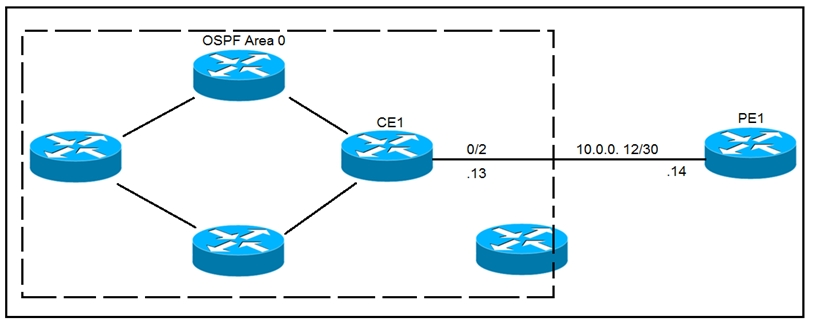
CE1 is the gateway router into the provider network via PE1. A network operator must
inject a default route into OSPF area 0. All devices inside area 0 must be able to reach
PE1. Which configuration achieves this goal?
.png)
A. Option A
B. Option B
C. Option C
D. Option D
Refer to the exhibit.
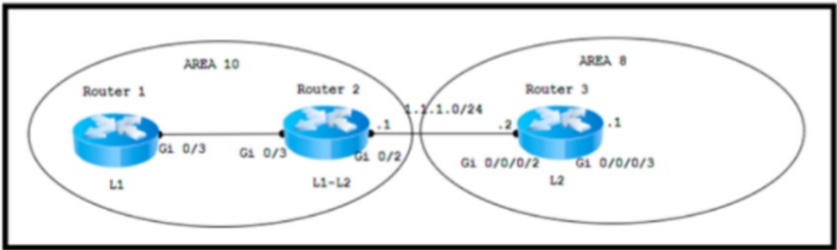
An engineer at a large ISP is troubleshooting suboptimal routing on a customer's IS-IS
network with multiple Level 1-2 routers. The network consists of numerous routers that are
configured for MPLS. When IS-IS picks the closest Level 1-2 router to exit the area,
suboptimal routing occurs in Area 8 and Area 10. The other IGP protocols are running
correctly, and the IS-IS adjacency between routers is established. Which action resolves
the issue?
A. Configure each interface as either Level 1 or Level 2 circuit type on router 1.
B. Configure the router as DIS for each of the interfaces on router 1.
C. Redistribute Level 2 prefixes into Level 1 on router 2.
D. Disable advertisement of the default route on router 2.
Refer to the exhibit.
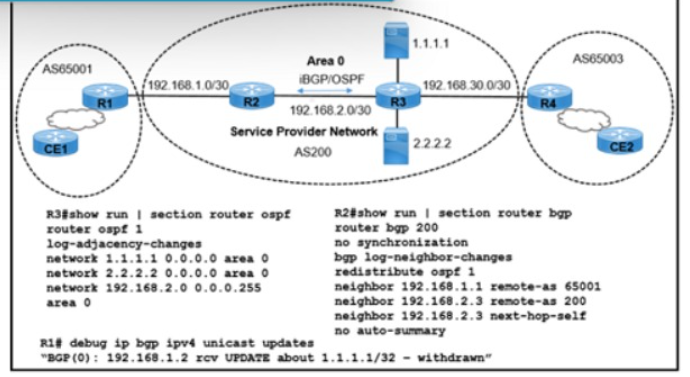
Users connected to an application on 1.1.1.1 via routers CE1 and CE2
are complaining of frequent disconnections. While troubleshooting the issue, a network
engineer with an employee ID: 4333:96:916 determined that the application itself is working
normally, but the link connected to the 1.1.1.1 application is flapping. The users on CE1
and CE2 are accessing applications on 2.2.2.2 without difficulty. Which action resolves the
issue?
A. Disable split horizon on router R2.
B. Redistribute CE1 routes on router R2.
C. Enable passive interface on the router R3 Loopback1 interface.
D. Enable route dampening on routers R1 and R2
After an engineer configures BGP in R1, it starts receiving this message
*Jun 29 13:30:50.122: %BGP-5-ADJCHANGE: neighbor 192.168.10.1 Down User reset
Jun 29 13:30:52.341: %BGP-3-NOTIFICATION: sent to neighbor 192.168.10.1 2/6
(unacceptable hold time) 0 bytes
Which action makes the peering come back up again?
A. Make a soft reset to the peer.
B. Set up a minimum hold-down timer higher.
C. Set up a hello timer higher.
D. Set up a hold-down timer higher.
Which two routing protocols have extensions capable of running SRv6? (Choose two.)
A. OSPF
B. BGP
C. RIP
D. IGRP
E. EIGRP
| Page 4 out of 23 Pages |
| 1234567 |
| 300-510 Practice Test Home |
Real-World Scenario Mastery: Our 300-510 practice exam don't just test definitions. They present you with the same complex, scenario-based problems you'll encounter on the actual exam.
Strategic Weakness Identification: Each practice session reveals exactly where you stand. Discover which domains need more attention, before 300-510 exam day arrives.
Confidence Through Familiarity: There's no substitute for knowing what to expect. When you've worked through our comprehensive 300-510 practice exam questions pool covering all topics, the real exam feels like just another practice session.
Copyright © All Rights Reserved