
A security engineer for a company is investigating suspicious traffic on a web application in the AWS Cloud. The web application is protected by an Application Load Balancer (ALB) behind an Amazon CloudFront distribution. There is an AWS WAF web ACL associated with the ALB. The company stores AWS WAF logs in an Amazon S3 bucket. The engineer notices that all incoming requests in the AWS WAF logs originate from a small number of IP addresses that correspond to CloudFront edge locations. The security engineer must identify the source IP addresses of the clients that are initiating the suspicious requests. Which solution will meet this requirement?
A. Enable VPC Flow Logs in the VPC where the ALB is deployed. Examine the source field to capture the client IP addresses.
B. Inspect the X-Forwarded-For header in the AWS WAF logs to determine the original client IP addresses.
C. Modify the CloudFront distribution to disable ALB connection reuse. Examine the clientIp field in the AWS WAF logs to identify the original client IP addresses.
D. Configure CloudFront to add a custom header named Client-IP to origin requests that are sent to the ALB.
A company uses AWS Organizations. The company has teams that use an AWS CloudHSM hardware security module (HSM) that is hosted in a central AWS account. One of the teams creates its own new dedicated AWS account and wants to use the HSM that is hosted in the central account. How should a security engineer share the HSM that is hosted in the central account with the new dedicated account?
A. Use AWS Resource Access Manager (AWS RAM) to share the VPC subnet ID of the HSM that is hosted in the central account with the new dedicated account. Configure the CloudHSM security group to accept inbound traffic from the private IP addresses of client instances in the new dedicated account.
B. Use AWS Identity and Access Management (IAM) to create a cross-account role to access the CloudHSM cluster that is in the central account. Create a new IAM user in the new dedicated account. Assign the cross-account role to the new IAM user.
C. Use AWS IAM Identity Center to create an AWS Security Token Service (AWS STS) token to authenticate from the new dedicated account to the central account. Use the cross-account permissions that are assigned to the STS token to invoke an operation on the HSM in the central account.
D. Use AWS Resource Access Manager (AWS RAM) to share the ID of the HSM that is hosted in the central account with the new dedicated account. Configure the CloudHSM security group to accept inbound traffic from the private IP addresses of client instances in the new dedicated account.
An application is running on an Amazon EC2 instance that has an IAM role attached. The IAM role provides access to an AWS Key Management Service (AWS KMS) customer managed key and an Amazon S3 bucket. The key is used to access 2 TB of sensitive data that is stored in the S3 bucket. A security engineer discovers a potential vulnerability on the EC2 instance that could result in the compromise of the sensitive data. Due to other critical operations, the security engineer cannot immediately shut down the EC2 instance for vulnerability patching. What is the FASTEST way to prevent the sensitive data from being exposed?
A. Download the data from the existing S3 bucket to a new EC2 instance. Then delete the data from the S3 bucket. Re-encrypt the data with a client-based key. Upload the data to a new S3 bucket.
B. Block access to the public range of S3 endpoint IP addresses by using a host-based firewall. Ensure that internet-bound traffic from the affected EC2 instance is routed through the host-based firewall.
C. Revoke the IAM role’s active session permissions. Update the S3 bucket policy to deny access to the IAM role. Remove the IAM role from the EC2 instance profile.
D. Disable the current key. Create a new KMS key that the IAM role does not have access to, and re-encrypt all the data with the new key. Schedule the compromised key for deletion.
A company's security engineer receives an abuse notification from AWS. The notification indicates that someone is hosting malware from the company's AWS account. After investigation, the security engineer finds a new Amazon S3 bucket that an IAM user created without authorization. Which combination of steps should the security engineer take toMINIMIZE the consequencesof this compromise? (Select THREE.)
A. Encrypt all AWS CloudTrail logs.
B. Turn on Amazon GuardDuty.
C. Change the password for all IAM users.
D. Rotate or delete all AWS access keys.
E. Take snapshots of all Amazon Elastic Block Store (Amazon EBS) volumes. F.
F. Delete any resources that are unrecognized or unauthorized.
A company creates AWS Lambda functions from container images that are stored in Amazon Elastic Container Registry (Amazon ECR). The company needs to identify any software vulnerabilities in the container images and any code vulnerabilities in the Lambda functions. Which solution will meet these requirements?
A. Enable Amazon GuardDuty. Configure Amazon ECR scanning and Lambda code scanning in GuardDuty.
B. Enable Amazon GuardDuty. Configure Runtime Monitoring and Lambda Protection in GuardDuty.
C. Enable Amazon Inspector. Configure Amazon ECR enhanced scanning and Lambda code scanning in Amazon Inspector.
D. Enable AWS Security Hub. Configure Runtime Monitoring and Lambda Protection in Security Hub.
A company is operating an open-source software platform that is internet facing. The legacy software platform no longer receives security updates. The software platform operates using Amazon Route 53 weighted load balancing to send traffic to two AmazonEC2 instances that connect to an Amazon RDS cluster. A recent report suggests this software platform is vulnerable to SQL injection attacks, with samples of attacks provided. The company's security engineer must secure this system against SQL injection attacks within 24 hours. The security engineer’s solution must involve the least amount of effort and maintain normal operations during implementation. What should the security engineer do to meet these requirements?
A. Create an Application Load Balancer with the existing EC2 instances as a target group. Create an AWS WAF web ACL containing rules that protect the application from this attack, then apply it to the ALB. Test to ensure the vulnerability has been mitigated, then redirect the Route 53 records to point to the ALB. Update security groups on the EC2 instances to prevent direct access from the internet.
B. Create an Amazon CloudFront distribution specifying one EC2 instance as an origin. Create an AWS WAF web ACL containing rules that protect the application from this attack, then apply it to the distribution. Test to ensure the vulnerability has been mitigated, then redirect the Route 53 records to point to CloudFront.
C. Obtain the latest source code for the platform and make the necessary updates. Test the updated code to ensure that the vulnerability has been mitigated, then deploy the patched version of the platform to the EC2 instances.
D. Update the security group that is attached to the EC2 instances, removing access from the internet to the TCP port used by the SQL database. Create an AWS WAF web ACL containing rules that protect the application from this attack, then apply it to the EC2 instances. Test to ensure the vulnerability has been mitigated, then restore the security group to the original setting.
A company has the following security policy for its Amazon Aurora MySQL databases for a single AWS account: • Database storage must be encrypted at rest. • Deletion protection must be enabled. • Databases must not be publicly accessible. • Database audit logs must be published to Amazon CloudWatch Logs. A security engineer must implement a solution thatcontinuously monitorsall Aurora MySQL resources for compliance with this policy. The solution must be able todisplay a database's compliance state for each part of the policy at any time. Which solution will meet these requirements?
A. Enable AWS Audit Manager. Configure Audit Manager to use a custom framework that matches the security requirements. Create an assessment report to view the compliance state.
B. Enable AWS Config. Implement AWS Config managed rules that monitor all Aurora MySQL resources for the security requirements. View the compliance state in the AWS Config dashboard.
C. Enable AWS Security Hub. Create a configuration policy that includes the security requirements. Apply the configuration policy to all Aurora MySQL resources. View the compliance state in Security Hub.
D. Create an Amazon EventBridge rule that runs when an Aurora MySQL resource is created or modified. Create an AWS Lambda function to verify the security requirements and to send the compliance state to a CloudWatch custom metric.
A company runs several applications on Amazon Elastic Kubernetes Service (Amazon EKS). The company needs a solution to detect any Kubernetes security risks by monitoring Amazon EKS audit logs in addition to operating system, networking, and file events. The solution must send email alerts for any identified risks to a mailing list that is associated with a security team. Which solution will meet these requirements?
A. Deploy AWS Security Hub and enable security standards that contain EKS controls. Create an Amazon Simple Notification Service (Amazon SNS) topic and set the security team's mailing list as a subscriber. Use an Amazon EventBridge rule to send relevant Security Hub events to the SNS topic.
B. Enable Amazon Inspector container image scanning. Configure Amazon Detective to analyze EKS security logs. Create Amazon CloudWatch log groups for EKS audit logs. Use an AWS Lambda function to process the logs and to send email alerts to the security team.
C. Enable Amazon GuardDuty. Enable EKS Protection and Runtime Monitoring for Amazon EKS in GuardDuty. Create an Amazon Simple Notification Service (Amazon SNS) topic and set the security team's mailing list as a subscriber. Use an Amazon EventBridge rule to send relevant GuardDuty events to the SNS topic.
D. Install the AWS Systems Manager Agent (SSM Agent) on all EKS nodes. Configure Amazon CloudWatch Logs to collect EKS audit logs. Create an Amazon Simple Notification Service (Amazon SNS) topic and set the security team's mailing list as a subscriber. Configure a CloudWatch alarm to publish a message to the SNS topic when new audit logs are generated.
A security engineer needs to build a solution to turn AWS CloudTrail back on in multiple AWS Regions in case it is ever turned off. What is the MOST efficient way to implement this solution?
A. Use AWS Config with a managed rule to initiate the AWS-EnableCloudTrail remediation.
B. Create an Amazon EventBridge event with a cloudtrail.amazonaws.com event source and a StartLogging event name to invoke an AWS Lambda function to call the StartLogging API.
C. Create an Amazon CloudWatch alarm with a cloudtrail.amazonaws.com event source and a StopLogging event name to invoke an AWS Lambda function to call the StartLogging API.
D. Monitor AWS Trusted Advisor to ensure CloudTrail logging is enabled.
A company runs several applications on Amazon Elastic Kubernetes Service (Amazon EKS). The company needs a solution to detect any Kubernetes security risks by monitoring Amazon EKS audit logs in addition to operating system, networking, and file events. The solution must send email alerts for any identified risks to a mailing list that is associated with a security team. Which solution will meet these requirements?
A. Deploy AWS Security Hub and enable security standards that contain EKS controls. Create an Amazon Simple Notification Service (Amazon SNS) topic and set the security team’s mailing list as a subscriber. Use an Amazon EventBridge rule to send relevant Security Hub events to the SNS topic.
B. Enable Amazon Inspector container image scanning. Configure Amazon Detective to analyze EKS security logs. Create Amazon CloudWatch log groups for EKS audit logs. Use an AWS Lambda function to process the logs and to send email alerts to the security team.
C. Enable Amazon GuardDuty. Enable EKS Protection and Runtime Monitoring for Amazon EKS in GuardDuty. Create an Amazon Simple Notification Service (Amazon SNS) topic and set the security team's mailing list as a subscriber. Use an Amazon EventBridge rule to send relevant GuardDuty events to the SNS topic.
D. Install the AWS Systems Manager Agent (SSM Agent) on all EKS nodes. Configure Amazon CloudWatch Logs to collect EKS audit logs. Create an Amazon Simple Notification Service (Amazon SNS) topic and set the security team's mailing list as a subscriber. Configure a CloudWatch alarm to publish a message to the SNS topic when new audit logs are generated.
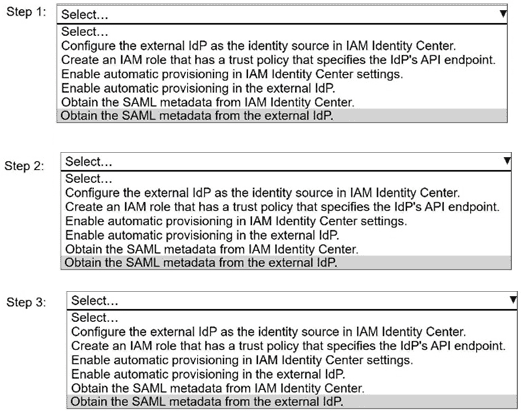
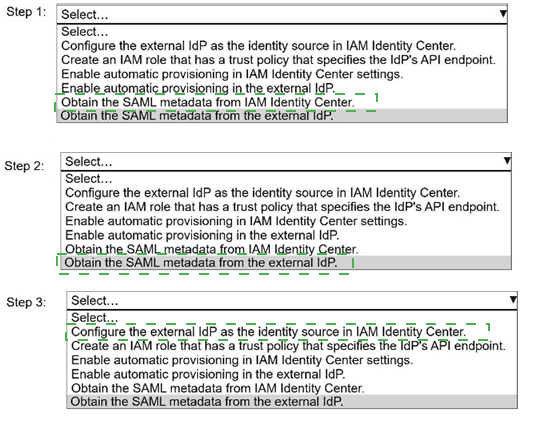
A security engineer needs to implement AWS IAM Identity Center with an external identity
provider (IdP).
Select and order the correct steps from the following list to meet this requirement. Select
each step one time or not at all. (Select and order THREE.)
. Configure the external IdP as the identity source in IAM Identity Center.
. Create an IAM role that has a trust policy that specifies the IdP's API endpoint.
. Enable automatic provisioning in IAM Identity Center settings.
. Enable automatic provisioning in the external IdP.
. Obtain the SAML metadata from IAM Identity Center.
. Obtain the SAML metadata from the external IdP.
A security engineer recently rotated the host keys for an Amazon EC2 instance. The security engineer is trying to access the EC2 instance by using the EC2 Instance Connect feature. However, the security engineer receives an error for failed host key validation. Before the rotation of the host keys, EC2 Instance Connect worked correctly with this EC2 instance. What should the security engineer do to resolve this error?
A. Import the key material into AWS Key Management Service (AWS KMS).
B. Manually upload the new host key to the AWS trusted host keys database.
C. Ensure that the AmazonSSMManagedInstanceCore policy is attached to the EC2 instance profile.
D. Create a new SSH key pair for the EC2 instance.
| Page 2 out of 15 Pages |
| 12345 |
| SCS-C03 Practice Test Home |
Real-World Scenario Mastery: Our SCS-C03 practice exam don't just test definitions. They present you with the same complex, scenario-based problems you'll encounter on the actual exam.
Strategic Weakness Identification: Each practice session reveals exactly where you stand. Discover which domains need more attention, before AWS Certified Security – Specialty exam day arrives.
Confidence Through Familiarity: There's no substitute for knowing what to expect. When you've worked through our comprehensive SCS-C03 practice exam questions pool covering all topics, the real exam feels like just another practice session.
Copyright © All Rights Reserved