
Topic 2: Relecloud
Case study
This is a case study. Case studies are not timed separately. You can use as much
exam time as you would like to complete each case. However, there may be additional
case studies and sections on this exam. You must manage your time to ensure that you
are able to complete all questions included on this exam in the time provided.
To answer the questions included in a case study, you will need to reference information
that is provided in the case study. Case studies might contain exhibits and other resources
that provide more information about the scenario that is described in the case study. Each
question is independent of the other questions in this case study.
At the end of this case study, a review screen will appear. This screen allows you to review
your answers and to make changes before you move to the next section of the exam. After
you begin a new section, you cannot return to this section.
To start the case study
To display the first question in this case study, click the Next button. Use the buttons in the
left pane to explore the content of the case study before you answer the questions. Clicking
these buttons displays information such as business requirements, existing environment,
and problem statements. If the case study has an All Information tab, note that the
information displayed is identical to the information displayed on the subsequent tabs.
When you are ready to answer a question, click the Question button to return to the
question.
Background
Relecloud provides regional air service in North America. The company uses a variety of
systems, apps, and services to manage the business. You are hired to design a new
solution to manage passenger information, reservations, and maintenance.
Current environment
The company uses Microsoft Office 365.
The company has a custom app for managing and tracking passenger luggage.
The app uses Microsoft Dataverse.
For flights longer than four hours, passengers receive a meal. Customers can
select a meal when they make a reservation and can save the meal choices as a
customer preference.
The company offers two types of meals: standard and vegetarian. Meal types can
be temporarily unavailable. The airline is considering offering other meal types,
such as gluten-free and low-sodium options.
The company uses paper-based reservation checklists to help ensure that all the
steps for a reservation are complete.
The company uses vendors to service aircraft
Environment
Ensure that employees can sign in to all Microsoft apps by using one set of
credentials per employee.
Minimize the use of third-party products and custom development.
Reduce customer support call volumes by having the system automatically resolve
common issues.
The security rule for agents must contain the privileges in the default Customer
Service Representative security role.
Log issues as cases. The case form must show variable sections based on the
case type. Include a custom entity named Seats and grant agents access to the
entity.
Application use layout should be role specific.
Agents
You must standardize the format used by agents to enter customer phone
numbers.
Agents need a solution to replace paper reservation checklists.
Agents need dashboards to show a current count of all reservations on the entity.
Agents need a way to track reservation issues.
Agents need a visual indicator in the interface to determine the reservation step to
provide a seamless customer experience.
Agents need different versions of cancellation policies to send customers. One
version must be controllable within the system.
Agents need to view which pieces of luggage match to each passenger, and then
need to add the total on the passenger record.
IT
IT staff needs a mobile solution to see IT cases at the top of the menu since this is
their primary focus.
IT staff needs a system that is easy to navigate to active cases.
IT specialists want to design Power BI reports. They need to understand the
underlying table relationships of the system.
IT specialists need a solution that is visual rather than text-based so they can
quickly complete their tasks.
Management
Management requires paginated reports for stakeholders.
Management wants to provide frequent flyers with better service when the flyers
call.
Managers need to see all customer dashboards at the top of their menu on their
mobile device.
Maintenance
Maintenance supervisors must not have access to Dynamics 365 Customer
Service. The supervisors must be able to communicate with the contracts team
about contracts.
Aircraft maintenance vendors must have only view and upload privileges to their invoices and receipts.
Contracts with maintenance companies must be stored in Dynamics 365 Customer Service.
You need to recommend an authentication solution for the planned implementation of Dynamics 365.
What should you include in the recommendation?
A. Use synchronized identities
B. Use the Office 365 tenant for Dynamics 365 Customer Service
C. Create a new tenant for Dynamics 365 Customer Service
D. Use federated identities
Explanation:
For implementing Dynamics 365 in an organization that likely already uses Microsoft 365, the recommended authentication approach is to leverage the existing centralized identity management. This ensures a single user identity across all Microsoft cloud services, simplifying administration, security, and the user experience (Single Sign-On).
Correct Option:
A. Use synchronized identities
This is the standard and recommended practice for most enterprise deployments. It involves using Azure AD Connect to synchronize on-premises Active Directory user accounts to Azure Active Directory (which underpins both Microsoft 365 and Dynamics 365). Users then have one identity to access all services. It provides centralized password management (either via on-prem AD or Azure AD), enables seamless Single Sign-On (SSO), and is the foundation for a hybrid identity model.
Incorrect Option:
B. Use the Office 365 tenant for Dynamics 365 Customer Service:
While this is technically true and part of the correct implementation, it is an incomplete answer. Dynamics 365 always runs within an Office 365/Microsoft 365 tenant; you don't have a choice to not use it. The critical decision is how users are provisioned and authenticated within that tenant, which is best answered by "synchronized identities."
C. Create a new tenant for Dynamics 365 Customer Service:
This is generally not recommended unless there is a strict legal or operational requirement for complete isolation (e.g., for a separate subsidiary). It creates management overhead, fragments user identity, and prevents easy collaboration and data sharing. The standard guidance is to deploy Dynamics 365 into the organization's existing Microsoft 365 tenant.
D. Use federated identities:
This is a specific type of advanced identity configuration (like using ADFS or a third-party IdP for authentication). While it can be part of a synchronized identity model to enable true SSO, it is not the primary, all-encompassing recommendation. "Synchronized identities" is the broader, foundational category that can include federated authentication as an option.
Reference:
Microsoft's Identity models and authentication for Dynamics 365 guidance strongly recommends a hybrid identity model with directory synchronization as the baseline for any enterprise deployment, as it unifies management and access across the Microsoft cloud ecosystem.
You need to select an appropriate app for Relecloud.
Which app should you recommend?
A. Dynamics 365 Field Service
B. Dynamics 365 Sales
C. Dynamics 365 Project Operations
D. Dynamics 365 Customer Service
Explanation:
In the Relecloud case study, the organization requires a solution to manage passenger information, handle reservations, and track maintenance issues. A key architectural requirement is the ability to log issues as cases, manage service-level agreements (SLAs), and provide agents with a unified interface to resolve customer inquiries. As a Solution Architect, you must select the Dynamics 365 app that provides the native framework for case management and support workflows. Dynamics 365 Customer Service is the most appropriate choice because it is purpose-built for high-volume support environments, offering robust tools for case tracking, knowledge management, and customer interaction history.
Correct Option:
D. Dynamics 365 Customer Service:
This app is the correct choice because the Relecloud scenario specifically outlines requirements for managing support "cases," tracking reservation issues, and providing agents with a "Customer Service Representative" security role. Dynamics 365 Customer Service provides the native Case entity and Service Hub required to meet these needs. Furthermore, the case study mentions storing contracts with maintenance companies within this specific app, reinforcing its role as the central repository for service-related data and customer issue resolution within the Relecloud environment.
Incorrect Option:
A. Dynamics 365 Field Service:
This app is designed for organizations that dispatch technicians to physical locations (on-site service). While Relecloud has "maintenance" needs, the core requirement focuses on case management and reservations rather than managing work orders, truck routing, or inventory for field-based repairs.
B. Dynamics 365 Sales:
This app focuses on lead generation, opportunity management, and sales pipelines. Relecloud’s requirements are post-purchase (reservations and support) rather than pre-sales activities. Using Sales would require heavy customization to replicate the case management features native to Customer Service.
C. Dynamics 365 Project Operations:
This app is intended for project-based businesses that need to track time, expenses, and resource utilization for long-term engagements. Relecloud’s operational model is based on transactional airline reservations and discrete support cases, which do not fit the project-centric structure of this application.
You need to recommend a solution for integrating luggage information.
What should you recommend? To answer, drag the appropriate types to the correct tables.
Each type may be used once, more than once, or not at all. You may need to drag the split bar between panes or scroll to view content.
NOTE: Each correct selection is worth one point.
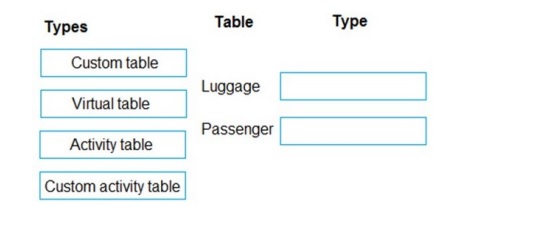
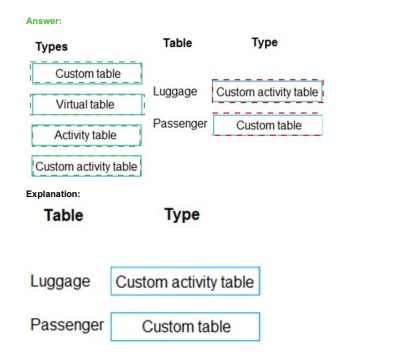
Explanation:
This question tests the understanding of when to use standard, custom, or virtual tables in Dataverse. The choice depends on whether the data is core business data, represents an action, or resides in an external system. "Luggage" is a tangible business object, while "Passenger" is typically a core entity that may need to integrate with an external HR or booking system.
Correct Matching:
Table: Luggage
Recommended Type: Custom table
Explanation:
Luggage is a core business concept that needs to store specific attributes (weight, tag number, status, flight ID) and have relationships (e.g., to a Passenger). A Custom Table is the correct choice to define this new entity with its own schema, forms, and views within Dataverse.
Table: Passenger
Recommended Type: Virtual table
Explanation:
Passenger information often originates from and is mastered in an external system (e.g., an airline reservation system, an HR database). A Virtual Table (Virtual Entity) allows you to surface this external data within Dataverse, making it appear as a native table for relationships and lookups without duplicating or manually syncing the data. This is the standard pattern for integrating master data from legacy systems.
Why the Other Types Are Incorrect:
Activity table:
This is a predefined table type for tracking actions like tasks, emails, phone calls, or appointments. Luggage and Passenger are not activities; they are core data entities (nouns).
Custom activity table:
This is for creating a new type of activity (e.g., "Site Visit"). It inherits activity behavior but is designed for a new kind of task, not for representing a business entity like Luggage or an external record like Passenger.
Reference:
Microsoft Learn documentation on "Table types" distinguishes custom tables (for creating new business entities) from virtual tables/entities (for integrating external data sources). The guidance is to use virtual entities to represent data stored in external systems.
You need to provide the IT specialists with design diagrams.
What should you provide?
A. Business process modeler (BPM)
B. Al Builder
C. Entity relationship diagram (ERD)
D. Dynamics 365 Product Visualize
Explanation:
"Design diagrams" for IT specialists should illustrate the workflow logic, process steps, and system interactions that constitute the solution's architecture. The tool must map business requirements to technical implementation in a standardized format that developers and analysts can follow.
Correct Option:
A. Business process modeler (BPM)
The Business Process Modeler (BPM) in Power Automate or solutions is specifically designed to create visual workflow diagrams (using BPMN notation) that map out process stages, actions, conditions, and integrations. These diagrams are the primary design artifacts for IT specialists to understand the flow of logic, data, and automation before development begins.
Incorrect Option:
B. AI Builder:
This is a service for creating AI models (like prediction, form processing), not a diagramming or design documentation tool. It is a component that might be used in a design, but it does not produce design diagrams.
C. Entity relationship diagram (ERD):
An ERD is a data model diagram showing tables and their relationships. While important for database specialists, it is only one aspect of the overall solution design. The BPM provides a broader, process-centric view that is more critical for IT specialists to understand the behavior of the application.
D. Dynamics 365 Product Visualize:
This is an immersive sales and marketing app that uses mixed reality to visualize products in 3D. It is a front-end application for sales scenarios, not a backend design or documentation tool for IT specialists.
Reference:
Microsoft Learn documentation on "Business process flows overview" and specifically the "Process Advisor" or modeler capabilities describes BPM as the tool for designing, visualizing, and documenting business processes within the Power Platform, making it the standard for technical design communication.
You need to provide the IT team and managers with a mobile solution.
How many apps should you recommend?
A. one app for each job role
B. one app for each user
C. one app for all employees of the team
D. one app for each team of employees
Explanation:
The goal is to provide a mobile solution for both IT teams and managers. The recommendation must consider security (role-based data access), user experience (relevant functionality), and practical maintenance overhead. The solution should avoid unnecessary app proliferation while ensuring users only see what they need.
Correct Option:
A. One app for each job role
This follows the role-based app design best practice. You create a single, well-structured canvas or model-driven app and then use security roles and app-specific permissions to control which screens, features, and data are visible to different job roles (e.g., IT Technicians vs. IT Managers). This provides a tailored experience for each role while maintaining a single codebase for easier updates and management.
Incorrect Option:
B. One app for each user:
This is impractical and unmanageable. Creating and maintaining a unique app for every individual user would lead to massive overhead, versioning nightmares, and inconsistent functionality. Security and personalization should be handled within a shared app via configuration, not separate apps.
C. One app for all employees of the team:
This often violates security and usability principles. A single app showing all data and functions to all users (from entry-level staff to managers) can lead to information overload, accidental data modification, and security risks from over-privileged access.
D. One app for each team of employees:
This is too granular and can lead to unnecessary app duplication if multiple teams have similar or overlapping functions (e.g., different regional IT teams). It's more efficient to define access by job function (role), which can span multiple teams, rather than by team affiliation alone
Reference:
Microsoft's Power Apps application lifecycle management (ALM) and security guidance promotes building single applications with role-based views as a best practice. This simplifies deployment, testing, and maintenance while still delivering a personalized experience through security trimming and context variables.
You need to recommend the field type to use for configuring meal selections during reservation.
Which field type should you recommend?
A. Global Option Set
B. Lookup
C. Option Set
D. Two Options
Explanation:
During a reservation, "meal selections" refers to a predefined, finite list of choices (e.g., Vegetarian, Vegan, Gluten-Free, Standard) from which a user must select one option. The data is simple, static for the context of the reservation, and specific to the "Reservation" table itself. The field type must enforce this constraint and provide a user-friendly dropdown interface.
Correct Option:
C. Option Set
An Option Set (also called a Choice column) is a field type that provides a fixed, local list of text options. It is the perfect fit for "meal selections" because:
The list is specific to the reservation process and unlikely to be needed identically by other tables.
The options are simple text labels (not records from another table).
It creates a required, constrained dropdown in forms, ensuring data consistency and ease of entry.
Incorrect Option:
A. Global Option Set:
This is a reusable list defined centrally and shared across multiple tables. While it could work, it is over-engineered for a simple, table-specific attribute like meal choices. Global option sets are best for truly common lists used in many places (e.g., "Status" or "Priority").
B. Lookup:
This creates a relationship to another table (e.g., a 'Meals' table). This would be unnecessarily complex, requiring a separate table to store meal options. It is suitable for a dynamic, large list of records that have their own properties, not for a simple static list.
D. Two Options:
This field type is for a Boolean choice (Yes/No, True/False). It is designed for a single binary decision, not for selecting one option from a list of several items.
Reference:
Microsoft Learn documentation on "Create and edit columns for Microsoft Dataverse" defines Option Sets (Choices) as the column type to use "when you want users to select from a list of predetermined options." This directly matches the requirement for a meal selection dropdown during reservation.
You need to recommend tools for agents and management.
Which tools should you recommend? To answer, select the appropriate option in the answer area.
NOTE: Each correct selection is worth one point.
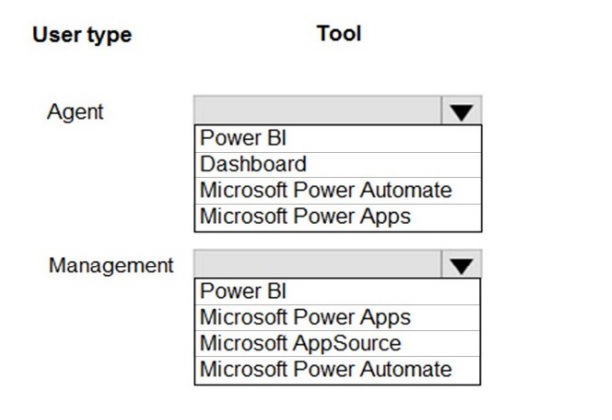
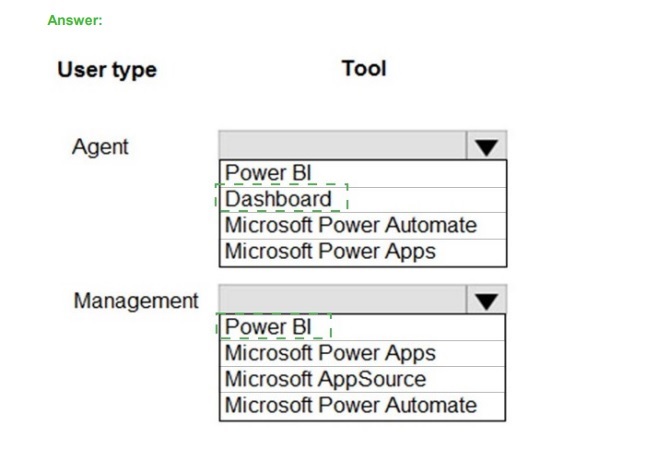
Explanation:
The recommended tool depends on the user's primary need. Agents (e.g., customer service, field workers) need an application to perform daily tasks and input data. Management needs consolidated views and analytics to monitor performance and make decisions.
Correct Matching:
User type: Agent
Recommended Tool: Microsoft Power Apps
Explanation:
Agents are operational staff who need a task-focused application to interact with business data (e.g., view customer cases, update records, log inspections). Microsoft Power Apps (specifically, Canvas Apps or Model-Driven Apps) is the core tool for building these custom, role-based user interfaces that streamline daily work.
User type: Management
Recommended Tool: Power BI
Explanation:
Management requires analytics, dashboards, and reports to track KPIs, monitor team performance, and gain business insights. Power BI is Microsoft's primary business intelligence and data visualization tool, designed specifically for creating and consuming interactive dashboards and reports to support data-driven decision-making.
Why the Other Tools Are Not the Best Primary Recommendation:
For Agents:
Power BI: Used for viewing reports, not for performing transactional work.
Dashboard: This is a component within Power Apps or Power BI, not a standalone tool. An agent's primary tool is the app itself.
Microsoft Power Automate:This is an automation tool that runs in the background. Agents may trigger flows from within an app, but their primary interactive tool is the app (Power Apps).
For Management:
Microsoft Power Apps: Management may use apps, but their core need is analytics, not data entry or transaction processing.
Microsoft AppSource: This is a marketplace for finding and acquiring third-party apps and services, not a tool for daily management tasks.
Microsoft Power Automate: Again, this is for automation, not for analytical consumption.
Reference:
The core personas defined in Power Platform documentation: Power Apps for "app makers" and "app users" (like Agents), and Power BI for "data analysts" and "business users" (like Management) who consume insights.
You need to recommend a collaboration tool for each group.
Which tool should you use? To answer, select the appropriate tool in the answer area.
NOTE: Each correct selection is worth one point.

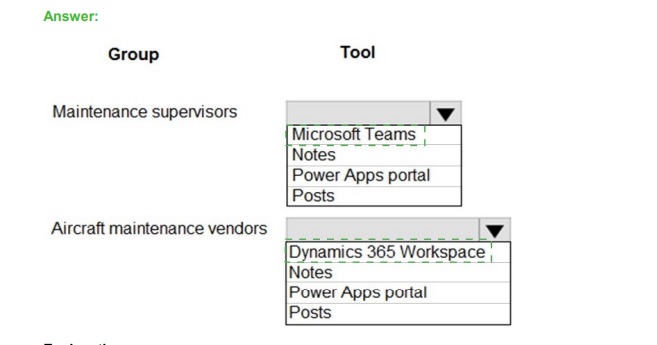
Box 1: Microsoft Teams
Maintenance supervisors must not have access to Dynamics 365 Customer Service. The
supervisors must be able to communicate with the contracts team about contracts.
Box 2: Dynamics 365 Workspace
Aircraft maintenance vendors must have only view and upload privileges to their invoices
and receipts.
The Expense management mobile workspace lets users capture and upload a receipt, so
that they can attach it to an expense report later.
You need to recommend a solution for agents when working with customers to make reservations.
What should you recommend?
A. task flows
B. Business Process Flows
C. workflows
D. Power Automate
Explanation:
When agents work interactively with customers to make reservations, they need an in-app guide that structures the conversation, ensures necessary data is collected in the correct order, and enforces a consistent business process. This tool must be visible and navigable directly on the form during the live interaction.
Correct Option:
B. Business Process Flows
Business Process Flows (BPFs) are visual guides displayed as a horizontal bar across the top of a form in model-driven apps. They lead agents step-by-step through stages (e.g., "Gather Details," "Select Flight," "Confirm Payment") and required fields for making a reservation. They enforce a standardized process, improve data quality, and provide a clear context for both the agent and the customer during the interaction.
Incorrect Option:
A. Task flows:
This term is often used interchangeably but imprecisely. In the Power Platform context, task flows typically refer to guided, UI-based processes built in Power Automate for desktop for robotic process automation (RPA), not for live agent-customer interactions in a CRM system.
C. Workflows:
These are classic, server-side automation tools (now largely replaced by cloud flows) that run in the background based on triggers. They perform actions (like sending an email) but do not provide a visual, interactive guide for an agent to follow on-screen during a customer call.
D. Power Automate:
This is the overarching service for creating automated workflows (cloud flows, desktop flows). While a Power Automate cloud flow could be triggered from a BPF, Power Automate itself is not the user-facing, step-by-step guide for the agent. The BPF is the front-end component built using Power Automate.
Reference:
Microsoft Learn documentation on "Business process flows overview" defines them as a way to "define a set of steps for people to follow to take them to a desired outcome." They are explicitly designed to guide users through processes like sales, service, or, in this case, reservation creation, ensuring consistency and completeness.
You need to create an Agent security role.
Which three actions should you recommend? Each correct answer presents part of the solution.
NOTE: Each correct selection is worth one point.
A. Add security to the seat entity and assign users to the Agents role
B. Add security to the Core Records and assign users to the Customer Service Representative role.
C. Copy the Microsoft Dataverse Basic User role.
D. Rename the Customer Service Representative role to Agents
E. Copy the Customer Service Representative role.
F. Name the new role Agents.
Explanation:
Creating a custom security role for Agents (like Customer Service Agents) follows a best-practice pattern: start from a baseline role that matches the job function, copy it to create a new customizable role with a descriptive name, and then assign users. This ensures the new role has appropriate initial permissions without starting from scratch.
Correct Option:
B. Add security to the Core Records and assign users to the Customer Service Representative role.
This statement is partially correct in its intent but incorrect in its final step. The correct first action is indeed to add or configure security within the role, but you assign users to the newly created "Agents" role, not to the out-of-the-box "Customer Service Representative" role. The "assign users" part should follow the creation of the new custom role.
E. Copy the Customer Service Representative role.
This is the correct first step. You never modify out-of-the-box system roles directly. Instead, you copy an existing role (like "Customer Service Representative") that closely matches the needed baseline permissions. This creates a new, customizable role with the same starting privileges.
F. Name the new role Agents.
This is the correct subsequent step. After copying the role, you rename the new copy to a descriptive name like "Agents" to reflect its purpose within your organization.
Incorrect Option:
A. Add security to the seat entity and assign users to the Agents role:
This is out of context. While you might configure permissions for specific entities (like "seat"), it's not a general step for creating the role itself. The "seat entity" is also not a standard entity, making this option suspect. Assigning users comes after the role is created, not as a concurrent "add security" step.
C. Copy the Microsoft Dataverse Basic User role:
This is a too-basic starting point. The "Basic User" role has minimal permissions and lacks the specific privileges needed for a Customer Service Agent (like full access to Cases, Contacts, etc.). You should copy a role aligned with the job function.
D. Rename the Customer Service Representative role to Agents:
This is a violation of best practice. You should never rename or modify out-of-the-box system roles. These roles are updated by Microsoft and should be preserved in their original state for upgrade compatibility and reference.
Reference:
Microsoft Learn documentation on "Copy a security role" explicitly states the procedure: locate a similar system role, use the Copy Role function, give the new role a meaningful name, modify its privileges as needed, and then assign users to the new custom role. This is the standard ALM and security management practice.
You need to recommend a feature that erases agent workloads and resolves reported issues.
What should you recommend?
A. Dynamics 365 Customer Service default functionality
B. Microsoft AppSource
C. Microsoft Store
Explanation:
The requirement describes a core function of any customer service system: to automatically clear an agent's workload (queue items) when the associated issue (case) is resolved. This is a fundamental, built-in automation to ensure efficiency and accurate reporting, not a feature that requires external acquisition or custom development.
Correct Option:
A. Dynamics 365 Customer Service default functionality
This is standard, out-of-the-box behavior. When an agent resolves and closes a case in Dynamics 365 Customer Service, the associated work item (like a queue item, task, or activity) is automatically completed or removed from their active workload. This is intrinsic process automation within the application to maintain data hygiene and reflect current agent availability.
Incorrect Option:
B. Microsoft AppSource:
This is the marketplace for finding and acquiring third-party apps, add-ons, and services that extend Dynamics 365 and other Microsoft products. It is not a "feature" that performs system automation. You might find a specialized workflow solution there, but the described need is satisfied by the default product.
C. Microsoft Store:
This is the consumer app store for Windows devices, primarily for downloading games, media, and personal productivity apps for PCs, tablets, and phones. It has no relation to enterprise Dynamics 365 functionality or business process automation.
Reference:
The core functionality of case management in Dynamics 365 Customer Service includes automatic status updates and the closure of related activities upon case resolution. This is documented in the standard product overview and user guides for case lifecycle management.
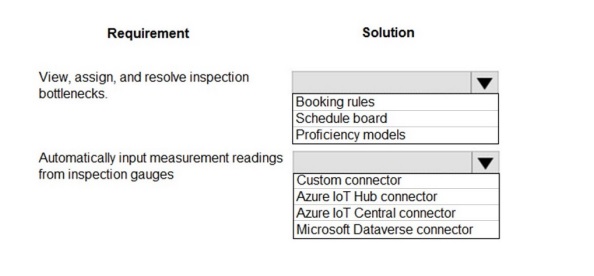
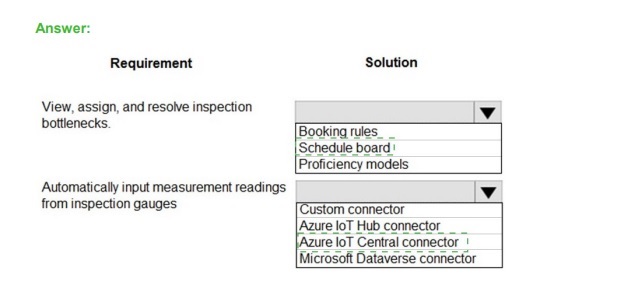
You need to recommend solutions to meet the inspection requirements.
What should you recommend? To answer, select the appropriate options in the answer area.
NOTE: Each correct selection is worth one point.
Explanation:
The requirements map to two distinct technical domains: resource management for human inspectors and IoT integration for automated data capture from equipment. The correct solutions are the specific tools designed to address these domains within the Microsoft ecosystem.
Correct Matching:
Requirement: View, assign, and resolve inspection bottlenecks.
Solution from Group 1: Schedule board
Explanation:
The Schedule Board is the central visual tool in Dynamics 365 Field Service for viewing workforce capacity, assigning jobs (inspections) to qualified technicians based on location and skill, and identifying bottlenecks (like overloaded inspectors or unresolved jobs). It is purpose-built for this operational management task.
Requirement: Automatically input measurement readings from inspection gauges.
Solution from Group 2: Azure IoT Hub connector
Explanation:
Inspection gauges are IoT devices/sensors. Azure IoT Hub is Microsoft's central service for ingesting, processing, and managing telemetry data from millions of IoT devices at scale. The Azure IoT Hub connector in Power Platform (Power Automate/Power Apps) allows you to build flows that automatically receive these measurement readings and input them into Dataverse or other systems.
Why Other Key Options Are Incorrect for These Requirements:
For Requirement 1 (Scheduling):
Booking rules / Proficiency models: These are supporting configuration elements for the Schedule Board. Booking rules define scheduling constraints; proficiency models define technician skills. They configure how the Schedule Board works but are not the primary tool for viewing and assigning to resolve bottlenecks.
For Requirement 2 (IoT Data):
Custom connector: This is for connecting to a custom or proprietary API, not specifically optimized for massive-scale, bidirectional IoT device telemetry like IoT Hub.
Azure IoT Central connector: IoT Central is a higher-level SaaS application built on top of IoT Hub for faster solution building. The connector is valid, but IoT Hub is the more foundational, core service for this raw data ingestion requirement and is the standard first-choice connector for IoT scenarios in Power Platform.
Microsoft Dataverse connector: This is for connecting to Dataverse from an external app. The requirement is to get data into Dataverse from gauges, making the IoT Hub connector (which sends data to the flow) the correct upstream choice.
Reference:
Microsoft Learn documentation on "Dynamics 365 Field Service - Schedule Board" and "What is Azure IoT Hub?" directly describes these as the tools for resource scheduling/dispatching and IoT device connectivity/telemetry ingestion, respectively.
| Page 2 out of 16 Pages |
| 12345 |
| PL-600 Practice Test Home |
Real-World Scenario Mastery: Our PL-600 practice exam don't just test definitions. They present you with the same complex, scenario-based problems you'll encounter on the actual exam.
Strategic Weakness Identification: Each practice session reveals exactly where you stand. Discover which domains need more attention, before Microsoft Power Platform Solution Architect exam day arrives.
Confidence Through Familiarity: There's no substitute for knowing what to expect. When you've worked through our comprehensive PL-600 practice exam questions pool covering all topics, the real exam feels like just another practice session.
Copyright © All Rights Reserved