
During the execution phase, user accepted testing failed; nonetheless, the vendor PM is insisting that the program manager approve the invoice for this phase. Which of the following actions should the Program manager take?
A. Escalate the issue with the project sponsor and ask for assistance in managing the situation.
B. Work with the vendor to achieve a compromise that benefits everyone.
C. Approve the invoice to avoid damaging the relationship with the vendor.
D. Schedule a call with the vendor PM and vendor executive to review the statement of work.
Which of the following items must be protected as Pll? (Select TWO).
A. Job title
B. Home address
C. Work phone number
D. Time zone
E. Date of birth
F. Blood type
Explanation: Home address and date of birth must be protected as personally identifiable information (PII). PII is any information that can be used to identify, contact, or locate an individual person, either alone or in combination with other sources. PII can include information such as name, email address, phone number, social security number, passport number, driver’s license number, bank account number, credit card number, biometric data, medical records, etc. PII must be protected from unauthorized access, use, disclosure, modification, or destruction to prevent identity theft, fraud, or other malicious activities that may harm the individual’s privacy or security.
Which of the following activities are performed during the closing phase? (Select three).
A. Requesting project charter sign-off
B. Recognizing project team efforts and rewarding team members
C. Working with the financial team to obtain return of investment
D. Revoking resource credentials from the system
E. Updating the risk register with new findings
F. Informing the functional manager about the release of resources
G. Monitoring project team performance
A project team participates in a brainstorming session to define the guidance, direction, and approach for monitoring established procedures for developed products. Which of the following plans is the team creating?
A. Project transition
B. Project management
C. Project communications
D. Project quality assurance
Explanation: Project quality assurance is the process of ensuring that the project meets the quality standards and requirements defined by the stakeholders and the organization. It involves planning, implementing, and monitoring quality activities throughout the project life cycle. Project quality assurance is different from project quality control, which is the process of inspecting and testing the project deliverables and outputs to identify and correct defects. Project quality assurance is also different from project transition, which is the process of transferring the project deliverables and outputs to the end users or customers. Project management is the application of knowledge, skills, tools, and techniques to project activities to meet the project objectives. Project communications is the process of planning, creating, distributing, and managing information among the project stakeholders.
As a result of lessons learned, a project manager convenes a meeting to understand the poor quality of the project documentation. During the meeting, project team members provide insights from their perspectives and discussions with group members. Which of the following is the project team doing?
A. Executing the approved contingency plan
B. Constructing an Ishikawa diagram to determine the root cause
C. Using a Pareto chart to prioritize the different causes
D. Engaging the senior management team in regard to the issue
Explanation: An Ishikawa diagram, also known as a fishbone diagram, is a tool used to identify and analyze the root causes of a particular problem. CompTIA Project+ references this tool as essential for quality management and problem-solving.
During a code implementation, a senior developer and junior tester are discussing the testing scenarios that were performed. A major malfunction resulted in an inoperative product condition. As a result, the team was forced to work until midnight to restore operations. Which of the following should the PM have generated FIRST to alleviate the impact of this issue prior to deployment?
A. A risk budget
B. A risk impact
C. A change request
D. A contingency plan
Explanation: The project manager should have generated a contingency plan first to alleviate the impact of this issue prior to deployment where a major malfunction resulted in an inoperative product condition during a code implementation. A contingency plan is a plan that outlines alternative courses of action or strategies to deal with potential problems or risks that may occur during a project. A contingency plan can help to prevent or minimize the negative impacts of unforeseen events or issues on the project objectives and deliverables and ensure business continuity and stability.
Before a configuration can be made to a system in development, a document containing information about how the new system will interact with other systems within the organization needs to be written. Which of the following relationships best describes this scenario?
A. Start-to-start
B. Start-to-finish
C. Finish-to-finish
D. Finish-to-start
Explanation: A finish-to-start relationship is a type of logical dependency between two tasks, in which the first task must be completed before the second task can start. In this scenario, the document containing information about how the new system will interact with other systems within the organization is a prerequisite for the configuration of the system in development. Therefore, the document writing task must finish before the configuration task can start, which is a finish-to-start relationship.
Which of the following cloud models is designed to provide compute, storage, and networking resources on demand?
A. Software as a service
B. Infrastructure as a service
C. Data as a service
D. Platform as a service
Explanation: Infrastructure as a service (IaaS) is a cloud model that provides on-demand
access to cloud-hosted physical and virtual servers, storage, and networking resources.
IaaS customers can provision, configure, and use these resources as they would use onpremises
hardware, but without the hassle of purchasing, installing, managing, and
maintaining them. The cloud service provider owns, manages, and maintains the hardware
and computing resources in its own data centers, and charges the customers based on
their usage. IaaS is suitable for customers who need flexibility, scalability, and control over
their IT infrastructure, and who want to avoid the high costs and complexity of owning and
operating their own hardware. The other options are not correct because:
Software as a service (SaaS) is a cloud model that provides on-demand access to
ready-to-use, cloud-hosted application software. SaaS customers do not need to
install, update, or maintain the software, as the cloud service provider handles all
the technical aspects. SaaS is suitable for customers who need to access common
applications, such as email, office productivity, or customer relationship
management, without worrying about the underlying infrastructure or platform.
Data as a service (DaaS) is a cloud model that provides on-demand access to
cloud-hosted data sources, such as databases, data warehouses, or data lakes.
DaaS customers can query, analyze, and visualize the data, as well as integrate it
with other applications or services, using APIs or web interfaces. DaaS is suitable
for customers who need to leverage data from various sources, such as social
media, IoT devices, or third-party providers, without having to store, manage, or
process the data themselves.
Platform as a service (PaaS) is a cloud model that provides on-demand access to
a complete, ready-to-use, cloud-hosted platform for developing, running,
maintaining, and managing applications. PaaS customers can use the platform’s
tools, frameworks, libraries, and services to create and deploy applications,
without having to worry about the underlying infrastructure or software. PaaS is
suitable for customers who need to develop, test, and deploy applications quickly
and efficiently, and who want to take advantage of the cloud’s scalability, reliability,
and security features.
During the execution phase of a project, the project team faced an unexpected website downtime The project manager how a brainstorming session and the team identified causes and effects tor the problem Now the project team needs to analyze and determine whether the particular cause and effect are related by using one of the following charts.
Which of the following should the team use?
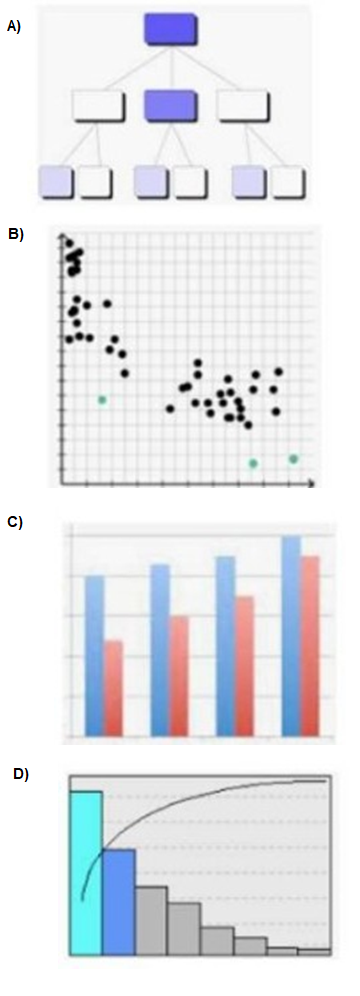
A. Option A
B. Option B
C. Option C
D. Option D
A visual that displays team progress was created for stand-up meetings. Which of the following BEST describes what is being represented on the visual?
A. Decision board
B. Whiteboard
C. Task board
D. Dashboard
Explanation: A task board is a visual tool that displays team progress for stand-up meetings. A task board usually consists of columns that represent different stages or statuses of tasks, such as to do, in progress, done, or blocked. Each task is represented by a card or sticky note that can be moved across the columns as the task progresses. A task board can help to facilitate communication, collaboration, and transparency among team members and stakeholders. It can also help to track and manage work flow, prioritize tasks, identify bottlenecks, and resolve issues3
Which of the following activities would force a team to remove a new package and leave the previous one during a smoke test?
A. Rollback plan
B. Downtime stage
C. Maintenance window
D. Validation checks
Explanation: A rollback plan is used when an issue is identified during testing or implementation. It allows the team to revert to the previous state, removing the new package. This aligns with CompTIA Project+ guidance on implementing fallback strategies for risk management.
Which of the following factors would be impacted the most by requirements for a project to implement an air quality control system at a coal plant?
A. Social
B. Regulatory
C. Environmental
D. Governmental
| Page 12 out of 31 Pages |
| Previous |