
A 32-year-old woman presents to the office with questions related to the mRNA vaccines that are approved for COVID-19. She is a health care worker. She gave birth to a healthy child 2 months ago. Before being immunized, which one of the following is the most important detail to elicit from the patient's history?
A. Previous anaphylactic reaction to vaccine components.
B. Presently breastfeeding.
C. Current immunosuppression.
D. Work in a medical unit caring for patients with COVID-19.
A 24-year-old nulligravid woman presents to the office with an absence of menstruation since discontinuing her oral contraceptives 8 months ago. She previously had a regular menstrual cycle when taking oral contraceptives for the past 10 years but stopped because of headaches, which have only gotten worse since. She also noticed mild breast discharge for the past several months. Which one of the following examination findings is most likely?
A. Nodular breast irregularities
B. Low BMI
C. Abnormal visual field testing results
D. Presence of severe hirsutism
A 19-year-old woman returns to your clinic to discuss her recent laboratory tests. She initially presented with dysuria, dyspareunia, and abnormal uterine bleeding. Her vulvovaginal examination was normal. Her last sexual encounter was 3 weeks prior to the onset of her symptoms. Which one of the following pathogens is most likely to explain this clinical presentation?
A. Actinomyces israelii
B. Herpes simplex virus
C. Treponema pallidum
D. Human papillomavirus
E. Chlamydia trachomatis
You are caring for a 78-year-old man admitted to hospital for heart failure. On your rounds, he asks why he is not getting better. He has a history of heart failure, hypertension, and type 2 diabetes. He has an implantable cardioverter-defibrillator. This is his fourth admission in the past 6 months for acute decompensation of his heart failure. Between hospital admissions, he reports worsening shortness of breath and a progressive decline in function. Which one of the following is the next best step?
A. Explain the end-stage nature of the patient's illness
B. Advise the patient to have his defibrillator deactivated
C. Reassure the patient that his condition will improve with proper medication adherence
A 3-year-old boy is brought to your office because his daycare teachers are concerned about his language development. His parents speak both English and French at home, and he can say around 15 words combined in both languages. His history reveals that he has minimal interest in playing with other children. Which one of the following is most appropriate?
A. Reassure that no intervention is needed.
B. Evaluate for attention deficit hyperactivity disorder.
C. Refer to a pediatric neurologist.
D. Screen for autism spectrum disorder.
E. Recommend use of one language at home.
An otherwise well 18-month-old girl is brought to your family practice office for routine
immunization. Her mouth is as shown in the attached image. She has no symptoms. Which
one of the following is the most likely cause of this presentation?
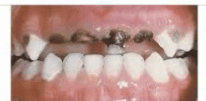
Image description: Severe black and brown decay of multiple upper front teeth, with
relatively spared lower teeth.
A. Vitamin D deficiency.
B. Lack of fluoride in drinking water.
C. Repeated courses of antibiotics.
D. Use of oral iron supplements.
E. Putting the child to bed with a bottle.
A 6-year-old boy is brought to the Emergency Department with a 2-day history of a limp. On examination, he looks well, has a temperature of 38 °C and is able to weight-bear. His hip examination reveals mild decreased range of motion. Radiographs of his hip and pelvis show no abnormality. His C-reactive protein level is 8 mg/L (< 6). Which one of the following is the most likely diagnosis?
A. Septic arthritis
B. Osteomyelitis
C. Transient synovitis
D. Trochanteric bursitis
E. Juvenile rheumatoid arthritis
A 21-year-old man presents to the office with persistent pain and swelling of the wrist 2 weeks after falling on his outstretched hand. Anteroposterior and lateral radiographs of the wrist taken at the time of the injury showed no evidence of fracture or dislocation. Which one of the following is the most likely cause of the patient's symptoms?
A. Fracture of the carpal scaphoid.
B. Undisplaced fracture of the distal radius.
C. Subluxation of the lunate bone.
D. de Quervain tenosynovitis.
You are caring for a 17-year-old girl who has end-stage renal disease. She is receiving dialysis at the hospital 3 times a week. She requests medical assistance in dying (MAID). Which of the following is the best next step?
A. Inform the patient that she will need parental consent to be assessed for MAID.
B. Explain to the patient that she is not terminally ill.
C. Refer the patient to a psychiatrist.
D. Suggest a trial of home dialysis.
E. Explore the reasons for the patient's request for MAID.
A 35-year-old woman presents to your clinic for follow-up regarding her persistent primary immune thrombocytopenic purpura. She was admitted to hospital with a relapse and received treatment with dexamethasone, intravenous immunoglobulin, and rituximab. She was recently discharged from hospital with a platelet count of 55 × 10/L (130–360), and also continues to take 10 mg of prednisone once daily. She is scheduled for a splenectomy in 4 weeks. Which one of the following is the best next step in preparation for the patient's surgical procedure?
A. Arrange for preoperative vaccination
B. Start calcium and vitamin D supplementation
C. Prescribe daily azithromycin 1 week preoperatively
D. Stop prednisone 2 weeks preoperatively
E. Transfuse 5 units of platelets 1 week preoperatively
A 25-year-old man presents to the Emergency Department with diffuse abdominal pain and anorexia. He was tackled in a football game yesterday. He reports a 3-week history of sore throat and fatigue. Vital signs are as follows: Blood pressure: 95/45 mm Hg Heart rate: 96/min Temperature: 37.6°C Which one of the following is the most likely diagnosis?
A. Ruptured spleen
B. Appendicitis
C. Pneumonia
D. Pyelonephritis
E. Ruptured duodenum
A 20-year-old nulligravid woman presents with severe pain during menstruation. She is unable to take nonsteroidal anti-inflammatory drugs (NSAIDs) and is adamant about not taking any hormonal therapy. She has questions about non-medicinal therapeutic options. Which one of the following recommendations is the most appropriate?
A. High-frequency transcutaneous electrical nerve stimulation (TENS)
B. Spinal manipulation
C. Massage therapy
D. Progesterone-releasing intrauterine device
E. Laparoscopic uterine nerve ablation (LUNA)
| Page 8 out of 20 Pages |
| 5678910 |
| MCCQE Practice Test Home |
Real-World Scenario Mastery: Our MCCQE practice exam don't just test definitions. They present you with the same complex, scenario-based problems you'll encounter on the actual exam.
Strategic Weakness Identification: Each practice session reveals exactly where you stand. Discover which domains need more attention, before Medical Council of Canada Qualifying Examination Part 1 Exam exam day arrives.
Confidence Through Familiarity: There's no substitute for knowing what to expect. When you've worked through our comprehensive MCCQE practice exam questions pool covering all topics, the real exam feels like just another practice session.
Copyright © All Rights Reserved