
A company uses Dynamics 365 Supply Chain Management.
For each of the following statements, select Yes if the statement is true. Otherwise, select No.
NOTE: Each correct selection is worth one point.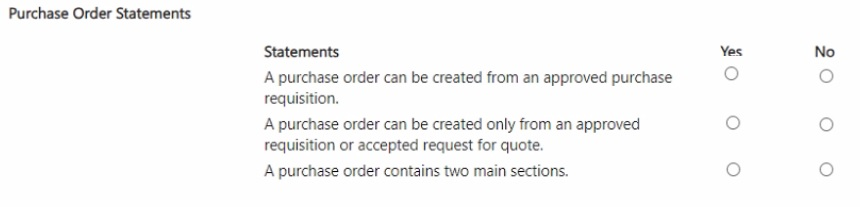
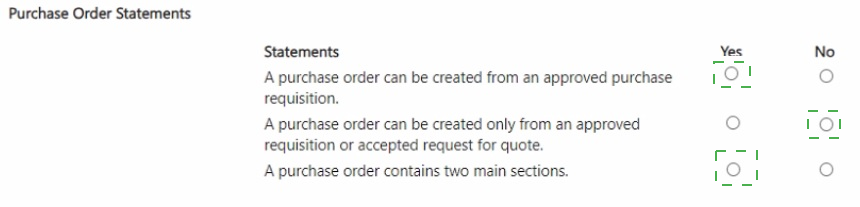
Explanation:
This question tests specific procedural and structural knowledge of the purchase order (PO) lifecycle and document format within Dynamics 365 Supply Chain Management. It checks if a PO can originate from different sources and verifies understanding of its core sections.
Correct Option Explanations:
Statement 1:
Yes. This is a standard procurement workflow. A purchase requisition is an internal request for goods/services. Once it is approved, it can be used as the source document to generate a formal purchase order that is sent to the vendor.
Statement 3:
Yes. A purchase order in D365 SCM is structured into two primary sections:
The Header:
Contains information applicable to the entire order (e.g., vendor, delivery address, payment terms).
The Lines:
Contains the specific items, quantities, prices, and delivery dates being ordered.
Incorrect Option Explanation:
Statement 2:
No. This statement is false because it uses the word "only." While purchase orders are commonly created from approved requisitions or accepted requests for quote (RFQs), they can also be created manually from scratch without any preceding document. This flexibility is essential for direct purchases and other scenarios.
Reference:
Microsoft Learn - "Create purchase orders" or "Procurement and sourcing overview." The documentation confirms the multiple creation paths for POs (manual, from requisitions, from RFQs) and details the standard two-section structure of the purchase order document.
A company plans to implement Dynamics 365 Finance.
Instructions: For each of the following statements, select Yes if the statement is true.
Otherwise, select No.
NOTE: Each correct selection is worth one point.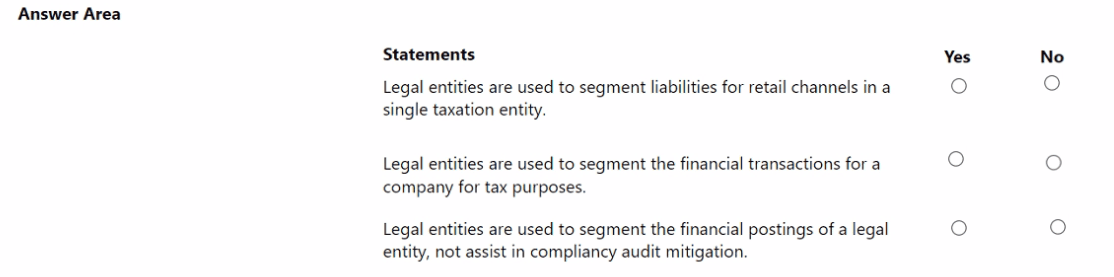
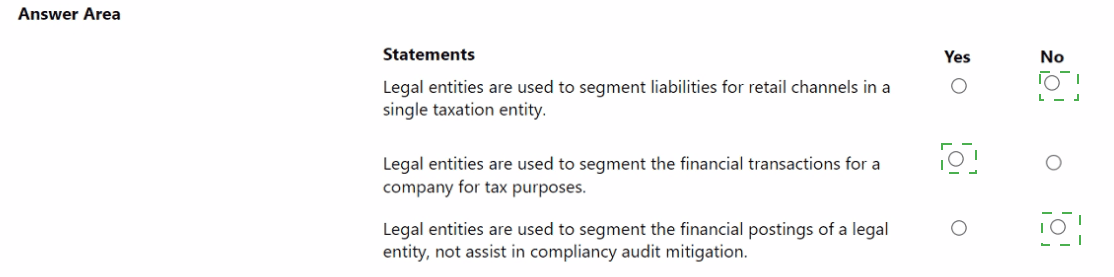
Explanation:
This question assesses the core purpose and function of a Legal Entity in Dynamics 365 Finance. A Legal Entity is a fundamental organizational construct that represents a company that can enter into contracts and is required to prepare financial statements that report on its performance.
Correct Option Explanation:
Statement 2:
Yes. This is the primary purpose. A legal entity is a distinct, legally recognized company (e.g., a corporation or LLC). In D365, it is the central unit for financial reporting and tax compliance. All financial transactions are recorded and isolated within a specific legal entity, allowing for accurate financial statements and tax filings for that company.
Incorrect Option Explanations:
Statement 1:
No. Retail channels are segmented using Operating Units (like Retail Channels or Stores), not legal entities. Multiple retail channels can exist within a single legal/taxation entity. Liabilities ultimately roll up to the legal entity, but channels are not legal entities themselves.
Statement 3:
No. This statement is incorrect on two counts. First, legal entities do segment financial postings (that's true). However, the second part is false; this segmentation is a primary tool for compliance and audit mitigation. Maintaining clean, legally separated financial records is essential for passing audits and meeting statutory compliance requirements.
Reference:
Microsoft Learn - "Plan your organizational hierarchy" or "Legal entities overview." The documentation defines a legal entity as an organization with a registered or legislated structure, capable of entering legal contracts and required to prepare financial statements, which directly supports tax and compliance reporting.
You are exploring the capabilities in Dynamics 365 Human Resources to manage employee leaves and absences.
Leave requests for paid time off must be approved either by a manager, by a human resources representative, or automatically based on specific rules.
You need to describe how this requirement can be configured in the system.
What should you recommend? To answer, select the appropriate option in the answer area.

Explanation:
The requirement is to enforce an approval process for leave requests based on roles (manager, HR) or rules. In Dynamics 365 Human Resources, this is achieved by creating a workflow, which is a configurable, automated process that defines the path and rules (e.g., approvals, notifications) a request must follow. The workflow type must match the specific business document it governs.
Correct Option:
Leave and absence type.
This is the correct configuration point. In Dynamics 365 Human Resources, you create a workflow of the type "Leave and absence request." You then assign this specific workflow to a particular Leave and absence type (e.g., "Paid Time Off" or "Sick Leave"). This ensures that all requests for that specific type of leave are routed according to the defined approval rules.
Incorrect Options:
Leave balance:
The leave balance is a calculated result showing an employee's available time. It is an output, not a configuration point for assigning approval processes.
Leave and absence plan:
A plan defines the rules for accruing leave (e.g., 10 days per year). While a workflow could be linked to requests stemming from a plan, the direct assignment for request routing is made at the type level, as the same plan (e.g., "Annual Accrual") might cover multiple types (e.g., "Vacation" and "Personal Day") that require different approval rules.
Reference:
Microsoft Learn - "Configure leave and absence workflows in Dynamics 365 Human Resources." The documentation specifies that you create a "Leave and absence request" workflow and then assign it to one or more leave types to control the approval process.
A company implements Dynamics 365 Finance.
You need to recommend which account types the company should use for main accounts.
What should you recommend?
To answer, drag the appropriate general ledger elements to the correct accounts. Each element may be used once, more than once, or not at all.
You may need to drag the split bar between panes or scroll to view content.
NOTE: Each correct selection is worth one point.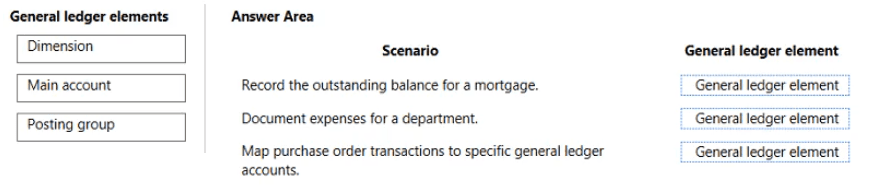
Explanation:
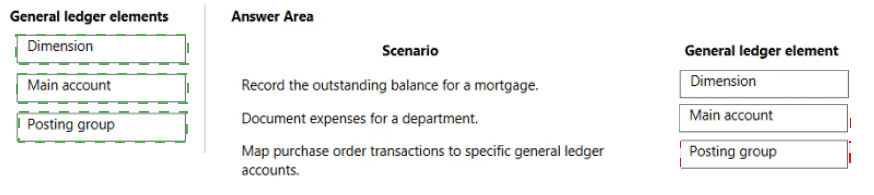
This drag-and-drop question tests understanding of the three core building blocks of the chart of accounts in Dynamics 365 Finance: Main Accounts, Financial Dimensions, and Posting Groups. Each serves a distinct purpose for recording and categorizing transactions.
Why the Other Elements Are Incorrect for the Mismatched Scenarios:
Using a Dimension for the mortgage balance or a Posting Group for department expenses would not correctly record the core financial value. The mortgage needs a ledger account (Main Account) to hold its balance, and the department is an analytical attribute (Dimension) of an expense, not an account mapping rule.
Using a Main Account to map transactions is too rigid; posting groups provide the necessary flexible, rule-based automation for determining accounts during business processes like purchasing.
Reference:
Microsoft Learn - "Plan the chart of accounts" and "Posting groups overview." The documentation explains that Main Accounts represent financial categories, Dimensions provide analytical depth, and Posting Groups automate ledger account assignments for specific transaction types (vendors, customers, items).
A company plans to use Dynamics 365 Supply Chain Management. Match each inventory
management function/technique to its use case.
To answer, drag the appropriate inventory management function/technique from the column on the left to its use case on the right. Each inventory management function/technique may be used once, more than once, or not at all.
NOTE: Each correct match is worth one point.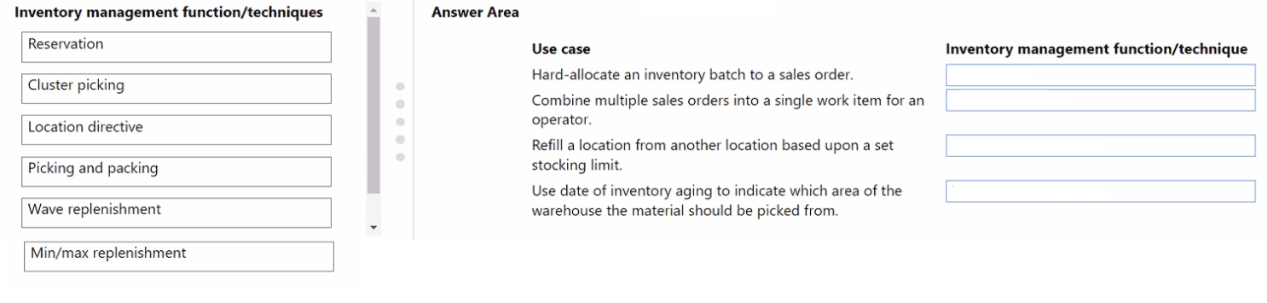
Explanation:
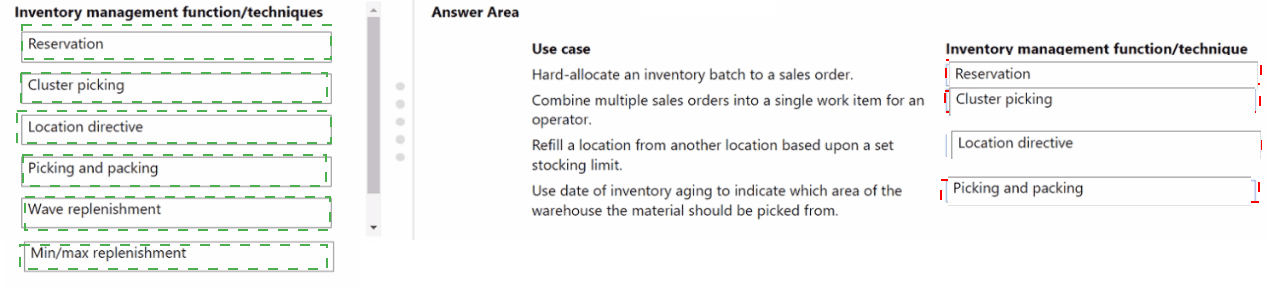
Dynamics 365 Supply Chain Management provides a robust suite of tools to optimize warehouse operations and ensure stock availability. These functions allow businesses to automate repetitive tasks, such as refilling shelves or grouping orders, which reduces human error and improves operational efficiency. Understanding how to match these specific technical capabilities to real-world business scenarios—like prioritizing high-value customers or managing perishable goods—is a core requirement for the MB-900 certification.
Correct Option:
Inventory Allocation:
This function allows a company to virtually reserve or "hard-allocate" specific on-hand stock or batches for a particular sales order or customer. It ensures that high-priority orders are fulfilled even during periods of limited supply.
Cluster Picking:
This technique enables a single warehouse operator to pick items for multiple sales orders simultaneously during one trip through the warehouse. It groups multiple orders into a single "cluster" work item to minimize travel time.
Min/Max Replenishment:
This strategy automates the movement of stock between locations. When inventory drops below a defined "Minimum" level, the system triggers a task to refill the location up to the "Maximum" stocking limit.
Location Aging:
This feature uses the date inventory entered a location (aging date) to drive picking logic, such as FIFO (First-In, First-Out) or LIFO (Last-In, First-Out), ensuring older stock is used first.
Incorrect Option:
Wave Demand Replenishment:
While similar to Min/Max, this is incorrect because it triggers replenishment based on current outbound demand (orders) rather than static stocking limits. It is used when you only want to refill a location if there is a pending order for it.
Manual Inventory Reservation:
This is incorrect for "hard-allocation" in a batch context because, while it reserves stock, it does not provide the same automated "virtual pool" management or priority-based allocation that the specific Inventory Allocation module offers for complex supply chains.
Cycle Counting:
This is an incorrect choice for these use cases as it is a process for verifying physical inventory accuracy by counting small subsets of inventory periodically, rather than managing how inventory is picked, moved, or allocated.
Reference:
Microsoft Learn: Replenishment strategies in SCM (Dynamics 365 Supply Chain Management documentation)
Microsoft Learn: Location directive inventory picking aging (Warehouse Management configuration guide)
Microsoft Learn: Set up cluster picking (Mobile device warehouse execution guide)
A company uses Dynamics 36S Commerce. The company is launching a new product line for select stores.
The company wants to ensure that stores participating in the launch receive the new products. Stores that are not participating in the launch must not be able to order the products.
You need to recommend a method to help the company launch the new product hne.
What should you recommend?
A. Define products for distribution using product assortment.
B. Define products for distribution using security roles.
C. Control product distribution using purchase agreement.
D. Control product distribution using trade agreement.
Explanation:
Dynamics 365 Commerce utilizes specific management tools to control the visibility and availability of products across various retail channels. In a retail environment, it is common to have different product mixes for different store locations based on regional demand or specific marketing campaigns. By using centralized management features, organizations can ensure that the right products reach the right stores without manually managing inventory restrictions for every individual shop or online portal.
Correct Option:
A. Define products for distribution using product assortment:
A product assortment is a collection of related products that you assign to specific retail channels (stores). By creating an assortment that includes the new product line and linking it only to the participating stores, you ensure that only those locations can see, order, and sell the items. This is the standard method for controlling regional or store-specific product availability within the Commerce ecosystem.
Incorrect Option:
B. Define products for distribution using security roles:
Security roles are used to control user access to software features and data within Dynamics 365, not to manage product availability in stores.
C. Control product distribution using purchase agreement:
Purchase agreements are legal contracts between a buyer and a seller for specific quantities or values over time; they do not control retail store assortments.
D. Control product distribution using trade agreement:
Trade agreements are used to define special pricing and discounts for products and customers, not to restrict which stores are allowed to carry a specific product line.
Reference:
Microsoft Learn: Assortments in Dynamics 365 Commerce
Microsoft Learn: Set up assortments for retail stores and online channels
Exam MB-900 Study Guide: Describe Dynamics 365 Commerce capabilities – Product management and assortments
An organization consisting of several companies is implementing Dynamics 365 Finance.
The organization views company and department data by geographical regions and business functions.
You need to recommend organization types for the company based on the requirements.
What should you recommend? To answer, drag the appropriate organization types to the correct scenarios. Each organization type may be used once, more than once, or not at all.
You may need to drag the split bar between panes or scroll to view content.
NOTE: Each correct selection is worth one point.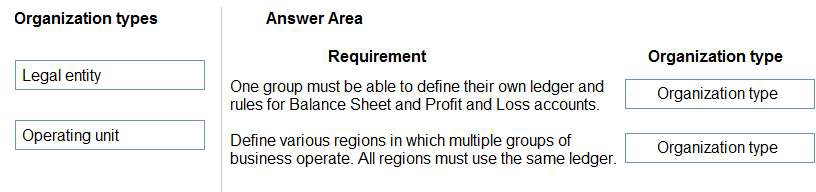
Explanation:
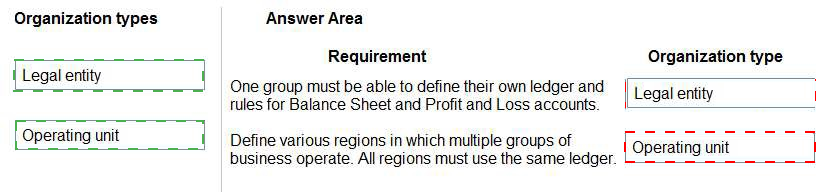
In Dynamics 365 Finance, the organizational structure is built using two primary building blocks: Legal Entities and Operating Units. A legal entity is the highest level of the organization and is required for any company that must file its own taxes and maintain its own financial ledger. Operating units, such as departments, cost centers, and business units, are internal divisions that allow a company to report on performance and control resources without the overhead of a separate legal registration.
Correct Option:
Legal Entity:
This is the correct recommendation for any part of the organization that is a registered legal body. It is mandatory for entities that need to enter into legal contracts, manage their own bank accounts, and prepare independent balance sheets and tax filings. Each legal entity is associated with a unique "DataAreaId," providing full data isolation for financial transactions.
Operating Unit:
This is recommended for internal divisions like departments (functional) or business units (geographical/product-based). Operating units share the parent legal entity's ledger and fiscal calendar, making them ideal for internal reporting and budgeting without needing to manage separate accounting rules for every branch.
Incorrect Option:
Teams:
While "Teams" is an organization type in Dynamics 365, it is used for collaboration and sharing records among specific groups of people, not for defining financial or geographical reporting structures.
Company (as a separate choice):
In the context of Dynamics 365, "Company" and "Legal Entity" are often used synonymously. Recommending a "Company" structure for an internal department would be incorrect as it would create unnecessary complexity in ledger management and tax reporting.
Financial Dimensions (as an organization type):
Although dimensions are used for reporting, they are not "organization types" themselves. Dimensions are tagged to transactions to categorize them by the organization types (like Department) you have already defined.
Reference:
Microsoft Learn: Organizations and organizational hierarchies overview (D365 Finance documentation)
Microsoft Learn: Plan your organizational hierarchy (Strategic planning guide)
Exam MB-900 Study Guide: Describe Dynamics 365 Finance – Organizational structures and legal entities
A company uses Dynamics 365 Finance.
The company requires a workflow that includes two independent approvals for purchase requisitions above $10,000.
You need to recommend the workflow element the company should use.
Which workflow element should you recommend?
A. manual decision
B. sub-workflow
C. conditional decision
D. parallel activity
Explanation:
In Dynamics 365 Finance, workflows are designed to automate business processes by defining how documents "flow" through the system for approval or processing. When a business requirement dictates that two or more individuals or groups must review a document simultaneously and independently—meaning one person's approval does not have to wait for the other's—a specific structural element is required. This ensures that the process remains efficient while maintaining strict internal controls for high-value transactions like large purchase requisitions.
Correct Option:
D. parallel activity:
This is the correct recommendation because a parallel activity allows for two or more workflow branches to run at the same time. In this scenario, the purchase requisition can be sent to two independent approvers simultaneously. The workflow only proceeds to the next step once both independent branches have been completed, satisfying the requirement for two independent approvals for amounts exceeding $10,000.
Incorrect Option:
A. manual decision:
This element is used when a user must choose between two different paths (e.g., "Approve" or "Reject"), but it does not facilitate independent, simultaneous approval paths.
B. sub-workflow:
A sub-workflow is a separate workflow that runs as a step within a parent workflow; while it can contain approvals, it is generally used for modularity rather than simple parallel processing.
C. conditional decision:
This is a "true/false" gateway used to route a document based on specific criteria (like whether the amount is > $10,000), but it directs the flow to only one path at a time.
Reference:
Microsoft Learn: Workflow elements overview (Dynamics 365 Finance & Operations)
Microsoft Learn: Configure parallel activities in a workflow
Exam MB-900 Study Guide: Describe Dynamics 365 Finance – Workflows and business processes
A company plans to use Dynamics 365 Supply Chain Management.
Instructions: For each of the following statements, select Yes if the statement is true.
Otherwise, select No.
NOTE: Each correct selection is worth one point.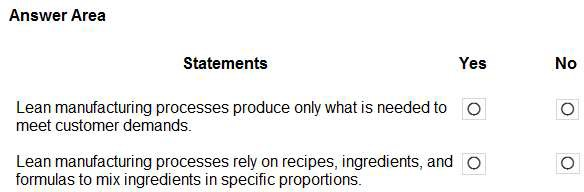
Explanation:
Dynamics 365 Supply Chain Management supports multiple manufacturing methodologies to cater to different industrial needs. Lean manufacturing is centered on the "pull" principle, where production occurs only in response to actual customer demand to minimize waste. Conversely, Process manufacturing is used for items produced in bulk, such as chemicals or food, requiring precise chemical formulas or recipes. Discrete manufacturing is utilized for distinct items that can be identified individually, like machinery, using a Bill of Materials (BOM).
Correct Option:
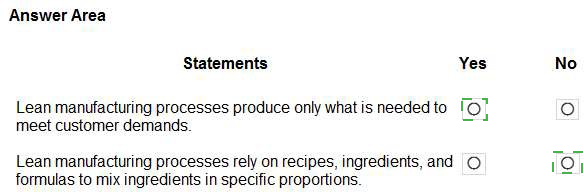
Lean manufacturing processes rely on customer demand (Yes):
This is correct because Lean is a "pull" system. It uses Kanban signals to trigger production or material movement only when a downstream process or customer order requests it, effectively reducing excess inventory and overhead costs.
Lean manufacturing relies on recipes, ingredients, and formulas (No):
This is correct because Lean uses production flows and activities rather than formulas. Formulas and ingredients are the defining characteristics of Process manufacturing, not the Lean methodology.
Process manufacturing relies on recipes, ingredients, and formulas (Yes):
This is correct because Process manufacturing involves mixing or blending components that usually cannot be undone. These products are managed via formulas that account for variables like potency, yields, and co-products.
Incorrect Option:
Discrete Manufacturing (Alternative Strategy):
This would be an incorrect match for "formulas" because Discrete manufacturing uses a Bill of Materials (BOM) to assemble distinct parts. It is also not a "pull" system by default, as it often relies on master scheduling and production orders.
Master Planning (Push System):
Using traditional "push" forecasting for Lean manufacturing is incorrect. Lean specifically avoids long-term forecasting for production triggers, preferring real-time demand to drive the flow of goods through the factory.
Reference:
Microsoft Learn: Describe manufacturing strategies in Dynamics 365 Supply Chain Management.
Microsoft Learn: Lean manufacturing overview for Dynamics 365.
Microsoft Learn: Process manufacturing and formula management.
A company is implementing Dynamics 365 Finance.
The company must create the structure that provides a breakdown by subcategories of all the company financial transactions by accounting period. Only one structure is requited per legal entity.
You need to configure the structure.
What should you use?
A. chart of accounts
B. general journal
C. ledger
D. company
Explanation:
In Dynamics 365 Finance, organizing financial data requires a structured framework that categorizes every transaction. The system uses a hierarchical approach to ensure that data is not only recorded but also reportable by specific segments, such as revenue, expenses, assets, and liabilities. This structure is essential for generating financial statements like Balance Sheets and Profit & Loss reports. It acts as the "backbone" of the financial system, allowing for consistent data entry and detailed analysis across different accounting periods.
Correct Option:
A. chart of accounts:
This is the correct recommendation because a Chart of Accounts (COA) is a structured list of a legal entity's general ledger accounts. It provides the necessary breakdown by subcategories (Main Accounts) for all financial transactions. While a COA can be shared across multiple companies to maintain consistency, each legal entity requires at least one primary structure to define its financial framework and reporting categories for every accounting period.
Incorrect Option:
B. general journal:
This is incorrect as a general journal is a tool used to enter and post-financial transactions into the ledger; it is not the underlying structure that defines the account categories themselves.
C. ledger:
While the ledger contains the financial data, the "Ledger" form in Dynamics 365 is where you link the legal entity to a specific Chart of Accounts, fiscal calendar, and currency. It is a configuration point, not the breakdown structure.
D. company:
In Dynamics 365, "Company" (or Legal Entity) is an organizational unit that performs business but does not represent the internal breakdown of accounts or subcategories of transactions.
Reference:
Microsoft Learn: Plan your chart of accounts in Dynamics 365 Finance.
Microsoft Learn: Get started with chart of accounts in Dynamics 365 Finance.
Exam MB-900 Study Guide: Describe Dynamics 365 Finance - Core financial management concepts and chart of accounts.
A company implements Dynamics 365 Project Operations.
Instructions: For each of the following statements, select Yes if the statement is true.
Otherwise, select No.
NOTE: Each correct selection is worth one point.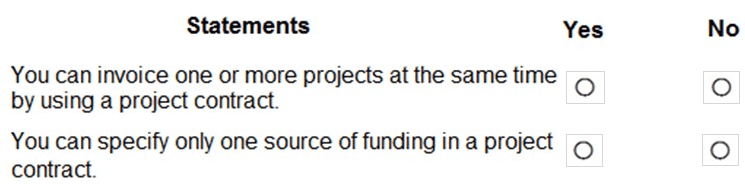
Explanation:
In Dynamics 365 Project Operations, the project contract serves as the primary billing agreement between your organization and its customers. It defines how work is invoiced and who is responsible for the costs. Unlike a simple sales order, a project contract can be linked to multiple individual projects, allowing for centralized billing management for large-scale operations that span different work streams or legal entities. This flexibility ensures that organizations can handle complex contractual requirements without duplicating administrative efforts.
Correct Option:
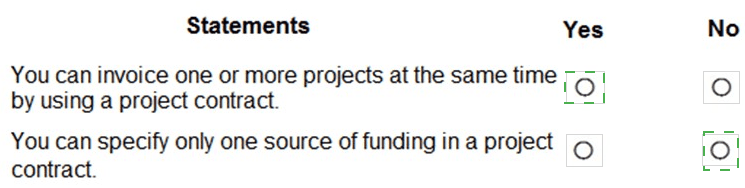
Invoice one or more projects (Yes):
A single project contract can be associated with multiple projects or sub-projects. This allows the system to generate a consolidated invoice that includes all "Ready to Invoice" transactions across every project linked to that specific contract, simplifying the billing process for the client.
Specify only one funding source (No):
Project contracts are highly flexible and can specify one or more sources of funding. This is used in scenarios where multiple parties, such as different departments, grants, or external partners, share the responsibility for funding project costs.
Split billing among multiple customers (Yes):
Dynamics 365 supports split billing, which allows you to define rules to distribute the cost and revenue of a single transaction among various funding sources. For example, you can set a 50/50 split between two customers for a specific set of project hours.
Incorrect Option:
Single Project Limit:
It is incorrect to assume a 1:1 relationship between a project and a contract. Restricting a contract to only one project would prevent a company from efficiently managing a program of work that involves multiple distinct project structures under one client agreement.
Manual Only Invoicing:
It is incorrect to believe that project invoices must be created manually one by one. The system supports automated batch runs and consolidated "Invoice Proposals" that can pull from multiple data sources simultaneously.
Fixed Funding Source:
Recommending a single funding source for a complex joint venture is incorrect. Since the system natively supports multiple funders and "Not-to-exceed" limits per source, using only one would require manual workarounds outside the system.
Reference:
Microsoft Learn: Project contracts overview in Project Operations.
Microsoft Learn: Project invoicing and billing rules.
Microsoft Learn: Split billing for project contracts.
For each of the following statements, select Yes if the statement is true. Otherwise, select No.
NOTE: Each correct selection is worth one point.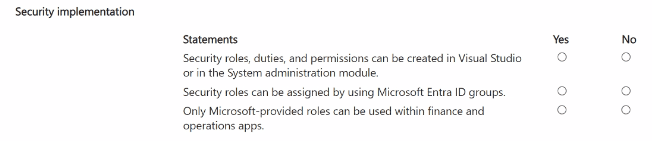
Explanation:
Dynamics 365 Finance and Operations uses a role-based security model to manage user access and protect sensitive business data. In this hierarchy, permissions are grouped into privileges, which are collected into duties, and finally bundled into security roles. This structure allows administrators to grant access based on an individual's job function rather than managing permissions for every user individually. It also ensures that licensing is correctly applied, as the license level is often determined by the highest-level security role assigned to a user.
Correct Option:
Users must be assigned to a role (Yes):
Without at least one security role, a user has no privileges and cannot view any part of the user interface or perform any tasks. Even "Basic User" roles must be explicitly assigned to provide foundational access to the system.
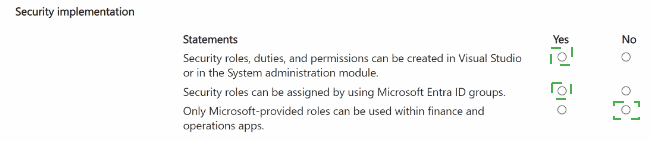
Custom security roles (Yes):
While Microsoft provides over 100 standard security roles out-of-the-box, administrators can duplicate and modify these or create entirely new custom roles to fit unique organizational needs.
Entra ID Group assignment (Yes):
Administrators can link Microsoft Entra ID (Azure AD) security groups to Dynamics 365. When a user is added to the Entra group, they automatically inherit the security roles assigned to that group within Finance and Operations, simplifying large-scale user management.
Incorrect Option:
Assigning Permissions Directly:
It is incorrect to suggest that permissions should be assigned directly to users. In the Dynamics 365 security model, permissions must be part of a privilege/role structure to be effective and maintainable.
Microsoft-Only Roles:
The claim that only pre-configured Microsoft roles can be used is false. The system is designed for extensibility, allowing developers to create custom security objects in Visual Studio or via the System Administration module.
Individual User Management Only:
Believing that users must be managed one-by-one is incorrect. Using Entra ID groups or automatic role assignment rules based on HR positions are the recommended "best practices" for efficient administration.
Reference:
Microsoft Learn: Role-based security in Finance and Operations apps.
Microsoft Learn: Security architecture and elements (Roles, Duties, Privileges).
Microsoft Learn: Manage user access using Microsoft Entra ID groups.
| Page 2 out of 13 Pages |
| Previous |