
Topic 3: Misc. Questions
A company is implementing Dynamics 365 and requires extensive data and end-to-end testing during each iteration.
You need to determine a testing strategy for multiple scenarios.
What should you recommend? To answer, drag the appropriate tools to the correct scenarios. Each tool may be used once, more than once, or not at all. You may need to drag the split bar between panes or scroll to view content.
NOTE: Each correct selection is worth one point.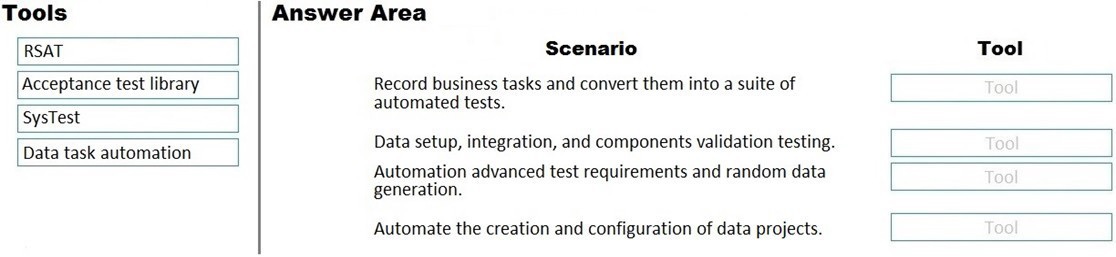
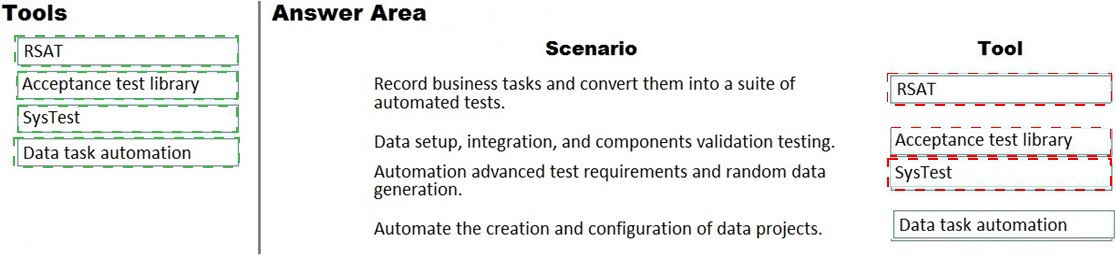
Explanation:
This question requires matching specific testing scenarios with the appropriate automation tool in the Dynamics 365 ecosystem. Each tool has a distinct primary purpose: RSAT for end-to-end business process testing, SysTest for developer-led unit/component testing, and the Data Task Automation framework for repetitive data setup.
Correct Mappings:
Record business tasks and convert them into a suite of automated tests: RSAT
The Regression Suite Automation Tool (RSAT) is designed precisely for this. Testers use Task Recorder to record a business process (e.g., create and confirm a sales order). RSAT then converts that recording into an automated test script that can be re-run. This is the standard tool for end-to-end business process regression testing.
Data setup, integration, and components validation testing: SysTest
SysTest is a developer framework within Visual Studio for writing unit and integration tests in X++. It is used by developers to test code components, data entities, and integrations at a granular level. "Data setup" and "components validation" are classic unit testing activities performed with SysTest.
Automation advanced test requirements and random data generation: SysTest
SysTest supports advanced testing patterns, including the use of data-driven tests and utilities to generate random or varied test data. This level of programmatic control over test logic and data is a feature of the developer-centric SysTest framework, not RSAT.
Automate the creation and configuration of data projects: Data task automation
The Data task automation framework (often part of the Data Management/DMF) is used to automate repetitive data-related tasks. This includes scripting the creation of data projects, configuring entities, setting up recurring data jobs, and executing data imports/exports. It is the tool for automating data lifecycle operations.
Incorrect Mappings / Reasoning:
Acceptance Test Library: This is not a standard primary tool name in this context. It might refer to a collection of RSAT test cases. It would not be the correct choice for developer-focused SysTest scenarios or data automation.
Using RSAT for data setup, integration testing, or advanced random data generation is incorrect. RSAT operates at the UI level for predefined business tasks and does not have the low-level, code-based flexibility for component validation or complex data generation.
Using Data task automation for recording business tasks or component testing is incorrect. Its scope is limited to data management operations, not UI-level test recording or code validation.
Reference:
Microsoft Learn documentation on RSAT, SysTest, and Data management and automation details the distinct purposes of these tools.
A company is using Dynamics 365 Finance.
You need to ensure that the production environment always uses the latest service updates from Microsoft. What should you recommend?
A. Deploy a production environment.
B. Set update settings for continuous updates.
C. Request the update through a service request.
D. Run the code upgrade service to analyze the code
Explanation:
For a Dynamics 365 Finance cloud deployment, Microsoft manages the application software updates. The goal is to have the production environment on the latest service updates automatically, minimizing manual effort and delay. This requires configuring the environment's update policy to opt into Microsoft's standardized update cadence.
Correct Option:
B. Set update settings for continuous updates.
In Lifecycle Services (LCS), you can configure the update settings for your production environment to enroll in continuous updates. This means the environment will automatically receive and apply Microsoft's regular, minor service updates during scheduled maintenance windows.
This ensures the environment always runs on a recent, supported version with the latest features, security patches, and performance improvements, directly meeting the requirement.
Incorrect Options:
A. Deploy a production environment.
This is a one-time action to create the environment. It does not address the ongoing process of receiving and applying future service updates from Microsoft. Deployment is a prerequisite, not a maintenance strategy.
C. Request the update through a service request.
This would be a manual, on-demand process for requesting a specific update, not a strategy to "always" have the latest updates. It is reactive, inefficient, and does not guarantee the environment stays current with all releases.
D. Run the code upgrade service to analyze the code.
The code upgrade service in LCS is used to analyze the impact of a new platform version on custom code during a version upgrade (e.g., moving from version 10.0.XX to 10.0.YY). It is not the mechanism for receiving routine service updates and does not apply updates itself. It is a preparatory tool for major upgrades, not for continuous maintenance.
Reference:
Microsoft Learn documentation on Service updates for Finance and Operations apps explains the two types of updates: service updates (continuous, minor) and version updates (major). It details how to configure environments in LCS to automatically apply continuous service updates.
A company is determining which reporting tools to use as part of a Dynamics 365 Finance
implementation.
Scenario A: Power users must use a free form tool to allow other power users to leverage transactional data to be consumed externally.
Scenario B: Developers must use a modeling tool to allow all users to leverage aggregated data to be consumed internally.
Scenario C: Developers must a free form tool to allow all users to leverage transactional and aggregated data to be consumed internally and externally.
Scenario D: Power users must use a free form tool to allow all users to leverage aggregated data to be consumed internally and externally.
Scenario E: Power users must use a modeling tool to allow other power users to leverage transactional data to be consumed externally.
You need to recommend which tool should be used for each scenario.
Which tool should you recommend? To answer, select the appropriate options in the answer area.
NOTE: Each correct selection is worth one point
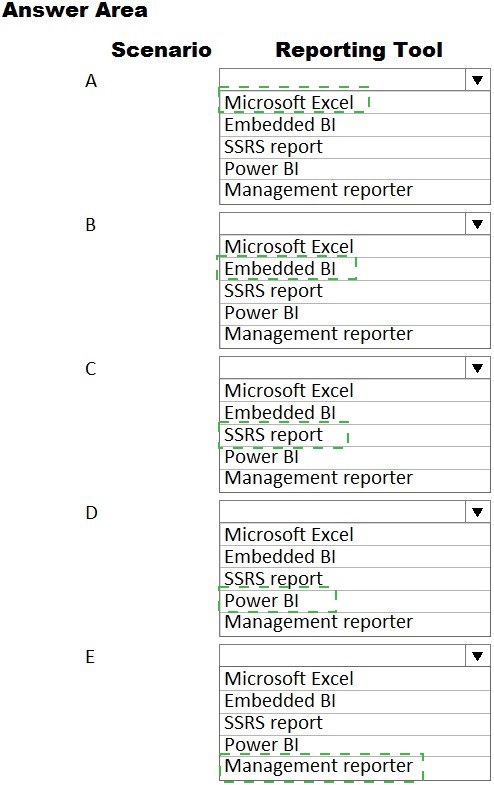
Explanation:
In Dynamics 365 Finance and Operations, selecting the correct reporting tool requires balancing the user persona (Developer vs. Power User), the data type (Transactional vs. Aggregated), and the intended audience (Internal vs. External). Solution Architects must distinguish between SSRS for high-volume document generation, Embedded BI for real-time operational insights within the client, and Power BI for complex cross-functional analysis. Choosing the wrong tool can lead to performance degradation or restricted data accessibility for external stakeholders.
Correct Options:
Scenario A:
Microsoft Excel Power users utilize the Excel Add-in as a free-form tool to interact with transactional data via OData entities. This is ideal for external consumption because Excel workbooks are easily shared and allow users to manipulate data outside the D365 environment without deep technical development.
Scenario B:
Embedded BI Embedded BI (Power BI embedded) allows developers to model aggregate data using Aggregate Dimensions and Measures in Visual Studio. These insights are integrated directly into D365 workspaces, providing all internal users with real-time, actionable analytics within their standard business processes.
Scenario C:
SSRS report SSRS is a developer-centric tool used to create precise, free-form layouts for both transactional and aggregated data. It supports internal needs (business documents) and external needs (invoices/statements) by generating PDFs or emails that can be shared with vendors and customers.
Scenario D:
Power BI Power BI is a free-form analytical tool that allows power users to create reports using the Power BI Desktop. By connecting to the Entity Store or Data Lake, it provides aggregated data visualizations that can be shared internally or published externally via the Power BI service.
Scenario E:
Management Reporter Now known as Financial Reporting, this is a modeling tool specifically for power users (finance professionals). It targets transactional ledger data to produce financial statements like Balance Sheets, which are often shared with external auditors or stakeholders in a standardized format.
Incorrect Options:
Scenario A (Embedded BI/SSRS):
Embedded BI is a modeling tool, not a free-form tool for power users. SSRS requires a developer to create the RDL definition in Visual Studio, making it unsuitable for power users looking for a flexible, ad-hoc tool to leverage transactional data.
Scenario B (Microsoft Excel/Power BI):
Excel is a free-form tool, not a modeling tool for developers to deploy to all users. Standalone Power BI is generally considered a "free-form" design experience; "modeling" in Scenario B refers to the metadata-driven Aggregate Measurements used in Embedded BI.
Scenario C (Management Reporter):
Management Reporter is restricted to financial data (GL) and cannot handle general transactional data across all modules. It is also a modeling tool with a specific row/column/tree structure, rather than a free-form developer design tool like SSRS.
Scenario D (SSRS/Management Reporter):
SSRS is a developer tool, not a power user tool. Management Reporter is a structured modeling tool for financial statements and lacks the free-form visualization flexibility required for broad aggregated data analysis across various business domains.
Scenario E (Power BI/Excel):
While Power BI uses modeling, it is often categorized as free-form for the end-user. Management Reporter is the more "classic" modeling tool for financial transactional data. Excel is purely free-form and lacks the formal modeling structures used for repeatable financial reporting.
Reference:
Microsoft Learn: Information access and reporting in Dynamics 365 Finance
A graphic design school is implementing ERP by using Dynamics 365 Finance.
The school needs to provide operational training and online training for employees.
You need to identify the right type of instance for the situation.
Which instance type should you recommend? To answer, drag the appropriate instance types to the correct requirements. Each instance type may be used once, more than once, or not at all. You may need to drag the split bar between panes or scroll to view content.
NOTE: Each correct selection is worth one point.

Explanation:
This question requires matching the purpose of each non-production activity to the appropriate environment tier in a Dynamics 365 Finance implementation. The key distinction is that User Acceptance Testing (UAT) requires a near-production environment that closely mirrors the live system, while training activities can occur in less critical, more flexible environments.
Correct Mappings:
Employee training: Sandbox
A sandbox (non-production) environment is ideal for hands-on employee training. It is isolated from live operations, allowing users to practice and make mistakes without affecting real business data. Sandbox environments can be refreshed or restored if needed, making them a safe, controlled space for learning.
Online courses: Sandbox
Similar to employee training, delivering structured online courses requires a stable, non-production environment. Using a sandbox ensures that the training data and exercises do not interfere with operational systems. It provides a consistent, dedicated environment for all course participants.
User acceptance testing: Production
User Acceptance Testing (UAT) must be performed in a production-tier environment. This is because UAT validates the final solution's performance, security, and business processes under conditions identical to the live system. Using a production-tier instance ensures accurate testing of data volumes, integrations, and user load before go-live. (Note: In practice, UAT is done in a pre-production or UAT sandbox that is a clone of production. However, in the context of these two given options—Sandbox vs. Production—the exam classifies the high-fidelity UAT environment as Production type, as it's the tier used for final validation.)
Incorrect Mappings / Reasoning:
Assigning Sandbox to UAT would be incorrect because standard sandbox environments (like a Tier 2) do not have the same performance characteristics, data scale, or exact configuration as the live production system, leading to inaccurate test results.
Assigning Production to Employee training or Online courses would be a severe misallocation of resources and a significant risk. Using the live operational system for training would corrupt transactional data, degrade performance for real users, and pose major security and compliance risks.
Reference:
Microsoft's environment strategy in Lifecycle Services (LCS) defines Production environments for live business operations and final acceptance testing. Sandbox environments (Standard Acceptance Test, Developer) are designated for development, testing, and training. The recommendation aligns with best practices for isolating training activities and reserving production-tier capacity for final validation and live use.
A company is moving financial workloads to Dynamics 365 Finance.
Balance sheet accounts do not require department dimension postings while profit and loss accounts require department dimensions.
You need to determine which functionality achieves the goal.
What should you recommend?
A. Legal entities
B. Financial dimensions
C. Account structures
D. Financial dimension sets
Explanation:
This scenario requires enforcing specific dimension entry rules at the account level. The system must allow postings to balance sheet accounts without a department dimension, while requiring the department dimension for all profit and loss (P&L) accounts. This is a configuration of validation rules tied to the chart of accounts structure.
Correct Option:
C. Account structures
Account structures define the mandatory and optional financial dimensions for groups of main accounts (like all balance sheet accounts vs. all P&L accounts).
You can create separate account structures: one for balance sheet accounts where the department dimension is set to Not allowed or Optional, and another for P&L accounts where the department dimension is set to Mandatory. Assigning the appropriate structure to each account type enforces the business rule directly during journal entry.
Incorrect Options:
A. Legal entities
Legal entities are the companies themselves (e.g., Contoso US, Contoso Germany). They are the containers for financial data but do not control dimension validation rules for individual accounts.
B. Financial dimensions
Financial dimensions (like Department, Cost Center) are the data attributes themselves. Enabling a dimension makes it available, but does not define when it is required. Dimensions are the building blocks, not the enforcement rules.
D. Financial dimension sets
Financial dimension sets are used to filter or restrict which dimension values are available for a specific purpose (like for a specific user, or in a specific journal). They control selectable values, not whether a dimension is mandatory for posting to an account.
Reference:
Microsoft Learn documentation on Account structures explains how to configure structures to define the dimension entry behavior for ledger accounts, including setting dimensions as optional, mandatory, or not allowed. This is the precise functionality needed to meet the requirement.
A client is implementing Dynamics 365 Finance.
You need to determine a testing solution to validate performance of critical business processes in the organization.
Which two tools should you use? Each correct answer presents a complete solution.
NOTE: Each correct selection is worth one point.
A. Task Recorder
B. SysTest
C. PerfSDK
D. Regression suite automation tool
Explanation:
The goal is to validate performance of critical business processes. This requires a two-step approach: first, accurately capture the steps of the business process, and second, execute that process under load to measure its performance. The tools must cover both process definition and performance load testing.
Correct Options:
A. Task Recorder
Task Recorder is the primary tool for capturing and defining the exact step-by-step workflow of a critical business process (e.g., "Procure-to-Pay" or "Order-to-Cash") from the user's perspective within the D365 UI. This recorded scenario forms the blueprint for what will be performance tested.
C. PerfSDK (Performance Software Development Kit)
The PerfSDK is the dedicated Microsoft tool for load and performance testing in Dynamics 365 Finance & Operations. It can consume the recordings created by Task Recorder, convert them into performance test scripts, and execute them with multiple virtual users to measure response times, throughput, and system stability under load, directly validating process performance.
Incorrect Options:
B. SysTest
SysTest is a developer framework for writing unit and integration tests in X++ within Visual Studio. It is used to test code correctness at a component level, not to measure end-to-end business process performance under load from a user perspective.
D. Regression suite automation tool (RSAT)
RSAT is for functional regression testing. It automates the execution of business process tests to verify they still work correctly after an update. While it uses Task Recorder recordings, its purpose is functional validation (pass/fail), not performance measurement (response times, scalability under load).
Reference:
Microsoft Learn documentation on performance testing outlines the standard methodology: use Task Recorder to document key scenarios and the PerfSDK to create and run load tests based on those recordings. This combination is specifically designed to validate business process performance.
An organization is implementing Dynamics 365 Finance
You need to assign security roles.
Which tools should you use? To answer, drag the appropriate tools to the correct tasks.
Each tool may be used once, more than once, or not at all. You may need to drag the split
bar between panes or scroll to view content.
NOTE: Each correct selection is worth one point.

You are preparing a proof of concept environment using Dynamics 365 Finance.
You need to analyze the results generated from the Regression suite automation tool (RSAT). Which Lifecycle Services tool should you use to store the RSAT testing files?
A.
Asset library
B.
Business process modeler
C.
Usage profiler
D.
Methodologies
Business process modeler
A winery is considering using Dynamics 365 Finance to implement a large-scale ERP
application and needs to understand the differences between cloud-based and onpremises
deployments.
You need to recommend deployment options for the company.
What should you recommend? To answer, drag the appropriate deployment types to the
correct features. Each deployment type may be used once, more than once, or not at all.
You may need to drag the split bar between panes or scroll to view content.
NOTE: Each correct selection is worth one point.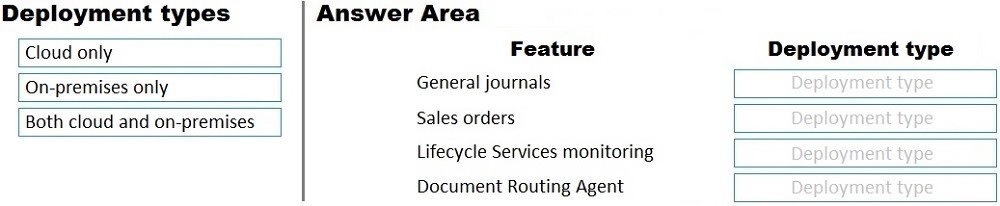
http://selfexamtraining.com/uploadimages/MB-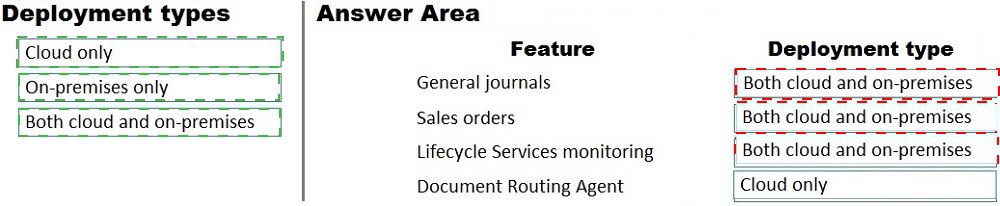
You are configuring automated business processes for an organization.
The business analyst has identified the following requirements:
Invoices need to be approved before payment.
A person who submits an item to workflow cannot approve that item.
You need to recommend a configuration workflow.
What should you recommend?
A.
Creae an advanced rule to validate signing limit in the workflow.
B.
Leave workflow settings at default to prevent approvals.
C.
Create a special rule in the workflow to prevent approval.
D.
Enable Disallow approval by submitter in the workflow configuration
Enable Disallow approval by submitter in the workflow configuration
company needs to create customer-facing documents in Dynamics 365 Finance.
The company does not have an in-house developer.
You need to determine a solution for creating the documents.
Which three tools should you recommend? Each correct answer presents a complete
solution. NOTE: Each correct selection is worth one point.
A.
SSRS reports
B.
Microsoft Excel
C.
Electronic reporting
D.
Microsoft Word
E.
Financial reports
Microsoft Excel
Electronic reporting
Microsoft Word
A company that rents photocopiers is implementing Dynamics 365 Supply Chain
Management.
Technicians carry spare parts in their trucks to use during maintenance visits.
You need to determine how to capture the parts consumed.
Where should you capture this information?
A.
Fixed Assets module
B.
Service module
C.
Service agreement
D.
Sales order
Fixed Assets module
| Page 3 out of 9 Pages |
| Previous |