
Which access points (APs) will be considered for inclusion in the AP Offline Marvis Action?
A. all APs assigned to sites that have connected to the cloud previously
B. all APs assigned to sites
C. all APs in inventory
D. all purchased APs
Explanation:
The "AP Offline" Marvis Action detects access points that are offline due to lack of power, loss of cloud connectivity, or other issues . According to official Juniper documentation, Marvis can determine the scope of offline AP actions by evaluating the connection history and prior connectivity status of APs .
Marvis monitors APs by tracking their cloud connectivity status. For an AP to be considered for the Offline action, the system must have previously observed it connected to the cloud. This historical baseline is necessary because Marvis cannot determine that an AP is "offline" if it has never been online in the first place. A new AP that has just been added to inventory but never assigned to a site or connected to the cloud would not trigger this alert—it is simply "unclaimed" or "not yet deployed" rather than "offline" .
The AP Offline alert is specifically triggered when a previously connected AP loses cloud connectivity or power. The scope analysis can identify various scenarios: an entire site down with all APs losing cloud connectivity, a switch failure causing downstream APs to go offline, or individual APs that are locally reachable but disconnected from the cloud .
Why other options are incorrect:
B. all APs assigned to sites – An AP can be assigned to a site but never powered on or connected to the cloud. Marvis cannot consider such APs "offline" because they were never online. The alert requires a prior connection state to establish a baseline.
C. all APs in inventory
– The inventory includes APs that are claimed but may still be in boxes, never deployed, or not yet assigned to any site. These APs have no connectivity history, so Marvis cannot generate an Offline action for them .
D. all purchased APs
– Purchased APs might not even be claimed in the inventory system yet. Without being claimed and having established prior cloud connectivity, they are outside the scope of Marvis monitoring for offline detection.
References:
Juniper Marvis Actions Documentation: "Marvis detects APs that are offline due to lack of power, loss of cloud connectivity, or any other issue"
Juniper AP Actions Guide: "Marvis can determine the scope of offline AP actions" including cases where APs were previously connected
Which Wireless Assurance SLE has classifiers of Association, Authorization, DHCP, and Internet Services?
A. Roaming
B. Coverage
C. Time to Connect
D. Capacity
Explanation:
The Time to Connect SLE measures how long it takes for a client to successfully connect to the internet, calculated from the first association packet to when the client can successfully move data. The classifiers for Time to Connect specifically track each phase of the connection lifecycle:
Association – Time to complete the association state exceeds 2 sigma from the site average
Authorization (Authentication) – Time to complete authentication exceeds 2 sigma from the site average
DHCP – DHCP time exceeds 2 sigma from the average successful completion time
Internet Services (IP Services) – Time between DHCP completion and the first DNS packet exceeds 2 sigma from the moving average
The official Mist API documentation confirms these exact classifiers: "Time to Connect: Association, Authorization, DHCP, Internet Services".
Why other options are incorrect:
A. Roaming
– The Roaming SLE tracks client transitions between APs. Its classifiers include Signal Quality, Wi-Fi Interference, Ethernet, and Capacity. Roaming does not involve Association, Authorization, DHCP, or Internet Services classifiers.
B. Coverage
– The Coverage SLE tracks signal strength issues. Its classifiers include Asymmetry Downlink, Asymmetry Uplink, and signal-related metrics. It does not track connection-phase classifiers like DHCP or Association.
D. Capacity
– The Capacity SLE tracks airtime utilization, interference, and client density issues. Its classifiers include Wi-Fi Interference and Non-Wi-Fi Interference, not Association, Authorization, DHCP, or Internet Services.
References:
Mist SLE API Documentation: "Time to Connect: Association, Authorization, DHCP, Internet Services"
Mist Service Level Expectations Guide: Lists all classifiers for Time to Connect including IP Services Latency (Internet Services)
A wireless client tries to use the highest modulation method available to have optimal throughput. When the wireless client moves further away from the access point, the signal is not strong enough. Consequently, it will step down the speed based on the modulation available at that distance from the AP. Which mechanism would explain this scenario?
A. Received signal strength indicator
B. Signal-to-noise ratio
C. Dynamic rate shifting
D. Free space path loss
Explanation:
Dynamic rate shifting (also known as Adaptive Rate Selection or Link Adaptation) is the mechanism by which a wireless client and AP automatically adjust the data rate downward as signal strength decreases when moving away from the AP, and upward as signal strength improves when moving closer. This process ensures the connection remains stable, trading throughput for reliability at longer distances.
Why C is correct:
The scenario explicitly describes a client "stepping down the speed based on the modulation available at that distance" — this is the textbook definition of dynamic rate shifting. In 802.11, lower modulation schemes (e.g., BPSK 1/2) are more robust but slower, while higher schemes (e.g., 256-QAM 5/6) are faster but require better SNR. The client and AP negotiate the highest usable MCS (Modulation and Coding Scheme) index in real time based on current RF conditions (RSSI, SNR, and PER). When moving further away, the signal weakens and the device shifts to a lower, more resilient rate.
Why A (RSSI) is incorrect:
Received Signal Strength Indicator is a measurement of signal power (in dBm), not a mechanism. While RSSI is an input to dynamic rate shifting, it does not perform the rate adjustment itself. The question asks for the mechanism that explains the behavior.
Why B (SNR) is incorrect:
Signal-to-Noise Ratio is a measurement (signal power relative to background noise), not a rate‑changing mechanism. SNR influences dynamic rate shifting decisions but is not the mechanism that steps down the speed.
Why D (Free space path loss) is incorrect:
Free space path loss is a theoretical physics principle describing how signal strength decreases predictably with distance over open air. It explains why signal weakens, but it does not describe the adaptive mechanism that changes modulation and data rate in response.
References
*802.11-2020 IEEE Standard*: "Dynamic rate adaptation allows a station to select the highest supported MCS that can be successfully decoded given current channel conditions."
Mist AI Documentation – RF Fundamentals: "Dynamic rate shifting automatically adjusts MCS index based on RSSI, SNR, and frame error rate to balance throughput and reliability."
Mist WLAN objects are configurable at which two levels? (Choose two.)
A. site group
B. organization
C. site
D. access point
Explanation:
In the Juniper Mist configuration hierarchy, WLAN objects (wireless network configurations) can be created and configured at two distinct levels: the organization level and the site level. This two-tier approach provides flexibility for network administrators to balance broad, consistent deployment with location-specific customization.
B. Organization-level WLANs are defined globally and can be applied across multiple sites simultaneously. This is typically done through Configuration Templates, which streamline deployment by allowing administrators to create standardized WLAN settings once and push them to many sites. Organization-level configurations are ideal for enterprise-wide SSIDs, security policies, or global guest networks that should behave identically across all locations.
C. Site-level WLANs are configured individually for each physical location or logical division (e.g., a specific office building, campus, or floor). These settings override or supersede organization-level configurations when both exist. Site-level WLANs allow for location-specific adjustments such as unique SSIDs, different VLAN assignments, or region-specific RF settings without affecting other sites.
The hierarchical relationship follows this order of precedence: device-level settings > site-level settings > organization-level templates. This means a WLAN defined at the site level will take precedence over an organization-wide template, while individual AP settings can further override site configurations.
Why other options are incorrect:
A. Site group
– Site groups are a logical collection used primarily for MSP (Managed Service Provider) or organizational grouping purposes, but they are not a direct configuration level for WLAN objects. WLANs are applied to sites, not directly to site groups.
D. Access point
– While individual APs can have device-specific overrides (such as radio settings or port configurations), WLANs themselves are not configured directly at the AP level. APs inherit WLAN configurations from their assigned site or organization; you cannot create a WLAN that exists only on a single AP without first defining it at the site or organization level.
References
Juniper Mist Configuration Hierarchy: "Juniper Mist has a three-tier configuration hierarchy: Organization, Site, Devices"
JWMA Course Outline: "Explain the difference between organization-level and site-level configuration objects"
You are installing and booting up your first Juniper Mist AP at your site. By default, which two statements are correct in this scenario? (Choose two.)
A. The AP will attempt to connect to the Mist cloud using port 443.
B. The AP will send DHCP requests using the native VLAN.
C. The AP will send DHCP requests with a VLAN ID of 10.
D. The AP will attempt to connect to the Mist cloud using port 8080.
Explanation:
When a Juniper Mist AP boots up for the first time out of the box, its behavior follows a predictable default sequence. Understanding this initial connection process is important for successful deployment.
Why A is correct: The AP needs to establish a secure connection to the Mist cloud for management and configuration. To do this, it initiates an outbound connection on TCP port 443 (HTTPS) . This is the standard port for encrypted web traffic, and it must be open on your firewall for the AP to communicate with cloud services like ep-terminator.mistsys.net .
Why B is correct:By default, a new, unconfigured Mist AP expects its uplink switch port to be configured as a trunk. It will send its initial DHCP request on the native VLAN, which is typically VLAN 1 . This behavior is by design, as the AP assumes the native VLAN will provide it with a path to the internet and the Mist cloud .
Why other options are incorrect:
C. The AP will send DHCP requests with a VLAN ID of 10:
This is false. An AP only sends a tagged DHCP request (with a specific VLAN ID like 10) if it has been explicitly configured to do so, either individually or via a device profile . Out of the box, it uses the untagged native VLAN.
D. The AP will attempt to connect to the Mist cloud using port 8080: >
This is also false. Port 8080 is an alternate HTTP port and is not used by Mist APs for cloud connectivity. While 8080 is sometimes used for local proxy services, the primary, non-configurable path to the cloud is over TCP port 443 .
References
Juniper Mist Documentation - Configure IP Settings: "When powered on for the first time, Juniper Mist APs send a DHCP request through the Eth0 interface. The switch port connected to the AP must be a trunked port, or be configured with a native VLAN where VLAN ID is 1" .
Mist Documentation - Check cloud connectivity: "To ensure your Access Point has access to the Mist cloud, please make sure firewalls aren’t blocking port 443" .
At which signal strength level range will an extra AP placed on the same channel cause cochannel contention?
A. -45 dBm to -65 dBm
B. -55 dBm to -80 dBm
C. -25 dBm to -80 dBm
D. -65 dBm to -85 dBm
Explanation:
Co-channel contention occurs when multiple access points (APs) operate on the same frequency channel, forcing them to share airtime and defer to each other's transmissions. The critical factor is the CCA-SD (Clear Channel Assessment - Signal Detect) threshold, which determines at what signal level a radio detects another transmission as "busy."
Why D is correct: Modern 802.11 radios trigger CCA-SD when they detect a signal just 4 dB above the noise floor . With a typical noise floor around -90 dBm to -95 dBm, this means co-channel contention begins as low as -85 dBm to -90 dBm. The range -65 dBm to -85 dBm represents the "danger zone" where:
At -65 dBm: Strong enough to cause significant contention (the radio will definitely defer)
At -85 dBm: Near the CCA-SD threshold where even weak distant APs cause deferral
This aligns with industry guidance that recommends looking for co-channel interferers when signals fall within this range . In this zone, APs on the same channel will detect each other's preambles and back off, reducing overall throughput even though clients may still have adequate signal strength .
Why other options are incorrect:
A. -45 dBm to -65 dBm
– At these very strong levels, co-channel contention is severe, but this range misses the lower boundary where contention begins. The question asks where an extra AP "will cause" contention, which starts at the CCA-SD threshold (~ -85 dBm), not at -65 dBm.
B. -55 dBm to -80 dBm
– While partially correct, this range excludes the critical -80 dBm to -85 dBm zone where contention begins.
C. -25 dBm to -80 dBm
– The upper end (-25 dBm) is extremely strong and unrealistic for practical WLAN deployment, but more importantly, this range misses the -80 dBm to -85 dBm boundary where contention initiates.
References:
*802.11 Standard – CCA-SD*: "Radios detect 802.11 preambles at levels just 4 dB above the noise floor"
Industry Best Practices: "Look for co-channel interference at signal strengths between -35 dBm and -85 dBm"
You are troubleshooting a client that has had intermittent connectivity problems. Using Marvis to troubleshoot, you see that AP uptime is negatively affecting the client. When inspecting Marvis' troubleshooting response, which category should you select to see when the AP went offline?
A. Location
B. Correlation
C. AP Metrics
D. Classifiers
Explanation:
When you use Marvis to troubleshoot a client and the analysis indicates that "AP uptime" is negatively affecting that client, you need to view the access point's operational history to see when it went offline. The AP Metrics category is specifically designed for this purpose.
When you select AP Metrics within Marvis' troubleshooting response, you gain access to the AP's historical operational data. This view typically includes key performance indicators such as:
Uptime statistics: Exactly when the AP was last rebooted or lost power.
CPU and memory utilization.
Radio statistics and channel utilization.
If the AP had a power interruption or a software crash, its uptime counter resets. Marvis correlates this metric with the client's connection failures. If the client's "bad events" happen simultaneously with the AP's uptime resetting (meaning the AP rebooted), Marvis can determine that the AP's stability is the root cause of the client's problem.
Why other options are incorrect:
A. Location
– This category provides physical location data, floor plans, and RF heatmaps. It helps with coverage issues but does not contain AP uptime or reboot history.
B. Correlation
– This view shows the "Scope of Impact" . It identifies which devices (APs, WLANs, or other clients) share the same problem pattern, but it does not show the AP's internal metric history like uptime.
D. Classifiers
– This section categorizes the type of failure (e.g., Authorization, DHCP, Association). While "AP Uptime" might be named as a specific classifier in some contexts, the question asks for the category selected to see when the AP went offline (i.e., to view the timeline/metrics), not just the failure label.
References:
Marvis Troubleshooting Guide: "Clicking on a particular failure reveals details about that failure. 'Failure Timeline' & 'Insights' provides redirection to the relevant pages".
JNCIS-MistAI Exam Practice: Recognizes "AP Metrics" as the correct category for viewing AP uptime impact on clients.
What does Mist qualify as a rogue AP?
A. An unauthorized AP on your wired network
B. A neighbor AP
C. An AP close to your network as measured by RSSI
D. A honeypot AP
Explanation:
According to official Juniper Mist documentation, a Rogue AP is specifically defined as any access point that meets two criteria:
It is not claimed onto your Organization (unauthorized)
It is detected as connected on the same wired network as your legitimate APs
This definition distinguishes rogue APs from other types of unwanted APs based on the key factor: physical connection to your wired infrastructure. A rogue AP represents a direct security risk because it provides an entry point into your internal LAN. The intent can be malicious (someone trying to gain illicit access) or benign (an employee creating their own hotspot to improve coverage), but either way, it is a security concern.
Rogue AP detection is disabled by default in Mist and must be manually enabled under Site Settings. Once enabled, you can set an RSSI threshold (default -80 dBm) for detection.
Why other options are incorrect:
B. A neighbor AP
– Neighbor APs are detected in the vicinity but are not connected to your wired network. These are simply other wireless networks operating nearby that your Mist APs can hear. While they may cause interference, they do not pose the same security risk as a rogue AP.
C. An AP close to your network as measured by RSSI
– Mist does not classify APs as rogue based on signal strength alone. You can configure an RSSI threshold to filter detection results, but proximity/RSSI is not the defining characteristic of a rogue AP.
D. A honeypot AP
– A honeypot (also known as an Evil Twin) is an unauthorized AP that advertises your SSID to trick users into connecting and capturing their credentials. While also a security threat, Mist distinguishes between rogues (connected to your wired network) and honeypots (spoofing your SSID over the air). Honeypot detection is enabled by default—the opposite of rogue detection.
References:
Mist Documentation – Rogue, Neighbor and Honeypot APs: "Rogue APs are defined as any AP not claimed onto your Organization, but detected as connected on the same wired network"
Juniper Networks Documentation: "Rogue APs are any wireless APs installed on your wired network without authorization"
You must define VLANs as untagged, tagged, or using VLAN pooling. In this scenario, where would you accomplish this task in the Juniper Mist UI?
A. site settings
B. WLAN settings
C. organization settings
D. policy settings
Explanation:
In the Juniper Mist UI, the definition of how VLANs are handled for wireless clients—whether they are untagged (using the AP's native/management VLAN), tagged (assigned a specific VLAN ID), or part of a VLAN Pool (distributing clients across multiple VLANs to reduce broadcast domain size)—is configured within the WLAN settings.
When you create or edit a WLAN, the "VLAN" section allows you to specify these behaviors. This ensures that any client connecting to that specific SSID is mapped to the correct network segment.
Why Other Options are Incorrect
Option A: Site settings are used to define site-wide parameters like time zones, AP local status pages, or radio management (RRM) defaults. While you can define a "Management VLAN" here, the specific mapping for user traffic happens at the WLAN level.
Option C: Organization settingsdeal with high-level administrative tasks, such as SSO, API keys, and global object definitions. While you can create WLAN Templates at the Org level, the actual "untagged/tagged/pooling" logic is still a component of the WLAN object settings within those templates.
Option D: Policy settings (such as WXLAN policies) are used to permit or deny traffic based on user roles or resources. They do not define the primary VLAN tagging or pooling mechanism for the SSID itself.
Reference
Juniper Mist Documentation: WLAN CLI & Config — "VLAN Tagging and Pooling."
JNCIS-MistAI Exam Objectives: Section 3 (WLAN Configurations) — Configuring SSIDs and VLAN mapping.
According to the 802.11 standard, how wide are 2.4 GHz band OFDM channels?
A. 5 MHz
B. 22 MHz
C. 20 MHz
D. 3 MHz
Explanation:
The 802.11 standard specifies that for Orthogonal Frequency Division Multiplexing (OFDM) operation in the 2.4 GHz band, the channel width is 20 MHz.
This specification applies to 802.11g and 802.11n (when operating in 20 MHz mode) in the 2.4 GHz frequency range. The 20 MHz channel consists of 64 subcarriers, with 48 used for data and 4 used as pilots for synchronization.
It is important to distinguish OFDM from the legacy Direct Sequence Spread Spectrum (DSSS) modulation used in original 802.11b. DSSS requires a 22 MHz channel width. The question specifically asks about OFDM channels, which are defined as 20 MHz.
Why other options are incorrect:
A. 5 MHz – This channel width applies to specific configurations in the 5 GHz band for certain 802.11 OFDM modes (e.g., half-clocking), not to standard 2.4 GHz OFDM operation.
B. 22 MHz – This is the channel width for DSSS modulation (802.11b), not for OFDM.
D. 3 MHz – This is not a defined channel width in any 802.11 standard for 2.4 GHz operation.
References:
*IEEE 802.11-2012 Standard, Section 18*: OFDM PHY specifies 20 MHz bandwidth
Wi-Fi Standards Table: 802.11g and 802.11n (2.4 GHz) list 20 MHz channel width
2.4 GHz Channel Allocation: OFDM requires 20 MHz channel spacing
What do 802.11 stations perform to help avoid collisions on the WLAN medium?
A. 802.11 stations detect collisions and set a back-off timer.
B. Listen to verify that the medium is free before transmitting.
C. Stations only transmit when polled by the access point.
D. Transmit on a fixed schedule.
Explanation:
802.11 stations use a mechanism called Carrier Sense Multiple Access with Collision Avoidance (CSMA/CA) . Unlike wired Ethernet, which can detect collisions after they happen (CSMA/CD), Wi-Fi radios cannot transmit and listen at the same time because they are half-duplex. Therefore, they must avoid collisions before they occur.
The primary method for avoiding collisions is Clear Channel Assessment (CCA) . Before a station transmits, it "listens" (senses) the wireless medium for energy. If energy is present (indicating another station is transmitting), the station defers and waits a random back-off period before trying again. Only after verifying the medium is free will the station transmit.
Why other options are incorrect:
A. 802.11 stations detect collisions and set a back-off timer.
— This is incorrect because 802.11 stations cannot detect collisions reliably (they cannot listen while transmitting). This describes CSMA/CD (used in Ethernet), not CSMA/CA (used in Wi-Fi).
C. Stations only transmit when polled by the access point.
— This describes polling (used in some legacy or point-to-point systems), not standard Wi-Fi. In infrastructure mode, stations contend for the medium; the AP does not continuously poll each station.
D. Transmit on a fixed schedule.
— This is Time Division Multiple Access (TDMA) , which is not part of standard 802.11 DCF (Distributed Coordination Function). Wi-Fi uses random back-off, not fixed schedules.
References:
*IEEE 802.11-2020 Standard*: "CSMA/CA requires a station to sense the medium before transmitting; transmit only if medium is idle."
Mist AI Documentation – RF Fundamentals: "Clear Channel Assessment (CCA) determines if the wireless medium is busy. Stations defer transmission if energy above threshold is detected."
You are asked to deploy a new Juniper Mist Edge VM for your customer.
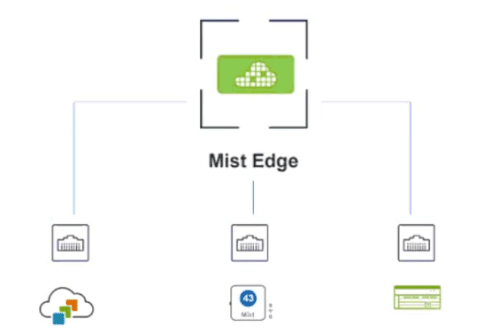
Referring to the exhibit, which three interfaces are required to accomplish this task?
(Choose three.)
A. out-of-band
B. downstream
C. proxy
D. upstream
E. revenue
Explanation:
Based on the official Juniper Mist and Juniper Networks documentation for Virtual Mist Edge deployment, the VM requires three virtual network interfaces to function correctly .
Why A, B, and D are correct:
A. Out-of-band (OOBM)
– This is the management interface. It is required for the Mist Edge VM to communicate with the Mist Cloud for configuration, telemetry, and statistics. It also handles the RADIUS proxy service (RadSec) on TCP port 2083 and connects to the EP-terminator service on TCP port 443 .
B. Downstream
– This is the Tunnel IP interface. It terminates the L2TPv3 or IPsec tunnels coming from the Mist Access Points (APs). The downstream port receives encapsulated traffic from the APs. It must allow incoming UDP port 1701 (L2TPv3) or UDP ports 500/4500 (IPsec) .
D. Upstream
– This is the Data interface. It connects to the trusted wired network (core/aggregate switch). After the Mist Edge decapsulates the tunneled traffic from the AP, it forwards the client traffic out the upstream port. This port is typically configured as a trunk carrying all the user VLANs mapped to the WLANs .
Why the other options are incorrect:
C. Proxy
– This is not a required interface type for the Virtual Mist Edge. While the Mist Edge VM can function as an Auth Proxy, this functionality is delivered over the OOBM interface, not a dedicated "Proxy" interface .
E. Revenue
– This is not a valid networking interface type in the context of Juniper Mist Edge deployment. It appears to be a distractor term.
References
Mist Documentation - Virtual Mist Edge: "Mist Edge requires the following three virtual NIC interfaces: Out of Band Management (OOBM), Tunnel IP, Upstream"
Juniper Networks Documentation - Getting Started: "Mist Port (Out-of-Band Management Port), Tunnel Port, Data Port"
| Page 2 out of 10 Pages |
| 123 |
| JN0-452 Practice Test Home |
Real-World Scenario Mastery: Our JN0-452 practice exam don't just test definitions. They present you with the same complex, scenario-based problems you'll encounter on the actual exam.
Strategic Weakness Identification: Each practice session reveals exactly where you stand. Discover which domains need more attention, before Mist AI Wireless - Specialist (JNCIS-MistAI-Wireless) exam day arrives.
Confidence Through Familiarity: There's no substitute for knowing what to expect. When you've worked through our comprehensive JN0-452 practice exam questions pool covering all topics, the real exam feels like just another practice session.
Copyright © All Rights Reserved