
What does coherence refer to in the SAP Fiori design principles? Note: There are 2 correct answers to this question.
A. A consistent interaction and visual design language
B. Design for business users needs and their work
C. Solves multiple use cases
D. The same intuitive experience across the whole enterprise
Explanation:
Coherence is about the "look and feel" and the "behavioral predictability" of the software suite.
A consistent interaction and visual design language (A):
Coherence means that a "Save" button looks the same, is located in the same place, and behaves the same way across all apps (whether it’s a Sales app or an HR app). By using a common design language (like the Quartz or Horizon themes) and shared UI patterns, users don't have to "re-learn" how to use the system every time they open a new tool.
+1
The same intuitive experience across the whole enterprise (D):
This refers to the broad application of the design standards. Whether the app is built with SAPUI5, SAP Fiori Elements, or even integrated legacy screens (via Screen Personas), the goal is for the user to perceive them as a single, unified enterprise system. This reduces training costs and increases user adoption.
Why the Other Options are Incorrect:
B. Design for business users needs and their work:
This is the definition of the Role-based principle. Role-based design focuses on specific personas and tasks, whereas Coherence focuses on the uniformity of the interface across those different roles.
C. Solves multiple use cases:
This is actually the opposite of what Fiori aims for. Fiori apps should be Simple, meaning one app should ideally focus on one specific task or a small set of related tasks. Attempting to solve "multiple [unrelated] use cases" in one app leads back to the complex "mega-transactions" of the past.
References:
SAP Learning (UX100): SAP Fiori Foundation – Unit 1, Lesson 2: "SAP Fiori Design Principles."
SAP Design Guidelines: The "Coherent" section explains how shared layouts and controls create a sense of harmony across the portfolio.
You created a new catalog that contains some apps. You want to assign these apps to an
existing role to provide authorization for
the business users.
How can you do this using the PFCG transaction?
A. By adding the semantic object to the catalog and group
B. By adding the catalog to the menu tab of the role
C. By assigning the authorization profile for the catalog in the authorization tab
D. By adding the tile and target mapping to the group
Explanation:
To assign apps from a catalog to an existing role using transaction PFCG, you must add the catalog to the Menu tab. This is the only documented method across all SAP official sources . The procedure: open the role in PFCG → Menu tab → "Add SAP Fiori Launchpad Catalog" → select catalog → critically: check "Include Applications" . This automatically reads all target mappings in the catalog, adds the referenced applications (OData services, transactions) as sub-nodes, and generates authorization proposals for the Authorization tab .
❌ Why other options are incorrect:
A. By adding the semantic object to the catalog and group:
Incorrect. Semantic objects are defined in transaction /UI2/SEMOBJ as part of target mapping configuration, not role assignment. You never add semantic objects to roles in PFCG .
C. By assigning the authorization profile for the catalog in the authorization tab:
Incorrect. The Authorization tab is where you generate the profile after the catalog is already in the Menu tab. There is no direct "catalog authorization profile" to assign—the profile is built from menu content .
D. By adding the tile and target mapping to the group:
Incorrect. Groups determine tile layout visibility on the launchpad, not authorizations. Catalogs provide authorizations; groups only organize tiles . Adding a group to the Menu tab does not assign any app permissions .
📚 References:
SAP Help Portal: "Add the relevant business catalog to the role menu... select the Include Applications checkbox"
To perform a QUnit test, what do you include in a test page under your webapp folder?
A. Mock code
B. Stub code
C. SAPUI5 bootstrap code
D. OPA function
You need to consume the OData Service from the Gateway to create a new SAP Fiori app in the SAP Web IDE What value do you configure in the WeblDEUsage property for the destination in the SAP HANA Cloud Platform?
A. dev_abap
B. odata_xs
C. odata_gen
D. odata_abap
While testing an SAP Fiori app you discover that a button on the page delivers no response. Which of the following agile pyramid options do you use?
A. Sinon
B. QUnit
C. OPA
D. Mock server
Which HTTP request methods does the SAP Gateway server use to compute and return a new eTag in a response header? Note: There are 2 correct answers to this question.
A. POST
B. DELETE
C. PUT
D. get
SAP Fiori Elements utilizes a metadata-driven approach for SAP Fiori app development. What are the implications of this?
A. SAPUI5 Smart Controls must be created by developers to utilize the OData annotations and metadata of SAP Fiori Elements templates.
B. The SAPUI5 runtime interprets metadata and annotations of the OData service and uses the corresponding views for the Fiori app at startup.
C. Smart Templates must be used by the developer to consume OData annotations and metadata so the SAPUI5 runtime can use the corresponding view.
D. App developers must use JavaScript to allow their applications to read OData annotations and metadata
In the code on the screenshot, what are the absolute paths of the property that retrieves
the City value for the company Acme
Inc.? _
Note: There are 2 correct answers to this question.
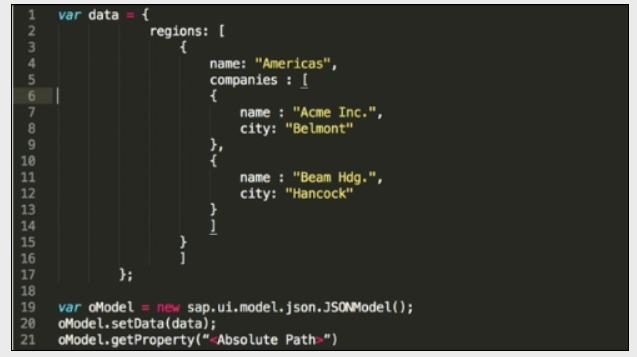
A. /regions/companies/O/city
B. /regions/1/companies/l/city
C. /regions/0/companies/O/city
D. /region[0]/companies[O]/city
What activity does the QUnit Stub functionality perform?
A. Supplies parameters for method calls.
B. Provides parameters and return values for method calls.
C. Retuns values for method calls
D. Verifies that expected methods are called correctly.
Which tile types can you use to display real-time data values that are read from an OData service? Note: There are 2 correct answers to this question.
A. App Launcher — Dynamic tile
B. App Launcher — Static tile
C. News tile
D. KPI-based tile
Which SAP Fiori application can you launch using the search function instead of a tile?
A. Transactional
B. Factsheet
C. Analytical
D. Legacy
Your customer requests a special create method to enable the creation of the full OData hierarchy. Which OData service method can you use?
A. EXECUTE_DEEP_INSERT
B. CREATE_BATCH_ENTITY
C. CREATE_STREAM
D. CREATE_DEEP_ENTITY
| Page 2 out of 7 Pages |
| Previous |