
Money is value. Having money when you need it is very important. Money can also be valuable when used wisely by knowing when to spend and when to conserve Also, planning now for future expenses can be a plus to the company rather than a debit. There are several ways to capitalize money and spending. Basically there is the single payment method that has a compound amount factor and a present worth factor. There is the uniform annual series that has a sinking fund factor, capital recovery factor and also the compound amount factor and present worth factor. At this point, we can assure money is worth 10%. The following question requires your selection of CCC/CCE Scenario 7 (4.8.50.1.1) from the right side of your split screen, using the drop down menu, to reference during your response/choice of responses. If $10,000 is scheduled to be paid out 5 years from now, what is the minimum amount we can invest today?
A. $3,855
B. $8,129
C. $6,209
D. $3,791
After collecting the control information on a light rail project within an original budget of 200.000 work hours, the construction contractor is ready for their monthly progress meeting with the client. A total of 100.000 work hours have boon scheduled to date. with 105.000 work hours earned, and 110.000 work hours paid. The stated progress by the contractor Is 60%. What is the cost variance (CV)?
A. BCWP-ACWP = 105,000-110,000 = -5,000
B. ACWP-BCWP = 110,000-105,000 = 5,000
C. BCWS-ACWP = 100,000-110,000 = -10,000
D. ACWP-BCWS = 110,000-100,000 = -10,000
Which of the following is a common technique to approximate the standard deviation?
A. Range/4
B. Range/16
C. Range * 2
D. Square root of the range
A major theme park is expanding the existing facility over a five-year period. The design phase will be completed one year after the contract is awarded. Major engineering drawings will be finalized two years after the design contract is awarded and construction will begin three years after the award of the design contract. New, unique ride technology will be used and an estimate will need to be developed to identify these costs that have no historical data. Which of the following methods a used for creating critical path schedules:
A. Precedence diagram method
B. Precedence and arrow diagram methods only
C. Gantt chart (bar chart) method
D. Arrow diagram method
After collecting the control information on a light rail project within an original budget of 200.000 work hours, the construction contractor is ready for their monthly progress meeting with the client. A total of 100.000 work hours have boon scheduled to date. with 105.000 work hours earned, and 110.000 work hours paid. The stated progress by the contractor Is 60%. What is the cost performance index (CPI)?
A. BCWP/ACWP = 105.000/110.000 = 0.95
B. ACWP/BCWP = 110.000/105,000 = 1.05
C. BCWS/ACWP = 100.000/110.000-0 91
D. ACWP/BCWS = 110,000/100.000- 1.10
A major theme park is expanding the existing facility over a five-year period. The design phase will be completed one year after the contract is awarded. Major engineering drawings will be finalized two years after the design contract is awarded and construction will begin three years after the award of the design contract. New, unique ride technology will be used and an estimate will need to be developed to identify these costs that have no historical data. The following question requires your selection of CCC/CCE Scenario 26 (2.5.50.1.2) from the right side of your split screen, using the drop down menu, to reference during your response/choice of responses. What class of estimate is used for the preliminary design phase of a project?
A. Class 5 - order of magnitude estimate with +50% / -30% accuracy
B. Class 1 - order of magnitude with +30% / -30% accuracy
C. Class 4 - budget estimate with +30% / -15% accuracy
D. Class 2 - definitive estimate with +15%/-5% accuracy
Budgeted cost of work scheduled is all of the following except:
A. Total costs incurred in accomplishing work in a given-time period
B. Baseline for performance measurement
C. Sum of the budgets for work scheduled
D. Includes portion of the budget for level-of-effort work
An agricultural corporation that paid 53% in income tax wanted to build a grain elevator designed to last twenty-five (25) years at a cost of $80,000 with no salvage value. Annual income generated would be $22,500 and annual expenditures were to be $12,000. Answer the question using a straight line depreciation and a 10% interest rate. The following question requires your selection of CCC/CCE Scenario 17 (4.2.50.1.1) from the right side of your split screen, using the drop down menu, to reference during your response/choice of responses. Assuming a 53% tax rate, how much cumulative depreciation will have been claimed at the end of the grain elevator's life span?
A. None
B. $42,400
C. $37,600
D. $80,000
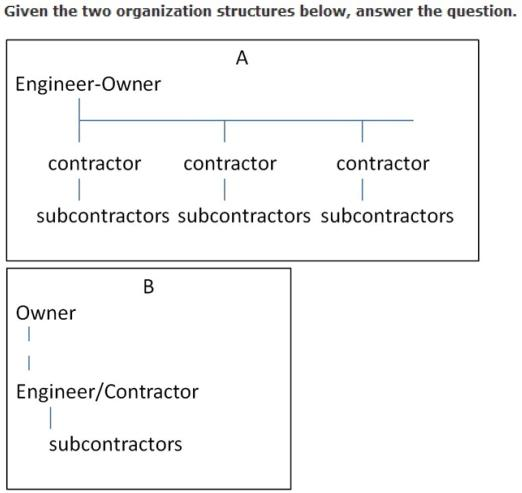
The following question requires your selection of CCC/CCE Scenario 28 (3.7.50.1.7) from
the right side of your split screen, using the drop down menu, to reference during your
response/choice of responses.
In the A relationship, the subcontractor might use an unbalance bid to:
A. To get more payment early in the job
B. Decrease the chances of extended claim litigation
C. Reduce the risk of quantities being greater than estimated
D. Provides an alternative to competitive bidding
A major theme park is expanding the existing facility over a five-year period. The design
phase will be completed one year after the contract is awarded. Major engineeringdrawings will be finalized two years after the design contract is awarded and construction
will begin three years after the award of the design contract. New, unique ride technology
will be used and an estimate will need to be developed to identify these costs that have no
historical data. A. Home office detail, specific vendor quotes, preliminary quantities with labor and material
factors applied
B. Square footage of buildings, factored indirects, types of rides and exhibits identified,
utility requirements, conceptual layouts
C. Detailed construction drawings, quantity takeoffs, detailed labor hours and material
costs applied, quotes from all major subcontractors
D. Utility requirements, detailed building plans and (- specifications, types of rides and
exhibits identified, all vendor quotes or estimates received from subcontractors
The following question requires your selection of CCC/CCE Scenario 26 (2.5.50.1.2) from
the right side of your split screen, using the drop down menu, to reference during your
response/choice of responses.
B. Square footage of buildings, factored indirects, types of rides and exhibits identified,
utility requirements, conceptual layouts
The process of stating goals and determining the most effective way of reaching them is the definition for:
A. Implementing
B. Mission Statement
C. Managing
D. Planning
A bond that guarantees the bidder will enter into a contract on the basis of his/her bid is referred to as:
A. Surety bond
B. Performance bond
C. Bid bond
D. Liability bond
| Page 8 out of 19 Pages |
| 5678910 |
| CCP Practice Test Home |
Real-World Scenario Mastery: Our CCP practice exam don't just test definitions. They present you with the same complex, scenario-based problems you'll encounter on the actual exam.
Strategic Weakness Identification: Each practice session reveals exactly where you stand. Discover which domains need more attention, before Certified Cost Professional (CCP) Exam exam day arrives.
Confidence Through Familiarity: There's no substitute for knowing what to expect. When you've worked through our comprehensive CCP practice exam questions pool covering all topics, the real exam feels like just another practice session.
Copyright © All Rights Reserved