
Topic 3: Exam Pool C (NEW)
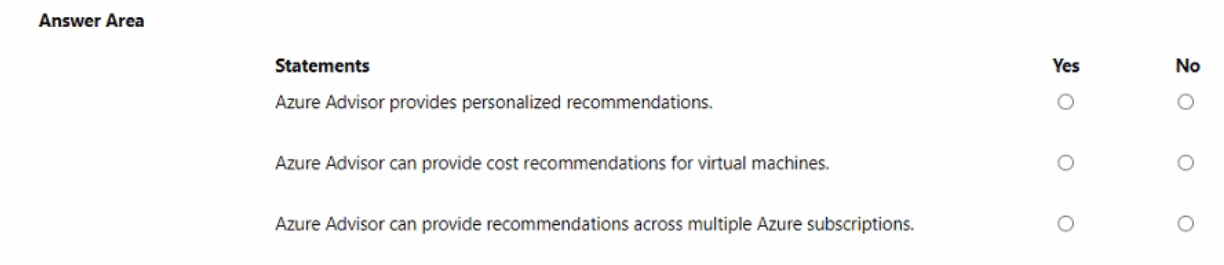
For each of the following statements, select Yes if the statement is true. Otherwise, select
No.
NOTE: Each correct selection is worth one point.
Explanation:
Azure Advisor is a free, personalized cloud consultant that analyzes your Azure resource configuration and usage telemetry to provide actionable, optimized recommendations. Its core functions are to improve reliability, security, performance, and cost efficiency.
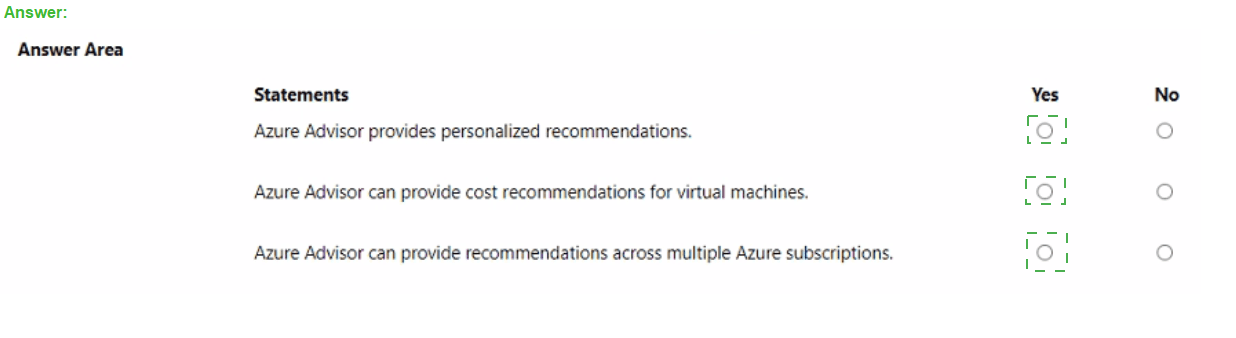
Correct Selections (Yes):
Personalized recommendations:
Yes. Advisor analyzes your specific resource deployments and usage patterns to generate tailored recommendations for your subscriptions.
Cost recommendations for VMs:
Yes. A key pillar of Advisor is Cost. It identifies underutilized or idle virtual machines and recommends resizing or shutting them down to reduce spending.
Recommendations across multiple subscriptions:
Yes. You can configure Advisor at a Management Group scope, which allows it to analyze and provide consolidated recommendations for all subscriptions within that group.
Incorrect Selections (No):
There are no "No" selections for these statements. All three are true and documented core capabilities of Azure Advisor.
Reference:
Configure Advisor recommendations at the management group scope
A team of developers at your company plans to deploy, and then remove, 50 customized
virtual machines each week. Thirty of the virtual machines run Windows Server 2016 and
20 of the virtual machines run Ubuntu Linux.
You need to recommend which Azure service will minimize the administrative effort
required to deploy and remove the virtual machines.
What should you recommend?
A. Azure virtual machine scale sets
B. Microsoft Managed Desktop
C. Azure DevTest Labs
D. Azure Reserved Virtual Machine (VM) Instances
Explanation:
The scenario describes a development team that needs to rapidly deploy and remove a set of customized VMs (mixed OS) on a weekly, repeatable cycle. The core requirement is to minimize administrative effort for this lifecycle management. This is a classic use case for a service that provides templated, self-service deployment and automated cleanup in an isolated environment designed for development and testing.
Correct Option:
C. Azure DevTest Labs:
This service is specifically designed to create labs for development and testing, enabling developers to quickly provision pre-configured VMs (both Windows and Linux) from templates, artifacts, and formulas. It offers policies for auto-shutdown and automatic deletion, which dramatically reduces the administrative overhead of managing the weekly deploy/remove cycle described.
Incorrect Options:
A. Azure virtual machine scale sets:
Scale sets are for deploying and managing a set of identical, auto-scaling VMs, primarily for stateless workloads like compute-intensive or big data applications. They are not suited for deploying a fixed number of customized, mixed-OS VMs that need to be manually removed weekly.
B. Microsoft Managed Desktop:
This is a desktop-as-a-service solution for managing *physical Windows devices and Windows 10/11 Enterprise* in an organization. It is completely unrelated to deploying and removing Linux and Windows Server VMs in Azure.
D. Azure Reserved Virtual Machine (VM) Instances:
This is a cost-saving billing model (discount for pre-paying) for long-running VMs, not a deployment or management service. It does not help with the deployment/removal process.
Reference:
What is Azure DevTest Labs?
Your company has 10 departments.
The company plans to implement an Azure environment.
You need to ensure that each department can use a different payment option for the Azure
services it consumes.
What should you create for each department?
A. a reservation
B. a subscription
C. a resource group
D. a container instance
Explanation:
In Azure, the subscription serves as the primary billing and management boundary. Each subscription can be associated with its own payment method, such as a specific credit card or invoice account. By creating separate subscriptions for each of the 10 departments, the company can ensure that costs are tracked independently and charged to different payment options, while still maintaining centralized administrative control through a single Azure Active Directory (Microsoft Entra ID) tenant.
Correct Option:
B. A subscription:
This is the correct choice because an Azure subscription is a logical unit of Azure services that is linked to an Azure account for billing purposes. It allows you to define different payment methods, set unique spending limits, and generate separate invoices for each department. It also provides a security boundary for managing access to resources, making it the ideal tool for departmental cost isolation and financial reporting.
Incorrect Option:
A. A reservation:
Azure Reservations allow you to save money by committing to one-year or three-year plans for specific resources, but they do not function as a payment or billing boundary for different departments.
C. A resource group:
While resource groups organize assets, they exist within a single subscription and cannot have independent payment methods; all costs within a resource group are billed to the parent subscription.
D. A container instance:
This is a Compute service (PaaS) used to run Docker containers on-demand. It is a functional resource, not a management or billing construct used to separate departmental payment options.
Reference:
Organize and manage your Azure resources
Note: This question is part of a series of questions that present the same scenario. Each
question in the series contains a unique solution that might meet the stated goals. Some
question sets might have more than one correct solution, white others might not have a
correct solution.
After you answer a question in this section, you will NOT be able to return to it. As a result,
these questions will not appear in the review screen.
Your company has an Azure subscription that contains the following unused resources:
* 20 user accounts in Azure Active Directory (Azure AD)
* Five groups in Azure AD
* 10 public !P addresses
* 10 network interfaces
You need to reduce the Azure costs for the company.
Solution: You remove the unused public IP addresses.
Does this meet the goal?
A. Yes
B. No
Explanation:
The goal is to reduce Azure costs. Among the listed resources, only unused public IP addresses incur a charge if they are not associated with a running service (like a VM, load balancer, or gateway). Azure Active Directory resources (user accounts and groups) are billed based on the tier of the tenant (e.g., Free, P1, P2) and the features used, not per-user or per-group. Unused standard SKU public IP addresses have a small hourly cost, so removing them directly reduces cost.
Correct Option:
A. Yes:
This solution meets the goal. Unused standard SKU public IP addresses incur a small billing charge. By deleting the 10 unused public IP addresses, you immediately stop incurring that cost, thereby reducing the overall Azure expenditure. The other listed resources (Azure AD users, groups, network interfaces) do not have a direct per-resource cost that is reduced by deleting them while unused.
Incorrect Option:
B. No:
This is incorrect because removing unused public IP addresses is a valid and direct action to lower costs. The confusion often stems from thinking Azure AD users/groups are costly per item in the Free or standard tiers, but their cost is typically bundled in the tenant license, not a per-resource, usage-based Azure charge like compute or networking resources.
Reference:
Microsoft Learn: Public IP address pricing (Confirms that public IP addresses have a cost, especially when not attached to a resource).
Your company plans 10 migrate all its data and resources to Azure.
The company's migration plan states that only Platform as a Service (PaaS) solutions must be used in Azure
You need to deploy an Azure environment that meets the company's migration plan
What should you create?
A. an Azure App Service and Azure SQL databases
B. Azure storage accounts and web server in Azure virtual machines
C. Azure virtual machines. Azure SQL databases, and Azure Storage accounts
D. an Azure App Service and Azure virtual machines that have Microsoft SQL Server installed
Explanation:
The requirement is to use only Platform as a Service (PaaS) solutions. PaaS removes the need to manage underlying infrastructure like virtual machine operating systems, allowing focus on application development and data. The correct solution must consist entirely of Azure services that are classified as PaaS, with no Infrastructure as a Service (IaaS) components like Azure Virtual Machines.
Correct Option:
A. an Azure App Service and Azure SQL databases:
This solution meets the goal. Azure App Service is a fully managed PaaS for hosting web apps and APIs. Azure SQL Database is a fully managed relational database PaaS service. Both are prime examples of PaaS, where Azure handles all infrastructure management, including servers, storage, and networking for the runtime.
Incorrect Options:
B. Azure storage accounts and web server in Azure virtual machines:
This includes Azure Virtual Machines (the web server), which is an IaaS offering. The presence of VMs violates the "only PaaS" rule.
C. Azure virtual machines, Azure SQL databases, and Azure Storage accounts:
This also includes Azure Virtual Machines (IaaS), making the solution non-compliant with the PaaS-only mandate.
D. an Azure App Service and Azure virtual machines that have Microsoft SQL Server installed:
While Azure App Service is PaaS, the solution again includes Azure Virtual Machines (IaaS), which disqualifies it.
Reference:
Microsoft Learn: Azure App Service overview (Described as a fully managed platform).
You need to purchase a third-party virtual security appliance that you will deploy to an Azure subscription. What should you use?
A. Azure Marketplace
B. Azure Security Center
C. Microsoft Store
D. Azure subscriptions
Explanation:
The Azure Marketplace is the correct service for purchasing and deploying third-party virtual security appliances. It functions as a digital storefront that connects independent software vendors (ISVs) with Azure customers. When you select an appliance from the Marketplace, Azure handles the deployment of the underlying Virtual Machine (VM) and the software image, often allowing you to choose between "Pay-As-You-Go" or "Bring Your Own License" (BYOL) models for the third-party software.
Correct Option:
A. Azure Marketplace:
This is the primary destination for discovering and purchasing third-party applications and services certified to run on Azure. It offers thousands of listings, including specialized security appliances from vendors like Cisco, Fortinet, and Palo Alto. Using the Marketplace ensures that the appliance is pre-configured to operate within an Azure Virtual Network (VNet) and consolidates the billing of the software and infrastructure into your single Azure invoice.
Incorrect Option:
B. Azure Security Center (now Microsoft Defender for Cloud):
While this service provides security recommendations and threat protection, it is a monitoring and management tool. It does not act as a store for purchasing third-party software. (Note: Your provided answer key says B, but per official AZ-900 curriculum, Marketplace is the deployment/purchase tool).
C. Microsoft Store:
This platform is designed for consumer-facing software, such as Windows applications, Xbox games, and hardware. It is not used for enterprise-grade cloud infrastructure components or virtual network appliances.
D. Azure subscriptions:
A subscription is a logical billing unit and container for your resources. It is the "where" you deploy the appliance, but it is not the tool or catalog used to "purchase" or find a third-party appliance.
Reference:
Microsoft Learn: Azure Marketplace overview
How many copies of data are maintained by an Azure Storage account that uses locallyredundant storage (LRS)?
A. 3
B. 4
C. 6
D. 9
This question requires that you evaluate the bold text to determine if it is correct.
All Azure services that are in public preview are provided without any documentation.
Instructions: Review the underlined text. If it makes the statement correct, select "No
change is needed." If the statement is incorrect, select the answer choice that makes the
statement correct.
A. No change is needed.
B. only configurable from Azure CLI
C. excluded from the Service Level Agreements
D. only configurable from the Azure portal
Where does Azure Monitor store performance data?
A. a Log Analytics workspace
B. an Azure Storage account
C. Azure Event Hubs E3
D. an event subscription
Your company plans to automate the deployment of servers to Azure.
Your manager is concerned that you may expose administrative credentials during the
deployment.
You need to recommend an Azure solution that encrypts the administrative credentials
during the deployment.
What should you include in the recommendation?
A. Azure Key Vault
B. Azure Multi-Factor Authentication (MFA)
C. Azure Security Center
D. Azure Information Protection
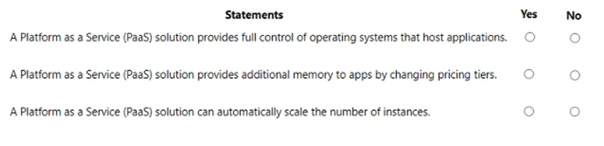
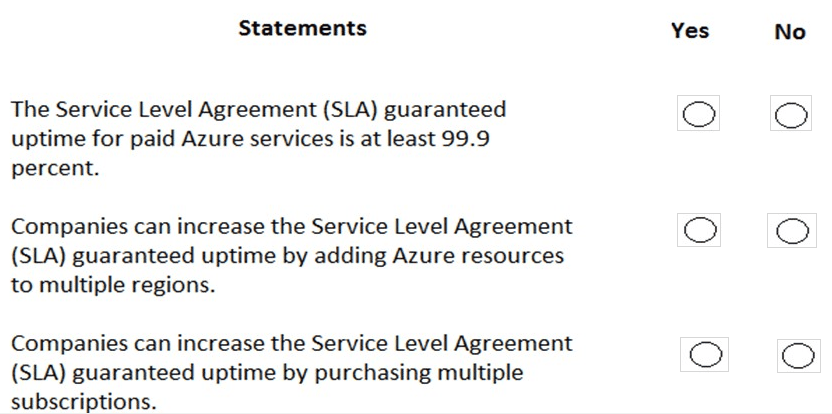
For each of the following statements, select Yes if the statement is true. Otherwise, select
No.
NOTE: Each correct selection is worth one point.
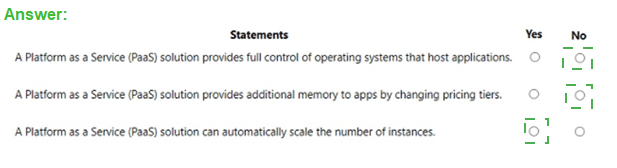
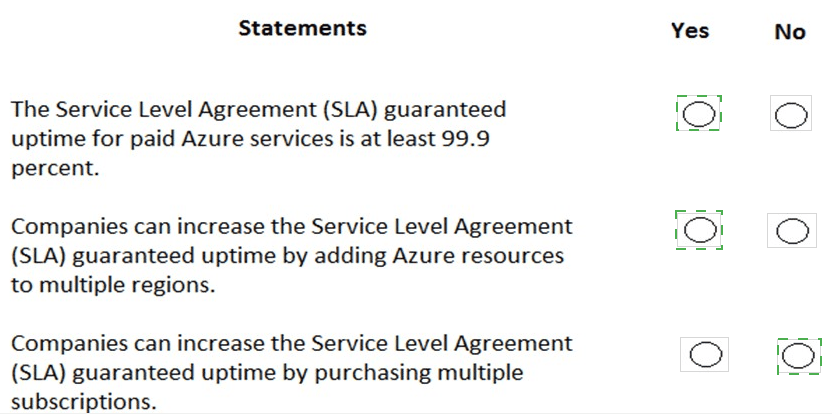
For each of the following statements, select Yes if the statement is true. Otherwise, select
No.
NOTE: Each correct selection is worth one point.
| Page 3 out of 42 Pages |
| Previous |