
Topic 1: Litware inc. Case Study: 1
Overview
Existing Environment
Litware, Inc. an independent software vendor (ISV) Litware has a main office and five
branch offices.
Application Architecture
The company’ s primary application is a single monolithic retirement fund management
system based on ASP.NE T web forms that use logic written in V8.NET. Some new
sections of the application are written in C#.
Variations of the application are created for individual customers. Currently, there are more
than 80 have code branches in the application’s code base.
The application was developed by using Microsoft Visual Studio. Source code is stored in
Team Foundation Server (TFS) in the main office. The branch offices access of the source
code by using TFS proxy servers.
Architectural Issues
Litware focuses on writing new code for customers. No resources are provided to refactor
or remove existing code. Changes to the code base take a long time, AS dependencies are
not obvious to individual developers.
Merge operations of the code often take months and involve many developers. Code
merging frequently introduces bugs that are difficult to locate and resolve.
Customers report that ownership costs of the retirement fund management system
increase continually. The need to merge unrelated code makes even minor code changes
expensive.
Requirements
Planned Changes
Litware plans to develop a new suite of applications for investment planning. The
investment planning Applications will require only minor integration with the easting
retirement fund management system.
The investment planning applications suite will include one multi-tier web application and
two iOS mobile applications. One mobile application will be used by employees; the other
will be used by customers.
Litware plans to move to a more agile development methodology. Shared code will be
extracted into a series of package.
Litware has started an internal cloud transformation process and plans to use cloud based
services whenever suitable.
Litware wants to become proactive m detecting failures, rather than always waning for
customer bug reports.
Technical Requirements
The company's investment planning applications suite must meet the following technical
requirements:
• New incoming connections through the firewall must be minimized.
• Members of a group named Developers must be able to install packages.
• The principle of least privilege must be used for all permission assignments
• A branching strategy that supports developing new functionality in isolation must be used.
• Members of a group named Team leaders must be able to create new packages and edit the permissions of package feeds
• Visual Studio App Center must be used to centralize the reporting of mobile application
crashes and device types in use.
• By default, all App Center must be used to centralize the reporting of mobile application
crashes and device types in use.
• Code quality and release quality are critical. During release, deployments must not
proceed between stages if any active bugs are logged against the release.
• The mobile applications must be able to call the share pricing service of the existing
retirement fund management system. Until the system is upgraded, the service will only
support basic authentication over HUPS.
• The required operating system configuration tor the test servers changes weekly. Azure
Automation State Configuration must be used to ensure that the operating system on each
test servers configured the same way when the servers are created and checked
periodically.
Current Technical
The test servers are configured correctly when first deployed, but they experience
configuration drift over time. Azure Automation State Configuration fails to correct the
configurations.
Azure Automation State Configuration nodes are registered by using the following
command.

How should you configure the release retention policy for the investment planning
applications suite? To answer, select the appropriate options in the answer area.
NOTE: Each correct selection is worth one point.
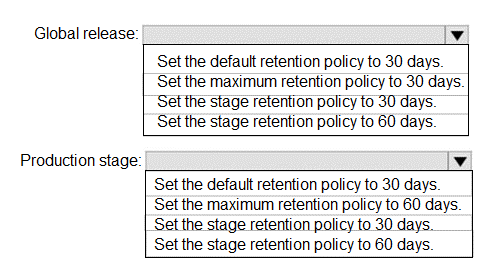
Based on the image content you've provided, I need to make some logical assumptions since the full question context isn't visible. The image shows two configuration sections:
Global release settings:
Default retention policy: 30 days
Maximum retention policy: 30 days
Stage retention policy: Two options (30 days and 60 days)
Production stage settings:
Default retention policy: 30 days
Maximum retention policy: 60 days
Stage retention policy: Two options (30 days and 60 days)
From typical Azure DevOps release retention policy configuration:
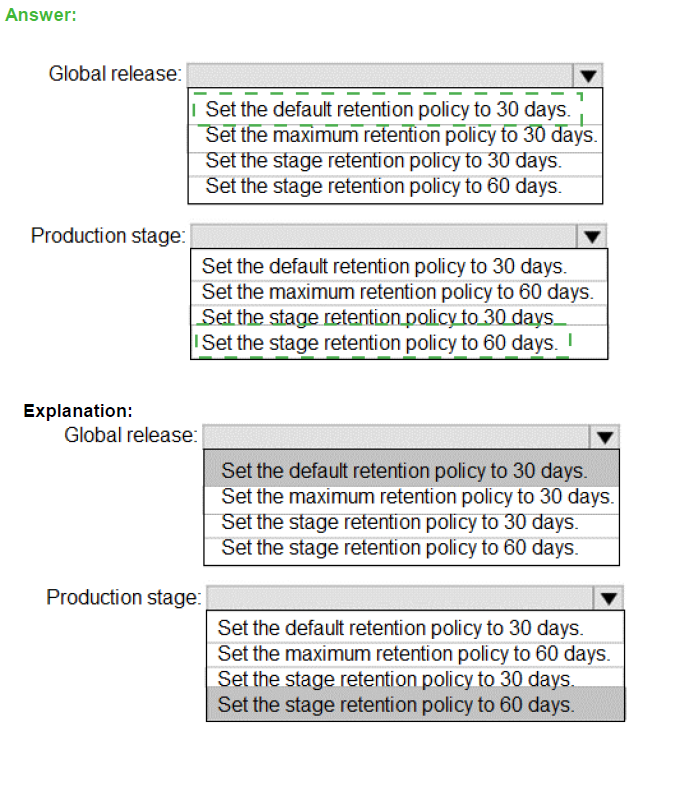
Answer:
For Global release:
Default retention policy: 30 days
Maximum retention policy: 30 days (maximum cannot exceed global maximum)
For Production stage:
Default retention policy: 30 days (inherits from global)
Maximum retention policy: 60 days (can exceed global maximum for production)
Stage retention policy: 60 days (since production typically needs longer retention)
Explanation:
In Azure DevOps, retention policies can be set at both global and stage levels. The production stage often requires longer retention for compliance or rollback purposes, so it makes sense to set it to 60 days while keeping other stages at 30 days. The production stage can have a higher maximum than the global setting for critical environments.
You have an Azure DevOps organization that contains a project named Project1. You need to create a published wiki in Project1. What should you do first?
A. Modify the Storage settings of Project1.
B. In Project1, create an Azure DevOps pipeline.
C. In Project1, create an Azure DevOps repository.
D. Modify the Team configuration settings of Project1.
Explanation:
This question is about setting up a wiki in Azure DevOps. Azure DevOps offers two types of wikis: code wiki (which lives in a Git repository) and project wiki (a published wiki). Both types require a Git repository as their foundation. The project wiki is essentially a special, published view of a wiki repository that is automatically created or selected.
Correct Option:
C. In Project1, create an Azure DevOps repository.
A published wiki in Azure DevOps is built from content stored in a Git repository.
When you create a project wiki, you either select an existing repository or a new, dedicated repository is automatically created to store the wiki pages (named ProjectName.wiki by default).
Therefore, the first step is ensuring a repository exists to host the wiki content. Creating or having an Azure DevOps repository is the prerequisite for creating a published wiki.
Incorrect Option:
A. Modify the Storage settings of Project1:
Azure DevOps projects do not have user-configurable "Storage settings" for wikis. Storage is managed automatically by the platform when you create a repository.
B. In Project1, create an Azure DevOps pipeline:
Build pipelines are used for CI/CD processes, not for creating or publishing wikis. While you could potentially automate wiki content generation via a pipeline, it is not the first or required step to create a published wiki.
D. Modify the Team configuration settings of Project1:
Team settings control areas, iterations, and permissions for a specific team, not the creation of project-wide artifacts like wikis. Wiki creation is a project-level feature, not a team configuration.
Reference:
Microsoft Learn - "Create a wiki for your project". The documentation states: "Each team project can have a wiki... When you create a wiki, you create a Git repository to store your wiki Markdown files." This confirms that creating a wiki first requires (or automatically creates) a repository.
Your company has a project in Azure DevOps for a new application. The application will be
deployed to several Azure virtual machines that run Windows Server 2022. You need to
recommend a deployment strategy for the virtual machines. The strategy must meet the
following requirements:
A. Azure Resource Manager templates and the PowerShell Desired State Configuration (DSC) extension for Windows
B. Deployment YAML and Azure pipeline deployment groups
C. Azure Resource Manager templates and the Custom Script Extension for Windows
D. Deployment YAML and Azure pipeline stage templates
Explanation:
This question requires selecting a deployment strategy for Windows Server VMs that ensures consistent configuration while minimizing administrative effort. The solution needs to address both infrastructure provisioning (the VMs themselves) and post-provisioning configuration (software, settings). Azure Resource Manager (ARM) templates handle the infrastructure, while extensions handle the configuration.
Correct Option:
A. Azure Resource Manager templates and the PowerShell Desired State Configuration (DSC) extension for Windows
ARM templates ensure consistent infrastructure provisioning (networks, VMs, disks).
The PowerShell DSC extension is designed for ongoing configuration consistency. It applies and maintains a declared configuration state (like installed features, registry settings, files) across all VMs, automatically correcting drift.
This combination meets both requirements: ARM for initial consistency and DSC for enforced, automated ongoing compliance with minimal ongoing admin effort.
Incorrect Option:
B. Deployment YAML and Azure pipeline deployment groups:
While YAML pipelines and deployment groups can orchestrate application deployments to existing VMs, they do not provision or guarantee the configuration state of the VMs themselves. This approach requires manual VM setup first and doesn't enforce configuration drift correction.
C. Azure Resource Manager templates and the Custom Script Extension for Windows:
ARM templates are correct for provisioning. However, the Custom Script Extension runs scripts once at deployment time. It does not ensure ongoing consistency or correct configuration drift over time, which the DSC extension is specifically designed to do.
D. Deployment YAML and Azure pipeline stage templates:
Pipeline YAML and templates automate CI/CD workflow stages but are not tools for configuring or maintaining the desired state of Azure virtual machine operating systems and software.
Reference:
Microsoft Learn - "Desired State Configuration extension with Azure Resource Manager templates". The documentation explains that the DSC extension is used to configure VMs as they are provisioned and to maintain their configuration over time, providing the consistency and reduced administrative effort required in the scenario.
You have an Azure pipeline that is used to deploy an app named App1. You need to ensure that new versions of App1 are released only if they exceed performance baselines. The solution must minimize administrative effort. What should you configure?
A. an Azure Repos branch policy
B. an Azure Pipelines release artifact
C. an Azure Pipelines deployment gate
D. an Azure Monitor alert
Explanation:
This question addresses implementing quality gates in a release pipeline. The requirement is to prevent deployment of new app versions unless they meet defined performance criteria (exceed baselines). This is a classic use case for a gate in a release pipeline, which acts as an automated checkpoint before proceeding to deployment. Gates evaluate external services and conditions without manual intervention, minimizing administrative effort once configured.
Correct Option:
C. an Azure Pipelines deployment gate
Deployment gates are automated checks that evaluate external health signals (like performance test results, monitoring alerts, or approval status) before a deployment proceeds to the next stage.
You can configure an Azure Monitor gate that queries Application Insights performance baselines. The release will only proceed if the performance metrics from testing exceed the defined thresholds.
Gates run automatically at specified intervals, requiring minimal administrative effort after the initial setup.
Incorrect Option:
A. an Azure Repos branch policy:
Branch policies control code merging behavior (like requiring PRs or builds) but cannot enforce performance baselines for a released application. They operate at the source code integration phase, not the release deployment phase.
B. an Azure Pipelines release artifact:
Artifacts are the outputs (packages, files) of a build that are consumed by a release pipeline. Configuring an artifact does not control whether a release proceeds based on performance criteria.
D. an Azure Monitor alert:
An alert can notify you when performance thresholds are breached, but it does not automatically block a deployment. You would need manual intervention to stop a release based on an alert, which does not minimize administrative effort.
Reference:
Microsoft Learn - "Deployment gates". Documentation explains that gates are used to automatically ensure that releases meet required criteria (like performance, security, or compliance) before deployment, enabling safe continuous deployment with quality checks.
Which branching strategy should you recommend for the investment planning applications suite?
A. release isolation
B. main only
C. development isolation
D. feature isolation
Explanation:
This question requires selecting a branching strategy for an application suite based on typical development practices. Without full context from the series, I must make a reasonable assumption. For enterprise applications requiring parallel development of features with isolation and integration control, a strategy that organizes work around features is common. This allows teams to develop independently while maintaining code quality through integration practices.
Correct Option:
D. feature isolation
Feature isolation (or feature branching) involves creating a separate branch for each new feature or user story.
This strategy allows developers to work in isolation without disrupting the main codebase, enabling parallel development of multiple features.
Features are integrated back to the main branch via pull requests, maintaining code quality through reviews and automated builds.
This approach balances isolation for development with controlled integration, which is suitable for application suites where different teams may work on different features simultaneously.
Incorrect Option:
A. release isolation:
This typically refers to release branching, where a branch is created to stabilize a release while development continues on the main branch. This is more about managing releases than organizing ongoing feature development.
B. main only:
Also known as trunk-based development, where all developers commit directly to the main branch. While this promotes continuous integration, it doesn't provide the isolation needed for feature development without potentially disrupting the main branch.
C. development isolation:
This isn't a standard branching strategy term. It might refer to having a dedicated development branch separate from main, but this doesn't specify how individual features are managed.
Reference:
Microsoft Learn - "Adopt a Git branching strategy" documentation discusses common strategies including feature branching for isolating work on specific features until they're ready for integration, which aligns with typical enterprise application development needs.
You use Azure Pipelines to build and deploy an app named Appl. You plan to monitor App1 by using Application Insights. You create an Application Insights instance named All. You need to configure App1 to use All. Which file should you modify?
A. appsettings.son
B. aunchSettings.json
C. startup.cs
D. project.son
Explanation:
This question involves configuring an application to use a specific Application Insights resource. The connection between an application and its Application Insights instance is typically managed through an instrumentation key or connection string. This configuration is stored in application settings files to allow environment-specific configuration without code changes.
Correct Option:
A. appsettings.json
appsettings.json is the standard configuration file for ASP.NET Core applications where external dependencies like Application Insights are configured.
You would add the Application Insights InstrumentationKey or ConnectionString setting to this file (or its environment-specific variants like appsettings.Production.json).
This allows the application to be dynamically configured for different environments (development, staging, production) by changing settings in the configuration file rather than modifying code.
Incorrect Option:
B. launchSettings.json:
This file contains Visual Studio launch profiles and settings for the development environment only (like ports, environment variables). It's not used for production configuration and doesn't affect the application when deployed.
C. startup.cs:
While you can configure Application Insights programmatically in Startup.cs (via services.AddApplicationInsightsTelemetry()), the specific Application Insights instance (All) would typically be configured via configuration (appsettings.json) rather than hardcoded in the C# code. Modifying code for configuration is less flexible than using config files.
D. project.json:
This file was used in early .NET Core versions for project configuration but has been replaced by .csproj files. It is not used in modern .NET Core/.NET 5+ applications for application settings.
Reference:
Microsoft Learn - "Application Insights for ASP.NET Core applications" documentation shows that the instrumentation key is typically set in appsettings.json or via environment variables, allowing the same code to connect to different Application Insights resources in different environments.
You are using GitHub as a source code repository. You create a client-side Git hook on the commit-msg event. The hook requires that each commit message contain a custom work item tag. You need to make a commit that does not have a work item tag. Which git commit parameter should you use?
A. --squash
B. --no-verify
C. --message ''
D. --no-post-rewrite
Explanation: The commit-msg hook is invoked by git-commit and git-merge, and can be bypassed with the --no-verify option.
Your company plans to use an agile approach to software development.
You need to recommend an application to provide communication between members of the
development team who work in locations around the world. The applications must meet the
following requirements:
A. Microsoft Project
B. Bamboo
C. Microsoft Lync
D. Microsoft Teams
Explanation:
Within each team, users can create different channels to organize their
communications by topic. Each channel can include a couple of users or scale to
thousands of users.
Microsoft Teams works on Android, iOS, Mac and Windows systems and devices.
It also works in Chrome, Firefox, Internet Explorer 11 and Microsoft Edge web
browsers.
The guest-access feature in Microsoft Teams allows users to invite people outside
their organizations to join internal channels for messaging, meetings and file
sharing. This capability helps to facilitate business-to-business project
management.
Teams integrates with Azure DevOps.
Your company uses Azure DevOps for the build pipelines and deployment pipelines of Java based projects. You need to recommend a strategy for managing technical debt. Which two actions should you include in the recommendation? Each correct answer presents part of the solution. NOTE: Each correct selection is worth one point.
A. Integrate Azure DevOps and SonarQube.
B. Integrates Azure DevelOPs and Azure DevTest Labs.
C. Configure post-deployment approvals in the deployment pipeline.
D. Configure pre-deployment approvals in the deployment pipeline.
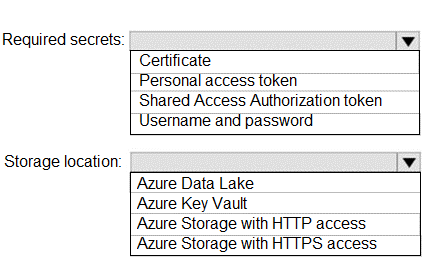
How should you confrere the release retention policy for the investment planning depletions suite? To answer, select the appropriate options in the answer area.
NOTE: Each correct selection is worth one point.
B. --no-verify
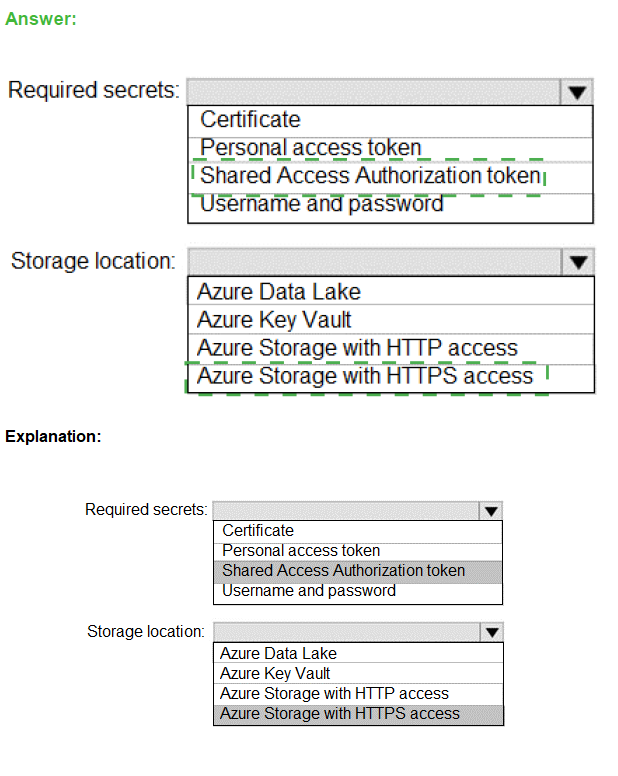
Every request made against a storage service must be authorized, unless the request is for a blob or container resource that has been made available for public or signed access. One option for authorizing a request is by using Shared Key.
Scenario: The mobile applications must be able to call the share pricing service of the existing retirement fund management system. Until the system is upgraded, the service will only support basic authentication over HTTPS.
The investment planning applications suite will include one multi-tier web application and two iOS mobile application. One mobile application will be used by employees; the other will be used by customers.
You have an Azure DevOps project that uses many package feeds. You need to simplify the project by using a single feed that stores packages produced by your company and packages consumed from remote feeds. The solution must support public feeds and authenticated feeds. What should you enable in DevOps?
A. Universal Packages
B. views in Azure Artifacts
C. upstream sources
D. a symbol server
You have an Azure subscription that contains the resources shown in the following table. DepPipeline1 and ADFPipeline1 use a single credential that is stored in Vault'. You need to configure ADFPipeline1 to retrieve the credential from Vault1. Which type of activity should you use?
A. Web
B. Copy
C. Lookup
D. Get Metadata
| Page 3 out of 41 Pages |
| 12345678910111213 |
| AZ-400 Practice Test Home |
Real-World Scenario Mastery: Our AZ-400 practice exam don't just test definitions. They present you with the same complex, scenario-based problems you'll encounter on the actual exam.
Strategic Weakness Identification: Each practice session reveals exactly where you stand. Discover which domains need more attention, before Microsoft Azure DevOps Solutions (beta) exam day arrives.
Confidence Through Familiarity: There's no substitute for knowing what to expect. When you've worked through our comprehensive AZ-400 practice exam questions pool covering all topics, the real exam feels like just another practice session.
Copyright © All Rights Reserved