
Topic 3: Misc. Questions
Note: This question is part of a series of questions that present the same scenario.
Each question in the series contains a unique solution that might meet the stated
goals. Some question sets might have more than one correct solution, while others
might not have a correct solution.
After you answer a question in this section, you will NOT be able to return to it. As a
result, these questions will not appear in the review screen.
You have an Azure Cognitive Search service.
During the past 12 months, query volume steadily increased.
You discover that some search query requests to the Cognitive Search service are being
throttled.
You need to reduce the likelihood that search query requests are throttled.
Solution: You add indexes.
Does this meet the goal?
A.
Yes
B.
No
No
Explanation:
Throttling in Azure Cognitive Search occurs when query requests exceed the capacity (replicas, partitions, or query units) of the current service tier. Adding more indexes does not increase query processing capacity. Indexes are logical containers for searchable data, not compute resources. Throttling is reduced by scaling replicas or upgrading tiers, not by adding indexes.
Correct Option:
B. No
Adding indexes distributes data across more logical containers but does not increase the number of replicas, partitions, or query throughput. Throttling is a function of load vs. capacity. Without adding replicas (to handle more concurrent queries) or partitions (to speed up indexing/search), the service remains at the same capacity and will still throttle under high query volume.
Incorrect Option:
A. Yes
This would be incorrect because indexes are not a scaling mechanism. If you have high query volume, adding indexes can actually increase resource consumption (each index consumes memory and storage) without improving query handling. The correct solutions include adding replicas, upgrading to a higher tier, or optimizing queries.
Reference:
Microsoft Learn documentation: "Cognitive Search throttling causes", "Scale replicas and partitions for query performance", and "Indexes vs. service capacity in Azure Cognitive Search"
You have receipts that are accessible from a URL.
You need to extract data from the receipts by using Form Recognizer and the SDK. The
solution must use a prebuilt model.
Which client and method should you use?
A.
the FormRecognizerClienc client and the ScarcRecognizeConcencFromUri method
B.
the FormTrainingClienc client and the ScarcRecognizeContentFromUri method
C.
the FormRecognizerClienc client and the ScarcRecognizeReceipcsFromUri method
D.
the FormTrainingClient client and the ScarcRecognizeReceipcsFromUri method
the FormRecognizerClienc client and the ScarcRecognizeReceipcsFromUri method
Explanation:
To extract data from receipts using a prebuilt model (prebuilt-receipt) with the Form Recognizer SDK, you need the FormRecognizerClient (not FormTrainingClient). The method StartRecognizeReceiptsFromUri (the question has a typo "ScarcRecognizeReceipcsFromUri") is the correct method for processing a receipt from a URL. The training client is only for creating custom models.
Correct Option:
C. the FormRecognizerClient client and the StartRecognizeReceiptsFromUri method
FormRecognizerClient:
This client is designed for analyzing documents using prebuilt or custom models. It handles recognition tasks like receipts, invoices, business cards, and ID documents.
StartRecognizeReceiptsFromUri:
This specific method is designed for the prebuilt receipt model. It accepts a URI to a receipt image/PDF and extracts fields like merchant name, date, total, and line items.
Incorrect Options:
A. FormRecognizerClient with StartRecognizeContentFromUri –
The StartRecognizeContent method extracts layout (text, tables, selection marks) but does not use the prebuilt receipt model. It will not extract receipt-specific fields like merchant name or transaction total. This does not meet the "prebuilt model" requirement for receipts.
B. FormTrainingClient with StartRecognizeContentFromUri –
FormTrainingClient is used only for training custom models (labeling, uploading training data, getting model info). It cannot perform document analysis. StartRecognizeContent is not available on this client. This combination is entirely invalid.
D. FormTrainingClient with StartRecognizeReceiptsFromUri –
The FormTrainingClient does not have a StartRecognizeReceiptsFromUri method. This client is strictly for model management (training, copying, deleting, listing models). It cannot analyze receipts. This option is incorrect and would cause a compilation error.
Reference:
Microsoft Learn documentation: "Form Recognizer – Prebuilt receipt model", "FormRecognizerClient class and StartRecognizeReceiptsFromUri method", and "FormTrainingClient vs FormRecognizerClient"
You need to implement a table projection to generate a physical expression of an Azure
Cognitive Search index.
Which three properties should you specify in the skillset definition JSON configuration table
node? Each correct answer presents part of the solution. (Choose three.)
NOTE: Each correct selection is worth one point.
A.
tableName
B.
generatedKeyName
C.
dataSource
D.
dataSourceConnection
E.
source
tableName
generatedKeyName
source
Explanation:
In Azure Cognitive Search, table projections allow you to output enrichment results into tables (e.g., in Azure Storage). Within a skillset definition JSON, the table node under projections specifies how to shape the data. The three required properties are tableName (target table), generatedKeyName (unique row identifier), and source (source path to the enriched data).
Correct Options:
A. tableName
This property specifies the name of the destination table in Azure Table Storage or Azure SQL Database. It is required to identify where the projected data should be stored. Without a table name, the projection has no target.
B. generatedKeyName
This property defines the name of the column that will contain an auto-generated unique key for each row in the target table. This key ensures each record is uniquely identifiable, which is essential for table storage and incremental indexing.
E. source
This property specifies the JSON path to the enriched data node (e.g., "/document/merged_content") that will be written into the table. It defines which part of the enrichment tree gets projected. This is required to map data from the skillset output to the table columns.
Incorrect Options:
C. dataSource
dataSource is not a valid property within a table projection node. It is a top-level property in an indexer definition, used to connect to a source data store (like Azure Blob or SQL). It has no role inside a skillset projection configuration.
D. dataSourceConnection
dataSourceConnection is also not a valid property inside a table projection. This term refers to the connection string or data source definition used by an indexer. In projections, you define the output destination via tableName and connection through indexer settings, not within the table node.
Reference:
Microsoft Learn documentation: "Table projections in Azure Cognitive Search", "Skillset JSON definition – projections property", and "Projections table node properties (tableName, generatedKeyName, source)"
You develop a test method to verify the results retrieved from a call to the Computer Vision API. The call is used to analyze the existence of company logos in images. The call returns
a collection of brands named brands.
You have the following code segment.
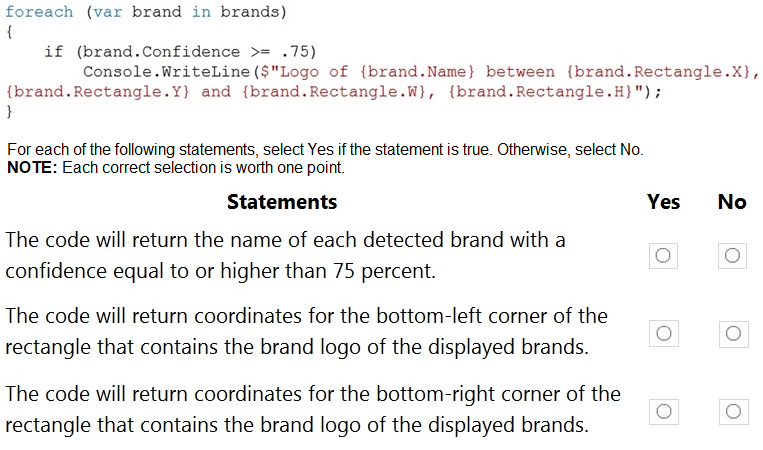
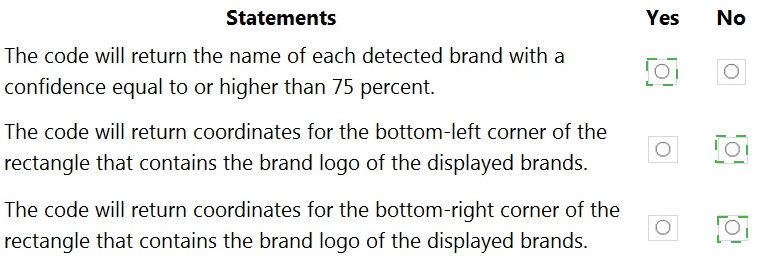
Statement 1: The code will return the name of each detected brand with a confidence equal to or higher than 75 percent.
Answer: Yes
Explanation:
The if (brand.Confidence >= .75) condition explicitly filters brands with a confidence threshold of 75% or higher. For each brand meeting this condition, brand.Name is printed to the console. Therefore, only brand names with confidence ≥ 75% are returned (displayed).
Statement 2: The code will return coordinates for the bottom-left corner of the rectangle that contains the brand logo of the displayed brands.
Answer: No
Explanation:
The printed coordinates are brand.Rectangle.X, brand.Rectangle.Y, brand.Rectangle.W, and brand.Rectangle.H. In Computer Vision API, Rectangle.X and Rectangle.Y typically represent the top-left corner, not bottom-left. No calculation is performed to derive bottom-left coordinates (which would be X, Y + H).
Statement 3: The code will return coordinates for the bottom-right corner of the rectangle that contains the brand logo of the displayed brands.
Answer: No
Explanation:
The code prints X, Y, W, H (top-left corner coordinates with width and height). It does not compute or return bottom-right corner coordinates (which would be X + W, Y + H). The output includes the top-left position and dimensions, not the bottom-right corner explicitly.
Reference:
Microsoft Learn documentation: "Computer Vision API – DetectedBrand object", "DetectedBrand.Confidence property", and "Bounding rectangle coordinates (top-left X, top-left Y, width, height)"
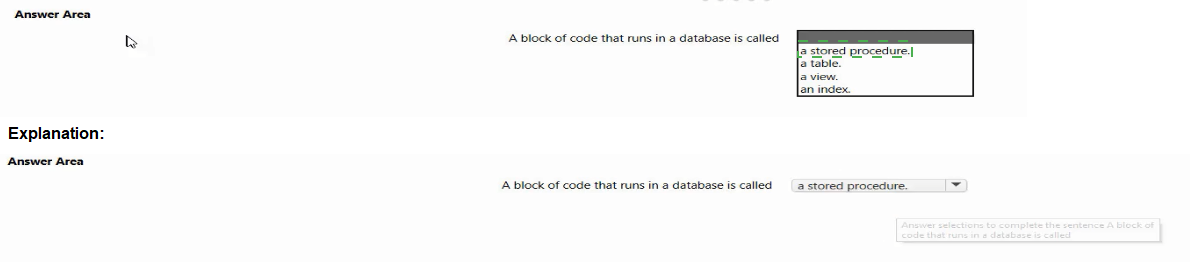
Select the answer that correctly completes the sentence.

Explanation:
A stored procedure is a precompiled block of code (containing SQL statements and logic) that is stored and executed directly on the database server. It can accept parameters, perform operations, and return results. This distinguishes it from other database objects like tables, views, or indexes, which are not executable code blocks.
Correct Option:
a stored procedure.
A stored procedure is a set of SQL statements and control logic (e.g., loops, conditionals) stored in the database. It runs on the database server, can be called by applications, and is used for data validation, complex business logic, or repetitive tasks. This matches "a block of code that runs in a database."
Incorrect Options:
a table. – A table is a structured collection of rows and columns that stores data. It is not executable code. Tables hold data but do not "run" as code. This does not fit the definition.
a view. – A view is a virtual table based on a stored SQL query. It represents data from one or more tables but does not contain procedural logic or run as a block of code. Views are read-only by default and cannot execute complex logic.
an index. – An index is a database object that improves the speed of data retrieval operations. It is a performance optimization structure, not a block of executable code. Indexes do not contain procedural logic or run independently.
Reference:
Microsoft Learn documentation: "Stored procedures in SQL Server", "Database objects overview", and "Difference between stored procedures, views, tables, and indexes"
You have a web app that uses Azure Cognitive Search.
When reviewing billing for the app, you discover much higher than expected charges. You
suspect that the query key is compromised.
You need to prevent unauthorized access to the search endpoint and ensure that users
only have read only access to the documents collection. The solution must minimize app
downtime.
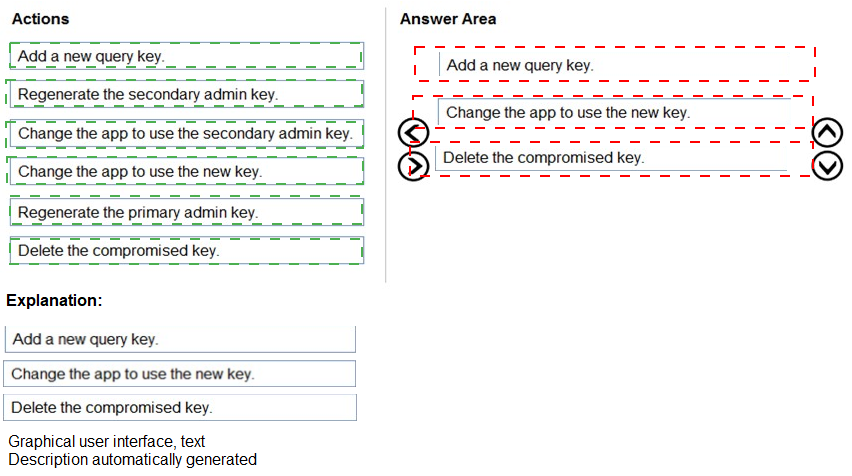
Which three actions should you perform in sequence? To answer, move the appropriate
actions from the list of actions to the answer area and arrange them in the correct order.
Explanation:
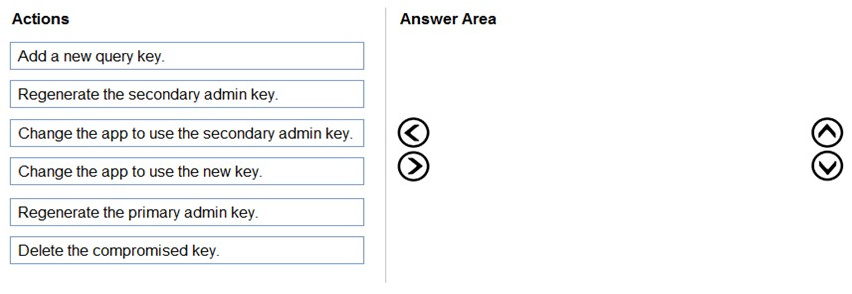
A compromised query key allows unauthorized read-only access. To resolve this with minimal downtime, you first create a new valid query key. Then update the app configuration to use the new key (no downtime if done via config refresh). Finally, delete the compromised key to revoke unauthorized access. Admin keys are not involved as users only need read-only access.
Correct Sequence (3 actions):
1. Add a new query key
Query keys are used for read-only access to search documents. Adding a new query key creates a fresh, uncompromised key that you will issue to legitimate users/apps. This action does not affect existing keys, so the app continues working during this step.
2. Change the app to use the new key
Update your web app's configuration (e.g., environment variables, key vault) to reference the newly created query key instead of the compromised one. This can be done without redeploying the app in many cases (e.g., restart or config refresh), minimizing downtime. The app now uses a secure key.
3. Delete the compromised key
Once the app is confirmed to be working with the new key, delete the compromised query key. This immediately revokes any unauthorized access. Deleting before updating the app would cause downtime, so this order ensures continuous service.
Incorrect or Out-of-Sequence Actions:
Regenerate the primary admin key – Admin keys provide full read/write access including index management. Users only need read-only access, so regenerating admin keys is unnecessary and introduces security risk if exposed. This does not solve a compromised query key issue.
Regenerate the secondary admin key – Same as above. Admin keys are not relevant for query key compromise. Regenerating them does not affect the compromised query key and adds unnecessary complexity.
Change the app to use the secondary admin key – This would give the app full admin privileges (write access), violating the requirement that users only have read-only access. Also, it does not address the compromised query key.
Reference:
Microsoft Learn documentation: "Cognitive Search security – Query keys vs Admin keys", "Regenerate or revoke query keys", and "Minimize downtime during key rotation"
For each of the following statements, select Yes if the statement is true. Otherwise, select
No.
NOTE: Each correct selection is worth one point.

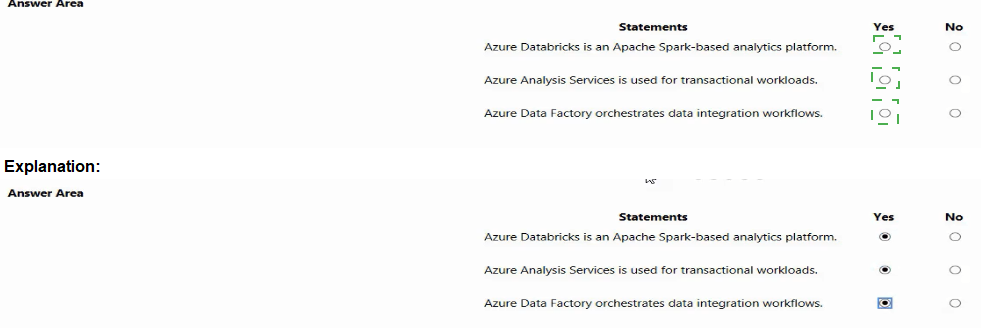
Statement 1: Azure Databricks is an Apache Spark-based analytics platform.
Answer: Yes
Explanation:
Azure Databricks is a fully managed, first-party service on Azure built on top of Apache Spark. It provides collaborative workspaces for big data processing, machine learning, and analytics. It integrates with Spark clusters to enable ETL, streaming, and data science workloads. This statement is factually correct.
Statement 2: Azure Analysis Services is used for transactional workloads.
Answer: No
Explanation:
Azure Analysis Services is an OLAP (Online Analytical Processing) engine for semantic modeling and data analysis. It is designed for analytical workloads (querying large volumes of aggregated data), not transactional workloads (OLTP). Transactional workloads require row-level insert/update/delete operations, which Azure Analysis Services does not support.
Statement 3: Azure Data Factory orchestrates data integration workflows.
Answer: Yes
Explanation:
Azure Data Factory (ADF) is a cloud-based ETL (Extract, Transform, Load) and data integration service. It orchestrates workflows by creating pipelines that copy, transform, and move data between supported sources and destinations. It includes triggers, activities, and monitoring, making it the correct choice for workflow orchestration.
Reference:
Microsoft Learn documentation: "What is Azure Databricks?", "Azure Analysis Services overview (analytical vs transactional)", and "Azure Data Factory – Orchestration and pipelines"
Note: This question is part of a series of questions that present the same scenario.
Each question in the series contains a unique solution that might meet the stated
goals. Some question sets might have more than one correct solution, while others
might not have a correct solution.
After you answer a question in this section, you will NOT be able to return to it. As a
result, these questions will not appear in the review screen.
You create a web app named app1 that runs on an Azure virtual machine named vm1.
Vm1 is on an Azure virtual network named vnet1.
You plan to create a new Azure Cognitive Search service named service1.
You need to ensure that app1 can connect directly to service1 without routing traffic over
the public internet.
Solution: You deploy service1 and a public endpoint, and you configure a network security
group (NSG) for vnet1.
Does this meet the goal?
A.
Yes
B.
No
No
Explanation:
Deploying a Cognitive Search service with a public endpoint means traffic still routes over the public internet, even with an NSG on vnet1. NSGs control traffic to/from vm1 but do not create a private connection to service1. To avoid public internet routing, you need a private endpoint (Azure Private Link) for service1 within vnet1.
Correct Option:
B. No
A public endpoint is accessible over the internet. While an NSG can restrict which source IPs can reach service1, the traffic still traverses public network infrastructure. The requirement is to avoid routing over the public internet entirely. This can only be achieved by deploying service1 with a private endpoint (integrated into vnet1), not a public endpoint.
Incorrect Option:
A. Yes
This would be incorrect because a public endpoint + NSG does not eliminate public internet routing. NSGs filter traffic but do not change the fact that the endpoint is internet-accessible. The goal requires a private, non-internet path, which mandates Azure Private Link for Cognitive Search.
Reference:
Microsoft Learn documentation: "Cognitive Search private endpoints using Azure Private Link", "Public endpoints vs private endpoints", and "Network security groups (NSG) limitations for private connectivity"
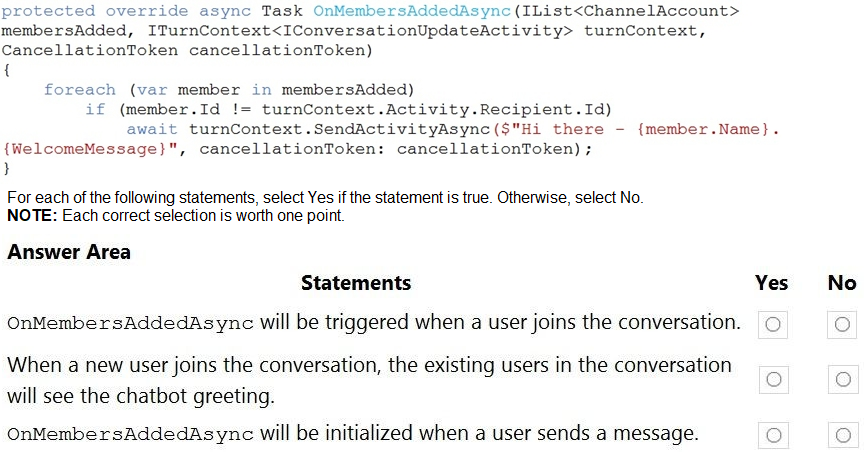
You are building a chatbot for a Microsoft Teams channel by using the Microsoft Bot
Framework SDK. The chatbot will use the following code.
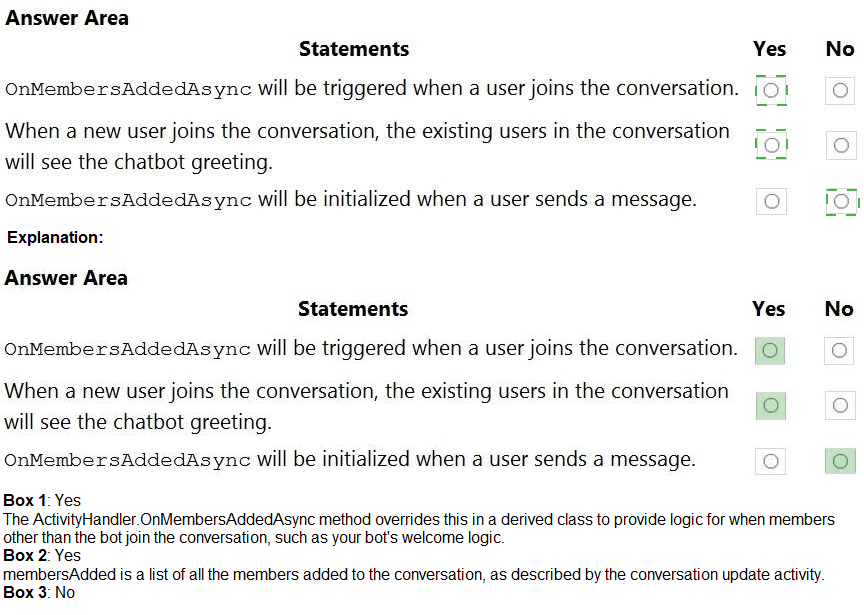
Statement 1: OnMembersAddedAsync will be triggered when a user joins the conversation.
Answer: Yes
Explanation:
The method OnMembersAddedAsync is a built-in Bot Framework handler that is automatically invoked whenever one or more members are added to a conversation. This includes scenarios such as a user joining a Teams channel, the bot being added, or a new participant entering a group conversation. The code explicitly checks for members added.
Statement 2: When a new user joins the conversation, the existing users in the conversation will see the chatbot greeting.
Answer: Yes
Explanation:
The code iterates through each member in membersAdded. It sends a greeting message ($"Hi there - {member.Name}. {WelcomeMessage}") for every member that is not the bot itself (since it checks member.Id != turnContext.Activity.Recipient.Id). This message is sent to the conversation, so all existing participants (including other users) will see the greeting.
Statement 3: OnMembersAddedAsync will be initialized when a user sends a message.
Answer: No
Explanation:
OnMembersAddedAsync is triggered only by ConversationUpdate activities where members are added. It is not triggered by a standard user message (which is an ActivityTypes.Message). When a user sends a message, the bot would typically handle it in OnMessageActivityAsync, not in OnMembersAddedAsync. Initialization happens at bot startup, not on each user message.
Reference:
Microsoft Learn documentation: "Bot Framework – OnMembersAddedAsync method", "ConversationUpdate activity in Teams", and "Bot activity handlers overview"
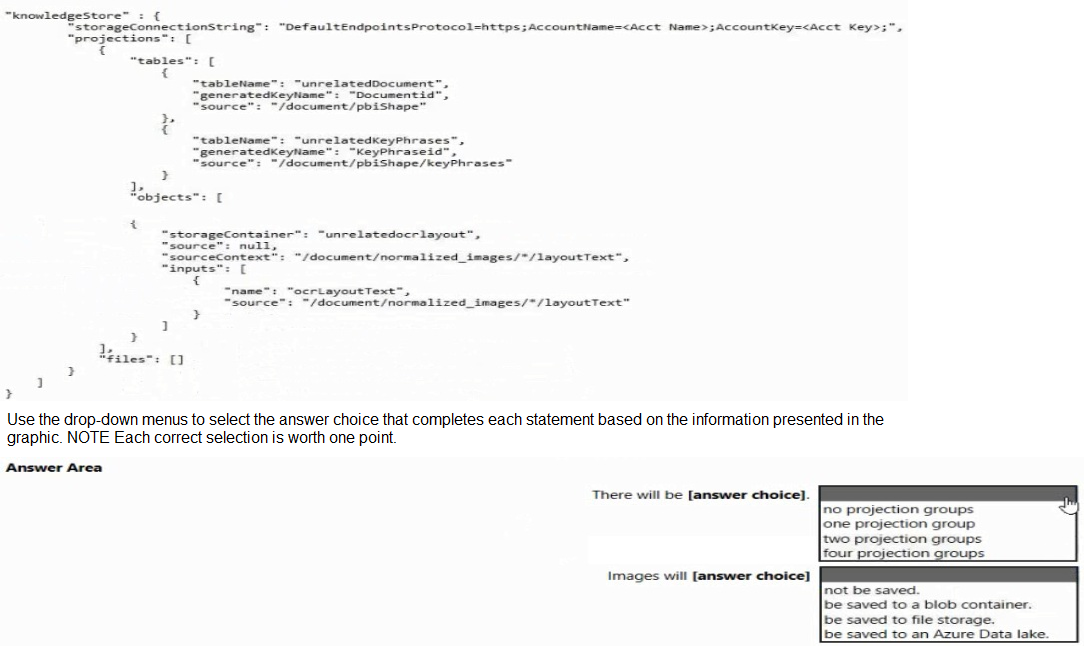
You create a knowledge store for Azure Cognitive Search by using the following JSON.
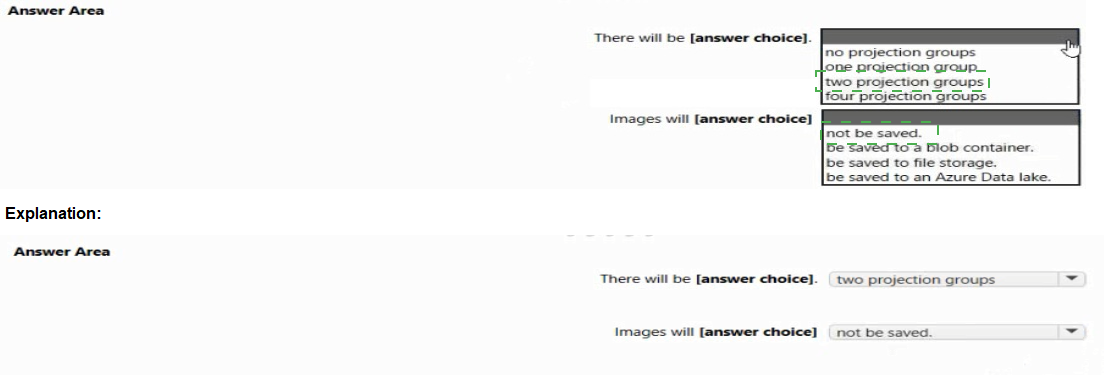
Statement 1: There will be [answer choice].
Answer: one projection group
Explanation:
The JSON shows a single object inside the projections array (denoted by the opening { after "projections": [ and closing } before the final ]). Within that single projection group, there are both tables and objects defined. Therefore, there is exactly one projection group, not zero, two, or four.
Statement 2: Images will [answer choice].
Answer: be saved to a blob container
Explanation:
The objects section contains a projection that specifies "storageContainer": "unrelateddoclayout". In Azure Cognitive Search knowledge store, objects are saved as JSON files in an Azure Blob Storage container. The storageContainer property explicitly defines the destination blob container. Images (referenced via sourceContext and inputs) will be stored there.
Reference:
Microsoft Learn documentation: "Knowledge store projections – Tables and objects", "Projection groups in Azure Cognitive Search", and "Knowledge store – Saving images to blob containers"
What should you use to automatically delete blobs from Azure Blob Storage?
A.
the change feed
B.
a lifecycle management policy
C.
soft delete
D.
archive storage
a lifecycle management policy
Explanation:
Azure Blob Storage provides lifecycle management policies to automatically delete blobs based on conditions like age, last access time, or creation date. You define rules (e.g., delete blobs after 30 days) in JSON, and Azure applies them automatically. This is the native, built-in mechanism for automated blob deletion without writing custom code.
Correct Option:
B. a lifecycle management policy
Lifecycle management policies allow you to automate transitioning blobs to cooler tiers (hot → cool → cold → archive) or deleting them entirely. For example, you can set a rule to delete blobs modified more than 365 days ago. This runs in the background, requires no manual intervention, and is cost-effective for retention requirements.
Incorrect Options:
A. the change feed –
The change feed provides a log of all blob creation, modification, and deletion events. It tracks changes but does not automatically delete blobs. You would need custom code to read the change feed and perform deletions, which is not an automatic deletion solution.
C. soft delete –
Soft delete protects blobs from accidental deletion by retaining deleted blobs for a specified retention period. It allows recovery of deleted blobs but does not automatically delete blobs. It is a data protection feature, not an automated deletion mechanism.
D. archive storage –
Archive storage is a tier for rarely accessed blobs with low storage cost but high retrieval latency. Moving blobs to archive does not delete them. You still need to manually delete or use lifecycle policies to delete archived blobs after a period. Archiving is not deletion.
Reference:
Microsoft Learn documentation: "Azure Blob Storage lifecycle management", "Automatically delete blobs with lifecycle policies", and "Difference between lifecycle management, soft delete, and archive tier"
Which database transaction property ensures that individual transactions are executed only
once and either succeed in their entirety or roll back?
A.
consistency
B.
isolation
C.
atomicity
D.
durability
atomicity
Explanation:
The ACID properties of database transactions include Atomicity, Consistency, Isolation, and Durability. Atomicity ensures that each transaction is treated as a single, indivisible unit. It guarantees that either all operations within the transaction complete successfully (commit) or none of them do (rollback). There is no partial execution.
Correct Option:
C. atomicity
Atomicity is the property that ensures a transaction is "all or nothing." If any part of the transaction fails, the entire transaction is rolled back, leaving the database unchanged. If all parts succeed, the transaction is committed. This prevents partial updates and maintains data integrity. This directly matches the description in the question.
Incorrect Options:
A. consistency –
Consistency ensures that a transaction brings the database from one valid state to another, respecting all defined rules (constraints, triggers, foreign keys). It does not guarantee "all or nothing" execution. Consistency relies on atomicity but is a separate property.
B. isolation –
Isolation ensures that concurrently executing transactions do not interfere with each other. It controls visibility of intermediate changes (e.g., read committed, serializable). It does not address whether a transaction executes fully or rolls back.
D. durability –
Durability guarantees that once a transaction is committed, its changes persist even after a system failure (e.g., power loss, crash). It does not relate to the all-or-nothing execution of a single transaction.
Reference:
Microsoft Learn documentation: "ACID properties in database transactions", "Atomicity in SQL Server transactions", and "Understanding transaction rollback and commit"
| Page 5 out of 34 Pages |
| 1234567891011 |
| AI-102 Practice Test Home |
Real-World Scenario Mastery: Our AI-102 practice exam don't just test definitions. They present you with the same complex, scenario-based problems you'll encounter on the actual exam.
Strategic Weakness Identification: Each practice session reveals exactly where you stand. Discover which domains need more attention, before Designing and Implementing a Microsoft Azure AI Solution exam day arrives.
Confidence Through Familiarity: There's no substitute for knowing what to expect. When you've worked through our comprehensive AI-102 practice exam questions pool covering all topics, the real exam feels like just another practice session.
Copyright © All Rights Reserved