
Topic 3: Misc. Questions
You train a Custom Vision model used in a mobile app.
You receive 1,000 new images that do not have any associated data.
You need to use the images to retrain the model. The solution must minimize how long it
takes to retrain the model.
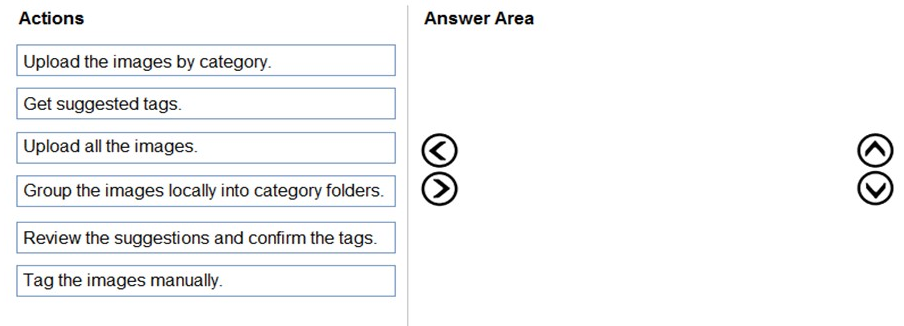
Which three actions should you perform in the Custom Vision portal? To answer, move the
appropriate actions from the list of actions to the answer area and arrange them in the
correct order.
Explanation:
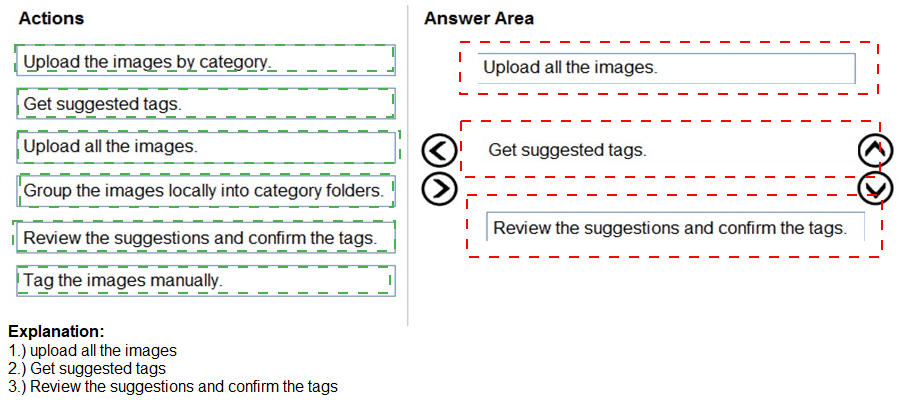
You have 1,000 unlabeled images. Manual tagging would be time-consuming. Custom Vision's smart labeler (suggested tags) feature uses the existing model to predict tags on new images, then you review and confirm. This minimizes retraining time by automating most of the labeling work.
Correct Option (in sequence):
Upload all the images.
First, upload all 1,000 unlabeled images to the Custom Vision portal project. The images will appear in the "Untagged" or "Unlabeled" section. Uploading all at once enables batch operations like smart labeling.
Get suggested tags.
Use the Smart Labeler feature (or "Get suggested tags" action). The existing model predicts tags for each uploaded image with confidence scores. This automates initial labeling across all 1,000 images instead of manual tagging.
Review the suggestions and confirm the tags.
Manually review the suggested tags, correct any misclassifications, and confirm correct ones. This step ensures high-quality labels before training. Confirmed tags are applied to images, creating a fully labeled dataset ready for retraining.
Incorrect Options (not used in sequence):
Upload the images by category. – This would require pre-grouping images locally by category, which you cannot do because the images have "no associated data." You don't know the categories in advance. This would actually increase preparation time.
Group the images locally into category folders. – Similar to above, this requires prior knowledge of categories. Since images are unlabeled, grouping locally is impossible without manual inspection first, defeating the goal of minimizing retraining time.
Tag the images manually. – Manual tagging of 1,000 images is extremely time-consuming (hours or days). The smart labeler approach reduces this to minutes of review. This option contradicts "minimize how long it takes to retrain."
Reference:
Microsoft Learn: "Smart Labeler in Custom Vision" – Use Smart Labeler to get suggested tags for unlabeled images, then review/confirm, then retrain.
Microsoft Learn: "Upload and tag images" – Recommends smart labeling for large unlabeled datasets to reduce manual effort.
Note: This question is part of a series of questions that present the same scenario. Each
question in the series contains a unique solution that might meet the stated goals. Some
question sets might have more than one correct solution, while others might not have a
correct solution.
After you answer a question in this section, you will NOT be able to return to it. As a result,
these questions will not appear in the review screen.
You build a language model by using a Language Understanding service. The language
model is used to search for information on a contact list by using an intent named FindContact.
A conversational expert provides you with the following list of phrases to use for training.
Find contacts in London. Who do I know in Seattle?
Search for contacts in Ukraine.
You need to implement the phrase list in Language Understanding.
Solution: You create a new intent for location.
Does this meet the goal?
A.
Yes
B.
No
No
Explanation:
The goal is to train the existing FindContact intent using the provided phrases. Creating a new intent for location would fragment the model: location is a parameter (entity) of the FindContact intent, not a separate intent. The phrases all describe the same user goal (finding contacts), only the location value changes.
Correct Option:
B. No
The solution does not meet the goal. Creating a separate intent for location misrepresents user intent. Each phrase asks to find contacts, just with different location parameters (London, Seattle, Ukraine). Locations should be captured as entities (e.g., geographyV2 or machine-learned entity) within the FindContact intent, not as a new intent.
Why the Solution Fails:
Intent vs. Entity confusion – Intents represent actions or user goals (FindContact). Locations are data points that modify that action. Mixing them creates an incorrect model where "Find contacts in London" and "London" would be split across intents, causing misrouting.
Training inefficiency – A new location intent would have no training phrases that actually express that intent. Users do not say just "London" to find contacts. This would increase confusion and lower prediction accuracy for the original FindContact intent.
Reference:
Microsoft Learn: "LUIS intents vs entities" – Intents classify user goals; entities extract specific data (locations, dates, names). Creating an intent for a data value is an antipattern.
Microsoft Learn: "Best practices for LUIS" – Do not create intents for variations of the same goal; use entities for variable parameters like locations.
What is the primary purpose of a data warehouse?
A.
to provide storage for transactional line-of-business (LOB) applications
B.
to provide transformation services between source and target data stores
C.
to provide read only storage of relational and non relational historical data
D.
to provide answers to complex queries that rely on data from multiple sources
to provide read only storage of relational and non relational historical data
Explanation:
A data warehouse is designed to store historical, integrated data from multiple source systems (both relational and non-relational) for analysis and reporting. It is optimized for read-heavy operations, not transactional writes. The primary purpose is to provide a stable, read-only repository of cleansed, transformed, and integrated historical data for business intelligence.
Correct Option:
C. to provide read only storage of relational and non relational historical data
Data warehouses store large volumes of historical data from diverse sources (SQL databases, flat files, APIs, NoSQL). They are optimized for read queries (SELECT statements) and typically do not support real-time updates. Data is loaded in batches via ETL/ELT processes. Both structured (relational) and semi-structured (JSON, XML) data can be stored.
Incorrect Options:
A. to provide storage for transactional line-of-business (LOB) applications
This describes an OLTP (Online Transaction Processing) database, not a data warehouse. LOB applications require high-volume, low-latency writes (INSERT, UPDATE, DELETE). Data warehouses are optimized for OLAP (Online Analytical Processing) with bulk loads and complex reads, not transactional workloads.
B. to provide transformation services between source and target data stores
Transformation is part of ETL (Extract, Transform, Load) processes performed by tools like Azure Data Factory or SSIS, not a core function of the data warehouse itself. The warehouse stores transformed data; transformation typically happens before loading (or during with ELT).
D. to provide answers to complex queries that rely on data from multiple sources
While data warehouses do support complex queries, this describes a capability (query answering) rather than the primary purpose. The fundamental purpose is storage of integrated historical data; complex querying is what you do with that stored data. Option C captures the foundational purpose more accurately.
Reference:
Microsoft Learn: "What is a data warehouse?" – A central repository of integrated, historical, read-only data from one or more disparate sources.
Kimball & Inmon definitions: Data warehouse stores subject-oriented, integrated, time-variant, non-volatile (read-only) historical data.
You successfully run the following HTTP request.
POST https://management.azure.com/subscriptions/18c51a87-3a69-47a8-aedca54745f708a1/
resourceGroups/RG1/providers/Microsoft.CognitiveServices/accounts/contosol/regenerateKey?api-version=2017-04-18
Body{"keyName": "Key2"}
What is the result of the request?
A.
A key for Azure Cognitive Services was generated in Azure Key Vault.
B.
A new query key was generated.
C.
The primary subscription key and the secondary subscription key were rotated.
D.
The secondary subscription key was reset.
The secondary subscription key was reset.
Explanation:
The HTTP request is a POST to the /regenerateKey endpoint for a Cognitive Services account, specifying "keyName": "Key2". In Cognitive Services, each account has two subscription keys (Key1/primary and Key2/secondary). Regenerating Key2 resets the secondary subscription key, generating a new key value. This is a common operation for key rotation without disrupting service (clients using Key1 continue working).
Correct Option:
D. The secondary subscription key was reset.
The request explicitly targets Key2, which is the secondary subscription key for the Cognitive Services account. The regenerateKey operation invalidates the existing Key2 and generates a completely new key value. The response will contain the new Key2 value. Key1 remains unchanged.
Incorrect Options:
A. A key for Azure Cognitive Services was generated in Azure Key Vault.
This request operates on Cognitive Services keys stored within the Cognitive Services resource itself, not Azure Key Vault. Key Vault integration requires separate configuration and a different API endpoint (/secrets). This request has no interaction with Key Vault.
B. A new query key was generated.
Cognitive Services uses subscription keys (Key1/Key2) for authentication, not "query keys." The term "query key" is not standard for Cognitive Services. Some other Azure services (e.g., Azure Search) use query keys, but Cognitive Services has only subscription keys (primary/secondary).
C. The primary subscription key and the secondary subscription key were rotated.
Rotating both keys simultaneously is not what this request does. The request only targets Key2. Rotating both would require two separate requests or a different operation. Key rotation typically regenerates one key at a time to maintain availability.
Reference:
Microsoft Learn: "Regenerate Cognitive Services account keys" – The regenerateKey operation with keyName: "Key2" resets the secondary subscription key. Key1 is unaffected.
Azure REST API Reference: Cognitive Services Accounts - Regenerate Key – Valid keyName values are "Key1" and "Key2". Response contains the new key.
Note: This question is part of a series of questions that present the same scenario. Each
question in the series contains a unique solution that might meet the stated goals. Some
question sets might have more than one correct solution, while others might not have a
correct solution.
After you answer a question in this section, you will NOT be able to return to it. As a result,
these questions will not appear in the review screen.
You build a language model by using a Language Understanding service. The language
model is used to search for information on a contact list by using an intent named
FindContact.
A conversational expert provides you with the following list of phrases to use for training.
Find contacts in London. Who do I know in Seattle?
Search for contacts in Ukraine.
You need to implement the phrase list in Language Understanding.
Solution: You create a new pattern in the FindContact intent.
Does this meet the goal?
A.
Yes
B.
No
No
Explanation:
The provided phrases contain variable location values (London, Seattle, Ukraine). A pattern in LUIS uses template-like syntax with entities (e.g., Find contacts in {Location}) to match utterances. However, patterns require that the entities (like Location) are already defined and trained. Simply creating a pattern without having the Location entity trained with examples will not effectively capture these variations.
Correct Option:
B. No
While patterns are useful for reducing the number of training utterances needed, they rely on pre-existing, well-trained entities. In this scenario, you still need to train the model with example utterances that contain the Location entity. Creating a pattern alone, without providing the phrase list as training utterances or defining the Location entity properly, does not fully implement the phrase list as intended.
Why the Solution Fails:
Patterns are not a substitute for training utterances – The requirement is to "implement the phrase list" for training. Patterns help generalize, but the model still needs labeled examples of the Location entity. The provided list contains specific location values that should be used as training utterances, not just encoded into a pattern.
Missing entity definition – A pattern like Find contacts in {Location} assumes a machine-learned or prebuilt entity named Location has been defined and trained with examples. Without that, the pattern will not correctly extract location values.
Reference:
Microsoft Learn: "Patterns in LUIS" – Patterns reduce the number of training utterances but require existing entities. They do not replace the need for labeled examples.
Microsoft Learn: "Best practices for LUIS" – Use patterns to enforce utterance structure after entities are trained, not as the sole method for implementing phrase lists.
Which property of a transactional workload guarantees that each transaction is treated as a
single unit that either succeeds completely or tails completely?
A.
isolation
B.
atomicity
C.
consistency
D.
durability
atomicity
Explanation:
The question describes the atomicity property of ACID (Atomicity, Consistency, Isolation, Durability) in database transactions. Atomicity ensures that a transaction is an indivisible unit: all operations within the transaction are committed, or none are. If any part fails, the entire transaction is rolled back, leaving no partial changes.
Correct Option:
B. atomicity
Atomicity treats a transaction as a single, indivisible unit. Either all operations (INSERT, UPDATE, DELETE) within the transaction complete successfully and are committed, or if any operation fails, all changes are rolled back. This prevents partial updates that could leave the database in an inconsistent state.
Incorrect Options:
A. isolation
Isolation ensures that concurrently executing transactions do not interfere with each other. It controls visibility of uncommitted changes (e.g., read phenomena like dirty reads, non-repeatable reads). Isolation does not address the all-or-nothing behavior of a single transaction.
C. consistency
Consistency ensures that a transaction brings the database from one valid state to another, preserving all defined rules (constraints, foreign keys, triggers). It guarantees data integrity but does not provide the all-or-nothing guarantee described in the question.
D. durability
Durability guarantees that once a transaction is committed, its changes persist even after system failures (power loss, crash). This is typically implemented via transaction logs or write-ahead logging. Durability does not address the success/failure atomicity of a transaction.
Reference:
Microsoft Learn: "ACID properties in Azure SQL Database" – Atomicity: "All or nothing" transaction processing.
Database fundamentals: Atomicity ensures transactions complete fully or roll back entirely.
You have an existing Azure Cognitive Search service.
You have an Azure Blob storage account that contains millions of scanned documents
stored as images and PDFs.
You need to make the scanned documents available to search as quickly as possible.
What should you do?
A.
Split the data into multiple blob containers. Create a Cognitive Search service for each
container. Within each indexer definition, schedule the same runtime execution pattern.
B.
Split the data into multiple blob containers. Create an indexer for each container.
Increase the search units. Within each indexer definition, schedule a sequential execution pattern.
C.
Create a Cognitive Search service for each type of document.
D.
Split the data into multiple virtual folders. Create an indexer for each folder. Increase the
search units. Within each indexer definition, schedule the same runtime execution pattern.
Split the data into multiple virtual folders. Create an indexer for each folder. Increase the
search units. Within each indexer definition, schedule the same runtime execution pattern.
Explanation:
The goal is to index millions of scanned documents (images and PDFs) quickly. Azure Cognitive Search indexers can process blobs in parallel. Splitting data into multiple virtual folders (blob prefixes) and creating an indexer per folder allows parallel indexing. Increasing search units (partitions/replicas) improves indexing throughput, enabling faster processing.
Correct Option:
D. Split the data into multiple virtual folders. Create an indexer for each folder. Increase the search units. Within each indexer definition, schedule the same runtime execution pattern.
Virtual folders (blob prefixes) allow logical separation without moving data. Multiple indexers running simultaneously on different folders parallelize the workload. Increasing search units (specifically partition count) improves indexing speed by distributing the cognitive skillset and indexing load. Scheduling same execution pattern ensures coordinated processing.
Incorrect Options:
A. Split data into multiple blob containers. Create a Cognitive Search service for each container. Schedule same runtime pattern.
Creating separate Cognitive Search services per container is unnecessary and costly. Multiple services do not inherently index faster than a single service with sufficient search units. This approach adds management overhead without performance benefit.
B. Split data into multiple blob containers. Create an indexer for each container. Increase search units. Schedule sequential execution pattern.
Sequential execution pattern defeats the purpose of multiple indexers. Indexers running sequentially will process one container at a time, providing no parallelization benefit. The goal is speed, so parallel (or overlapping) execution is required, not sequential.
C. Create a Cognitive Search service for each type of document.
Creating separate services per document type (images vs. PDFs) does not improve indexing speed for the overall corpus. A single service with sufficient search units and multiple indexers can handle both types. This option adds unnecessary cost and complexity.
Reference:
Microsoft Learn: "Index large datasets in Azure Cognitive Search" – Use multiple indexers on partitions/virtual folders + increase search units (partitions) for parallel indexing.
Microsoft Learn: "Scale for indexing" – Increasing partition count improves indexing performance for blob sources.
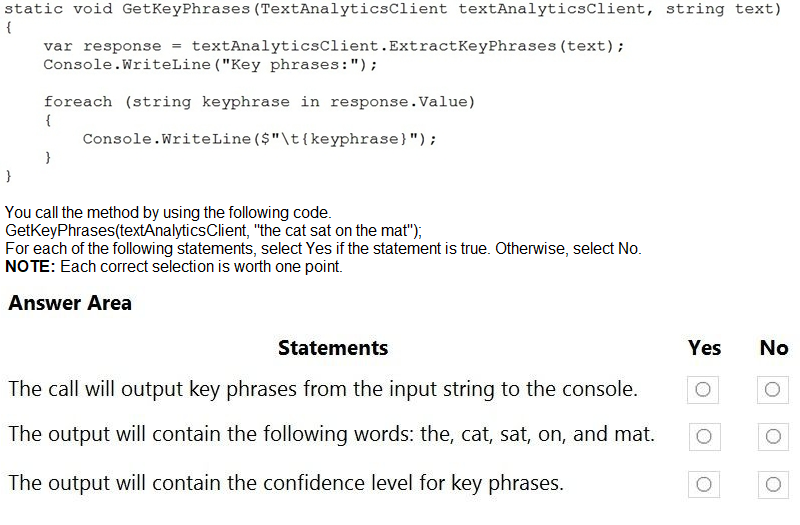
You are developing a text processing solution.
You develop the following method.
Explanation:
The code uses the Text Analytics client's ExtractKeyPhrases method on the sentence "the cat sat on the mat". Key phrase extraction identifies important words or phrases, typically nouns/noun phrases, not all words. Common stop words like "the", "on", and verbs like "sat" are usually excluded. The method returns only key phrase strings, not confidence scores.
Correct Answers:
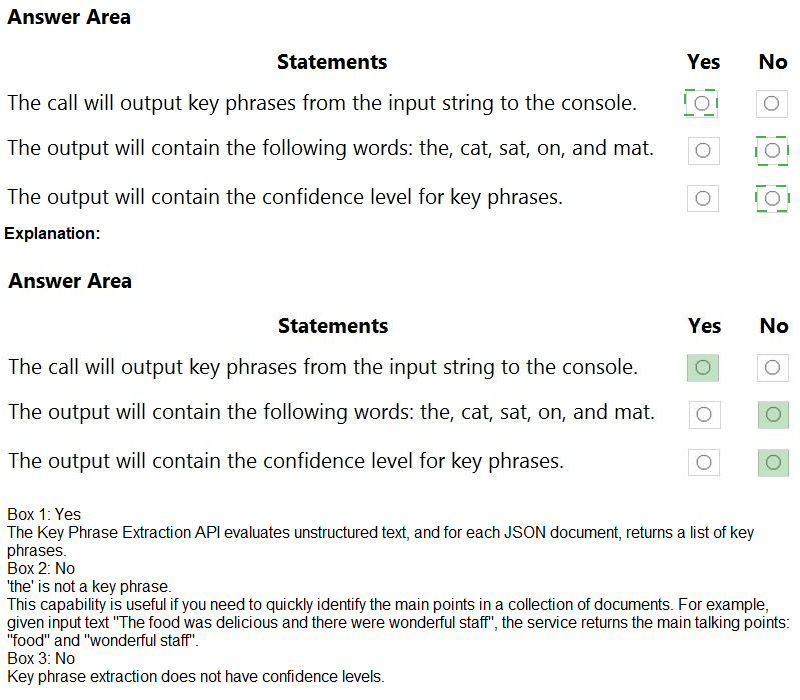
Statement 1: The call will output key phrases from the input string to the console.
Yes – The method iterates through response.Value and writes each key phrase to the console using Console.WriteLine(). Assuming the API call succeeds and returns at least one key phrase, output will be produced.
Statement 2: The output will contain the following words: the, cat, sat, on, and mat.
No – Key phrase extraction does not return stop words ("the", "on") or verbs ("sat"). It typically returns noun phrases. For this sentence, likely output is just "cat" and "mat" (or "cat" and "mat" separately). It will not output all five words as individual key phrases.
Statement 3: The output will contain the confidence level for key phrases.
No – The ExtractKeyPhrases method returns a KeyPhraseCollection containing only the key phrase strings. Confidence scores are not provided for key phrase extraction (unlike entity recognition or sentiment analysis). The code writes keyphrase directly, not any confidence value.
Reference:
Microsoft Learn: "Text Analytics - Key Phrase Extraction" – Returns key phrases as strings, no confidence scores. Stop words and common verbs are filtered out.
Azure AI Language documentation: ExtractKeyPhrases returns Response
Note: This question is part of a series of questions that present the same scenario.
Each question in the series contains a unique solution that might meet the stated
goals. Some question sets might have more than one correct solution, while others
might not have a correct solution.
After you answer a question in this section, you will NOT be able to return to it. As a
result, these questions will not appear in the review screen.
You create a web app named app1 that runs on an Azure virtual machine named vm1.
Vm1 is on an Azure virtual network named vnet1.
You plan to create a new Azure Cognitive Search service named service1.
You need to ensure that app1 can connect directly to service1 without routing traffic over
the public internet.
Solution: You deploy service1 and a private endpoint to vnet1.
Does this meet the goal?
A.
Yes
B.
No
Yes
Explanation:
Deploying a private endpoint for Azure Cognitive Search into the same virtual network (vnet1) as the web app's virtual machine (vm1) creates a private IP address for service1 within vnet1. Traffic between app1 and service1 stays on the Azure backbone network, never traversing the public internet. This meets the goal perfectly.
Correct Option:
A. Yes
A private endpoint uses a private IP address from vnet1 for service1. VM1 on vnet1 can connect to service1 via that private IP over the Microsoft backbone network. No public internet routing occurs. This is the standard Azure solution for securing cognitive services behind a virtual network.
Why This Works:
Private endpoint – Assigns a private IP to Cognitive Search within the specified virtual network. All traffic remains internal to Azure.
Same vnet – Since vm1 is already on vnet1, no peering or VPN is needed. Direct connectivity exists.
No public internet – The private endpoint disables public endpoint access by default (configurable), ensuring traffic does not leave the Microsoft network.
Reference:
Microsoft Learn: "Private endpoints for Azure Cognitive Search" – Allows search services to be accessed securely from a virtual network without public internet exposure.
Azure Networking documentation: Private endpoint traffic stays on the Microsoft backbone network.
You have the following C# method for creating Azure Cognitive Services resources
programmatically.
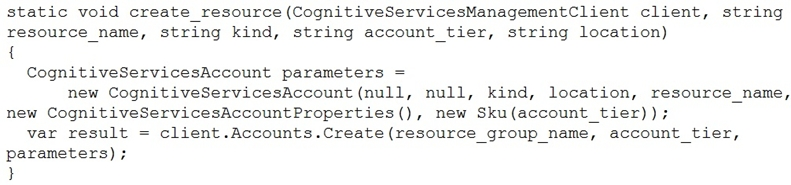
You need to call the method to create a free Azure resource in the West US Azure region.
The resource will be used to generate captions of images automatically.
Which code should you use?
A.
create_resource(client, "res1", "ComputerVision", "F0", "westus")
B.
create_resource(client, "res1", "CustomVision.Prediction", "F0", "westus")
C.
create_resource(client, "res1", "ComputerVision", "S0", "westus")
D.
create_resource(client, "res1", "CustomVision.Prediction", "S0", "westus")
create_resource(client, "res1", "ComputerVision", "F0", "westus")
Explanation:
The requirement is to create a free resource (F0 tier) in West US that generates image captions. Image captioning is a feature of the Computer Vision service, not Custom Vision. The correct kind is "ComputerVision" and the free tier is "F0". Custom Vision.Prediction is for custom image classification/object detection, not pre-built captioning.
Correct Option:
A. create_resource(client, "res1", "ComputerVision", "F0", "westus")
"ComputerVision" is the correct kind for pre-built image analysis including caption generation. "F0" is the free tier (limited to 20 calls per minute, 5,000 per month). "westus" is the West US Azure region. This combination meets all requirements.
Incorrect Options:
B. create_resource(client, "res1", "CustomVision.Prediction", "F0", "westus")
Custom Vision.Prediction is for deploying custom-trained image classification or object detection models. It does not provide built-in image captioning. You would need to train a custom model for captions, which is not the requirement (automatic captions without training).
C. create_resource(client, "res1", "ComputerVision", "S0", "westus")
While Computer Vision is correct for captioning, "S0" is the standard (paid) tier, not the free tier. The requirement explicitly says "free Azure resource". F0 is the free tier; S0 incurs charges per transaction.
D. create_resource(client, "res1", "CustomVision.Prediction", "S0", "westus")
This combines the wrong service (Custom Vision.Prediction) with a paid tier (S0). It fails both requirements: not Computer Vision and not free tier. Custom Vision does not offer pre-built image captioning.
Reference:
Microsoft Learn: "Computer Vision pricing" – Free tier (F0) and Standard tier (S0) for image captioning and other vision features.
Microsoft Learn: "Computer Vision vs Custom Vision" – Computer Vision provides pre-built image captioning; Custom Vision requires custom training.
You are developing a solution to generate a word cloud based on the reviews of a
company’s products.
Which Text Analytics REST API endpoint should you use?
A.
IceyPhrases
B.
sentiment
C.
languages
D.
entities/recognition/general
IceyPhrases
Explanation:
A word cloud requires the most frequently occurring or important terms from text. Key phrase extraction identifies the main talking points, concepts, and important terms in a document. For product reviews, key phrases would include product features, aspects, and descriptors that appear repeatedly, making them ideal for word cloud generation.
Correct Option:
A. keyPhrases
The /keyPhrases endpoint (or keyPhrases operation in Text Analytics) extracts the most relevant words and phrases from a text. These key phrases represent the main topics and concepts. Aggregating key phrases across many reviews and counting frequencies gives perfect input for a word cloud visualization.
Incorrect Options:
B. sentiment
The /sentiment endpoint returns an overall sentiment score (positive, negative, neutral, mixed) and sentiment labels for sentences. It outputs numeric scores and labels, not meaningful words or phrases. Sentiment data cannot be used to generate a word cloud.
C. languages
The /languages endpoint detects the language of input text (e.g., "en" for English, "es" for Spanish). It returns language codes and confidence scores, not content words. This is useless for building a word cloud from reviews.
D. entities/recognition/general
The /entities/recognition/general endpoint identifies named entities such as people, organizations, locations, dates, and quantities. While these could appear in a word cloud, product reviews often contain descriptive terms and features that are not named entities, so many important words would be missed.
Reference:
Microsoft Learn: "Text Analytics REST API – Key Phrases" – The /keyPhrases endpoint returns a list of strings representing the main concepts in the input text.
Microsoft Learn: "Text Analytics features" – Key phrase extraction is specifically designed for identifying important terms and topics in unstructured text.
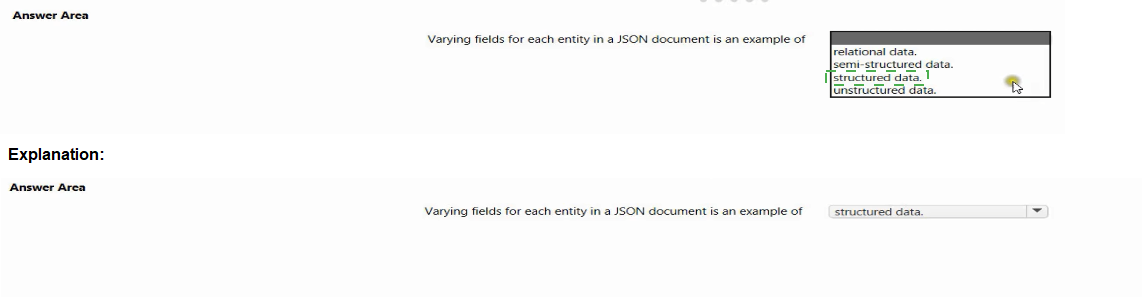
Select the answer that correctly completes the sentence.

Explanation:
A JSON document where fields can vary from one entity to another (e.g., one person has "spouse" field, another does not) is a classic example of semi-structured data. Unlike structured data (fixed schema) or unstructured data (no schema), semi-structured data uses tags/keys to organize information but allows flexibility in field presence and nesting.
Correct Option:
semi-structured data
JSON documents support optional fields, nested objects, arrays, and varying structures per entity. This flexibility sits between rigid relational tables (structured) and raw binary/text (unstructured). JSON, XML, and YAML are canonical examples of semi-structured data formats.
Incorrect Options:
relational data – Relational data requires a fixed schema with predefined columns and data types across all rows. Varying fields per entity would violate relational integrity. You cannot have a "spouse" column in only some rows without using NULLs, which is not the same as varying fields.
structured data – Structured data strictly implies a tabular format with consistent columns and rows (e.g., SQL tables). JSON with varying fields does not meet this definition because the "structure" is not uniform across all entities.
unstructured data – Unstructured data lacks any identifiable organizational structure (e.g., raw text files, images, audio, video). JSON has explicit keys, hierarchical organization, and parseable syntax, so it is never considered unstructured.
Reference:
Microsoft Learn: "Semi-structured data in Azure Cognitive Search" – JSON documents with varying fields are described as semi-structured.
Industry standard definitions: Structured (tables), Semi-structured (JSON, XML), Unstructured (blobs, free text).
| Page 13 out of 34 Pages |
| 89101112131415161718 |
| AI-102 Practice Test Home |
Real-World Scenario Mastery: Our AI-102 practice exam don't just test definitions. They present you with the same complex, scenario-based problems you'll encounter on the actual exam.
Strategic Weakness Identification: Each practice session reveals exactly where you stand. Discover which domains need more attention, before Designing and Implementing a Microsoft Azure AI Solution exam day arrives.
Confidence Through Familiarity: There's no substitute for knowing what to expect. When you've worked through our comprehensive AI-102 practice exam questions pool covering all topics, the real exam feels like just another practice session.
Copyright © All Rights Reserved