
Topic 3: Misc. Questions
You are building a Language Understanding model for an e-commerce chatbot. Users can
speak or type their billing address when prompted by the chatbot.
You need to construct an entity to capture billing addresses.
Which entity type should you use?
A.
machine learned
B.
Regex
C.
list
D.
Pattern.any
machine learned
Explanation:
A billing address can vary widely in format (street number, street name, city, postal code, etc.). A machine learned entity is the most flexible and powerful type because it learns from context and examples. It can extract complex, variable-length addresses without rigid patterns. List, Regex, or Pattern.any would be too restrictive for real-world address variations.
Correct Option:
A. machine learned
Machine learned entities are trained from labeled utterances. They can extract complex, multi-component entities like addresses where the structure varies. They understand context (e.g., "123 Main St" vs "PO Box 456") and can handle optional components. This is the recommended entity type for free-form, real-world data like addresses.
Incorrect Options:
B. Regex –
Regex entities match exact patterns (e.g., \d{5} for ZIP codes). Addresses have too many format variations to be captured by a single regex. Regex is suitable for fixed-format data like order numbers or phone numbers, not full addresses.
C. list –
List entities match exact text against a predefined set of normalized values. Addresses are too numerous and variable to predefine in a list. List entities work for small, closed sets (e.g., payment types: "credit card", "PayPal"), not for open-ended addresses.
D. Pattern.any –
Pattern.any is used in patterns to capture variable-length text where the entity may contain spaces or special characters. It requires a pattern to define its boundaries and is not suitable for complex, multi-field entities like addresses that have internal structure.
Reference:
Microsoft Learn documentation: "Entity types in Language Understanding", "Machine learned entities for complex extraction", and "When to use list, regex, or pattern.any entities"
Note: This question is part of a series of questions that present the same scenario. Each
question in the series contains a unique solution that might meet the stated goals. Some
question sets might have more than one correct solution, while others might not have a
correct solution.
After you answer a question in this section, you will NOT be able to return to it. As a result,
these questions will not appear in the review screen.
You develop an application to identify species of flowers by training a Custom Vision
model. You receive images of new flower species.
You need to add the new images to the classifier.
Solution: You add the new images, and then use the Smart Labeler tool.
Does this meet the goal?
A.
Yes
B.
No
No
Explanation:
The Smart Labeler tool in Custom Vision helps automate labeling by suggesting tags based on existing training images. It does not add new flower species to the classifier. To add new species, you must manually add the new images with their corresponding new tags (labels), then retrain the model. Smart Labeler assists with labeling efficiency but does not create new species categories.
Correct Option:
B. No
Adding new images alone does not add new species. You must also create new tags for the new flower species and assign those tags to the new images. The Smart Labeler tool suggests labels based on existing tags; it cannot invent new species tags. After tagging, you must retrain and republish the model. The described solution is incomplete.
Incorrect Option:
A. Yes
This would be incorrect because Smart Labeler is not the tool for adding new species. It is an assistance tool for labeling images with existing tags. To introduce a new class (flower species), you must manually add a new tag, label images with that tag, retrain the model, and then publish. Smart Labeler alone does not accomplish this.
Reference:
Microsoft Learn documentation: "Custom Vision – Smart Labeler overview", "Add new tags to a Custom Vision project", and "Train and publish a Custom Vision model"
You have an app named App1 that uses an Azure Cognitive Services model to identify
anomalies in a time series data stream. You need to run App1 in a location that has limited
connectivity. The solution must minimize costs. What should you use to host the model?
A.
Azure Kubernetes Services (AKS)
B.
a Kubernetes cluster hosted in an Azure Stack Hub integrated system
C.
Azure Container instances
D.
the Docker Engine
the Docker Engine
Explanation:
The requirement is to run App1 in a location with limited connectivity while minimizing costs. Anomaly Detector (like other Cognitive Services) offers Docker containers that can run on Docker Engine locally, without continuous internet access after initial setup. This allows offline operation and minimizes cloud costs. AKS or ACI would incur ongoing Azure costs and require more connectivity.
Correct Option:
D. the Docker Engine
Azure Cognitive Services provide Docker containers for on-premises or edge deployment. Running the Anomaly Detector container on Docker Engine allows the model to operate in disconnected or limited-connectivity environments. Once the container is downloaded and configured, it runs locally without calling Azure APIs, minimizing ongoing costs (only compute/storage locally).
Incorrect Options:
A. Azure Kubernetes Services (AKS) –
AKS is a managed Kubernetes service in Azure, requiring constant cloud connectivity for orchestration and control plane. It is not suitable for limited-connectivity locations and incurs ongoing Azure costs, contradicting the cost minimization requirement.
B. a Kubernetes cluster hosted in an Azure Stack Hub integrated system –
Azure Stack Hub is an on-premises solution, but it requires significant infrastructure investment and operational overhead. It does not minimize costs and is overkill for running a single anomaly detection container.
C. Azure Container instances –
ACI is a serverless container service in Azure that requires continuous cloud connectivity. It cannot run in locations with limited connectivity and incurs costs for each running container instance. This does not meet the limited connectivity or cost minimization requirements.
Reference:
Microsoft Learn documentation: "Cognitive Services containers – Anomaly Detector", "Run Cognitive Services containers on Docker Engine", and "Deploy Cognitive Services to disconnected environments"
You are examining the Text Analytics output of an application.
The text analyzed is: "Our tour guide took us up the Space Needle during our trip to Seattle
last week."
The response contains the data shown in the following table.

Which Text Analytics API is used to analyze the text?
A.
Sentiment Analysis
B.
Named Entity Recognition
C.
Entity Linking
D.
Key Phrase Extraction
Named Entity Recognition
Explanation:
The output shows detected entities with categories (PersonType, Location, Event, DateTime) and confidence scores. This is the output of Named Entity Recognition (NER). NER identifies and categorizes entities in text into predefined types like people, places, dates, and events. The example text contains "Tour guide" (PersonType), "Space Needle" (Location), "trip" (Event), "Seattle" (Location), and "last week" (DateTime).
Correct Option:
B. Named Entity Recognition
Named Entity Recognition (NER) is the Text Analytics API that detects entities in text and classifies them into categories such as Person, Location, Organization, DateTime, Event, Quantity, etc. The output includes each entity's text, category, and confidence score. This exactly matches the table provided.
Incorrect Options:
A. Sentiment Analysis –
Sentiment Analysis returns an overall sentiment label (positive, negative, neutral, mixed) and confidence scores for each document or sentence. It does not extract entities or categories like PersonType, Location, or DateTime. The output shown has no sentiment scores, so this is incorrect.
C. Entity Linking –
Entity Linking disambiguates entities by linking them to a knowledge base (e.g., Wikipedia). It returns a bingId or wikipediaId for recognized entities. The output shown does not include any knowledge base links or IDs, only categories and confidence scores, so this is NER, not Entity Linking.
D. Key Phrase Extraction –
Key Phrase Extraction identifies the main talking points in text (e.g., "tour guide", "Space Needle", "trip to Seattle") but does not categorize them into types like PersonType, Location, or DateTime. It returns a list of phrases without categories or confidence scores per phrase.
Reference:
Microsoft Learn documentation: "Named Entity Recognition in Azure Text Analytics", "Entity Linking vs Named Entity Recognition", and "Key Phrase Extraction and Sentiment Analysis overview"
You deploy a web app that is used as a management portal for indexing in Azure Cognitive
Search. The app is configured to use the primary admin key.
During a security review, you discover unauthorized changes to the search index. You
suspect that the primary access key is compromised.
You need to prevent unauthorized access to the index management endpoint. The solution
must minimize downtime.
What should you do next?
A.
Regenerate the primary admin key, change the app to use the secondary admin key,
and then regenerate the secondary admin key.
B.
Change the app to use a query key, and then regenerate the primary admin key and the
secondary admin key.
C.
Regenerate the secondary admin key, change the app to use the secondary admin key,
and then regenerate the primary key.
D.
Add a new query key, change the app to use the new query key, and then delete all the
unused query keys.
Regenerate the secondary admin key, change the app to use the secondary admin key,
and then regenerate the primary key.
Explanation:
When the primary admin key is suspected compromised, you need to rotate keys with minimal downtime. The recommended pattern: regenerate the secondary admin key (which is not currently used), change the app to use the new secondary key, then regenerate the primary key. This ensures the app never loses access because at least one valid key is always in use.
Correct Option:
C. Regenerate the secondary admin key, change the app to use the secondary admin key, and then regenerate the primary key.
This sequence maintains continuous availability:
Regenerate secondary admin key – The compromised primary key remains valid, and the secondary key gets a new value.
Change app to use secondary admin key – The app now uses the newly regenerated secondary key; the primary key is no longer in use.
Regenerate primary key – The compromised primary key is replaced. The app continues working with the secondary key throughout.
Incorrect Options:
A. Regenerate the primary admin key first –
This would immediately invalidate the key the app is currently using, causing downtime. The app would fail to authenticate until it is updated to use the secondary key. This violates the "minimize downtime" requirement.
B. Change the app to use a query key –
Query keys only provide read-only access, not index management (write) access. The app is a management portal that needs to modify the search index. Switching to a query key would break the app's functionality.
D. Add a new query key –
Query keys are for read-only client applications, not for index management. The app requires admin key privileges to perform indexing operations. Adding query keys does not address the compromised admin key issue.
Reference:
Microsoft Learn documentation: "Cognitive Search admin key rotation", "Minimize downtime during key regeneration", and "Admin keys vs query keys in Azure Cognitive Search"
You need to upload speech samples to a Speech Studio project. How should you upload
the samples?
A.
Combine the speech samples into a single audio file in the .wma format and upload the
file.
B.
Upload a .zip file that contains a collection of audio files in the .wav format and a
corresponding text transcript file.
C.
Upload individual audio files in the FLAC format and manually upload a corresponding
transcript in Microsoft Word format.
D.
Upload individual audio files in the .wma format.
Upload a .zip file that contains a collection of audio files in the .wav format and a
corresponding text transcript file.
Explanation:
Speech Studio projects for custom speech (e.g., Custom Voice or Custom Speech) require paired audio and transcript data. The standard method is to upload a .zip file containing multiple .wav audio files and a corresponding text transcript file (plain text). This batch upload ensures proper alignment between audio and labels for training acoustic and language models.
Correct Option:
B. Upload a .zip file that contains a collection of audio files in the .wav format and a corresponding text transcript file.
Speech Studio expects audio files (.wav recommended) and a transcript file (plain text, typically with the same base name) packaged in a .zip. The transcript contains the exact words spoken in each audio file. This pairing is required for training custom speech models. .wav format ensures lossless quality.
Incorrect Options:
A. Combine speech samples into a single .wma file –
Combining samples into one file prevents proper alignment with transcripts. Each utterance should be a separate file for accurate training. .wma is a compressed format, which is not recommended for high-quality speech training. Lossless formats like .wav are preferred.
C. Individual FLAC files with Word transcript –
While FLAC is a lossless format, uploading individual files is inefficient for large datasets. Microsoft Word format (.docx) is not accepted for transcripts; plain text (.txt) is required. Speech Studio expects batch upload via .zip for multiple files.
D. Individual .wma files –
Uploading individual files is time-consuming for large datasets. .wma is a compressed format that may degrade quality. Speech Studio supports batch upload via .zip for efficiency, and .wav (or FLAC) lossless formats are recommended for best training results.
Reference:
Microsoft Learn documentation: "Speech Studio – Upload data for custom speech", "Audio and transcript requirements", and "Prepare training data for Custom Voice"
You are building a social media extension that will convert text to speech. The solution
must meet the following requirements:
• Support messages of up to 400 characters.
• Provide users with multiple voice options.
• Minimize costs.
You create an Azure Cognitive Services resource.
Which Speech API endpoint provides users with the available voice options?
A.
https://uksouth.customvoice.apispeech.microsoft.eom/api/texttospeech/v3.0/longaudiosynt
hesis/voices
B.
https://uksouth.tts.speech.microsoft.conT/cognitiveservices/voices/list
C.
https://uksouth.voice.speech.microsoft.com/cognitiveservices/v1?deploymentld =
{deploymentld>
D.
https://uksouth.api.cognitive.microsoft.eom/speechtotext/v3.0/models/base
https://uksouth.tts.speech.microsoft.conT/cognitiveservices/voices/list
Explanation:
To get the list of available voices for text-to-speech, the correct endpoint is /cognitiveservices/voices/list. This endpoint returns all standard and neural voices available in the region, including voice names, genders, locales, and styles. It requires no deployment ID or custom voice model. This meets the requirement for multiple voice options at minimal cost.
Correct Option:
B. https://uksouth.tts.speech.microsoft.com/cognitiveservices/voices/list
The /cognitiveservices/voices/list endpoint is the standard REST API for listing all available text-to-speech voices in a region. It returns voice metadata (name, locale, gender, style, etc.) without any billing for TTS synthesis. Users can then select their preferred voice from this list before converting text to speech.
Incorrect Options:
A. /longaudiosynthesis/voices –
This endpoint is for long-form audio synthesis (e.g., audiobooks) and requires a custom voice model or deployment ID. It is not for listing standard voices and is unnecessary for short messages (up to 400 characters). It also incurs higher costs.
C. /cognitiveservices/v1?deploymentId= –
This is the text-to-speech synthesis endpoint, not a voice listing endpoint. It requires a deployment ID (for custom voices) and generates audio, which incurs costs. It does not return a list of available voice options.
D. /speechtotext/v3.0/models/base –
This endpoint lists base models for speech-to-text, not text-to-speech. It is for transcription models, not voice options for synthesis. This is completely unrelated to the requirement.
Reference:
Microsoft Learn documentation: "Text-to-Speech API – List voices", "Get available voices endpoint", and "Speech service REST API for voices"
You are developing an application that will use Azure Cognitive Search for internal
documents.
You need to implement document-level filtering for Azure Cognitive Search.
Which three actions should you include in the solution? Each correct answer presents part
of the solution.
NOTE: Each correct selection is worth one point.
A.
Send Azure AD access tokens with the search request.
B.
Retrieve all the groups.
C.
Retrieve the group memberships of the user.
D.
Add allowed groups to each index entry.
E.
Create one index per group.
F.
Supply the groups as a filter for the search requests.
Retrieve the group memberships of the user.
Add allowed groups to each index entry.
Supply the groups as a filter for the search requests.
Explanation:
Document-level filtering in Azure Cognitive Search (also called security trimming) ensures users only see documents they are authorized to access. The standard pattern involves: (1) retrieving the user's group memberships, (2) storing allowed groups on each index entry, and (3) supplying those groups as a filter in search requests using $filter with OData syntax.
Correct Options:
C. Retrieve the group memberships of the user
Before querying, you need to know which groups the current user belongs to (e.g., from Azure AD, custom identity system). This information is used to build the security filter. Without user group memberships, you cannot determine which documents the user can access.
D. Add allowed groups to each index entry
Each document in the index must have a field (e.g., allowedGroups) that lists the group IDs authorized to access that document. This field is typically an array of strings. This enables filtering based on the user's group memberships.
F. Supply the groups as a filter for the search requests
In the search query, add a $filter clause like $filter=allowedGroups/any(g: g in ['group1','group2']) using the user's group memberships. This ensures the search results only include documents where the user's groups intersect with the document's allowed groups.
Incorrect Options:
A. Send Azure AD access tokens with the search request –
While Azure AD tokens can authenticate users, they do not automatically perform document-level filtering. Tokens provide identity, but you still need to retrieve group memberships and apply filters as described in C, D, and F. Tokens alone are insufficient.
B. Retrieve all the groups –
Retrieving all groups in the system is inefficient and unnecessary. You only need the specific group memberships of the current user (option C). Retrieving all groups would expose unnecessary data and degrade performance.
E. Create one index per group –
Creating separate indexes per group is not scalable (hundreds or thousands of groups would require hundreds of indexes). Document-level filtering within a single index is the recommended pattern for security trimming.
Reference:
Microsoft Learn documentation: "Security trimming in Azure Cognitive Search", "Implement document-level permissions", and "Filter based on user identity and group membership"
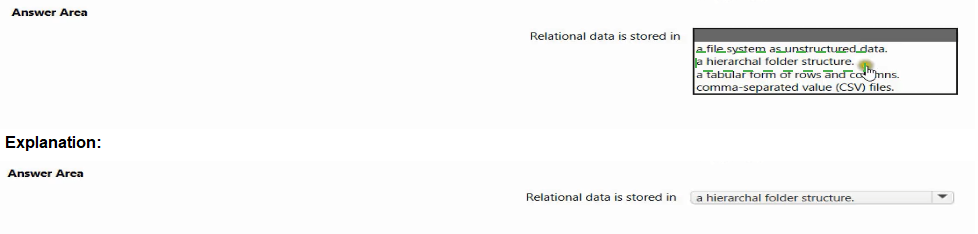
Select the answer that correctly completes the sentence.

Explanation:
Relational data is structured data organized into tables consisting of rows (records) and columns (attributes). Each row represents a unique record, and each column represents a specific attribute of that record. This tabular structure is fundamental to relational databases like SQL Server, PostgreSQL, and MySQL, where relationships are defined between tables using keys.
Correct Option:
a tabular form of rows and columns.
Relational data models are based on mathematical set theory and predicate logic. Data is presented in two-dimensional tables (relations) where rows are tuples (records) and columns are attributes (fields). This structure enables efficient querying, indexing, and joining across multiple tables. This is the defining characteristic of relational data.
Incorrect Options:
a file system as unstructured data. – File systems store unstructured or semi-structured data (e.g., text files, images, videos). Relational data is structured, not unstructured. File systems do not enforce schemas, data types, or relationships.
a hierarchical folder structure. – Hierarchical structures (like folders on a disk or XML/JSON trees) represent parent-child relationships. Relational data is tabular, not hierarchical. While some databases support hierarchical queries, the native storage is tabular.
comma-separated value (CSV) files. – CSV files are a file format that can represent tabular data, but they are not the definition of relational data. CSV files lack constraints, data types, relationships, and indexing. Relational databases use tables, not CSV files, as their storage mechanism.
Reference:
Microsoft Learn documentation: "Relational data model overview", "Tables, rows, and columns in relational databases", and "Difference between relational and unstructured data"
Your company needs to implement a relational database in Azure. The solution must
minimize ongoing maintenance. Which Azure service should you use?
A.
SQL Server on Azure Virtual Machines
B.
Azure SOL Database
C.
Azure HDInsight
D.
Azure Cosmos DB
Azure SOL Database
Explanation:
Azure SQL Database is a fully managed Platform as a Service (PaaS) relational database. It automates backups, patching, high availability, and scaling, minimizing ongoing maintenance. In contrast, SQL Server on Azure VMs (IaaS) requires manual management of the OS, SQL Server installation, backups, and patching, increasing maintenance effort.
Correct Option:
B. Azure SQL Database
Azure SQL Database is a PaaS relational database service that handles maintenance tasks automatically: automatic backups with point-in-time restore, automated patching, built-in high availability, and automatic threat detection. It requires no infrastructure management, significantly reducing operational overhead compared to IaaS solutions.
Incorrect Options:
A. SQL Server on Azure Virtual Machines –
This is IaaS. You manage the VM, OS, SQL Server installation, patching, backups, and high availability. This requires significant ongoing maintenance (e.g., applying security updates, managing storage, configuring replication), contradicting the "minimize ongoing maintenance" requirement.
C. Azure HDInsight –
HDInsight is a managed big data analytics service for Hadoop, Spark, Hive, and other open-source frameworks. It is not a relational database. It is designed for data warehousing and batch processing, not transactional relational workloads. Maintenance is lower than IaaS but the service type is wrong.
D. Azure Cosmos DB –
Cosmos DB is a NoSQL multi-model database (document, graph, key-value, column-family). It is not a relational database. It does not support SQL Server-compatible T-SQL, joins, or ACID transactions across multiple tables in the same way as a relational database.
Reference:
Microsoft Learn documentation: "Azure SQL Database vs SQL Server on Azure VMs", "Managed services vs IaaS maintenance overhead", and "Choose the right Azure database service"
Note: This question is part of a series of questions that present the same scenario.
Each question in the series contains a unique solution that might meet the stated
goals. Some question sets might have more than one correct solution, while others
might not have a correct solution.
After you answer a question in this section, you will NOT be able to return to it. As a
result, these questions will not appear in the review screen.
You create a web app named app1 that runs on an Azure virtual machine named vm1.
Vm1 is on an Azure virtual network named vnet1.
You plan to create a new Azure Cognitive Search service named service1.
You need to ensure that app1 can connect directly to service1 without routing traffic over
the public internet.
Solution: You deploy service1 and a public endpoint, and you configure an IP firewall rule.
Does this meet the goal?
A.
Yes
B.
No
No
Explanation:
Configuring a public endpoint with an IP firewall rule restricts which source IPs can access the service, but traffic still routes over the public internet. The requirement is to connect without routing traffic over the public internet. To achieve this, you need a private endpoint (Azure Private Link) that assigns a private IP address to service1 within vnet1.
Correct Option:
B. No
A public endpoint, even with IP firewall rules, means traffic travels over the public internet infrastructure. IP firewall rules provide access control (authorization) but do not change the network path. For private connectivity (traffic staying within Microsoft's backbone network and your virtual network), you must deploy service1 with a private endpoint using Azure Private Link.
Incorrect Option:
A. Yes
This would be incorrect because a public endpoint + IP firewall does not eliminate public internet routing. The traffic still leaves the virtual network and traverses the internet to reach service1's public IP. The goal requires direct connection without public internet, which is only possible with a private endpoint.
Reference:
Microsoft Learn documentation: "Private endpoints for Azure Cognitive Search", "Public endpoints vs IP firewall vs Private Link", and "Connect privately to Cognitive Search"
You plan to use containerized versions of the Anomaly Detector API on local devices for
testing and in on-premises datacenters.
You need to ensure that the containerized deployments meet the following requirements:
Prevent billing and API information from being stored in the command-line
histories of the devices that run the container.
Control access to the container images by using Azure role-based access control
(Azure RBAC).
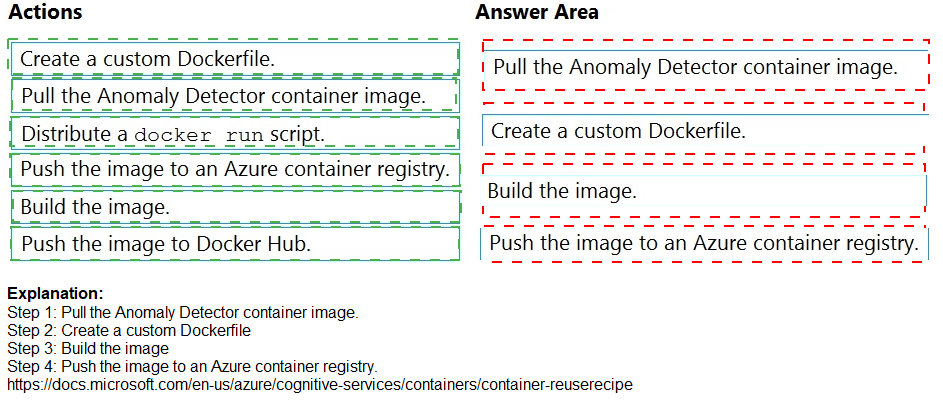
Which four actions should you perform in sequence? To answer, move the appropriate
actions from the list of actions to the answer area and arrange them in the correct order.
(Choose four.)
NOTE: More than one order of answer choices is correct. You will receive credit for any of
the correct orders you select.
Explanation:
To avoid storing billing keys in command-line history, you bake the API key and endpoint into a custom Docker image instead of passing them as runtime environment variables. To control access via Azure RBAC, you push the image to Azure Container Registry (ACR), which supports RBAC. The sequence: pull the base image, create Dockerfile, build, then push to ACR.
Correct Sequence (4 actions):
1. Pull the Anomaly Detector container image
First, pull the official Microsoft Anomaly Detector container image from Microsoft Container Registry (MCR) to your local machine or build environment. This provides the base image you will customize.
2. Create a custom Dockerfile
Create a Dockerfile that uses the base image and embeds the billing endpoint and API key as environment variables inside the image (e.g., using ENV directives). This prevents keys from appearing in command-line history when running the container, as they are stored within the image itself.
3. Build the image
Run docker build to compile your custom Dockerfile into a new Docker image. This image contains the embedded billing information and any other custom configurations. The built image is stored locally initially.
4. Push the image to an Azure container registry
Push the custom image to Azure Container Registry (ACR). ACR supports Azure RBAC, allowing you to control who can pull, push, or manage images. Devices can then authenticate via Azure AD to pull the image without exposing credentials in command lines.
Incorrect or Out-of-Sequence Actions:
Distribute a docker run script – This is not required in the sequence. If you embed the keys in the image, you don't need a separate run script. A script might expose keys if it contains environment variables, contradicting the requirement.
Push the image to Docker Hub – Docker Hub does not support Azure RBAC. It uses its own access control (personal access tokens, teams) that is not integrated with Azure AD. This would not meet the Azure RBAC requirement.
Pull after building – Pulling must occur first to obtain the base image. Pulling after building would overwrite or conflict with the custom image.
Reference:
Microsoft Learn documentation: "Azure Container Registry RBAC permissions", "Run Cognitive Services containers with embedded billing", and "Customize Cognitive Services container images"
| Page 10 out of 34 Pages |
| 56789101112131415 |
| AI-102 Practice Test Home |
Real-World Scenario Mastery: Our AI-102 practice exam don't just test definitions. They present you with the same complex, scenario-based problems you'll encounter on the actual exam.
Strategic Weakness Identification: Each practice session reveals exactly where you stand. Discover which domains need more attention, before Designing and Implementing a Microsoft Azure AI Solution exam day arrives.
Confidence Through Familiarity: There's no substitute for knowing what to expect. When you've worked through our comprehensive AI-102 practice exam questions pool covering all topics, the real exam feels like just another practice session.
Copyright © All Rights Reserved