
Which version is used to provide encryption for SNMP management traffic in collaboration
deployments?
A.
SNMPv1
B.
SNMPv3
C.
SNMPv2
D.
SNMPv2c
SNMPv3
Explanation
SNMP (Simple Network Management Protocol) is used to monitor and manage network devices in Cisco collaboration deployments. Of the listed versions, SNMPv3 provides security features including authentication, message integrity, and encryption. By contrast, SNMPv1 and SNMPv2c use community strings and do not encrypt management traffic.
Correct Option
B. SNMPv3
SNMPv3 supports different security levels. To encrypt SNMP management traffic, configure the authPriv security level, which provides both authentication and privacy (encryption). Authentication alone (authNoPriv) does not encrypt the data.
Incorrect Options
- A. SNMPv1 —
Uses community strings and does not provide encryption.
- C. SNMPv2 —
The option is imprecise; the commonly deployed SNMPv2c version does not provide encryption.
- D. SNMPv2c —
Uses community-based security, with no built-in encryption of management traffic.
Reference
- Cisco — Secure Simple Network Management Protocol
Endpoint A is attempting to call endpoint B. Endpoint A only supports G.711ulaw with a
packetization rate of 20 ms, and endpoint B supports packetization rate of 30 ms for
G.711ulaw. Which two media are resources are allocated to normalize packetization rates
through transrating?
A.
Hardware MTP on Cisco IOS Software
B.
Software MTP on Cisco Unified Communication Manager
C.
Software MTP on Cisco IOS Software
D.
Software transcoder on Cisco unified Communications manager
E.
Hardware transcoder on Cisco IOS Software
Hardware MTP on Cisco IOS Software
Software MTP on Cisco Unified Communication Manager
Explanation
The key concept is transrating, which changes the packetization interval while keeping the same codec. Here, both endpoints use G.711 μ-law, but Endpoint A sends 20 ms packets and Endpoint B requires 30 ms packets. This is a packetization mismatch, not a codec mismatch, so the call needs an MTP capable of repacketizing the media. Cisco documentation explains that this operation requires DSP resources rather than a software-only MTP.
Correct Options
A. Hardware MTP on Cisco IOS Software
A hardware MTP on a Cisco IOS voice gateway uses DSP resources to normalize the different G.711 packetization intervals. It can receive 20 ms packets and send 30 ms packets while preserving the codec.
B. Software MTP on Cisco Unified Communications Manager
This is the other expected exam answer. Cisco documentation notes that Unified CM's terminology for MTP resources can differ from the implementation terminology used on gateways. In particular, Cisco describes certain hardware MTP resources as “software MTP” from the Unified CM perspective.
Incorrect Options
- C. Software MTP on Cisco IOS Software —
A software-only IOS MTP does not provide the DSP-based repacketization required for this packetization mismatch.
- D. Software transcoder on Cisco Unified Communications Manager —
Transcoding converts between codecs; both endpoints already use G.711 μ-law.
- E. Hardware transcoder on Cisco IOS Software —
A transcoder is primarily for codec conversion. The issue here is different packetization intervals, so an MTP is the appropriate resource.
Reference
- Cisco Unified Communications Manager and Cisco IOS Interoperability Guide — Media Resources
Refer to the exhibit.

An administrator is attempting to register a SIP phone to a Cisco UCM but the registration
is failing. The IP address of the SIP Phone is 10.117.34 222 and the IP 1 address of the
Cisco UCM is 10.0.101.10. Pings from the SIP phone to the Cisco UCM are successful.
What is the cause of this issue and how should it be resolved?
A.
The certificates on the SIP phone are not trusted by the Cisco UCM. The SIP phone
must generate new certificates.
B.
DNS lookup for the Cisco UCM FQDN is failing. The SIP phone must be reconfigured
with the proper DNS server.
C.
An NTP mismatch is preventing connection of the TCP session between the SIP phone
and the Cisco UCM. The SIP phone and Cisco UCM must be set with identical NTP
sources.
D.
An network device is blocking TCP port 5060 from the SIP phone to the Cisco UCM.
This device must be reconfigured to allow traffic from the IP phone.
An network device is blocking TCP port 5060 from the SIP phone to the Cisco UCM.
This device must be reconfigured to allow traffic from the IP phone.
Explanation
The key concept is transrating, which changes the packetization interval while keeping the same codec. Here, both endpoints use G.711 μ-law, but Endpoint A sends 20 ms packets and Endpoint B requires 30 ms packets. This is a packetization mismatch, not a codec mismatch, so the call needs an MTP capable of repacketizing the media. Cisco documentation explains that this operation requires DSP resources rather than a software-only MTP.
Correct Options
A. Hardware MTP on Cisco IOS Software
A hardware MTP on a Cisco IOS voice gateway uses DSP resources to normalize the different G.711 packetization intervals. It can receive 20 ms packets and send 30 ms packets while preserving the codec.
B. Software MTP on Cisco Unified Communications Manager
This is the other expected exam answer. Cisco documentation notes that Unified CM's terminology for MTP resources can differ from the implementation terminology used on gateways. In particular, Cisco describes certain hardware MTP resources as “software MTP” from the Unified CM perspective.
Incorrect Options
- C. Software MTP on Cisco IOS Software —
A software-only IOS MTP does not provide the DSP-based repacketization required for this packetization mismatch.
- D. Software transcoder on Cisco Unified Communications Manager —
Transcoding converts between codecs; both endpoints already use G.711 μ-law.
- E. Hardware transcoder on Cisco IOS Software —
A transcoder is primarily for codec conversion. The issue here is different packetization intervals, so an MTP is the appropriate resource.
Reference
- Cisco Unified Communications Manager and Cisco IOS Interoperability Guide — Media Resources
In the cisco expressway solution, which two features does mobile and Remote access
provide? (Choose two)
A.
VPN-based enterprise access for a subset of Cisco Unified IP Phone models
B.
Secure reverse proxy firewall travelsal connectivity
C.
the ability to register third-party SIP or H.323 devices on Cisco UCM without requiring
VPN
D.
the ability of Cisco IP Phones to access the enterprise through VPN connection
E.
the ability for remote users and their devices to access and consume enterprise
collaboration applications and services
Secure reverse proxy firewall travelsal connectivity
the ability for remote users and their devices to access and consume enterprise
collaboration applications and services
Explanation
Cisco Expressway Mobile and Remote Access (MRA) enables remote users and supported collaboration endpoints to access enterprise collaboration services without requiring a VPN. Expressway-C and Expressway-E work together to provide secure firewall traversal, while Unified CM continues to provide call control and related services. Cisco's official documentation describes both features in options B and E exactly as core MRA capabilities.
Correct Options
B. Secure reverse proxy firewall traversal connectivity
Expressway provides secure traversal through the enterprise firewall. Expressway-E acts as the external-facing edge, while Expressway-C establishes a secure traversal connection and proxies endpoint registration to Unified CM.
E. The ability for remote users and their devices to access and consume enterprise collaboration applications and services
MRA lets supported remote users access services such as voice, video, messaging, presence, and provisioning without first connecting through a VPN.
Incorrect Options
- A. VPN-based enterprise access for a subset of Cisco Unified IP Phone models —
MRA is designed to provide access without requiring a VPN; it is not a VPN-based access feature.
- C. Register third-party SIP or H.323 devices on Cisco UCM without requiring VPN —
Third-party SIP or H.323 endpoints may register to Expressway-C and interoperate with Unified CM through a SIP trunk, but this is distinct from the two core MRA features described in the question.
- D. Cisco IP Phones access the enterprise through VPN —
This describes VPN-based connectivity rather than MRA's secure traversal approach.
Reference
- Cisco Expressway — MRA Overview
Users dial a 9 before a 10-digit phone number to make an off-net call All 11 digits are sent
to the Cisco Unified Border Element before going out to the PSTN The PSTN provider
accepts only 10 digits. Which configuration is needed on the Cisco Unified Border Element
for calls to be successful?
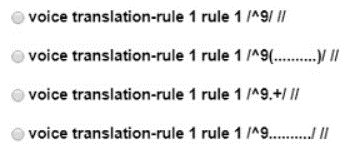
A.
Option A
B.
Option B
C.
Option C
D.
Option D
Option A
Explanation
The users dial 9 followed by a 10-digit number, but the Cisco Unified Border Element (CUBE) sends all 11 digits to the PSTN provider. Since the provider accepts only 10 digits, CUBE must remove the leading 9 from the called number before forwarding the call. Cisco IOS supports this through voice translation rules and an outgoing translation profile applied to the appropriate dial peer.
Correct Option
A. Option A — assuming the exhibit's configuration matches the required leading-digit removal.
The required logic is equivalent to:
voice translation-rule 9
rule 1 /^9\(.*\)/ /\1/
!
voice translation-profile STRIP-9
translate called 9
!
dial-peer voice
translation-profile outgoing STRIP-9
For example, 92125551212 becomes 2125551212, so the PSTN receives the required 10 digits.
Incorrect Options
I can't reliably identify the exact differences among options B, C, and D without reading the configuration text in the exhibit. The correct configuration must remove only the leading 9 from the called number on the outbound CUBE dial peer.
Reference
- Cisco — Understand IOS and IOS XE Call Routing
Which open-standard protocol is the basis for the Extensible Messaging and Presence
Protocol?
A.
Json
B.
SIP
C.
XML
D.
HTTP
XML
Explanation
Extensible Messaging and Presence Protocol (XMPP) is an open-standard protocol for real-time messaging and presence information. It is based on Extensible Markup Language (XML), which structures the messages and data exchanged between clients and servers. XMPP is widely associated with instant messaging and presence services, including collaboration platforms.
Correct Option
C. XML
XMPP uses XML streams and XML stanzas to exchange structured information, including messages, presence updates, and request-response data.
Incorrect Options
- A. JSON —
A common data-interchange format, but not the basis of XMPP.
- B. SIP —
A signaling protocol used to establish, modify, and terminate communication sessions.
- D. HTTP —
A web application protocol that can transport some XMPP implementations, but it is not the foundation of XMPP.
Reference
- IETF RFC 6120 — Extensible Messaging and Presence Protocol (XMPP): Core
Which Cisco Unified Communications Manager feature is to determine the maximum bit
rate for a call between two video endpoints?
A.
Partitions
B.
Locations
C.
Regions
D.
transformations
Regions
Explanation
Cisco Unified Communications Manager (CUCM) uses Regions to determine the maximum audio and video bit rates for calls between endpoints. The region configuration defines bandwidth limits for calls within the same region and between different regions. CUCM uses these limits when negotiating the media capabilities of a call.
Correct Option
C. Regions
Administrators configure the Maximum Session Bit Rate for Video Calls in the Region configuration. This setting limits the maximum video bandwidth CUCM allows when endpoints establish a video call.
Navigation: Cisco Unified CM Administration → System → Region Information → Region. Configure the relevant region relationship and its maximum video call bit rate.
Incorrect Options
- A. Partitions —
Control which directory numbers and route patterns are reachable through a Calling Search Space; they do not set video bandwidth.
- B. Locations —
Manage the total bandwidth available across network links for Call Admission Control (CAC), rather than defining the maximum video bit rate for a region relationship.
- D. Transformations —
Modify calling or called party numbers; they do not control media bandwidth.
Reference
- Cisco Unified CM Feature Configuration Guide — Video Telephony
Refer to the Exhibit.

Which command is required to allow this media resource to handle Video Media streams?
A.
maximum sessions hardware 50
B.
video codec h264
C.
codec pass-through
D.
associate application Cisco Unified Border Element
codec pass-through
Explanation
The correct answer is C. codec pass-through.
Cisco IOS DSP-farm profiles can provide Media Termination Point (MTP) or transcoding services. By configuring codec pass-through on a supported MTP or transcoding profile, the resource operates as a software MTP without performing codec conversion. This pass-through mode allows it to handle video and data media streams in addition to audio.
Correct Option
C. codec pass-through
This command is entered in DSP-farm profile configuration mode. It enables pass-through behavior so the resource can process video media streams instead of being limited to ordinary audio handling.
Incorrect Options
- A. maximum sessions hardware 50 —
Configures the maximum number of hardware sessions; it does not enable video pass-through.
- B. video codec h264 —
H.264 specifies a video codec for supported video conferencing or transcoding profiles, but it does not enable generic media pass-through.
- D. associate application Cisco Unified Border Element —
Associates an application with a resource profile; it does not enable video-stream processing.
Reference
- Cisco IOS Voice Command Reference — codec (DSP farm profile)
What is required for Cisco UCM to accept SIP calls with a URI in the format of “sip
2001@cucmpub.cisco.com”?
A.
Define Cluster Fully Qualified Domain Name under Servers in Cisco UCM.
B.
Change the Destination Address to a Fully Qualified Domain Name on the SIP trunk.
C.
Set the SIPS URI Handling to True in CallManager Service Parameters.
D.
Define Cluster Fully Qualified Domain Name in Enterprise Parameters.
Define Cluster Fully Qualified Domain Name in Enterprise Parameters.
Explanation
Cisco Unified Communications Manager (CUCM) can accept SIP calls addressed using a URI such as sip:2001@cucmpub.cisco.com when the URI's host portion matches a configured Cluster Fully Qualified Domain Name (CFQDN). This parameter tells CUCM which domain names identify the cluster for incoming SIP URI routing. It is configured under Enterprise Parameters, not under individual server settings.
Correct Option
D. Define Cluster Fully Qualified Domain Name in Enterprise Parameters.
Navigate to Cisco Unified CM Administration → System → Enterprise Parameters → Cluster Fully Qualified Domain Name.
Add cucmpub.cisco.com to the configured FQDNs. CUCM can then recognize the host portion of the SIP URI as belonging to its cluster and route the numeric user portion (2001) according to the local dial plan.
Incorrect Options
- A. Define Cluster Fully Qualified Domain Name under Servers —
Server configuration identifies CUCM nodes and their server names; the cluster-wide URI domain is configured separately.
- B. Change the Destination Address to an FQDN on the SIP trunk —
The SIP trunk destination address controls where CUCM sends outbound trunk traffic, not whether it recognizes the host portion of an incoming SIP URI as its own cluster.
- C. Set SIPS URI Handling to True in CallManager Service Parameters —
This is not the setting that identifies the cluster domain for numeric SIP URI routing.
Reference
- Cisco Unified CM System Configuration Guide — Enterprise Parameters
Which transport protocol does the application layer protocol SNMP use?
A.
HTTP
B.
XML
C.
UDP
D.
SIP
UDP
Explanation
The Simple Network Management Protocol (SNMP) is an application-layer protocol commonly used to monitor and manage network devices. Its standard transport mapping uses User Datagram Protocol (UDP), which provides connectionless communication with low overhead. SNMP managers typically send requests to agents on UDP port 161, while SNMP traps are commonly sent to UDP port 162.
Correct Option
C. UDP
UDP is the standard transport protocol for SNMP in typical network-management deployments.
Incorrect Options
- A. HTTP —
Used for web communication, not the standard SNMP transport.
- B. XML —
A markup language for structuring data, not a transport protocol.
- D. SIP —
Used for establishing and managing communication sessions, such as voice and video calls.
Reference
- IETF RFC 3417 — Transport Mappings for SNMP
Which two protocols does Cisco IM and Presence use to authenticate Jabber? (Choose
two.)
A.
TCP
B.
SOAP
C.
AXL
D.
XMPP
E.
QBE
SOAP
XMPP
Explanation
Cisco IM and Presence uses SOAP and XMPP during Cisco Jabber sign-in. The login process has two stages: SOAP handles initial user authentication and retrieval of service configuration, while XMPP establishes the messaging and presence session. Cisco documentation confirms that Jabber communicates with IM and Presence using these two protocols during login.
Correct Options
B. SOAP
Simple Object Access Protocol (SOAP) is used during the initial login process to authenticate the user and retrieve configuration information from the IM and Presence service.
D. XMPP
Extensible Messaging and Presence Protocol (XMPP) establishes the client session used for instant messaging, presence updates, and roster management.
Incorrect Options
- A. TCP —
A transport protocol that can carry application traffic, but it is not the application-level authentication protocol being asked for.
- C. AXL —
Administrative XML (AXL) is used for configuration and database-related interactions with Unified CM. Although AXL/SOAP is used for synchronization between Unified CM and IM and Presence, AXL is not the second Jabber login protocol.
- E. QBE —
Query By Example is not one of the protocols used for Jabber authentication in this workflow.
Reference
- Cisco — Troubleshoot Jabber Login: Common Issues
An engineer is designing a high availability and failover solution for two Cisco Unified
Border Element routers. The first router (cube 1.abc.com) takes 60% of the calls and the
second router (cube2 abc.com) takes 40% of the calls. Assume all DNS A records have
been created. Which two SRV records are needed for a load balanced solution? (Choose
two.)
A.
_sip_udp.abc.com 60 IN SRV 1 60 cube1.abc.com
B.
_sip_udp.abc.com 60 IN SRV 1 40 cube2.abc.com
C.
_sip_udp.abc.com 60 IN SRV 60 1 cube1abc.com
D.
_sip_udp.abc.com 60 IN SRV 2 60 cube1.abc.com
E.
_sip_udp.abc.com 60 IN SRV 3 60 cube2.abc.com
_sip_udp.abc.com 60 IN SRV 1 60 cube1.abc.com
_sip_udp.abc.com 60 IN SRV 1 40 cube2.abc.com
Explanation
The correct answers are A and B. DNS SRV records support load balancing by using the priority and weight fields. To distribute calls between two Cisco Unified Border Element (CUBE) routers in a 60:40 ratio, both records must have the same priority, with weights of 60 and 40 respectively. Clients use the weights to select targets proportionally when priorities are equal.
Correct Options
A. _sip_udp.abc.com 60 IN SRV 1 60 cube1.abc.com
- Priority: 1
- Weight: 60
- Target: cube1.abc.com
B. _sip_udp.abc.com 60 IN SRV 1 40 cube2.abc.com
- Priority: 1
- Weight: 40
- Target: cube2.abc.com
With equal priority and weights totaling 100, the intended distribution is 60% of calls to CUBE 1 and 40% to CUBE 2.
Incorrect Options
- C. Reverses the priority and weight values and has a malformed hostname (cube1abc.com).
- D. Uses priority 2 for CUBE 1, so it would not share the same priority as the other router's record.
- E. Uses priority 3 for CUBE 2, making it a lower-preference target rather than a peer in the same load-balanced group.
Reference
- Cisco CUBE Configuration Guide — Load Balance Among SRV Records
| Page 9 out of 46 Pages |
| 23456789101112131415 |
| 350-801 Practice Test Home |
Real-World Scenario Mastery: Our 350-801 practice exam don't just test definitions. They present you with the same complex, scenario-based problems you'll encounter on the actual exam.
Strategic Weakness Identification: Each practice session reveals exactly where you stand. Discover which domains need more attention, before Implementing Cisco Collaboration Core Technologies (350-801 CLCOR) exam day arrives.
Confidence Through Familiarity: There's no substitute for knowing what to expect. When you've worked through our comprehensive 350-801 practice exam questions pool covering all topics, the real exam feels like just another practice session.
Copyright © All Rights Reserved