
Which two functions are provided by Cisco Expressway series? (Choose two.)
A.
endpoint registration
B.
interworking of SIP and H.323
C.
voice and video conferencing
D.
voice and video transcoding
E.
intercluster extension mobility
endpoint registration
interworking of SIP and H.323
Explanation
The correct answers are A. Endpoint registration and B. Interworking of SIP and H.323.
Cisco Expressway provides endpoint registration and call-control capabilities, including acting as a SIP registrar and an H.323 gatekeeper. It can also interwork SIP and H.323, translating signaling so endpoints using different protocols can communicate. In Mobile and Remote Access (MRA) deployments, Expressway also provides secure traversal for remote endpoints connecting to Cisco Unified Communications Manager (CUCM).
Correct Options
A. Endpoint registration
Expressway can accept SIP endpoint registrations as a SIP registrar and H.323 registrations as a gatekeeper, depending on its configuration. In CUCM-based MRA deployments, however, endpoints such as Cisco Jabber typically register with CUCM through Expressway rather than registering directly to Expressway for call control.
B. Interworking of SIP and H.323
Expressway can translate between SIP and H.323 signaling, allowing endpoints that support different protocols to establish calls. It also handles relevant media negotiation and DTMF signaling interworking for supported calls.
Incorrect Options
- C. Voice and video conferencing —
Expressway supports call routing and traversal, but it is not the conferencing bridge or multiparty conferencing resource itself.
- D. Voice and video transcoding —
Expressway performs protocol and media-negotiation interworking for supported scenarios, but it is not a general-purpose voice/video transcoder.
- E. Intercluster extension mobility —
This is a CUCM feature, not a core Expressway function.
Reference
- Cisco Expressway Administrator Guide — Protocols
An incoming off-net call to a user fails. An engineer notices that the off-net call is G.711,
but the phone accepts only G.729. Which media resource on a Cisco Unified Border Element and Cisco Unified Communications Manager must the engineer configure to
Manage the engineer configure to manage the codec negotiation?
A.
CFB
B.
transcoder
C.
MTP
D.
MOH
transcoder
Explanation
The correct answer is B. Transcoder.
A transcoder converts audio between different codecs so endpoints that do not share a common codec can communicate. In this scenario, the incoming off-net call uses G.711, while the destination phone supports only G.729. A transcoder converts G.711 audio to G.729 toward the phone and converts the return audio as needed. The transcoding resource must be supported, available, and correctly configured in the call path.
Correct Option
B. Transcoder
A transcoder is the appropriate media resource for codec conversion. Cisco Unified CM manages transcoder resources through the Media Resource Manager (MRM), using Media Resource Groups (MRGs) and Media Resource Group Lists (MRGLs). On Cisco Unified Border Element, supported transcoding can also be configured to bridge incompatible codec legs. The exact placement depends on the call architecture and where the codec mismatch occurs.
Incorrect Options
- A. CFB (Conference Bridge):
Provides multiparty audio or video conferencing. It is not the resource intended to convert G.711 audio to G.729.
- C. MTP (Media Termination Point):
Provides media termination and signaling-related functions, such as support for certain DTMF or supplementary-service requirements. It is not the standard answer for codec conversion, although some hardware transcoder resources can also provide MTP functionality.
- D. MOH (Music on Hold):
Supplies music or audio to callers placed on hold. It does not independently resolve a codec mismatch between the incoming call and the phone.
Reference
- Cisco Unified CM — Configure Media Resources
An engineer wants to manually deploy a Cisco Webex DX80 video endpoint to an end user.
Which type of provisioning can be configured on the endpoint?
A.
CUC
B.
CUBE
C.
CMS
D.
Edge
Edge
Explanation
The correct answer is D. Edge.
The Cisco Webex DX80 supports several provisioning modes, including CUCM, Edge, Webex, TMS, and VCS. Edge provisioning allows the endpoint to receive its configuration from Cisco Unified Communications Manager (CUCM) through the Cisco Expressway infrastructure. This is commonly used when deploying endpoints for remote users who connect securely from outside the corporate network.
Correct Option
D. Edge
On the DX80, the administrator can configure Provisioning Mode: Edge. The endpoint connects to CUCM through Expressway, enabling provisioning and registration across the enterprise edge. Cisco documentation notes that the endpoint must have the required encryption option key installed to register over Expressway.
Incorrect Options
- A. CUC —
Cisco Unity Connection provides voicemail and unified messaging; it is not a DX80 provisioning mode.
- B. CUBE —
Cisco Unified Border Element provides voice and video border functions, such as SIP interworking and session control, rather than DX80 endpoint provisioning.
- C. CMS —
Cisco Meeting Server provides conferencing services; it is not a selectable DX80 provisioning mode.
Reference
- Cisco DX70 and DX80 Administrator Guide — Provisioning Mode
An engineer configures local route group names to simplify a dial plan. Where does the
engineer set the route group according to the local route group names that are configured?
A.
CSS
B.
device pool
C.
route list
D.
route pattern
device pool
Explanation
The correct answer is B. Device pool.
Cisco Unified Communications Manager (CUCM) uses Local Route Groups (LRGs) to simplify dial plans across multiple sites. Instead of creating separate route patterns for each location, an administrator can use a shared route list containing a Local Route Group. CUCM then selects the appropriate route group based on the originating device’s device pool, allowing calls to use the correct local PSTN gateway.
Correct Option
B. Device pool
To associate a configured route group with a Local Route Group:
1. Navigate to System > Device Pool in CUCM Administration.
2. Select the appropriate device pool.
3. Under Local Route Group Settings, choose the route group from the Standard Local Route Group drop-down list.
4. Save the configuration.
This association allows CUCM to select the appropriate local gateway based on the originating device’s device pool.
Incorrect Options
- A. CSS (Calling Search Space):
Determines which partitions and dial-plan patterns a device or line can access. It does not associate a Local Route Group with a site.
- C. Route list:
A route list can contain a Local Route Group, but the device pool determines which actual route group is associated with that local placeholder.
- D. Route pattern:
Defines digit patterns and directs calls to a route list, gateway, or trunk. It does not map Local Route Groups to specific sites.
Reference
- Cisco Unified CM System Configuration Guide — Configure Local Route Groups
Due to provider requirements, outgoing calls from the Enterprise to the PSTN must start
with channel 1. Which ISDN command changes the channel selection on IOS to meet this requirement?
A.
isdn bchan-number-order ascending
B.
isdn protocol-emulate network
C.
isdn incoming-voice
D.
isdn bchan-number-order decending
isdn bchan-number-order ascending
Explanation
The correct answer is A. isdn bchan-number-order ascending.
On a Cisco IOS router configured for an ISDN Primary Rate Interface (PRI), the isdn bchan-number-order command determines the order in which the router selects outgoing B-channels. The ascending keyword selects the lowest-numbered available channel first, beginning with channel 1. This meets the provider's requirement for outgoing calls to start with channel 1, provided that channel is available.
Correct Option
A. isdn bchan-number-order ascending
Configure the command under the PRI interface:
Router(config)# interface Serial0:23
Router(config-if)# isdn bchan-number-order ascending
Incorrect Options
- B. isdn protocol-emulate network —
Sets the ISDN interface's protocol-emulation role; it does not control outgoing B-channel selection order.
- C. isdn incoming-voice —
Controls how incoming ISDN voice calls are handled, not which B-channel is selected for outgoing calls.
- D. isdn bchan-number-order descending —
Selects channels in descending order, starting with the highest-numbered available channel rather than channel 1. Also, the option spells descending incorrectly.
Reference
- Cisco IOS Dial Technologies Command Reference — isdn bchan-number-order
An engineer troubleshoots a Cisco Jabber login problem on a Windows PC in the corporate
network. The login fails with the error message "Cannot find your services automatically.
Click advanced settings to set up manually.’’ Which action should the engineer take first?
A.
Verify the username and password and try again
B.
Verify whether the cup-xmpp certificates are valid.
C.
Perform a manual DNS lookup of SRV record _collab-edge._tls.domain.com.
D.
Perform a manual DNS lookup of SRV record _cisco-uds.tcp.domain.com.
Perform a manual DNS lookup of SRV record _cisco-uds.tcp.domain.com.
Explanation
The correct answer is D. Perform a manual DNS lookup of the SRV record _cisco-uds._tcp.domain.com — not A.
Cisco Jabber displays “Cannot find your services automatically” when it cannot discover the required collaboration services through DNS. Because the Windows PC is on the corporate network, the first step is to verify the on-premises service-discovery SRV record _cisco-uds._tcp. The _collab-edge._tls record is used for Mobile and Remote Access (MRA) from outside the corporate network.
Correct Option
D. Perform a manual DNS lookup of SRV record _cisco-uds._tcp.domain.com.
On the Windows PC, open Command Prompt and run:
nslookup
set type=SRV
If the query fails or returns no SRV record, check the DNS configuration and ensure the record points to the appropriate CUCM server hostname. Depending on the deployment, Jabber may also use _cuplogin._tcp for IM and Presence service discovery.
Incorrect Options
- A. Verify the username and password and try again.
Incorrect credentials generally produce an authentication error, not a service-discovery error.
- B. Verify whether the cup-xmpp certificates are valid.
Certificate issues can cause other login failures, but DNS service discovery should be checked first for this specific message.
- C. Look up _collab-edge._tls.domain.com.
This SRV record is used for MRA discovery, not normal on-premises discovery when the PC is on the corporate network.
Reference
- Cisco — Troubleshoot Jabber Log in: Common Issues
An administrator is configuring LDAP for Cisco UCM with Active Directory integration. A
customer has requested to use 'ipphone' instead of ‘telephoneNumber ’ as the phone
number attribute. Where does the administrator specify this attribute mapping in Cisco
UCM?
A.
LDAP directory custom user fields
B.
LDAP Authentication
C.
LDAP directory user fields
D.
LDAP custom Filter
LDAP directory user fields
Explanation
In Cisco Unified Communications Manager (CUCM), LDAP attribute mapping determines which Active Directory attributes populate corresponding CUCM user fields during LDAP synchronization. To use ipPhone instead of telephoneNumber for the phone number, the administrator changes the mapping in the LDAP Directory configuration, under the user fields to be synchronized. Cisco documentation confirms that the CUCM Phone Number field can map to either telephoneNumber or ipPhone in Active Directory.
Correct Option
C. LDAP directory user fields
Navigate to System → LDAP → LDAP Directory, open the relevant LDAP directory configuration, and locate the User Fields to be Synchronized section. Change the phone number mapping from telephoneNumber to ipPhone, save the configuration, and perform a full synchronization if required.
Incorrect Options
- A. LDAP directory custom user fields —
Custom fields are not where the standard CUCM Phone Number field mapping is configured.
- B. LDAP Authentication —
This configures LDAP authentication settings, not the mapping used to populate synchronized user phone numbers.
- D. LDAP custom Filter —
A custom filter controls which directory entries qualify for synchronization; it does not change which attribute populates the phone number field.
Reference
- Cisco Collaboration SRND — Directory Integration and Identity Management
Which DTMF relay method configured on a SIP dial-peer will ensure that a media resource
is not invoked by Unified CM for calls to UCCX IVRs?
A.
dtmf-relay sip-kpml
B.
dtmf-relay rtp-nte
C.
sdtmf-relay h245-signal
D.
dtmf-relay sip-notify
dtmf-relay sip-notify
Explanation
Cisco Unified Communications Manager (CUCM) can invoke a media resource, such as a transcoder or MTP, when the DTMF signaling method negotiated for a SIP call requires interworking or conversion. For calls to UCCX IVRs, the goal is to relay DTMF without unnecessarily requiring a media resource. The relevant distinction is between SIP NOTIFY signaling and methods such as RTP-NTE, which carries DTMF events in the RTP stream.
Correct Option
D. dtmf-relay sip-notify
SIP NOTIFY transports DTMF digits out of band using SIP signaling. Cisco documentation explains that this method can support interoperability with SCCP endpoints without requiring an MTP for DTMF conversion in the applicable gateway configuration. This is why D is the expected exam answer for avoiding Unified CM media-resource invocation for UCCX IVR calls.
Incorrect Options
- A. dtmf-relay sip-kpml —
KPML also transports DTMF out of band, but it is not the specific method targeted by this question.
- B. dtmf-relay rtp-nte —
Carries DTMF events in RTP. When the other endpoint cannot support or negotiate NTE, an MTP may be needed for conversion.
- C. sdtmf-relay h245-signal —
This is not the correct SIP dial-peer command syntax; H.245 signaling is associated with H.323.
Reference
- Cisco Unified Communications SRND — Media Resources
Which two protocols should be configured for the cisco unity connection and cisco UCM
integration?
A.
SIP
B.
H.323
C.
MGCP
D.
RTP
E.
SCCP
SIP
SCCP
Explanation
Cisco Unified Communications Manager (CUCM) integrates with Cisco Unity Connection (CUC) using either SIP or SCCP for call signaling. The choice depends on the integration design: SIP uses a SIP trunk, while SCCP uses voicemail ports configured in CUCM. Both are supported integration methods, so the correct answers are A and E.
Correct Options
- A. SIP —
Uses a SIP trunk between CUCM and Unity Connection. It simplifies integration by using a trunk per Unity Connection server rather than multiple SCCP voicemail ports.
- E. SCCP —
Uses Skinny Client Control Protocol and configured voicemail ports to connect CUCM with Unity Connection. CUCM uses SCCP signaling for voicemail call control and message-waiting indication workflows.
Incorrect Options
- B. H.323 —
Commonly used for gateway and inter-system call signaling, but it is not one of the two standard direct CUCM–Unity Connection integration methods described here.
- C. MGCP —
Primarily controls voice gateways; it is not the protocol used for direct CUCM–Unity Connection voicemail integration.
- D. RTP —
Carries the audio media stream, not the call-control signaling protocol used to establish the Unity Connection integration.
Reference
- Cisco CUCM System Configuration Guide — Configure Cisco Unity Connection for Voicemail and Messaging
Refer to the exhibit.
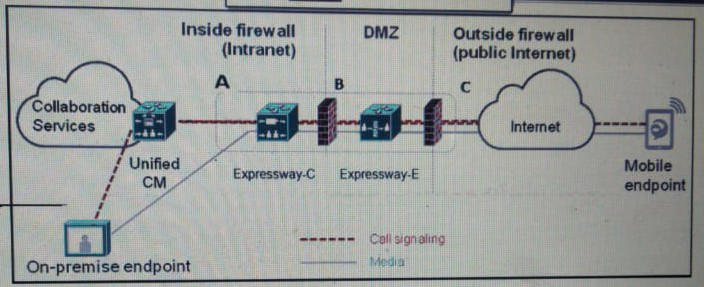
When making a call to a MRA client, what are the combinations of protocol on each of the
different sections A-B-C?
A.
IP TCP/TLS(A) +SIP TCP/TLS (B) +TLS (C)
B.
SIP TLS (A) +SIP TLS (B) +SIP TLS (C)
C.
SIP TCP/TLS (A) + SIP TLS (B) + SIP TLS (C)
D.
SIP TCP/TLS +SIP TCP/TLS (B) + SIP TCP/TLS (C)
SIP TCP/TLS (A) + SIP TLS (B) + SIP TLS (C)
Explanation
In a Cisco Mobile and Remote Access (MRA) deployment, SIP call signaling travels between Unified CM, Expressway-C, Expressway-E, and the remote client. The transport protocol depends on the network section and security configuration. The internal Unified CM–Expressway-C connection can use SIP over TCP or TLS, while the traversal and remote-client signaling legs use SIP over TLS.
Correct Option
C. SIP TCP/TLS (A) + SIP TLS (B) + SIP TLS (C)
- Section A — Inside firewall: SIP over TCP or TLS between Unified CM and Expressway-C, depending on configuration.
- Section B — DMZ/traversal: SIP over TLS between Expressway-C and Expressway-E.
- Section C — Outside firewall: SIP over TLS between Expressway-E and the MRA client.
Incorrect Options
- A. IP TCP/TLS + SIP TCP/TLS + TLS —
The protocol labels are incorrect or incomplete; the call signaling protocol is SIP.
- B. SIP TLS across all sections —
Does not account for the internal section potentially using SIP over TCP.
- D. SIP TCP/TLS across all sections —
Incorrectly applies TCP as an option to the traversal and remote-client signaling legs, which use TLS.
Reference
- Cisco Expressway MRA Deployment Guide — MRA Overview

Refer to the exhibit. An engineer is confining class of control for a user in Cisco UCM.
Which change will ensure that the user is unable to call 2143?
A.
Change line partition to Partition_A
B.
Change line CSS to only contain Partition_B
C.
Set the user's line CSS to
D.
Set the users device CSS to
Set the users device CSS to
Explanation
Cisco Unified Communications Manager (CUCM) uses Partitions and Calling Search Spaces (CSSs) to control which numbers a user can call. A CSS defines the partitions that a calling device or directory number can access. When both a line CSS and a device CSS are configured, CUCM combines them, with the line CSS listed first. Setting the device CSS to
Correct Option —
D. Set the user's device CSS to
This is the expected exam answer if the exhibit shows that the device CSS provides access to the partition containing number 2143, and the line CSS does not independently provide that access.
However, setting the device CSS to
Incorrect Options
- A. Change line partition to Partition_A —
Changes the partition assigned to the user's directory number, not which destination partitions the user can reach.
- B. Change line CSS to only contain Partition_B —
Could be a valid restriction if Partition_B excludes the destination partition, but it changes the line-level access rather than the device-level access targeted by the expected answer.
- C. Set the user's line CSS to
Removes the line-level CSS, but the device CSS can still grant access to 2143.
Reference
- Cisco: Configure Partition and Calling Search Space
Refer the exhibit.

Given this “debug isdn q921” output, what is the problem with the PRI?
A.
Layer 1 is down on the controller.
B.
PRI does not have an IP address configured on the interface.
C.
Noting, the PRI is sending keepalives.
D.
Layer 2 is down on the controller.
Layer 2 is down on the controller.
Explanation
The correct answer is D. Layer 2 is down on the controller.
The debug isdn q921 command displays Layer 2 signaling activity on the PRI D-channel between the Cisco router and the telephone network switch. If the output shows repeated attempts to establish the link without successful acknowledgment, or indicates that Layer 2 is down, the PRI cannot establish a stable signaling connection. Cisco identifies Q.921 debugging as a key tool for diagnosing these Layer 2 problems.
Correct Option
D. Layer 2 is down on the controller
Q.921 manages the data-link layer for ISDN signaling. Normally, the link reaches the MULTIPLE_FRAME_ESTABLISHED state. Repeated SABME messages without a successful UA response can indicate that Layer 2 is failing to initialize. The administrator should check the ISDN switch type, PRI configuration, and D-channel status.
Incorrect Options
- A. Layer 1 is down on the controller —
A Layer 1 problem indicates a physical or signal-level issue. It is confirmed by checking controller and Layer 1 status, rather than simply observing Q.921 signaling failures.
- B. PRI does not have an IP address configured on the interface —
A traditional ISDN PRI does not require an IP address on its D-channel interface to establish Q.921 signaling.
- C. Nothing, the PRI is sending keepalives —
Keepalive or receiver-ready (RR) frames can be normal, but repeated initialization attempts or an explicit Layer 2 down state indicate a problem.
Reference
- Cisco: Troubleshoot T1 PRI
| Page 8 out of 46 Pages |
| 1234567891011121314 |
| 350-801 Practice Test Home |
Real-World Scenario Mastery: Our 350-801 practice exam don't just test definitions. They present you with the same complex, scenario-based problems you'll encounter on the actual exam.
Strategic Weakness Identification: Each practice session reveals exactly where you stand. Discover which domains need more attention, before Implementing Cisco Collaboration Core Technologies (350-801 CLCOR) exam day arrives.
Confidence Through Familiarity: There's no substitute for knowing what to expect. When you've worked through our comprehensive 350-801 practice exam questions pool covering all topics, the real exam feels like just another practice session.
Copyright © All Rights Reserved