
When a remote office location is set up with limited bandwidth resources, which codec
carries the most voice calls?
A.
G.722
B.
G.711
C.
G.723
D.
G.729
G.729
Explanation
The correct answer is D. G.729.
When a remote office has limited WAN bandwidth, a low-bit-rate codec allows more simultaneous voice calls to share the available link. G.729 compresses voice to 8 kbps, compared with 64 kbps for G.711 and G.722. G.723.1 uses an even lower codec bit rate, but its bandwidth requirements, packet overhead, and codec characteristics must also be considered.
Correct Option
D. G.729
G.729 provides good voice quality at a low bit rate of 8 kbps. Cisco's bandwidth tables show that a typical G.729 call using 20 ms RTP packets requires approximately 24 kbps over IPv4, excluding Layer 2 overhead, while G.711 and G.722 require around 80 kbps. This makes G.729 a common choice for conserving WAN bandwidth in enterprise voice deployments.
Incorrect Options
- A. G.722:
A wideband codec operating at 64 kbps. It offers HD voice quality but consumes substantially more bandwidth than G.729.
- B. G.711:
Uses 64 kbps for the voice payload and typically requires about 80 kbps per call at the IP layer, excluding Layer 2 overhead.
- C. G.723:
G.723.1 operates at 5.3 or 6.3 kbps and can use less bandwidth than G.729. However, the supplied exam answer identifies G.729, commonly used for bandwidth-efficient enterprise telephony. Strictly speaking, if the question means which listed codec uses the least bandwidth, G.723.1 is a strong contender.
Reference
- Cisco, Modify Bandwidth Consumption Calculation for Voice Calls
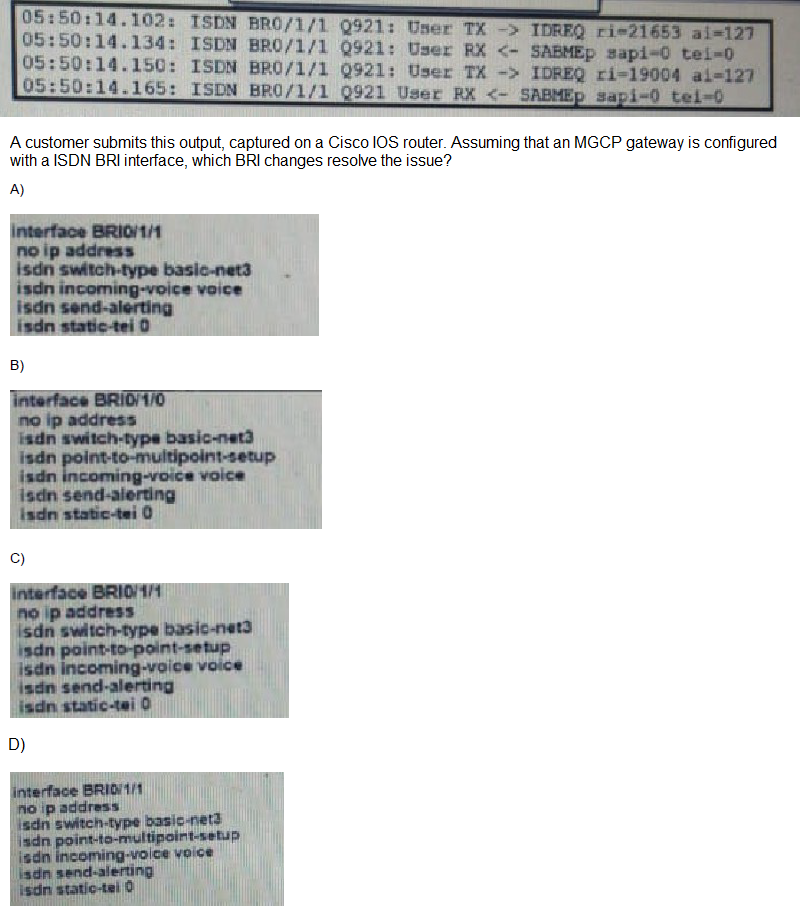
Refer to the exhibit.
A.
Option A
B.
Option B
C.
Option C
D.
Option D
Option C
Explanation
This question tests ISDN BRI configuration on a Cisco IOS gateway controlled by Cisco Unified Communications Manager through MGCP. The debug output shows repeated IDREQ and SAMEIP messages, indicating an issue with the ISDN BRI setup. For an MGCP-controlled BRI interface, the correct configuration must match the required ISDN switch type and point-to-point or point-to-multipoint signaling mode.
Correct Option
C. Configure isdn point-to-point-setup on interface BRI0/1/1.
Option C selects the correct BRI interface and configures point-to-point SETUP signaling. The isdn static-tei 0 command assigns a static Terminal Endpoint Identifier (TEI) of 0, while isdn point-to-point-setup ensures SETUP messages are sent using that static TEI. Cisco documents that the point-to-point command requires a static TEI to be configured.
Incorrect Options
- A. Uses the correct interface but configures point-to-multipoint signaling, which does not match the intended fix.
- B. Uses the wrong interface (BRI0/1/0) and point-to-point setup, so it does not correctly address the affected interface.
- D. Uses the correct interface but configures point-to-multipoint setup rather than the required point-to-point setup.
Reference
- Cisco, Configuring the Cisco Fourth-Generation Voice and Fax Network Interface Module
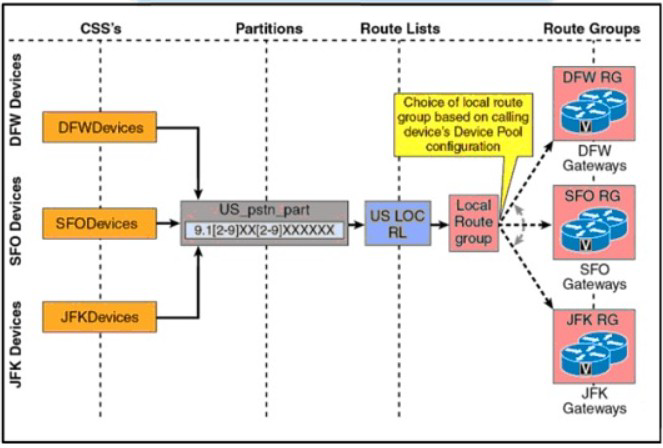
Refer to the exhibit A user takes a phone from San Francisco to New York for a short
reassignment. The phone was set up to use the San Francisco device pool, and device
mobility is enabled on the Cisco UCM. The user makes a call that matches a route pattern
in a route list that contains the Standard Local Route Group. To where does the call
retreat?
A.
The call egresses in New York because the device automatically is assigned a New
York device pool and uses the local gateway
B.
The call egresses in San Francisco because the user uses device mobility and is
allowed to roam while still keeping the number and resources assigned in San Francisco
C.
The call fails because the Standard Local Route Group is being used only if no
configuration is set for the device pools
D.
The call fails because device mobility is turned on. and the phone is not configured in
New York The engineer must configure which sites the device should be roaming to
The call egresses in San Francisco because the user uses device mobility and is
allowed to roam while still keeping the number and resources assigned in San Francisco
Explanation
Cisco Unified Communications Manager (CUCM) Device Mobility allows a phone moved from San Francisco to New York to use site-specific settings when the feature is configured correctly. When a route list contains the Standard Local Route Group, CUCM selects the local route group associated with the calling phone's effective device pool. If the phone remains assigned to its San Francisco device pool, the call uses the San Francisco route group and gateway.
Correct Option
B. The call egresses in San Francisco because the user uses device mobility and is allowed to roam while still keeping the number and resources assigned in San Francisco.
This is the expected answer if the phone continues using its home device pool settings. However, the question explicitly says Device Mobility is enabled. If CUCM recognizes the New York subnet as a roaming location and assigns the appropriate New York device pool, the call normally uses the New York local gateway instead. Cisco explains that Device Mobility can dynamically assign a roaming device pool based on the phone's IP subnet.
Incorrect Options
- A. This would be correct if CUCM detects the phone as roaming and dynamically assigns the New York device pool.
- C. Incorrect. The Standard Local Route Group is designed to work with device-pool-level route group configuration; it does not cause call failure simply because it is used.
- D. Incorrect. Device Mobility does not inherently prevent calls when a phone moves. Proper subnet, physical location, and device mobility configuration determine whether CUCM assigns a roaming device pool.
Reference
- Cisco, Device Mobility — CUCM Feature Configuration Guide
When a user dials a number with a phone that is registered to the Cisco Unified
Communications Manager, what is the default timeout before the number is sent?
A.
3 seconds
B.
15 seconds
C.
10 seconds
D.
5 seconds
15 seconds
Explanation
The correct answer is B. 15 seconds.
In Cisco Unified Communications Manager (CUCM), the default interdigit timeout is controlled by the T302 service parameter, which is set to 15 seconds by default. When a user dials digits one at a time, CUCM may wait for additional digits if the dialed number could match a longer route pattern. If no further digits arrive before the timer expires, CUCM proceeds with call routing based on the digits received.
Correct Option
B. 15 seconds
The CUCM T302 timer determines how long CUCM waits for additional digits when processing an incomplete or variable-length dialed number. Its default value is 15 seconds. This is distinct from the phone-side interdigit timeout, which may be 10 seconds in certain dialing scenarios.
Incorrect Options
- A. 3 seconds:
Not the default CUCM T302 timer value.
- C. 10 seconds:
This value can apply to certain phone-side interdigit timeout scenarios, but it is not the default T302 value in CUCM.
- D. 5 seconds:
This is not the default; an administrator can configure different timeout values.
Reference
- Cisco, Urgent Priority Configuration on Directory Number
Which configuration step is necessary for a Cisco SIP phone to synchronize its time with a
specific source?
A.
Change the Time Zone from “America/Los_Angeles” to “Etc/GMT+8”.
B.
Add a phone NTP Reference to the date/time Group.
C.
Assign the device to the correct region.
D.
Change the time format from 24-hour to 12-hour.
Add a phone NTP Reference to the date/time Group.
Explanation
The correct answer is B. Add a phone NTP Reference to the Date/Time Group.
Cisco SIP phones need a configured Network Time Protocol (NTP) reference to synchronize their clocks with a specific time source. In CUCM, the NTP reference is created under System > Phone NTP Reference and then added to a Date/Time Group. That group is assigned through the device pool, allowing the phone to receive the appropriate time configuration.
Correct Option
B. Add a phone NTP Reference to the Date/Time Group.
Configure the phone NTP reference with the intended NTP server's IP address and mode, then associate it with the relevant Date/Time Group. Ensure the Date/Time Group is assigned to the device pool used by the phone. Cisco specifies that Phone NTP References are mandatory for SIP phones; SCCP phones obtain time differently.
Incorrect Options
- A. Change the time zone:
This changes the displayed time-zone offset, not the source used to synchronize the phone's clock.
- C. Assign the device to the correct region:
Regions primarily control codec selection and audio/video bandwidth settings between devices, not time synchronization.
- D. Change the time format:
This changes how the time is displayed, such as 12-hour versus 24-hour format, without changing the time source.
Reference
- Cisco, System Configuration Guide for CUCM 14 — Phone NTP References
Refer to the exhibit.

You deploy Mobile and Remote Access for Jabber and discover that Jabber for Windows
does not register to cisco Unified Communications Manager while outside of the office.
What is a cause of this issue?
A.
The DNS record should be created for _ cisco-uds._tcp example.com.
B.
The DNS record should be changed from _collab-edge._tls example.com.
C.
The DNS record type should be changed from SRV to A.
D.
Server 4.2.2.2 is not a valid DNS server.
The DNS record should be changed from _collab-edge._tls example.com.
Explanation
The supplied answer B is correct. For Mobile and Remote Access (MRA), Jabber for Windows uses the external DNS SRV record _collab-edge._tls to discover Cisco Expressway-E. If the record is incorrectly configured, Jabber may fail to discover the Expressway-E server and therefore cannot register with CUCM while outside the corporate network.
Correct Option
B. The DNS record should be changed from _collab-edge._tls.example.com.
The issue is that the _collab-edge._tls SRV record is the required discovery record for MRA, so it should not simply be changed away from this service name. The exhibit likely shows a problem with the record's configuration or target. The record should point to the FQDN of Expressway-E on port 8443, not directly to an IP address.
Incorrect Options
- A. _cisco-uds._tcp is primarily used for internal CUCM service discovery. For remote access, Jabber uses _collab-edge._tls to find Expressway-E.
- C. Incorrect because MRA discovery requires an SRV record, not an A record alone.
- D. 4.2.2.2 is a publicly used DNS resolver address; the key issue is the service-discovery record configuration, not necessarily that the DNS server address is invalid.
Reference
- Cisco, Expressway Series — DNS SRV Configuration for Mobile and Remote Access
On which protocol and port combination does Cisco prime collaboration receive
notifications (Traps and InformRequests) from several network devices in the collaboration
infrastructure for which it has requested notifications?
A.
UDP 161
B.
TCP 161
C.
TCP 80
D.
UDP 162
UDP 162
Explanation
The correct answer is D. UDP 162.
Cisco Prime Collaboration receives SNMP notifications, including traps and InformRequests, from network devices over the SNMP notification port. The standard port used for receiving SNMP traps is UDP 162. By contrast, UDP 161 is typically used for SNMP polling, where the management system queries devices for information. Cisco's collaboration network-management documentation lists UDP 162 for SNMP traps.
Correct Option
D. UDP 162
SNMP traps are notifications sent by network devices to a management system when events occur, such as interface failures or device status changes. Prime Collaboration listens on UDP port 162 to receive these notifications. InformRequests are also SNMP notification messages; in this exam context, UDP 162 is the expected answer.
Incorrect Options
- A. UDP 161:
Used primarily for SNMP queries and polling between the management system and network devices.
- B. TCP 161:
Not the standard transport and port combination for SNMP trap reception.
- C. TCP 80:
Used for HTTP web traffic, not SNMP notifications.
Reference
- Cisco, Collaboration System Release 11.x SRND — Network Management and Port Utilization
How does Cisco Unified Communications Manager perform a digit analysis on-hook versus
off-hook for an outbound call from a Cisco IP phone that is registered to Cisco Unified CM?
A.
On-hook, by pressing the digits and entering “#” to process the call, Unified CM
performs a digit-by-digit analysis; off-hook, Unified CM analyses all digits as a string.
B.
On-hook, unified CM performs a digit-by-digit analysis; off-hook, Unified CM considers
all digit were dialed and dos not wait for additional digits.
C.
On-hook, no digit analysis is performed; off-hook, Unified CM requires the “#” to start the
digit analysis.
D.
On-hook, Unified CM considers all digits were dialed and does not wait for additional
digits; off-hook, Unified CM performs a digit-by-digit analysis.
On-hook, Unified CM considers all digits were dialed and does not wait for additional
digits; off-hook, Unified CM performs a digit-by-digit analysis.
Explanation
Your answer, D, is correct.
Cisco Unified Communications Manager (Unified CM) handles digit collection differently depending on whether the user dials with the phone on-hook or off-hook. With on-hook dialing, the user enters the complete number before initiating the call, so Unified CM treats the digits as a completed dial string and does not wait for more digits. With off-hook dialing, Unified CM analyzes digits incrementally as the user enters them, checking for matching dial-plan patterns.
Correct Option
D. On-hook, Unified CM considers all digits were dialed and does not wait for additional digits; off-hook, Unified CM performs a digit-by-digit analysis.
- On-hook: The user enters the number first and then presses the Dial button or lifts the handset. Unified CM receives the completed digit string for processing.
- Off-hook: The user picks up the handset first and dials. Unified CM analyzes the digits as they arrive, looking for matches in the configured dial plan.
Incorrect Options
- A — Incorrect:
Reverses the behavior. Off-hook dialing generally involves incremental digit analysis, while on-hook dialing submits the completed number.
- B — Incorrect:
Reverses the two modes and incorrectly states that Unified CM does not wait for additional digits during off-hook dialing.
- C — Incorrect:
Unified CM does perform digit analysis during on-hook dialing; pressing # is not universally required to initiate digit analysis.
Reference
1. Cisco, Unified Communications SRND — Dial Plan and Dialed Pattern Recognition
What is required when deploying co-resident VMs by using Cisco UCM?
A.
Provide a guaranteed bandwidth of 10 Mbps.
B.
Ensure that applications will perform QoS.
C.
Avoid hardware oversubscription.
D.
Deploy the VMs to a server running Cisco UCM.
Avoid hardware oversubscription.
Explanation
Your answer, C, is correct.
When deploying co-resident virtual machines (VMs) for Cisco Unified Communications Manager (Unified CM), Cisco requires that hardware resources must not be oversubscribed. The virtual hardware allocated to the VMs must have a corresponding allocation of physical resources, including CPU and memory, while storage and network capacity must also be sufficient for the combined workload. This helps prevent resource contention that could degrade real-time voice and collaboration services.
Correct Option
C. Avoid hardware oversubscription.
Cisco’s virtualization policy requires a one-to-one mapping between virtual and physical hardware resources according to its sizing rules. Administrators must ensure that the physical server has sufficient CPU cores and RAM, and that storage and network resources can support all co-resident VMs. Simply placing multiple VMs on the same server is not enough; the supported co-residency and sizing requirements must also be met.
Incorrect Options
- A. Provide a guaranteed bandwidth of 10 Mbps — Incorrect.
Cisco does not define a universal 10 Mbps bandwidth guarantee as the main requirement for VM co-residency. Network capacity must instead be sized to handle the aggregate traffic generated by all hosted VMs.
- B. Ensure that applications will perform QoS — Incorrect.
QoS is important for protecting real-time voice and video traffic across the network, but it is not the defining requirement for co-resident VM deployment. Cisco also requires appropriate physical and virtual resource sizing.
- D. Deploy the VMs to a server running Cisco UCM — Incorrect.
Co-resident VMs share a supported physical server and virtualization host; the server does not have to be running Unified CM as a separate host-level application. The deployment must follow Cisco's hardware, virtualization, and co-residency support policies.
Reference
1. Cisco, Collaboration Virtualization Sizing — see General Rules for Co-residency and Physical/Virtual Hardware Sizing and No Hardware Oversubscription.
An administrator needs to stop the leading 9 from outbound calls on an IOS Voice Gateway
and ensure that the system handles 911 emergency calls Which configuration is needed to
accomplish this task?

A.
Exhibit A
B.
Exhibit B
C.
Exhibit C
D.
Exhibit D
Exhibit B
Explanation
This question tests Cisco IOS voice translation rules and rule order. The gateway must remove the leading 9 from ordinary outbound calls while preserving emergency dialing when the user dials 911 with or without the access prefix (9911).
The key is to configure a specific rule for 9911 before the general rule that strips the leading 9. Cisco IOS processes matching translation rules in order, so a general rule that matches first can prevent the emergency-specific rule from being applied.
Correct Option
B. Exhibit B
Exhibit B uses the correct translation-rule syntax and order:
voice translation-rule 1
rule 1 /9?911/ /911/
rule 2 /^9\(.*\)/ /\1/
- Rule 1: Matches 911 or 9911 and translates either to 911, preserving emergency calling.
- Rule 2: Matches a leading 9 followed by any remaining digits. The \(.*\) captures the remaining digits, and \1 replaces the original string with that captured portion, removing the leading 9.
The emergency rule comes first, ensuring that 9911 is handled before the general digit-stripping rule.
Incorrect Options
- A — Incorrect:
The second rule uses \0 rather than the correct capture-group reference \1. It does not correctly express the intended removal of the leading 9.
- C — Incorrect:
The general rule that strips the leading 9 appears first. It can transform 9911 into 911 before the emergency-specific rule gets a chance to match.
- D — Incorrect:
The replacement /&/ does not correctly reference the captured remainder of the dialed number. The correct replacement is /\1/.
Reference
1. Cisco, Configure Number Translation with Voice Translation Profiles
When a 8800 series phone is registered over MRA, where does it register?
A.
Cisco Unified Communications Manager
B.
Expressway-C
C.
Cisco Unified Presence Server
D.
Expressway-E
Cisco Unified Communications Manager
Correct Option
A. Cisco Unified Communications Manager (Unified CM)
A Cisco 8800 Series IP phone registered over Mobile and Remote Access (MRA) registers with Unified CM, which provides call control and device registration. Expressway-E and Expressway-C provide the secure traversal path that allows the phone to connect from outside the corporate network.
The signaling path passes through Expressway-E and Expressway-C to Unified CM; neither Expressway server replaces Unified CM as the call-control platform.
Incorrect Options
- B. Expressway
It provides the internal traversal and proxy functions for MRA signaling, but Unified CM handles the phone’s registration and call control.
- C. Cisco Unified Presence Server — Incorrect:
IM and Presence provides presence and messaging services; it is not the phone’s registration server.
- D. Expressway-E — Incorrect:
It provides the external-facing secure access point and relays MRA signaling through the traversal architecture rather than serving as the phone’s Unified CM registration destination.
Reference
Cisco, Mobile and Remote Access Through Cisco Expressway — MRA Overview
Which SNMP service must be activated manually on the Cisco Unified Communications
Manager after installation?
A.
Cisco CallManager SNMP
B.
SNMP Master Agent
C.
Connection SNMP Agent
D.
Host Resources Agent
Cisco CallManager SNMP
Explanation
Your answer, A, is correct.
Cisco Unified Communications Manager (Unified CM) requires the Cisco CallManager SNMP service to be activated manually after installation. This service provides access to Cisco-specific call-processing management information through the CISCO-CCM-MIB.
The SNMP Master Agent is the primary service for the MIB interface and is normally running by default. Cisco documentation explicitly distinguishes it from the Cisco CallManager SNMP service, which must be activated separately.
Correct Option
A. Cisco CallManager SNMP
To activate it, navigate to:
1. Open Cisco Unified Serviceability.
2. Go to Tools → Control Center – Feature Services (or Service Activation, depending on the version).
3. Select the appropriate Unified CM server.
4. Locate Cisco CallManager SNMP Service under Performance and Monitoring services and activate it.
For a cluster, ensure the service is activated on the required nodes.
Incorrect Options
- B. SNMP Master Agent —
Incorrect: This is the primary SNMP service for the MIB interface and normally runs automatically after installation.
- C. Connection SNMP Agent —
Incorrect: This service is associated with Cisco Unity Connection, not the Unified CM service that the question asks about.
- D. Host Resources Agent —
Incorrect: This provides standard host resource information and is normally running after installation; it is not the service that must be manually activated.
Reference
- Cisco, Unified CM Administration Guide — Simple Network Management Protocol
| Page 6 out of 46 Pages |
| 1234567891011121314 |
| 350-801 Practice Test Home |
Real-World Scenario Mastery: Our 350-801 practice exam don't just test definitions. They present you with the same complex, scenario-based problems you'll encounter on the actual exam.
Strategic Weakness Identification: Each practice session reveals exactly where you stand. Discover which domains need more attention, before Implementing Cisco Collaboration Core Technologies (350-801 CLCOR) exam day arrives.
Confidence Through Familiarity: There's no substitute for knowing what to expect. When you've worked through our comprehensive 350-801 practice exam questions pool covering all topics, the real exam feels like just another practice session.
Copyright © All Rights Reserved