
Which two steps are required for bulk configuration transactions on the Cisco UCM database utilizing BAT? (Choose two)
A.
A data file in comma-separated values format must be uploaded to Cisco UCM
B.
A server template must be created in Cisco UCM.
C.
A device template must be created in Cisco UCM.
D.
A data file in Abstract Syntax Notation One format must be uploaded to Cisco UCM
E.
A data file in Extensible Markup Language format must be uploaded to Cisco UCM
A data file in comma-separated values format must be uploaded to Cisco UCM
A device template must be created in Cisco UCM.
Explanation
The correct answers are A and C.
The Cisco Unified Communications Manager Bulk Administration Tool (BAT) allows administrators to add, update, or manage multiple devices in the CUCM database in a single bulk transaction. BAT uses two essential components: a device template, which defines common configuration settings, and a CSV data file, which contains device-specific information. These components work together to perform bulk configuration tasks.
Correct Options
A. A data file in comma-separated values (CSV) format must be uploaded to Cisco UCM
The CSV file contains unique values for each device, such as MAC address, description, directory number, and other configuration details. The administrator uploads the file to CUCM through the BAT interface so it can be validated and processed.
C. A device template must be created in Cisco UCM
The device template defines shared settings for the devices in the bulk transaction, such as device pool, button template, and calling search space. BAT combines the template with the CSV file to configure multiple devices efficiently.
Incorrect Options
- B. A server template must be created in Cisco UCM. BAT uses device templates for device-related bulk transactions, not a generic server template.
- D. A data file in Abstract Syntax Notation One (ASN.1) format must be uploaded. ASN.1 is not the required input format for standard BAT bulk device configuration.
- E. A data file in Extensible Markup Language (XML) format must be uploaded. Standard BAT device transactions use CSV data files, not XML files.
References
1. Cisco — Bulk Administration Guide, Release 15
Refer to the exhibit. An engineer must configure a SIP route pattern using domain routing with destination +13135551212. The domain ciscocm1.jupiter.com resolves to 192.168.1.3. How must the IPV4 pattern be configured?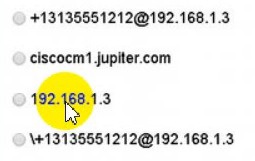
A.
Option A
B.
Option B
C.
Option C
D.
Option D
Option B
Explanation
The correct answer is B. Option B — configure the IPv4 Pattern as ciscocm1.jupiter.com.
When a SIP route pattern uses Domain Routing, Cisco Unified Communications Manager expects the domain name in the IPv4 Pattern field, provided that the domain resolves to a valid IPv4 address. In this question, ciscocm1.jupiter.com resolves to 192.168.1.3, so the domain name is the correct value.
Correct Option
B. ciscocm1.jupiter.com
Configure the SIP route pattern with:
- Pattern Usage: Domain Routing
- IPv4 Pattern: ciscocm1.jupiter.com
- Destination: The SIP trunk or route list that routes the call toward the target system
The called number +13135551212 is separate from the domain used for routing. The domain identifies the SIP destination, and DNS resolves that domain to 192.168.1.3.
Incorrect Options
- A. +13135551212@192.168.1.3:
Combines the called number and IP address in a format that is not valid for the IPv4 Pattern field under Domain Routing.
- C. \+13135551212@192.168.1.3:
The escaped plus sign does not make this a valid domain-routing pattern.
- D. 192.168.1.3:
This is an IP address, appropriate when using IP Address Routing, rather than the specified Domain Routing mode.
References
1. Cisco — Configure SIP Route Patterns
Which cisco collaboration Edge architecture product allows remote end points to leverage corporate on-premises cisco Unified communications infrastructure?
A.
Cisco Webex
B.
Cisco VPN Client
C.
Cisco Unified Communications Mobile and Remote Access
D.
Cisco Umbrella
Cisco Unified Communications Mobile and Remote Access
Explanation
The correct answer is C. Cisco Unified Communications Mobile and Remote Access (MRA).
MRA is part of Cisco Collaboration Edge Architecture. It allows remote endpoints, such as Cisco Jabber clients, to use the organization's on-premises Cisco Unified Communications Manager (CUCM) for registration, call control, provisioning, messaging, and presence services—without requiring users to connect through a traditional VPN. Cisco Expressway-C and Expressway-E provide the secure traversal between remote endpoints and the enterprise UC infrastructure.
Correct Option
C. Cisco Unified Communications Mobile and Remote Access
MRA enables remote users to make voice and video calls, use instant messaging and presence, search the corporate directory, and access other supported collaboration services. It relies on Expressway-C, Expressway-E, and CUCM.
Incorrect Options
- A. Cisco Webex:
A collaboration platform with cloud-based services; it is not the name of the architecture feature described in the question.
- B. Cisco VPN Client:
Provides VPN connectivity to a corporate network, but MRA is designed to provide supported collaboration services without requiring a traditional VPN.
- D. Cisco Umbrella:
A cloud-delivered security service focused on DNS-layer security and secure internet access, not remote access to CUCM services.
References
1. Cisco — Mobile and Remote Access Overview
What dialled numbers match this Cisco UCM route pattern?
1[23]XX
A.
1200 through 1300 on1ly
B.
1200 through 1399 only
C.
12300 through 12399 only
D.
1230 through 1239 only
1200 through 1300 on1ly
Explanation
The correct answer is B. 1200 through 1399 only — the supplied answer key, A, appears to be incorrect.
In Cisco Unified Communications Manager (CUCM), the route pattern 1[23]XX matches four-digit numbers that begin with 1, followed by either 2 or 3, followed by any two digits (0–9).
- 1 matches the first digit.
- [23] matches either 2 or 3.
- Each X matches any single digit from 0 through 9.
Therefore, the pattern matches 1200–1299 and 1300–1399, not just 1200 through 1300.
Correct Option
B. 1200 through 1399 only
More precisely, the pattern matches two ranges:
- 1200–1299
- 1300–1399
Cisco's documentation confirms that X matches any digit from 0–9 and square brackets select one digit from the listed choices.
Incorrect Options
- A. 1200 through 1300 only:
Incorrect. The pattern matches far more than those 101 numbers.
- C. 12300 through 12399 only:
Incorrect. These are five-digit numbers, while the pattern has four digits.
- D. 1230 through 1239 only:
Incorrect. This is only a small subset of the numbers matched when the second digit is 2 or 3.
Exam tip: 1[23]XX means four digits total, with the second digit restricted to 2 or 3.
In an eleven-class queueing model following Realtime. Best effort, and scavenger queuing rules. What recommended percentage of bandwidth must be allocated for interactive video?
A.
10%
B.
12%
C.
15%
D.
20%
15%
Explanation
The correct answer is C. 15%.
Cisco's eleven-class QoS queuing model recommends allocating 15% of link bandwidth for interactive video. This class commonly carries video-conferencing traffic marked with DSCP AF41. The allocation helps maintain video quality by providing sufficient bandwidth during congestion while preserving capacity for voice, signaling, critical data, best-effort, and scavenger traffic.
Correct Option
C. 15%
Cisco's Enterprise QoS Solution Reference Network Design Guide lists these example allocations:
- Voice: 18%
- Interactive video: 15%
- Best effort: at least 25%
- Bulk data: 4%
- Scavenger: 1%
Incorrect Options
- A. 10%:
Not the recommended allocation in this eleven-class model.
- B. 12%:
Not the standard recommendation for this class in the referenced model.
- D. 20%:
Higher than the model's recommended 15% allocation.
References
1. Cisco — Enterprise QoS Solution Reference Network Design Guide
A collaboration engineer adds a voice gateway to Cisco UCM The engineer creates a new gateway device in Cisco UCM, selects VG320 as the device type and selects MGCP as the protocol What must be done next to add the gateway to the Cisco UCM database?
A.
Configure the module in slot 0 of the new gateway
B.
Select the DTMF relay type for the gateway
C.
Select a device pool for the new gateway
D.
Add the FQDN or hostname of the device
Configure the module in slot 0 of the new gateway
Explanation
The correct answer is A. Configure the module in slot 0 of the new gateway — consistent with the supplied answer key.
After selecting the VG320 gateway type and MGCP protocol in Cisco Unified Communications Manager (CUCM), the engineer must configure the gateway's installed hardware modules and voice interface cards (VICs) under Configured Slots, VICs and Endpoints. This allows CUCM to identify the gateway's available interfaces and create the appropriate endpoints.
Correct Option
A. Configure the module in slot 0 of the new gateway
In CUCM Administration:
1. Go to Device > Gateway and add the VG320.
2. Select MGCP as the protocol.
3. Configure the applicable module and subunit information for the gateway.
4. Click Save to populate the available port interfaces.
5. Complete the required gateway configuration fields and save.
Incorrect Options
- B. Select the DTMF relay type:
This is not the next required step for adding the MGCP gateway to the CUCM database.
- C. Select a device pool:
A device pool is important for endpoint configuration, but the module and interface information must be configured as part of the gateway setup.
- D. Add the FQDN or hostname:
The gateway's domain name is also a required configuration field, but CUCM's documented workflow includes configuring the module information in the gateway setup. The exact order can vary by interface and release.
References
1. Cisco — Configure Gateways, CUCM 12.5
A collaboration engineer troubleshoots issues with a Cisco IP Phone 7800 Series The IPv4 address of the phone is reachable via ICMP and HTTP and the phone is registered to Cisco UCM However, the engineer cannot reach the CLI of the phone Which two actions in Cisco UCM resolve the issue? (Choose two)
A.
Enable FIPS Mode under Product Specific Configuration Layout in Cisco UCM
B.
Enable Settings Access under Product Specific Configuration Layout in Cisco UCM.
C.
Enable SSH Access under Product Specific Configuration Layout in Cisco UCM
D.
Disable Web Access under Product Specific Configuration Layout in Cisco UCM
E.
Set a username and password under Secure Shell Information in Cisco UCM
Enable SSH Access under Product Specific Configuration Layout in Cisco UCM
Set a username and password under Secure Shell Information in Cisco UCM
Correct answers: C and E (not A and C)
The answer key supplied with the question appears to be incorrect. Cisco's documentation confirms that SSH access is disabled by default and must be enabled for command-line access. The SSH credentials must also be configured.
Correct Options
C. Enable SSH Access under Product Specific Configuration Layout in Cisco UCM
This enables the phone's SSH daemon, allowing remote CLI connections over TCP port 22.
E. Set a username and password under Secure Shell Information in Cisco UCM
These credentials allow the engineer to authenticate to the phone's CLI over SSH.
Incorrect Options
- A. Enable FIPS Mode:
FIPS configures cryptographic compliance; it does not enable SSH access.
- B. Enable Settings Access:
Controls access to the phone's local Settings menu, not its remote CLI.
- D. Disable Web Access:
Controls web-page access and does not enable SSH.
References
1. Cisco IP Phone 7800 Series Administration Guide — Product-Specific Configuration
Refer to the exhibit.
An administrator must fix the SRV records to ensure that server 1 .sample.com is always
contacted first from the three servers. Which solution should the engineer apply to resolve
this issue?
A.
Priority = 100. Weight = 90
B.
Priority = 5. Weight = 70
C.
Priority = 10, Weight = 5
D.
Priority = 10. Weight =10
Priority = 5. Weight = 70
Explanation
The correct answer is B. Priority = 5, Weight = 70, according to the supplied answer key.
DNS SRV records use priority to determine which server is preferred. A lower numeric priority is preferred over a higher one. The weight field influences the selection probability only among records with the same priority. Therefore, assigning server 1 a priority of 5 makes it preferred over servers configured with priority 10 or 100.
Correct Option
B. Priority = 5, Weight = 70
- Priority 5: Makes server 1 the preferred server if the other two servers have higher priority values.
- Weight 70: Influences selection among servers sharing priority 5; it does not override priority.
Incorrect Options
- A. Priority = 100, Weight = 90:
A higher priority number makes the server less preferred than servers with lower priority values.
- C. Priority = 10, Weight = 5:
A priority of 10 would not beat another server configured with priority 5.
- D. Priority = 10, Weight = 10:
Also less preferred than priority 5; the weight does not override the priority.
References
1. RFC 2782 — DNS SRV Records
What are two characteristics of priority queueing? (Choose two.)
A.
It guarantees bandwidth for user-defined traffic classes.
B.
It applies strict priority to user-defined traffic classes.
C.
It allocates an equal share of bandwidth to each flow.
D.
It places traffic Into one of four queues.
E.
It ensures that critical traffic queues are serviced first
It places traffic Into one of four queues.
It ensures that critical traffic queues are serviced first
Explanation
The correct answers are D and E.
Cisco's traditional Priority Queuing (PQ) mechanism classifies traffic into four queues: high, medium, normal, and low. The scheduler services the highest-priority queue first and moves to lower-priority queues when higher-priority queues are empty. This provides preferential treatment to critical traffic, but can cause lower-priority traffic to be starved during sustained congestion.
Correct Options
D. It places traffic into one of four queues.
PQ uses four queues—high, medium, normal, and low. Traffic is assigned according to configured classification rules; unmatched traffic typically enters the normal queue.
E. It ensures that critical traffic queues are serviced first.
PQ uses strict priority scheduling. The high-priority queue is checked first, followed by medium, normal, and low. This benefits delay-sensitive or mission-critical traffic.
Incorrect Options
- A. It guarantees bandwidth for user-defined traffic classes.
This is more characteristic of Class-Based Weighted Fair Queuing (CBWFQ), which can reserve bandwidth for configured classes.
- B. It applies strict priority to user-defined traffic classes.
Although PQ does use strict priority, this wording is less accurate for traditional PQ's fixed four-level queue model; the option is likely intended to distinguish PQ's queueing behavior from other mechanisms.
- C. It allocates an equal share of bandwidth to each flow.
This describes fair queueing behavior, not traditional PQ.
References
1. Cisco — Congestion Management Overview
An administrator works with an ISDN PRI that is connected to a third-party PBX. The ISDN
link does not come up; and the administrator finds that the third-party PBX uses the QSIG
signalling method. Which command enables the Cisco IOS Gateway to use QSIG
signalling on the ISDN link?
A.
isdn switch-type basic-qsig
B.
isdn switch-type basic-ni
C.
isdn switch-type primary-qsig
D.
isdn incoming-voice voice
isdn switch-type primary-qsig
Explanation
The correct answer is C. isdn switch-type primary-qsig, not A.
The question specifies an ISDN PRI connection. Cisco IOS uses the primary-qsig switch type to enable QSIG signaling on a PRI interface connected to a third-party PBX. The basic-qsig option is intended for ISDN BRI, not PRI. Cisco's official configuration guide explicitly lists primary-qsig for PRI connections to PBX systems.
Correct Option
C. isdn switch-type primary-qsig
Configure the switch type globally or under the relevant PRI interface, for example:
The exact serial interface depends on the gateway and PRI controller configuration.
Incorrect Options
- A. isdn switch-type basic-qsig:
Used for QSIG on BRI interfaces; the question specifies PRI.
- B. isdn switch-type basic-ni:
Configures a BRI switch type for National ISDN, not QSIG PRI signaling.
- D. isdn incoming-voice voice:
Controls incoming voice-call handling; it does not select the ISDN signaling protocol.
References
1. Cisco — Configuring ISDN PRI
After an administrator installs the Cisco jabber Client, it fails to register with the cisco UCM server. Which two actions should be taken to troubleshoot this problem? (Choose two.)
A.
Verify the installation of the LMHOST file on the PC
B.
Verify the configuration of the DNS SRV record.
C.
Verify corporate firewall settings for client connections.
D.
Verify Layer 3 connectivity on the gateway.
E.
Reboot the Cisco Unified Border Element Gateway
Verify the configuration of the DNS SRV record.
Verify corporate firewall settings for client connections.
Explanation
When Cisco Jabber fails to register with Cisco Unified Communications Manager (CUCM) after installation, troubleshoot DNS service discovery and network connectivity through corporate firewalls. Jabber relies on DNS SRV records to discover the appropriate collaboration services, while firewall rules must permit the required client-to-server connections. Cisco recommends testing SRV records with nslookup to confirm they resolve correctly.
Correct Options
B. Verify the configuration of the DNS SRV record.
Check that the required SRV records—particularly _cisco-uds._tcp for on-premises deployments—exist and point to the correct CUCM services. Use nslookup, then set type=SRV, to verify the records.
C. Verify corporate firewall settings for client connections.
Confirm that firewalls allow the required Jabber traffic to CUCM and related collaboration services. Blocked ports or network access-control rules can prevent successful service discovery, authentication, or registration.
Incorrect Options
- A. Verify the installation of the LMHOST file on the PC.
LMHOSTS supports legacy NetBIOS name resolution; it is not the standard method for Jabber service discovery.
- D. Verify Layer 3 connectivity on the gateway.
This may be useful in broader network troubleshooting, but the question points more directly to DNS discovery and firewall connectivity.
- E. Reboot the Cisco Unified Border Element Gateway.
CUBE is not normally required for Jabber to register with CUCM, so rebooting it does not address the likely causes.
References
1. Cisco — Jabber On-Premises Deployment: Configure Service Discovery
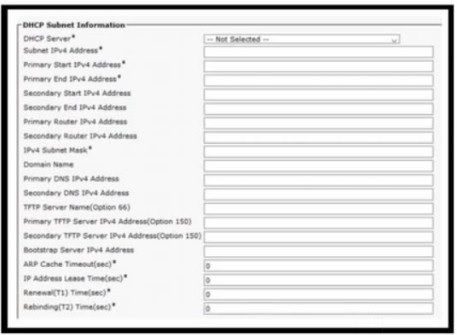
Refer to the exhibit. An engineer must configure DHCP service on the cisco service on the
Cisco UCM. In which filed must the engineer configure the server IP to provide the
configuration files to the endpoint?
A.
Primary Router IPv4 Address
B.
Primary TFTP Server IPv4 Address (Option 150)
C.
Primary Start IPv4 Address
D.
Bootstrap Server IPv4 Address
Primary TFTP Server IPv4 Address (Option 150)
Explanation
When Cisco Unified Communications Manager (CUCM) provides DHCP service, it must tell endpoints where to download their configuration files. Cisco IP phones use DHCP Option 150 to discover the IP address of the Trivial File Transfer Protocol (TFTP) server. The TFTP server provides configuration files, including device-specific settings needed for phone initialization and registration.
Correct Option
B. Primary TFTP Server IPv4 Address (Option 150)
This field specifies the IPv4 address of the primary TFTP server. When an endpoint receives its DHCP response, it uses this address to contact TFTP and retrieve its configuration files. Cisco recommends Option 150 for IPv4 phones and gateways to discover the TFTP server.
Incorrect Options
- A. Primary Router IPv4 Address —
Specifies the default gateway used to reach devices on other networks, not the server that supplies configuration files.
- C. Primary Start IPv4 Address —
Not the field used to identify the TFTP server; an address-pool start address would relate to IP address allocation.
- D. Bootstrap Server IPv4 Address —
Identifies a server used in the next step of the bootstrap process; it is not the standard recommended field for endpoint TFTP discovery when Option 150 is available.
Reference
- Cisco CUCM System Configuration Guide — TFTP Servers and Option 150
| Page 21 out of 46 Pages |
| 1415161718192021222324252627 |
| 350-801 Practice Test Home |
Real-World Scenario Mastery: Our 350-801 practice exam don't just test definitions. They present you with the same complex, scenario-based problems you'll encounter on the actual exam.
Strategic Weakness Identification: Each practice session reveals exactly where you stand. Discover which domains need more attention, before Implementing Cisco Collaboration Core Technologies (350-801 CLCOR) exam day arrives.
Confidence Through Familiarity: There's no substitute for knowing what to expect. When you've worked through our comprehensive 350-801 practice exam questions pool covering all topics, the real exam feels like just another practice session.
Copyright © All Rights Reserved