
An administrator must implement toll fraud prevention on cisco UCM using these
parameters:
How must the route pattern be implemented?
A.
Pattern = 3.800xxxxxx
B.
Pattern = 8005551212.1122113
C.
Pattern = 8005xxxxxx
D.
Pattern = 1122113.8005551212
Pattern = 8005xxxxxx
Explanation
Cisco UCM helps prevent toll fraud by restricting which numbers users can call. Route patterns define digit sequences that CUCM can match, while partitions and calling search spaces (CSS) determine which patterns a phone is permitted to access. The exhibit likely specifies a permitted number range, and the route pattern should match only that range rather than allowing broader access to external destinations.
Correct Option
C. Pattern = 8005xxxxxx
This pattern matches numbers beginning with 8005 followed by exactly six digits. The x wildcard matches one digit, so the pattern restricts matching to the specified 10-digit number range. This is narrower than a pattern that permits arbitrary numbers beginning with 3 or matches a specific number followed by an additional sequence.
Incorrect Options
- A. 3.800xxxxxx —
The dot represents a digit discard instruction in CUCM route patterns; this pattern has a different prefix and digit structure.
- B. 8005551212.1122113 —
Matches a much more specific sequence and uses the dot as a discard instruction; it does not describe the broad permitted range represented by option C.
- D. 1122113.8005551212 —
Uses a different leading digit sequence and does not match the required 8005 number range.
References
1. Cisco — Configure Call Routing, CUCM 12.5
Refer to the exhibit.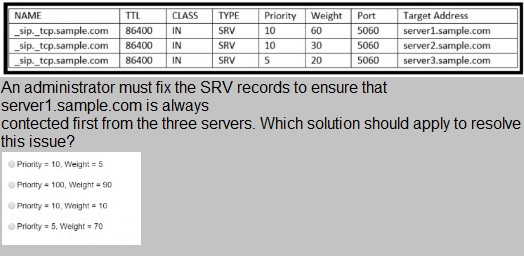
A.
Priority = 10, Weight = 5
B.
Priority = 100, Weight = 90
C.
Priority = 10, Weight = 10
D.
Priority = 5, Weight = 70
Priority = 5, Weight = 70
Explanation
For SIP routing in Cisco Unified Communications Manager (CUCM) IM and Presence, priority and weight determine which route is preferred. A lower priority value means higher preference. If two routes have the same priority, the route with the higher weight is preferred; weight is used only when priorities are equal.
Correct Option
D. Priority = 5, Weight = 70
According to the supplied answer key, option D is correct. It configures a relatively high-priority route compared with options using priority 10 or 100. The weight of 70 influences route selection only when another route has the same priority of 5.
Important: The exhibit containing the routing requirements is not visible in the message, so I can’t independently verify why priority 5 and weight 70 meet those specific requirements.
Incorrect Options
- A. Priority = 10, Weight = 5:
Lower preference than priority 5; weight 5 matters only when comparing routes with equal priority.
- B. Priority = 100, Weight = 90:
Priority 100 is lower preference than priorities 5 or 10, regardless of its high weight when compared with routes of different priority.
- C. Priority = 10, Weight = 10:
Lower preference than priority 5; weight 10 does not override the priority difference.
References
1. Cisco — Configure Advanced Routing for IM and Presence
Refer to the exhibit.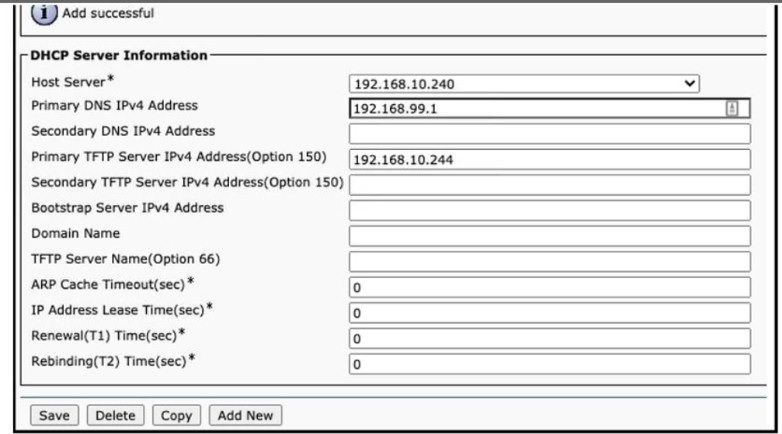
A collaboration engineer configures Cisco UCM to act as a DHCP server What must be done next to configure the DHCP server?
A.
Restart the TFTP service under Cisco Unified Serviceability
B.
Add a DHCP subnet to the DHCP server under Cisco UCM Administration
C.
Restart the Cisco DHCP Monitor Service under Cisco Unified Serviceability.
D.
Add the new DHCP server to the primary DNS server
Add a DHCP subnet to the DHCP server under Cisco UCM Administration
Explanation
Cisco Unified Communications Manager (CUCM) can provide DHCP services to IP phones. After creating the DHCP server entry, the administrator must configure a DHCP subnet so CUCM knows the network and address range for which it should provide DHCP information.
Adding the DHCP server itself to a DNS server is not a required step. DNS resolves hostnames to IP addresses; it does not configure DHCP address pools. Cisco's DHCP configuration workflow uses CUCM Administration to configure the DHCP server and subnet.
Correct Option
B. Add a DHCP subnet to the DHCP server under Cisco UCM Administration.
This is the technically correct next step. Navigate to System > DHCP > DHCP Subnet in CUCM Administration and configure the subnet and its required parameters.
The supplied answer key (D) appears incorrect. Adding the new DHCP server to the primary DNS server is not the required step to configure CUCM's DHCP service.
Incorrect Options
- A. Restart the TFTP service:
Not the next step for configuring the DHCP address pool.
- C. Restart the Cisco DHCP Monitor Service:
Restarting a service does not replace the required subnet configuration.
- D. Add the new DHCP server to the primary DNS server:
DNS configuration does not define the DHCP subnet or address pool.
References
1. Cisco — Unified Communications Manager Administration Guide
A company has an excessive number of call transfers to local and long-distance PSTN from Cisco Unity Connection voicemail Which action in the Cisco Unity Connection restriction table resolves this issue?
A.
Implement password complexity on voicemail boxes to prevent accounts from being compromised
B.
Block PSTN patterns on Default Transfer. Default Outdial. and Default System Transfer
C.
Create a custom restriction table ??????????? and block it
D.
Create a custom restriction table *********** and Wock it
Block PSTN patterns on Default Transfer. Default Outdial. and Default System Transfer
Explanation
Cisco Unity Connection uses restriction tables to control which external numbers can be used for call transfers, message-notification calls, and caller-directed system transfers. Excessive transfers to local and long-distance PSTN numbers can indicate toll fraud, so the restriction tables should explicitly block the applicable PSTN dialing patterns. Cisco recommends adapting restriction-table patterns to the organization’s trunk access codes and dialing plan.
Correct Option
B. Block PSTN patterns on Default Transfer, Default Outdial, and Default System Transfer.
This is the correct answer. These three tables control different outbound-call scenarios:
- Default Transfer: Restricts numbers used for call transfers.
- Default Outdial: Restricts numbers used for message notifications and certain recording/playback functions.
- Default System Transfer: Restricts destinations entered by callers using the Caller System Transfer feature.
Blocking unauthorized local and long-distance PSTN patterns across the relevant tables helps prevent toll fraud. Ensure the patterns match your actual dialing plan and trunk access prefixes.
Incorrect Options
- A. Implement password complexity:
Strong voicemail PINs are important, but this does not directly restrict outbound destinations.
- C. Create a custom restriction table using ? wildcards: ? matches exactly one digit or character.
A custom table may be useful for specific requirements, but the question calls for blocking PSTN patterns in the existing relevant tables.
- D. Create a custom restriction table using * wildcards: * matches zero or more characters.
This can be useful for pattern matching, but creating a custom table alone does not ensure the relevant call-transfer and outdial features use it.
References
1. Cisco — Security Guide: Preventing Toll Fraud in Unity Connection
What are two features of Cisco Expressway that the customer gets if Expressway-C and Expressway-E are deployed? (Choose two.)
A.
highly secure firewall-traversal technology to extend organizational reach
B.
complete endpoint registration and monitoring capabilities for devices that are local and remote
C.
session-based access to comprehensive collaboration for remote workers, without the need for a separate VPN client
D.
additional visibility of the edge traffic in an organization
E.
utilization and adoption metrics of all remotely connected devices
highly secure firewall-traversal technology to extend organizational reach
session-based access to comprehensive collaboration for remote workers, without the need for a separate VPN client
Explanation
Cisco Expressway-C and Expressway-E are typically deployed together to provide secure firewall traversal and Mobile and Remote Access (MRA). This lets remote users access collaboration services without needing a separate VPN client. Cisco identifies both capabilities as core benefits of the Expressway solution.
Correct Options
A. Highly secure firewall-traversal technology to extend organizational reach
Expressway-C inside the enterprise and Expressway-E in the DMZ establish a secure traversal connection. This allows collaboration signaling and media to cross the firewall without requiring unsolicited inbound connections to the internal network.
C. Session-based access to comprehensive collaboration for remote workers, without the need for a separate VPN client
MRA enables supported remote endpoints and Cisco Jabber clients to access collaboration services through Expressway. Users can work remotely without connecting through a separate VPN client.
Incorrect Options
- B. Complete endpoint registration and monitoring capabilities for local and remote devices:
Expressway supports endpoint registration in specific deployment scenarios, but comprehensive monitoring of all local and remote endpoints is not the defining benefit of the C/E pair.
- D. Additional visibility of edge traffic:
This is not a primary advertised customer benefit of deploying Expressway-C and Expressway-E.
- E. Utilization and adoption metrics of all remotely connected devices:
These metrics are associated with monitoring and analytics solutions rather than being a core Expressway deployment feature.
References
1. Cisco — Expressway Administrator Guide: Introduction
Refer to the exhibit.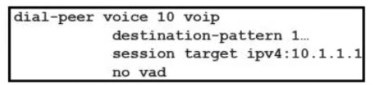
An engineer configures a VoIP dial peer on a Cisco gateway Which codec is used?
A.
No codec is used (missing codec command).
B.
G.729r8
C.
G.711ulaw
D.
G.711alaw
G.729r8
Explanation
On a Cisco IOS voice gateway, the codec used by a VoIP dial peer is determined by the codec command under the dial-peer configuration. If no codec is explicitly configured, the gateway uses the platform’s default codec, typically G.711 mu-law (g711ulaw) on many North American configurations. However, the exhibit’s configuration may explicitly specify a codec or inherit one from another configuration context.
Correct Option
B. G.729r8
According to the supplied answer key, G.729r8 is the codec used by the dial peer. G.729r8 compresses voice to approximately 8 kbps, making it more bandwidth-efficient than G.711. To verify this directly, the exhibit should show codec g729r8 under the relevant VoIP dial peer or a matching codec selection through the applicable configuration.
Incorrect Options
- A. No codec is used (missing codec command).
A missing codec command does not mean that no codec is used; the gateway normally selects a default codec.
- C. G.711ulaw.
G.711 μ-law uses approximately 64 kbps of codec payload bandwidth and is not the answer indicated by the supplied key.
- D. G.711alaw.
G.711 A-law also uses approximately 64 kbps of codec payload bandwidth and is not the answer indicated by the supplied key.
References
1. Cisco — Configure Dial Peers and Voice Ports
Which two actions must be taken to provision a new device using self-provisioning?
A.
Enable the self-provisioning IVR in the Cisco UCM
B.
Import the user profile to the corporate LDAP directory.
C.
Link the appropriate service profile to the provisioning template.
D.
Link the appropriate universal device template to the user profile.
E.
Ensure the user has a directory URI and a primary extension
Enable the self-provisioning IVR in the Cisco UCM
Link the appropriate universal device template to the user profile.
Explanation
Cisco Unified Communications Manager (CUCM) self-provisioning allows users to associate a new phone with their user account through a self-provisioning IVR or supported activation workflow. The administrator must configure the self-provisioning service and associate the correct device settings with the user. The Universal Device Template (UDT) provides the baseline device configuration used when CUCM creates the new phone.
Correct Options
A. Enable the self-provisioning IVR in Cisco UCM.
The self-provisioning IVR allows users to initiate phone provisioning by calling the configured IVR pilot and following the prompts. The relevant self-provisioning service and associated settings must be enabled and configured in CUCM.
D. Link the appropriate universal device template to the user profile.
The Universal Device Template defines baseline phone settings, such as device type, protocol, and other configuration values. Associating the appropriate UDT with the user's User Profile allows CUCM to apply those settings when creating the device.
Incorrect Options
- B. Import the user profile to the corporate LDAP directory.
User profiles are configured in CUCM; they are not imported into LDAP as a self-provisioning requirement.
- C. Link the appropriate service profile to the provisioning template.
A service profile provides services such as voicemail and messaging settings; it is not the required UDT-to-User Profile association.
- E. Ensure the user has a directory URI and a primary extension.
A primary extension is relevant to user and device association, but a directory URI is not the defining requirement for enabling self-provisioning IVR and assigning a UDT.
References
1. Cisco — CUCM System Configuration Guide: Self-Provisioning
Which Cisco Collaboration Edge architecture product allows remote endpoints to leverage corporate on-premises Cisco Unified Communications infrastructure?
A.
Cisco Webex
B.
Cisco VPN Client
C.
Cisco Unified Communications Mobile and Remote Access
D.
Cisco Umbrella
Cisco Unified Communications Mobile and Remote Access
Explanation
Cisco Collaboration Edge provides secure access to enterprise collaboration services for users outside the corporate network. Mobile and Remote Access (MRA) allows supported remote endpoints and Cisco Jabber clients to access on-premises Cisco Unified Communications services through Cisco Expressway-C and Expressway-E, without requiring a separate VPN client.
Correct Option
C. Cisco Unified Communications Mobile and Remote Access
MRA enables remote users to register supported endpoints and use enterprise collaboration services, such as call control, messaging, and presence, while CUCM and related services remain on premises. Expressway-C and Expressway-E provide the secure traversal path between remote clients and the enterprise network.
Incorrect Options
- A. Cisco Webex:
A cloud collaboration platform, not the specific architecture component for remote access to on-premises CUCM.
- B. Cisco VPN Client:
Provides network-level VPN connectivity, but it is not the Cisco Collaboration Edge architecture product being described.
- D. Cisco Umbrella:
A cloud-delivered security service focused on DNS-layer security and internet access protection.
References
1. Cisco — Mobile and Remote Access Deployment Guide
Refer to the exhibit.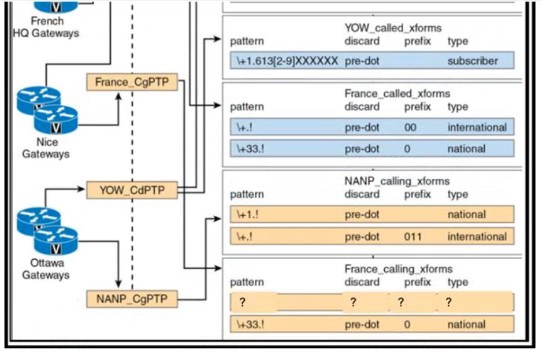
A call from +1 613 555 1234 that is sent out through the Nice Gateways should result in a
calling party of 001 613 555 1234 with the numbering type "international" Which
configuration accomplishes this goal?
A.
\+.l pre-dot 00 international
B.
\+ 0011 pre-dot 1 international
C.
\+1 ! none pre-dot 001 international
D.
613XXXXXXX none +011 international
\+1 ! none pre-dot 001 international
Explanation
The correct answer is C, assuming the exhibit shows a translation rule intended to convert the calling number from +1 613 555 1234 to 001 613 555 1234.
Cisco IOS voice translation rules can match a number pattern, replace or remove digits, and set the numbering type. The goal is to remove the leading +1, prepend 001, and set the resulting calling-party number type to international. Cisco documents the translation-rule syntax and numbering-type behavior in its Voice Translation Rules guide.
Correct Option
C. \+1 ! none pre-dot 001 international
This option is intended to match a number beginning with +1, replace that prefix with 001, preserve the remaining digits, and set the number type to international. Thus, the desired result is:
- Original: +1 613 555 1234
- Translated: 001 613 555 1234
- Numbering type: international
Important caveat: The answer text appears to use a particular translation-rule notation, and the exhibit is needed to confirm the exact syntax and how the rule is applied to the Nice gateways.
Incorrect Options
- A. Does not clearly specify the required removal of +1 and replacement with 001 while preserving the remaining digits.
- B. The replacement pattern does not clearly produce the required 001 prefix for this input.
- D. Matches a specific digit pattern rather than correctly handling the leading +1 and preserving the complete remaining number.
Reference
- Cisco — Determine Voice Translation Rules
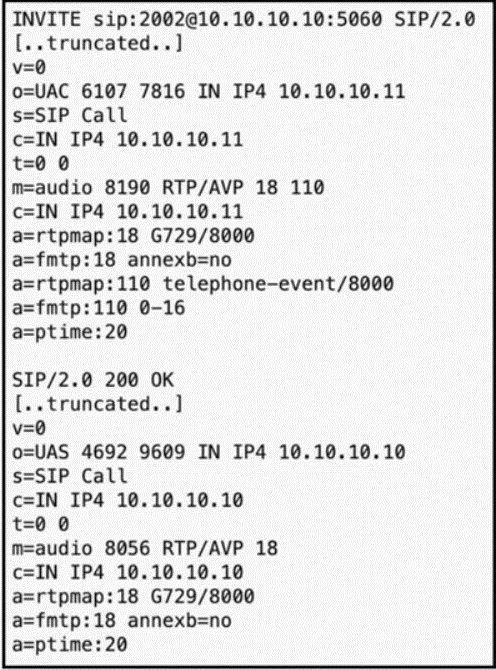
Refer to the exhibit. The SDP offer/answer has been completed successfully but there is no DTMF when users press keys. What is the cause of the issue?
A.
Payload type 110 was negotiated rather than type 101.
B.
DTMF was negotiated property in these messages.
C.
DTMF was not negotiated on the call.
D.
G.729 rather than G.711ulaw was negotiated
DTMF was not negotiated on the call.
Explanation
The correct answer is C. DTMF was not negotiated on the call.
SDP offer/answer negotiation establishes which media formats and RTP payload types both endpoints can use. For out-of-band DTMF, the SDP typically includes a telephone-event payload mapping and an event range, such as 0-15. If the offer and answer do not negotiate a compatible telephone-event format, users may hear normal audio but pressing keypad digits will not deliver DTMF events as expected.
Correct Option
C. DTMF was not negotiated on the call.
The exhibit's SDP should be checked for lines similar to:
a=rtpmap:101 telephone-event/8000
a=fmtp:101 0-15
These lines identify the RTP payload used for telephone events and the supported DTMF event range. If no compatible telephone-event payload is negotiated, DTMF signaling is unavailable through that method.
Incorrect Options
- A. Payload type 110 was negotiated rather than type 101.
Dynamic RTP payload numbers can differ; 110 is not inherently incorrect. What matters is whether the payload is mapped to telephone-event and negotiated compatibly by both endpoints.
- B. DTMF was negotiated properly in these messages.
If DTMF had been negotiated correctly, the absence of keypad events would require investigation of other causes, such as a media-path or interworking issue.
- D. G.729 rather than G.711 μ-law was negotiated.
G.729 does not inherently prevent DTMF when telephone-event signaling is negotiated. Codec choice alone does not explain the missing DTMF.
References
1. RFC 4733 — RTP Payload for DTMF Digits and Telephony Events
Which program is required to deploy the Cisco Jabber client on an on-premises Cisco collaboration solution?
A.
Cisco Expressway-C
B.
Cisco UCM IM and Presence
C.
Cisco Unity Connection
D.
Cisco UCM
Cisco UCM
Explanation
The correct answer is D. Cisco UCM (Unified Communications Manager).
Cisco UCM provides call control and telephony services for Cisco Jabber in an on-premises collaboration deployment. It manages Jabber softphone devices, user associations, directory-number assignments, and voice/video calling. For full Unified Communications mode, Jabber typically also uses the IM and Presence Service for instant messaging and presence, but CUCM is the core telephony platform.
Correct Option
D. Cisco UCM
CUCM is required for Jabber telephony features such as registering softphone devices and placing or receiving calls. Cisco's deployment guide explains that a device-specific COP file may be required to make Jabber available as a device in CUCM for supported releases. See the Cisco Jabber on-premises deployment guide.
Incorrect Options
- A. Cisco Expressway-C:
Supports secure firewall traversal and Mobile and Remote Access (MRA) for remote Jabber users. It is not the core call-control platform.
- B. Cisco UCM IM and Presence:
Provides instant messaging and presence. It is commonly used alongside CUCM for full UC deployments, but does not replace CUCM's telephony role.
- C. Cisco Unity Connection:
Provides voicemail and messaging integration; it does not provide core call control for Jabber.
References
1. Cisco — Jabber On-Premises Deployment Workflows
Which IP precedence value maps to DSCP EF?
A.
0
B.
1
C.
3
D.
5
5
Explanation
The correct answer is D. 5.
IP precedence uses the three most significant bits of the IP Type of Service (ToS) field to classify traffic into eight levels, numbered 0 through 7. Differentiated Services Code Point (DSCP) uses six bits. The first three DSCP bits correspond to IP precedence, so precedence value 5 (101) maps to the class associated with Expedited Forwarding (EF).
Correct Option
D. 5
DSCP EF has the decimal value 46, or binary 101110. Its first three bits are 101, which equal IP precedence 5. EF is commonly used for delay-sensitive voice media because it is intended to receive low-delay, low-jitter, low-loss forwarding treatment.
Incorrect Options
- A. 0: Represents best-effort traffic (000), not EF.
- B. 1: Represents precedence bits 001, corresponding to class-selector DSCP 8.
- C. 3: Represents precedence bits 011, corresponding to class-selector DSCP 24; it is commonly associated with signaling or other traffic classes, not EF.
References
1. Cisco — QoS for Voice over IP
| Page 20 out of 46 Pages |
| 1314151617181920212223242526 |
| 350-801 Practice Test Home |
Real-World Scenario Mastery: Our 350-801 practice exam don't just test definitions. They present you with the same complex, scenario-based problems you'll encounter on the actual exam.
Strategic Weakness Identification: Each practice session reveals exactly where you stand. Discover which domains need more attention, before Implementing Cisco Collaboration Core Technologies (350-801 CLCOR) exam day arrives.
Confidence Through Familiarity: There's no substitute for knowing what to expect. When you've worked through our comprehensive 350-801 practice exam questions pool covering all topics, the real exam feels like just another practice session.
Copyright © All Rights Reserved