
Refer to the exhibit.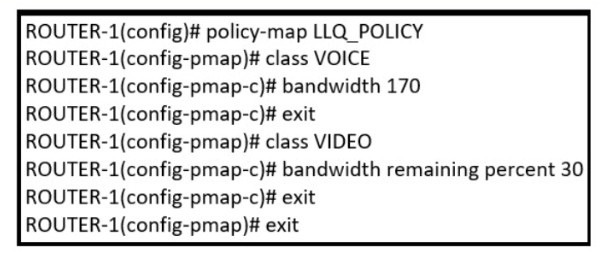
An engineer must modify the existing QoS policy-map statement to implement LLQ for voice traffic. Which change must the engineer make in the configuration?
A.
bandwidth 170 to LLQ 170
B.
bandwidth 170 to priority 170
C.
bandwidth 170 to reserve 170
D.
bandwidth 170 to percent 170
bandwidth 170 to priority 170
Explanation
Low Latency Queueing (LLQ) prioritizes delay-sensitive traffic, such as voice, during network congestion. In Cisco IOS QoS Modular CLI (MQC), the bandwidth command guarantees bandwidth, whereas the priority command enables the strict-priority queue used for LLQ.
Correct Option
B. Change bandwidth 170 to priority 170.
policy-map VOICE-POLICY
class VOICE
priority 170
This configures the voice class for LLQ with a priority rate of 170 kbps.
Incorrect Options
- A. LLQ 170 — not a valid standard Cisco IOS MQC command.
- C. reserve 170 — not the command used to configure LLQ.
- D. percent 170 — does not enable LLQ. The valid percentage-based syntax is priority percent 17, for example, which reserves 17% of the applicable bandwidth.
References
- Cisco — Bandwidth and Priority Commands in QoS
Which two features of Cisco Prime Collaboration Assurance require advanced licensing g? (Choose two.)
A.
real time alarm browse
B.
multicluster support
C.
call quality monitoring
D.
email notifications
E.
customizable events
multicluster support
call quality monitoring
Explanation
Cisco Prime Collaboration Assurance was offered in Standard and Advanced editions. Standard provides essential monitoring features, including alarm browsing and email notifications. Advanced adds capabilities for managing multiple clusters from one instance and deeper voice/video diagnostics, including call-quality monitoring. Cisco’s feature comparison and the exam discussion support B and C as the correct answers.
Correct Options
B. Multicluster support
Advanced licensing supports monitoring multiple CUCM clusters through a single Prime Collaboration Assurance instance. Standard is intended for a single-cluster environment.
C. Call quality monitoring
Advanced provides deeper diagnostics and voice/video session monitoring to help identify and troubleshoot collaboration quality problems. This goes beyond Standard’s basic fault and performance monitoring.
Incorrect Options
- A. Real-time alarm browse —
basic alarm browsing is available in Standard.
- D. Email notifications —
listed among Standard features in Cisco’s feature overview.
- E. Customizable events —
not one of the two Advanced-only features identified by the supplied answer key; basic alerting and monitoring are available in Standard, although exact event capabilities vary by release.
References
- Cisco Community — Prime Collaboration Assurance Feature Overview
AN administrator needs to help remote employee make a free call to an international
destination. The administrator calls the employee, then conferences in the international
party. The administrator drops the call, and the employee and the international party
continue their conversation. Which action prevents this type of toll fraud in the Cisco USM?
A.
Set service parameter "Advanced Ad Hoc Conference" to FALSE
B.
Set service parameter "Drop Ad Hoc Conference" to "Do not allow outside parties "
C.
Set service parameter "Drop Ad Hoc Conference" to "When Conference Controller leaves"
D.
Set service parameter "Advanced Ad Hoc Conference" to 2.
Set service parameter "Drop Ad Hoc Conference" to "When Conference Controller leaves"
Explanation
This scenario describes toll fraud through an ad hoc conference. The administrator acts as the conference controller, connects an internal employee with an international caller, and then leaves the conference. If the conference continues, the external parties can keep talking while the organization pays for the international call.
Cisco Unified Communications Manager provides the Drop Ad Hoc Conference service parameter to prevent this behavior by terminating the conference when the conference controller leaves.
Correct Option
C. Set service parameter “Drop Ad Hoc Conference” to “When Conference Controller Leaves.”
This setting terminates the active ad hoc conference when its creator hangs up, preventing the employee and international party from continuing the call after the administrator disconnects.
Incorrect Options
- A. Set “Advanced Ad Hoc Conference” to FALSE —
disables advanced conferencing capabilities, but it is not the specific control that terminates a conference when its controller leaves.
- B. Set “Drop Ad Hoc Conference” to “Do not allow outside parties” —
this is not a valid value for the CUCM service parameter.
- D. Set “Advanced Ad Hoc Conference” to 2 —
this is not the relevant service parameter setting for preventing the described toll fraud.
References
- Cisco CUCM 12.5 — Ad Hoc Conferencing Service Parameters
An engineer must manually register an analog port with cisco UCM using the MGCP protocol. Which commands are required?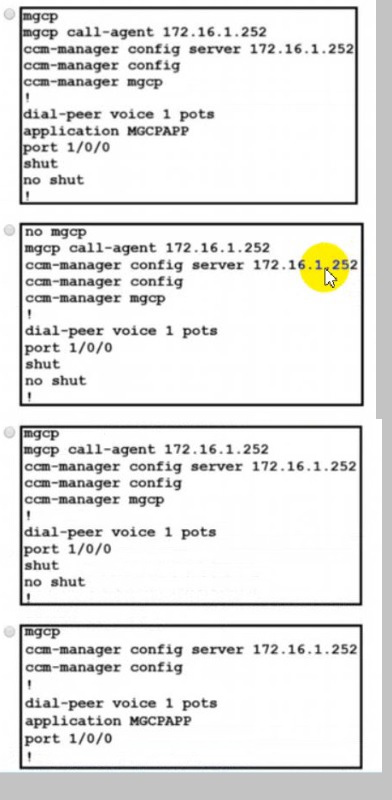
A.
Option A
B.
Option B
C.
Option C
D.
Option D
Option A
Explanation
To manually register an analog port with Cisco Unified Communications Manager (CUCM) using MGCP, the gateway must identify the analog voice port and associate it with the MGCP application. For an analog POTS port, Cisco IOS uses a POTS dial peer, the application mgcpapp command, and the port command.
Correct Option
A. Option A — according to the supplied answer key.
The essential command sequence for an analog port is:
dial-peer voice 101 pots
application mgcpapp
port 1/0/0
The dial-peer tag and port identifier are examples; use the actual voice-port numbering for the gateway. application mgcpapp binds the MGCP application to the dial peer, while port identifies the analog port.
Incorrect Options
The image’s command snippets are not available in the text of the question, so I can’t reliably explain the specific errors in B, C, and D. Options that omit application mgcpapp, use the wrong dial-peer type, or reference an incorrect port would not correctly configure this analog MGCP endpoint.
References
- Cisco — Configuring MGCP Gateway Support for CUCM
An administrator configures Cisco UCM to use UDP for SIP signaling and finds that an endpoint cannot make calls Which action resolves this issue?
A.
Change the phone security profile.
B.
Change the SIP dial rules.
C.
Change the SIP profile
D.
Change the common phone profile
Change the phone security profile.
Explanation
When Cisco Unified Communications Manager (CUCM) uses SIP over UDP, the endpoint’s phone security profile must be compatible with that transport. The profile defines device security settings and, for non-secure SIP phones, the transport type can be configured as UDP, TCP, or TCP + UDP. If the endpoint’s profile requires an incompatible transport, it may fail to communicate correctly with CUCM.
Correct Option
A. Change the phone security profile.
The administrator should verify that the endpoint is assigned the correct SIP phone security profile and that its Device Security Mode and Transport Type match the intended configuration. For non-secure SIP phones, select UDP or TCP + UDP as appropriate. Authenticated or encrypted profiles use TLS instead, so they are not compatible with a requirement for plain SIP over UDP.
Incorrect Options
- B. Change the SIP dial rules.
Dial rules control aspects of digit interpretation and dialing behavior; they do not configure the SIP signaling transport.
- C. Change the SIP profile.
A SIP profile contains SIP feature and protocol settings, but the endpoint’s signaling transport and security mode are configured through its phone security profile.
- D. Change the common phone profile.
This provides shared phone settings, such as certain feature and service configurations, rather than the SIP transport security settings at issue.
References
1. Cisco — Phone Security Profile Setup, CUCM 12.5
A collaboration engineer must optimize the dial plan within Cisco UCM. There are multiple
remote sites. And each site has its own route patterns and local gateways. What should the
engineer do on the cisco UCM to optimize the dial plan?
A.
Configure a Standard Local Route Group to use a single route pattern for all calls within the cluster.
B.
Create a centralized dial plan with a Cisco UCM Session Management Edition cluster or a Cisco gatekeeper.
C.
Implement ILS with GDPR so the dial plan can dynamically replicate across clusters.
D.
Leverage Cisco UCM Express as SRST so the phones can have more features of each remote site
Implement ILS with GDPR so the dial plan can dynamically replicate across clusters.
Explanation
Cisco Unified Communications Manager (CUCM) supports Global Dial Plan Replication (GDPR) through the Intercluster Lookup Service (ILS). In a multi-cluster environment, ILS allows clusters to exchange global dial-plan information, including directory URIs, alternate numbers, advertised patterns, and PSTN failover information. This reduces the need to configure the same global dial-plan components independently on every cluster.
Correct Option
C. Implement ILS with GDPR so the dial plan can dynamically replicate across clusters.
This is the expected answer when the goal is to share dial-plan information across multiple CUCM clusters. Configure ILS between the clusters and enable Global Dial Plan Replication. Each cluster can then learn and advertise global dial-plan data across the ILS network, simplifying multi-cluster dial-plan administration.
Incorrect Options
- A. Configure a Standard Local Route Group:
Local Route Groups can reduce duplicate route patterns and route lists by allowing sites to use a common pattern while CUCM selects the appropriate local gateway. This is useful for centralized call-control designs, but it does not replicate dial-plan information across clusters.
- B. Create a centralized dial plan with SME or a gatekeeper:
Session Management Edition can centralize call routing between systems, but it is a different architecture and is not the specific mechanism for dynamically replicating global dial-plan data.
- D. Leverage Cisco UCM Express as SRST:
Survivable Remote Site Telephony provides limited call-processing functionality during WAN or CUCM connectivity failures. It does not optimize or replicate the enterprise dial plan across clusters.
References
1. Cisco — Configure Global Dial Plan Replication, CUCM 15
Refer to the exhibit.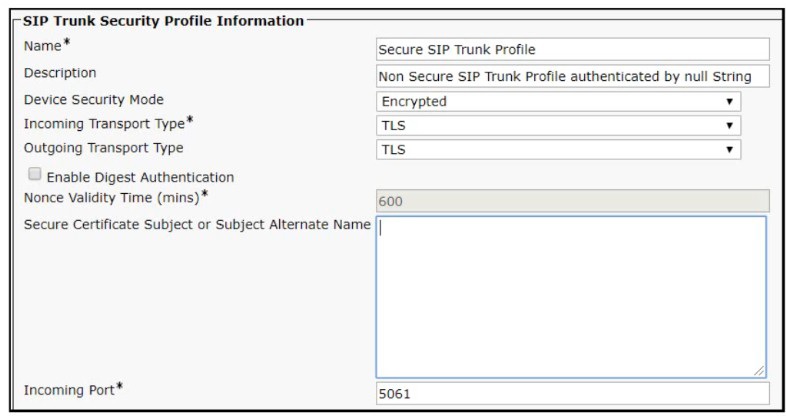
An administrator configures a secure SIP trunk on Cisco UCM. Which value is needed in
the Secure Certificate Subject or Subject Alternate Name field to accomplish this task?
A.
the fully qualified domain name of the remote device that is configured on the SIP trunk
B.
the common name of the Cisco UCM CallManager certificate
C.
the common name of the remote device certificates
D.
the fully qualified domain name of all Cisco UCM nodes that run the CallManager service
the fully qualified domain name of all Cisco UCM nodes that run the CallManager service
Explanation
A secure SIP trunk in Cisco Unified Communications Manager (CUCM) uses TLS to protect SIP signaling. CUCM validates the certificate presented by the remote TLS peer against the configured trust and certificate identity requirements. The Secure Certificate Subject or Subject Alternate Name field specifies the certificate identity or identities that CUCM expects to validate; the value must match the subject or SAN information in the presented certificate.
The important distinction is whether the field is validating the remote peer’s certificate or identifying the local CUCM nodes. The exact configuration and certificate presented by each end determine which identity must match.
Correct Option
D. The fully qualified domain name of all Cisco UCM nodes that run the CallManager service.
This is the expected answer when the secure SIP trunk connects to another CUCM cluster and the TLS peer can resolve to multiple nodes. The field can contain multiple certificate subject names or SAN values, separated by spaces, commas, semicolons, or colons. Each value must match the identity in the certificate presented by the corresponding remote node.
Incorrect Options
- A. FQDN of the remote device configured on the SIP trunk:
This may be appropriate for a single remote TLS peer, but it may not cover every node when the remote endpoint is a CUCM cluster.
- B. Common name of the Cisco UCM CallManager certificate:
This identifies a certificate by its CN, but the question’s cluster scenario requires the identities of all relevant nodes.
- C. Common name of the remote device certificates:
This is too general; the field must contain the actual certificate subject or SAN identity, which may be an FQDN.
References
1. Cisco — Trunk and Gateway SIP Security, CUCM 15
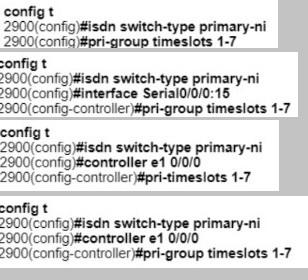
An administrator needs to create a partial PRI consisting of the first seven timeslots
available. Which configuration snippet configures the ISDN E1 PRI for this task?
A.
Option A
B.
Option B
C.
Option C
D.
Option D
Option D
Explanation
To configure a partial ISDN E1 PRI, use the pri-group timeslots command under the E1 controller configuration. The command specifies which timeslots belong to the PRI group. Since E1 uses timeslot 16 for the D-channel, the configuration must account for that signaling slot when selecting the first seven available timeslots. Cisco documents the command syntax as pri-group timeslots timeslot-range.
Correct Option
D. Option D — according to the supplied answer key.
The expected configuration is likely:
controller E1 0/0/0
pri-group timeslots 1-7
This selects timeslots 1 through 7 for the partial PRI. However, I cannot independently confirm that Option D contains this exact snippet because the exhibit’s option text is not visible in your message.
Incorrect Options
- A. Option A:
Incorrect if it configures all E1 timeslots or selects a different range.
- B. Option B:
Incorrect if it uses channel-group rather than pri-group for ISDN PRI.
- C. Option C:
Incorrect if it configures a different timeslot range or uses an incompatible configuration command.
These distinctions are based on the command requirements; the exact contents of the image options are unavailable for direct comparison.
References
1. Cisco — Configuring ISDN PRI
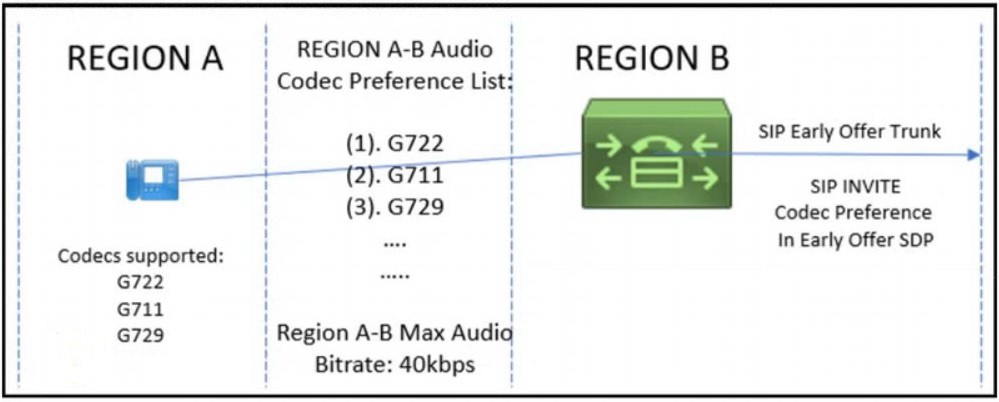
Refer to the exhibit. In this cisco UCM setup configured for EARLY offer, what is the codec preference line in the initial SIP INVITE SDP?
A.
m=audio 16444 RTP/AVP 9 18 101
B.
m=audio 16444 RTP/AVP 0 8 18 101
C.
m=audio 16444 RTP/AVP 18 101
D.
m=audio 16444 RTP/AVP 9 0 8 18 101
m=audio 16444 RTP/AVP 9 0 8 18 101
Explanation
In Cisco Unified Communications Manager (CUCM), Early Offer means the initial SIP INVITE contains an SDP body that advertises the caller’s media capabilities, including supported audio codecs. The m=audio line lists RTP payload types in preference order. For this question, the expected sequence includes G.722, G.711 μ-law, G.711 A-law, G.729, and the dynamic telephone-event payload used for DTMF.
Correct Option
D. m=audio 16444 RTP/AVP 9 0 8 18 101
- 16444 — RTP audio port.
- RTP/AVP — RTP Audio/Video Profile.
- 9 — G.722.
- 0 — G.711 μ-law.
- 8 — G.711 A-law.
- 18 — G.729.
- 101 — telephone-event, commonly used for out-of-band DTMF.
The order of payload types represents the codec preference order advertised in the SDP offer. Cisco’s collaboration documentation confirms that the m=audio line carries the offered codec payload types in preference order.
Incorrect Options
- A. m=audio 16444 RTP/AVP 9 18 101 —
Omits both G.711 variants.
- B. m=audio 16444 RTP/AVP 0 8 18 101 —
Omits G.722, which is included in the expected configuration.
- C. m=audio 16444 RTP/AVP 18 101 —
Offers only G.729 and telephone-event, omitting the other expected audio codecs.
References
1. Cisco — Unified CM Trunks and SDP Early Offer
An engineer must configure a route pattern that can route all + E.164 globalized
international numbers for the dial plans of all countries. Which cisco UCM configuration accomplishes this task?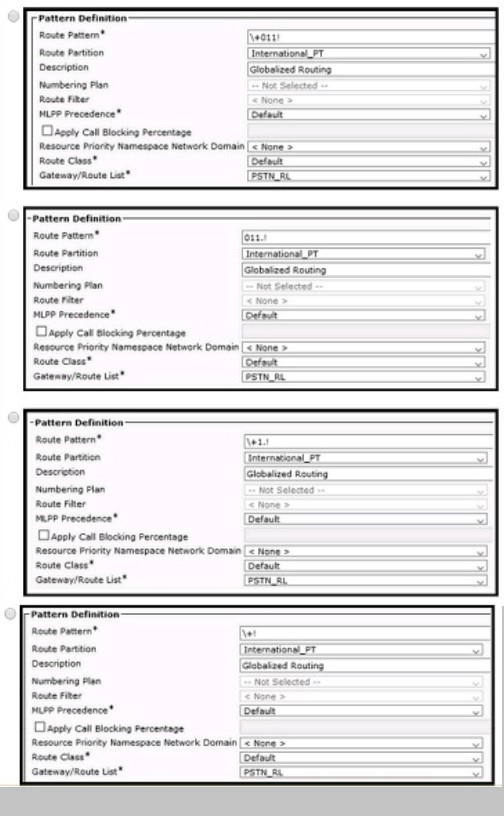
A.
Option A
B.
Option B
C.
Option C
D.
Option D
Option D
Explanation
In Cisco Unified Communications Manager (CUCM), a route pattern can use digit-matching wildcards to match a range of dialed numbers. For globalized international numbers, the + prefix identifies the number as an E.164 global number. To route international numbers across countries, the pattern must accommodate varying country codes and national number lengths rather than hard-code a single country's dialing plan.
The key is to select a pattern that matches the globalized +E.164 number format and uses the appropriate CUCM wildcard syntax.
Correct Option
D. Option D — assuming it configures the route pattern as:
\+!
- \+ matches a literal plus sign, as used in globalized E.164 numbers.
- ! matches one or more digits, accommodating international numbers of varying lengths.
This pattern can match globalized numbers such as +442071234567 and +923001234567. Cisco documents \+ as the literal international escape character and ! as a variable-length digit wildcard.
Incorrect Options
The exact configuration snippets in options A, B, and C are not visible in the supplied exhibit, so I cannot reliably explain each one individually. Patterns using 011 or another country's international access prefix would not match all globalized +E.164 numbers.
References
1. Cisco — CUCM 12.5 System Configuration Guide: Route Pattern Wildcards
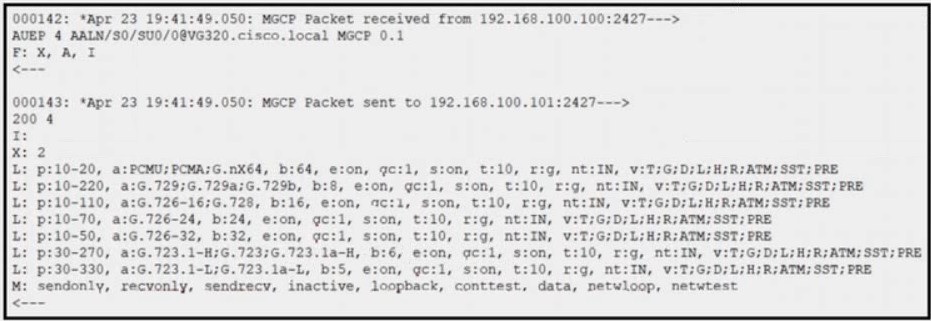
Refer to the exhibit. What is the registration state of the analog port in this debug output?
A.
The MGCP Gateway is not communicating with the Cisco UCM.
B.
The analog port failed to register to Cisco UCM with an error code 200.
C.
The analog port is currently shut down.
D.
The analog port is registered to Cisco UCM.
The analog port is registered to Cisco UCM.
Explanation
In Cisco Unified Communications Manager (CUCM), an MGCP gateway registers its analog and digital voice endpoints with the call-control server. Debug output showing a successful endpoint registration or an endpoint state of registered indicates that CUCM recognizes the port and can manage it through MGCP. The key is to distinguish a successful registration response from errors, shutdown indications, or gateway-to-CUCM communication failures.
Correct Option
D. The analog port is registered to Cisco UCM.
According to the supplied answer key, the debug output indicates that the analog port has successfully registered with CUCM. In MGCP, successful endpoint registration confirms that the gateway has established the required control relationship for that endpoint. The actual exhibit text is not visible in your message, so this conclusion follows the provided answer key rather than an independent reading of the debug lines.
Incorrect Options
- A. The MGCP Gateway is not communicating with Cisco UCM.
This would generally be associated with connectivity failures, timeouts, or failed MGCP transactions.
- B. The analog port failed to register with error code 200.
HTTP-style interpretation is misleading here; MGCP response codes and messages must be interpreted in context. A successful response should not be treated as a registration failure simply because it contains a numeric code.
- C. The analog port is currently shut down.
A shutdown or administratively disabled endpoint would show a corresponding disabled or shutdown state rather than successful registration.
References
1. Cisco — Configure and Troubleshoot MGCP Gateways
An engineer must configure a route pattern that can route all +E.164 globalized
international numbers for the plans of all countries. Which Cisco UCM configuration accomplish this task?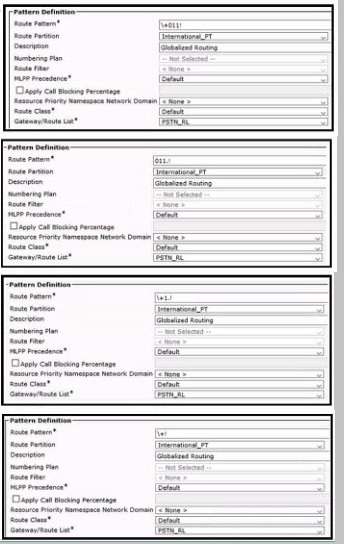
A.
Option A
B.
Option B
C.
Option C
D.
Option D
Option D
Explanation
Cisco Unified Communications Manager (CUCM) can route globalized E.164 numbers using route patterns that match the literal + prefix and a variable-length sequence of digits. The pattern must support numbers from different countries, whose country codes and total lengths vary. A pattern that uses a national or international access prefix, such as 011, would not match every globalized +E.164 number.
Correct Option
D. Option D — consistent with the supplied answer key, if it configures the globalized E.164 route pattern as \+!.
- \+ matches a literal plus sign.
- ! matches one or more digits, allowing different country codes and number lengths.
For example, the pattern can match +442071234567 and +923001234567. Cisco documents \+ as the international escape character and ! as a variable-length digit wildcard.
Incorrect Options
The exhibit’s option details are not visible in the message, so I cannot verify the exact differences between A, B, and C. Patterns that use a country-specific prefix or omit the literal + may fail to match all globalized E.164 numbers.
References
1. Cisco — Configure Call Routing, CUCM 12.5
| Page 19 out of 46 Pages |
| 1213141516171819202122232425 |
| 350-801 Practice Test Home |
Real-World Scenario Mastery: Our 350-801 practice exam don't just test definitions. They present you with the same complex, scenario-based problems you'll encounter on the actual exam.
Strategic Weakness Identification: Each practice session reveals exactly where you stand. Discover which domains need more attention, before Implementing Cisco Collaboration Core Technologies (350-801 CLCOR) exam day arrives.
Confidence Through Familiarity: There's no substitute for knowing what to expect. When you've worked through our comprehensive 350-801 practice exam questions pool covering all topics, the real exam feels like just another practice session.
Copyright © All Rights Reserved