
A customer has Cisco Unity Connection that is integrated with LDAP. As a unity connection
administrator, you have received a request to change the first name for VM user. Where
must the change be performed?
A.
Cisco unity connection
B.
Cisco IM and presence
C.
Cisco Unified Communications Manager end user
D.
Active directory
Active directory
Explanation:
When Cisco Unity Connection is integrated with an LDAP directory (normally Active Directory), user identity attributes such as first name, last name, and email address are mastered in the LDAP directory and periodically synchronized into Unity Connection. Any change to those attributes must be performed in the LDAP source; Unity Connection will then import the updated value on the next synchronization cycle. Directly editing the first name inside Unity Connection is either blocked or overwritten by the next LDAP sync.
Correct Option:
D. Active directory
Modify the user’s first-name attribute in Active Directory (or the LDAP directory that Unity Connection is synchronized with). After the next successful DirSync cycle the new first name appears in Unity Connection.
Incorrect Option:
A. Cisco unity connection
The field is LDAP-synchronized and cannot be permanently changed locally.
B. Cisco IM and presence
IM and Presence is not the source of Unity Connection mailbox attributes.
C. Cisco Unified Communications Manager end user
Even if CUCM is also LDAP-integrated, the authoritative source for the Unity Connection user object remains the LDAP directory.
Reference:
Cisco Unity Connection Administration Guide – LDAP Directory Integration: user attributes that are imported from LDAP must be changed in the LDAP directory; Unity Connection does not allow permanent local edits of synchronized fields.
An engineer must configure an MGCP gateway and register it to Cisco Unified
Communications Manager. Which prerequisite must be met before applying the gateway
commands to enable MGCP?
A.
The MGCP gateway and the Cisco Unified CM must be able to communicate over
2427,2428, and 2727.
B.
The MGCP gateway must have voice service VoIP configured.
C.
Cisco Unified CM and the MGCP gateway must utilize the SIP OPTIONS ping feature to
monitor status.
D.
The MGCP gateway and the Cisco Unified CM must be able to communicate over ports
5060 and 5061.
The MGCP gateway and the Cisco Unified CM must be able to communicate over
2427,2428, and 2727.
Explanation
The correct answer is A. The MGCP gateway and Cisco Unified CM must be able to communicate over ports 2427, 2428, and 2727.
Before configuring an MGCP gateway, verify IP connectivity and ensure that the required MGCP-related ports are permitted through any intervening firewall. MGCP uses UDP 2427 for gateway-control messages and TCP 2428 for connection management and backhaul functions. Port 2727 is also included in Cisco integration guidance for the required connectivity.
Correct Option
A. Ports 2427, 2428, and 2727
These ports support the communication needed for MGCP gateway configuration and registration with Unified CM. If a firewall blocks the necessary traffic, the gateway may fail to establish its control connection or register correctly. Also verify that the gateway is configured in Unified CM and that its hostname or fully qualified domain name matches the gateway configuration.
Incorrect Options
B. The MGCP gateway must have voice service voip configured.
This is not a general prerequisite for MGCP registration. The gateway requires the appropriate MGCP and Cisco Unified CM configuration, such as mgcp call-agent, ccm-manager config, ccm-manager mgcp, and mgcp. The voice service voip configuration is associated with other voice-gateway features and is not the required condition identified by this question.
C. Cisco Unified CM and the MGCP gateway must utilize SIP OPTIONS ping.
SIP OPTIONS is a SIP mechanism, not a prerequisite for MGCP gateway registration. MGCP uses its own control protocol to communicate between the gateway and the call agent. SIP OPTIONS monitoring may be relevant to SIP trunks or SIP peers, but it does not enable MGCP registration.
D. Ports 5060 and 5061 must be reachable.
These ports are associated with SIP and secure SIP (SIPS), respectively, rather than the MGCP control connection. They may be needed for SIP-based gateway or trunk deployments, but they are not the required MGCP ports for this scenario.
Reference
- Cisco — Configure and Troubleshoot MGCP Gateways
An engineer must manually provision a Cisco IP Phone 8845 using SIP. Which two fields
must be configured for a successful provision? (Choose two.)
A.
Media resources group list
B.
SIP profile
C.
CSS
D.
Location
E.
Device security profile
SIP profile
Device security profile
Explanation:
When manually adding a SIP-based Cisco IP Phone (such as the 8845) in Unified Communications Manager, two fields are mandatory for the device to register successfully:
A SIP Profile that defines SIP timers, supported features, and SDP options.
A Device Security Profile that specifies whether the phone uses non-secure, authenticated, or encrypted signaling and media.
Without these two settings the phone cannot complete SIP registration.
Correct Option:
B. SIP profile
Select or create a SIP Profile (for example, “Standard SIP Profile”) and assign it to the phone.
E. Device security profile
Assign a Phone Security Profile that matches the desired security mode (usually “Cisco 8845 – Standard SIP Non-Secure” for basic deployments).
Incorrect Option:
A. Media resources group list
Useful for conferences/transcoding but not required for basic registration.
C. CSS
Calling Search Space is needed for dialing but is not mandatory for the phone to register.
D. Location
Location is used for CAC and is not a required field for SIP phone registration.
Reference:
Cisco Unified Communications Manager Administration Guide – Phone Configuration: for SIP phones the SIP Profile and Device Security Profile fields are mandatory.
Refer to the exhibit.

AN engineer configures a VoIP dial peer on a Cisco gateway. which codec is used?
A.
G.711ulaw
B.
No codec is used (missing codec command).
C.
G.711alaw
D.
G.729r8
G.729r8
Explanation:
When a VoIP dial-peer is configured without an explicit codec command, Cisco IOS/IOS-XE applies the default codec G.729r8 (8 kbps). The dial-peer shown contains only a destination-pattern, session target and “no vad”; therefore the gateway uses the default G.729r8 codec for media negotiation.
Correct Option:
D. G.729r8
Because no codec statement is present, the dial-peer inherits the platform default of G.729r8.
Incorrect Option:
A. G.711ulaw
G.711 µ-law is not the default; it must be explicitly configured.
B. No codec is used (missing codec command).
A codec is always used; the absence of the command simply selects the default.
C. G.711alaw
G.711 A-law is also not the default and must be configured if required.
Reference:
Cisco IOS Voice Command Reference and Dial-Peer Configuration Guide: the default codec for a VoIP dial-peer is g729r8 when no codec is specified.
What is a QoS requirement for VoIP calls?
A.
150 ms of one-way latency from mouth to ear
B.
15% packet loss
C.
150 bps per phone of guaranteed bandwidth
D.
150 ms of jitter
150 ms of one-way latency from mouth to ear
Explanation:
Cisco and ITU-T G.114 recommend that the one-way mouth-to-ear delay for a VoIP call should not exceed 150 ms. Beyond this threshold, conversational quality degrades noticeably. This is therefore the primary latency QoS requirement for voice.
Correct Option:
A. 150 ms of one-way latency from mouth to ear
Design and provision the network so that the total one-way delay (encoding, packetization, serialization, queuing, propagation, decoding) stays at or below 150 ms.
Incorrect Option:
B. 15% packet loss
Acceptable packet loss for voice is ≤ 1 % (preferably < 0.5 %); 15 % would render the call unusable.
C. 150 bps per phone of guaranteed bandwidth
A typical G.711 call requires approximately 80–100 kbps; 150 bps is far too low.
D. 150 ms of jitter
Target jitter is ≤ 30 ms (ideally < 10–20 ms); 150 ms of jitter is excessive.
Reference:
Cisco Collaboration QoS Design Guide / ITU-T G.114: one-way mouth-to-ear latency for VoIP should not exceed 150 ms.
A user reports transfer failures from an IP phone for calls received from a PSTN to another
PSTN number. What is a reason for these failures?
A.
The incoming calling search space of the SIP trunk does not include the partition of the
line in the IP phone.
B.
The service parameter related to Offnet to Offnet call Transfer is set to TRUE
C.
The IP phone is configured with the Wrong region.
D.
The gateway is configured with the wrong device pool.
The service parameter related to Offnet to Offnet call Transfer is set to TRUE
Explanation:
Cisco Unified Communications Manager contains a service parameter that prevents an incoming PSTN (OffNet) call from being transferred to another PSTN (OffNet) destination. When this parameter is set to True, any attempt by an IP-phone user to transfer a received PSTN call to another external number is rejected, producing the reported transfer failures.
Correct Option:
B. The service parameter related to Offnet to Offnet call Transfer is set to TRUE
The cluster-wide service parameter “Block OffNet to OffNet Transfer” (or the equivalent setting) is enabled. CUCM therefore blocks the transfer of an inbound PSTN call to another PSTN number.
Incorrect Option:
A. The incoming calling search space of the SIP trunk does not include the partition of the line in the IP phone.
This would prevent the inbound call from reaching the IP phone at all, not merely block the subsequent transfer.
C. The IP phone is configured with the Wrong region.
Region settings affect codec selection, not transfer permissions.
D. The gateway is configured with the wrong device pool.
An incorrect device pool may affect media resources or location, but it does not specifically block OffNet-to-OffNet transfers.
Reference:
Cisco Unified Communications Manager System Guide – Service Parameters: the “Block OffNet to OffNet Transfer” parameter, when set to True, prevents transfers between two OffNet parties and is a common cause of the described failure.
Refer to the exhibit.
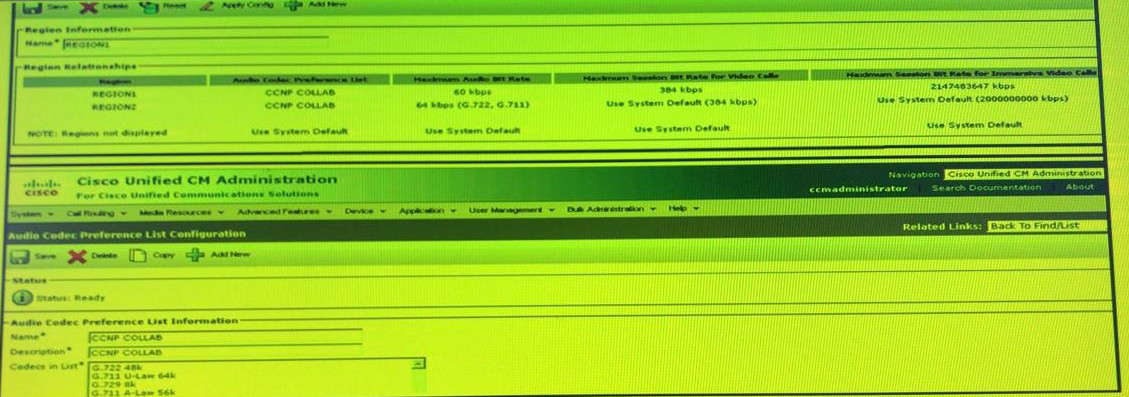
An engineer is troubleshooting a codec negotiation issue where both endpoints that are
involved in the call support the codecs listed in the exhibit. Which audio codec is selected il
a call between two endpoints in Region 1 is placed?
A.
G.711u
B.
G.722
C.
G.729
D.
G.711a
G.729
Explanation:
The Region relationship for calls within Region 1 sets the Maximum Audio Bit Rate to 8 kbps. Among the codecs commonly supported by Cisco endpoints, only G.729 operates at 8 kbps. Even though the Audio Codec Preference List contains higher-bandwidth codecs (G.722, G.711 µ-law, G.711 A-law), the Region limit of 8 kbps overrides the preference list and forces the selection of G.729.
Correct Option:
C. G.729
Because the Region 1-to-Region 1 relationship caps the audio bit rate at 8 kbps, CUCM negotiates G.729 for the call.
Incorrect Option:
A. G.711u
G.711 µ-law requires 64 kbps and is not permitted by the 8 kbps Region limit.
B. G.722
G.722 also requires 64 kbps and is excluded by the Region setting.
D. G.711a
G.711 A-law likewise requires 64 kbps and cannot be selected.
Reference:
Cisco Unified Communications Manager System Guide – Regions: the Maximum Audio Bit Rate configured in a Region relationship restricts codec selection; an 8 kbps limit permits only G.729.
A network administrator with ID392116981 has determined that a WAN link between two
Cisco UCM clusters supports only 1 Mbps of bandwidth for voice traffic How many calls
does this link support if G.711 as the audio codec is used?
A.
15
B.
16
C.
13
D.
12
12
Explanation
The correct answer is D. 12 calls.
Cisco Unified Communications Manager (Unified CM) uses approximately 80 kbps per G.711 call for Call Admission Control (CAC), including IP-layer overhead. However, actual WAN bandwidth consumption depends on Layer 2 encapsulation and other overhead. Using the commonly applied exam calculation of approximately 87.2 kbps per call with Ethernet and SRTP overhead, a 1 Mbps link supports about 11–12 calls. Therefore, 12 calls is the intended answer.
Correct Option
D. 12
Cisco documentation lists G.711 bandwidth at approximately 80 kbps per call for Unified CM location-based CAC, and about 85.6 kbps with Ethernet Layer 2 overhead for a non-encrypted call. With SRTP, the Ethernet figure rises to approximately 87.2 kbps. A 1 Mbps link therefore supports roughly 11–12 calls, depending on the bandwidth convention and encapsulation. Among the given choices, 12 is the best answer.
Incorrect Options
- A. 15 calls:
This calculation typically divides 1,000 kbps by the 64 kbps codec payload rate. It ignores RTP, UDP, IP, and Layer 2 overhead, so it overestimates the number of simultaneous calls.
- B. 16 calls:
This exceeds the link capacity even when considering only the 64 kbps G.711 payload, which would require 1,024 kbps before protocol overhead.
- C. 13 calls:
Thirteen calls at approximately 87.2 kbps each require 1,133.6 kbps, exceeding the available 1 Mbps link.
Reference
- Cisco, Unified Communications System SRND — WAN Bandwidth Consumption
Users want their mobile phones to be able to access their cisco unity connection mailboxes
with only having to enter their voicemail pin at the login prompt calling pilot number where
should an engineer configure this feature?
A.
message settings
B.
greetings
C.
alternate extensions
D.
transfer rules
alternate extensions
Explanation:
Cisco Unity Connection can recognize a caller’s phone number (ANI/CLI) and map it to a subscriber’s mailbox. By defining the user’s mobile-phone number as an Alternate Extension, Unity Connection automatically identifies the mailbox when that number calls the voicemail pilot. The caller is then prompted only for the voicemail PIN, exactly as requested.
Correct Option:
C. alternate extensions
In the user account (or via bulk edit) add the mobile number as an Alternate Extension. When the user dials the pilot from that mobile, Unity Connection matches the ANI to the alternate extension and proceeds directly to the PIN prompt.
Incorrect Option:
A. message settings
Message settings control message playback, retention, etc.; they do not map external phone numbers to mailboxes.
B. greetings
Greetings define what callers hear; they do not perform automatic mailbox identification.
D. transfer rules
Transfer rules control how calls are transferred out of Unity Connection; they are not used for PIN-only login from a mobile number.
Reference:
Cisco Unity Connection User Moves, Adds, and Changes Guide – Alternate Extensions: an alternate extension allows Unity Connection to identify a subscriber by the calling number so that only the voicemail PIN is required at the login prompt.
Which configuration on Cisco Unified Communication Manager is required for SIP MWI to
work?
A.
The line partition must be inside the inbound CSS assigned to the CUC SIP trunk.
B.
Assign a MWI extension on the mailbox
C.
The line partition must be inside the rerouting CSS assigned to the Cisco assigned to
the Cisco unity connection SIP trunk.
D.
Set the “Enable message waiting indicator” on the port group.
The line partition must be inside the inbound CSS assigned to the CUC SIP trunk.
Explanation:
With a SIP integration, Cisco Unity Connection sends MWI notifications as out-of-dialog SIP NOTIFY messages through the SIP trunk to Unified Communications Manager. For those NOTIFY messages to reach the phone DNs and light the message-waiting lamp, the partition that contains the phone lines must be reachable from the Inbound Calling Search Space assigned to the SIP trunk. If the line partition is missing from that CSS, the MWI NOTIFY is rejected and the lamp never updates.
Correct Option:
A. The line partition must be inside the inbound CSS assigned to the CUC SIP trunk.
Ensure the partitions of all user directory numbers are included in the Inbound Calling Search Space of the SIP trunk that connects Unity Connection to CUCM. This allows SIP MWI NOTIFY messages to be delivered to the phones.
Incorrect Option:
B. Assign a MWI extension on the mailbox
MWI on/off extensions are used with SCCP integrations; SIP MWI does not require them.
C. The line partition must be inside the rerouting CSS assigned to the Cisco unity connection SIP trunk.
The Rerouting CSS is used for call transfer/redirect scenarios, not for MWI NOTIFY delivery.
D. Set the “Enable message waiting indicator” on the port group.
This setting is relevant to SCCP port groups; SIP MWI is controlled by the SIP trunk security profile and CSS.
Reference:
Cisco Unity Connection SIP Integration Guide and CUCM SIP MWI troubleshooting: the inbound CSS of the SIP trunk must contain the partitions of the phone DNs for SIP MWI to function.
Which DSCP class selector is necessary to mark scavenger traffic?
A.
CS1
B.
AF21
C.
AF11
D.
CS2
CS1
Explanation
Scavenger traffic is low-priority traffic that should receive less bandwidth than ordinary best-effort traffic during network congestion. Examples include recreational video streaming, peer-to-peer file sharing, and other non-business-critical applications. In Cisco QoS designs, scavenger traffic is marked with DSCP CS1 (Class Selector 1), decimal value 8. This marking allows network devices to identify and preferentially drop scavenger traffic when congestion occurs.
Correct Option
A. CS1
CS1 is the recommended DSCP marking for scavenger traffic in Cisco's QoS design guidance. When congestion occurs, routers and switches can assign this traffic a lower-priority queue or drop precedence so that business-critical applications, such as voice and interactive video, receive preferential treatment. Remember that DSCP CS1 corresponds to decimal 8 and binary 001000.
Incorrect Options
- B. AF21:
Assured Forwarding class 2, drop precedence 1. AF21 is used for traffic that needs an assured forwarding treatment, not the standard scavenger classification.
- C. AF11:
Assured Forwarding class 1, drop precedence 1. AF11 belongs to the AF class used for differentiated forwarding treatment; it is not the standard DSCP marking for scavenger traffic.
- D. CS2:
Class Selector 2, decimal value 16. CS2 is not the standard marking for scavenger traffic in Cisco's QoS recommendations.
Reference
1. Cisco — Quality of Service Design Overview
Cisco Enterprise QoS Solution Reference Network Design Guide
Which access control group is required on an end user to allow Jabber to do deskphone
mode?
A.
Standard CTI Enabled
B.
Standard CTI Allow Reception of SRTP key Material
C.
Allow control of device from CTI
D.
Standard CTI Secure Connection
Standard CTI Enabled
Explanation
The correct answer is A. Standard CTI Enabled.
Cisco Jabber desk phone control mode allows Jabber to control a user's associated Cisco IP phone through Computer Telephony Integration (CTI), while the phone handles the actual call audio. To enable this functionality, the end user must have the appropriate CTI access-control group assigned in Cisco Unified Communications Manager (Unified CM). The Standard CTI Enabled group grants the baseline permissions required for CTI operations.
Incorrect Options
- B. Standard CTI Allow Reception of SRTP key Material:
This permission relates to receiving SRTP key material for secure media scenarios. It is not the baseline access group required for deskphone control.
- C. Allow control of device from CTI:
This is a device configuration checkbox, not the name of the required access control group. Enable it on the relevant phone and ensure the user and device associations are configured.
- D. Standard CTI Secure Connection:
This group is not required for standard deskphone control. Cisco specifically advises not assigning it to users provisioned for secure phone capabilities in this configuration.
References
1. Cisco — Configure Deskphone Control (official documentation)
| Page 17 out of 46 Pages |
| 1011121314151617181920212223 |
| 350-801 Practice Test Home |
Real-World Scenario Mastery: Our 350-801 practice exam don't just test definitions. They present you with the same complex, scenario-based problems you'll encounter on the actual exam.
Strategic Weakness Identification: Each practice session reveals exactly where you stand. Discover which domains need more attention, before Implementing Cisco Collaboration Core Technologies (350-801 CLCOR) exam day arrives.
Confidence Through Familiarity: There's no substitute for knowing what to expect. When you've worked through our comprehensive 350-801 practice exam questions pool covering all topics, the real exam feels like just another practice session.
Copyright © All Rights Reserved