
An administrator would like to set several Cisco Jabber configuration parameters to only
apply to mobile clients (iOS and Android). How does the administrator accomplish this with
Cisco Jabber 12.9 and Cisco UCM 12.5?
A.
Assign the desired configuration file to "Mobile" Jabber Client Configuration in the
Service Profile.
B.
Deploy jabber-config-user.xml on iOS and Android devices
C.
Upload the jabber-config.enc file to TFTP
D.
Create a user profile in Jabber Policies.
Assign the desired configuration file to "Mobile" Jabber Client Configuration in the
Service Profile.
Explanation:
Starting with Cisco UCM 12.5 and Jabber 12.9, client configuration parameters are managed through a Jabber Client Configuration UC Service that is assigned inside a Service Profile. The Service Profile allows the administrator to select a specific configuration file (or set of parameters) that applies only to the “Mobile” client type (iOS and Android). Desktop clients continue to use their own configuration, achieving the desired mobile-only settings without deploying separate XML files.
Correct Option:
A. Assign the desired configuration file to "Mobile" Jabber Client Configuration in the Service Profile.
Create a Jabber Client Configuration UC Service containing the mobile-specific parameters, then in the Service Profile assign that UC Service to the Mobile client type. Only iOS and Android Jabber clients receive those settings.
Incorrect Option:
B. Deploy jabber-config-user.xml on iOS and Android devices
Manual per-device deployment is not scalable and is not the supported method in 12.9/12.5.
C. Upload the jabber-config.enc file to TFTP
Encrypted configuration files are not the mechanism used for mobile-specific parameters in this release.
D. Create a user profile in Jabber Policies.
Jabber Policies do not provide a mobile-only configuration scope; the Service Profile + UC Service is the correct place.
Reference:
Cisco Jabber 12.9 Parameter Reference Guide and UCM 12.5 Jabber Client Configuration UC Service documentation: mobile-specific parameters are applied by assigning the configuration to the Mobile client type in the Service Profile.
Which filed id configured to change the caller ID information on a SIP route pattern?
A.
Calling party transformation Mask
B.
Route partition
C.
Called party Transformation Mask
D.
Connected Line ID Presentation
Calling party transformation Mask
Explanation:
A SIP route pattern can modify the calling-party number (caller ID) that is presented to the destination. The field that performs this digit manipulation is the Calling Party Transformation Mask. When a call matches the SIP route pattern, CUCM applies the mask to the original calling number and sends the resulting value as the caller ID in the outbound SIP INVITE.
Correct Option:
A. Calling party transformation Mask
Configure the desired mask (for example, to prefix, strip, or completely rewrite the calling number) in the Calling Party Transformation Mask field of the SIP route pattern. The transformed number becomes the caller ID sent toward the SIP trunk or remote domain.
Incorrect Option:
B. Route partition
The partition only controls visibility of the pattern; it does not alter caller ID.
C. Called party Transformation Mask
This field modifies the called (dialed) number, not the calling-party information.
D. Connected Line ID Presentation
This setting controls whether the connected-party identity is allowed or restricted; it does not rewrite the caller ID digits.
Reference:
Cisco Unified Communications Manager Administration Guide – SIP Route Pattern Configuration: the Calling Party Transformation Mask field is used to change the caller ID information.
Which description of the function of call handlers in Cisco Unity Connection is true?
A.
They control outgoing calls by allowing you to specify the numbers that Cisco Unity
Connection can dial to transfer calls, notify users of massages, and delivery faxes.
B.
They collect information from callers by playing a series of questions and recording the
answers.
C.
They answer calls, take message, and provide menus of options.
D.
They provide access to a corporate directory by playing an audio list that users and
outside callers users and leave messages.
They answer calls, take message, and provide menus of options.
Explanation:
Call handlers are the primary call-processing objects in Cisco Unity Connection. Their fundamental role is to answer incoming calls, play a recorded greeting, present a menu of options to the caller, and, when appropriate, take a message. This behavior is the core function of both system call handlers and user greetings that are based on call-handler templates.
Correct Option:
C. They answer calls, take message, and provide menus of options.
A call handler answers the call, plays its greeting, offers keypad choices (for example, “press 1 for sales”), and can record a message if the caller selects that option or if the call is redirected to a mailbox.
Incorrect Option:
A. They control outgoing calls by allowing you to specify the numbers that Cisco Unity Connection can dial\ldots
Outbound dialing restrictions are controlled by restriction tables, not by call handlers.
B. They collect information from callers by playing a series of questions and recording the answers.
That function is performed by interview handlers, a specialized type of call handler.
D. They provide access to a corporate directory by playing an audio list\ldots
Directory handlers (a different object type) provide the audio directory listing.
Reference:
Cisco Unity Connection System Administration Guide – Call Handlers: “Call handlers answer calls, greet callers, offer menu options, and take messages.”
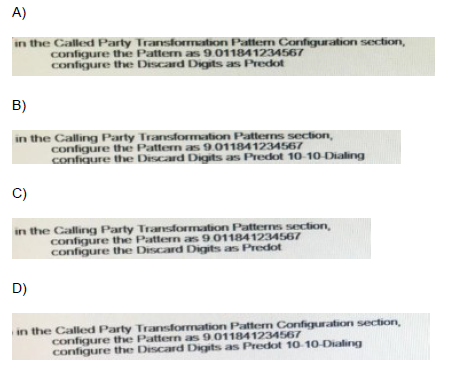
A user dials 9011841234567 to reach Vietnam. Which steps send the call to the PSTN
provider as 011841234567?
A.
Option A
B.
Option B
C.
Option C
D.
Option D
Option A
Explanation:
The user dials 9011841234567 (9 = PSTN access code + 011841234567). The PSTN provider expects the number without the leading access code, i.e., 011841234567. A Called Party Transformation Pattern is applied that matches the dialed string and uses the Discard Digits instruction “PreDot” to strip the digits before the dot, leaving exactly 011841234567 to be sent to the gateway/PSTN.
Correct Option:
A. Option A
In the Called Party Transformation Pattern Configuration:
Pattern = 9.011841234567
Discard Digits = PreDotThe “9.” is discarded, and the remaining 011841234567 is presented to the PSTN provider.
Incorrect Option:
B & C
These use Calling Party Transformation Patterns, which modify the calling number (caller ID), not the called number.
D
Uses an incorrect Discard Digits instruction (“PreDot 10-10-Dialing”) that does not simply strip the leading 9.
Reference:
Cisco Unified Communications Manager Dial Plan Guide – Called Party Transformation Patterns: use a pattern such as 9.@ or 9.011\ldots with Discard Digits = PreDot to remove the access code before sending the call to the PSTN.
Which feature is enabled by Cisco Mobile and Remote Access?
A.
Internal SIP clients registered to Cisco UCM can call external companies.
B.
Clients such as Cisco Jabber can use call control on Cisco UCM
C.
VPN connectivity can be established to Cisco UCM.
D.
Cisco UCC Express clients can obtain VPN connectivity to Cisco UCC Enterprise.
Clients such as Cisco Jabber can use call control on Cisco UCM
Explanation:
Cisco Mobile and Remote Access (MRA) is a Collaboration Edge feature that allows remote Cisco Jabber clients (and supported video endpoints) to register securely to on-premises Cisco Unified Communications Manager over the Internet. Once registered, the clients receive full call-control services (registration, calling, presence, messaging, etc.) from CUCM without requiring a VPN tunnel.
Correct Option:
B. Clients such as Cisco Jabber can use call control on Cisco UCM
Through the Expressway-C/E pair, remote Jabber clients establish a secure connection and register to CUCM, obtaining the same call-control features they would have on the corporate network.
Incorrect Option:
A. Internal SIP clients registered to Cisco UCM can call external companies.
This is ordinary B2B or PSTN calling and does not require MRA.
C. VPN connectivity can be established to Cisco UCM.
MRA is specifically designed to eliminate the need for a VPN.
D. Cisco UCC Express clients can obtain VPN connectivity to Cisco UCC Enterprise.
Contact-center VPN connectivity is unrelated to Mobile and Remote Access.
Reference:
Cisco Expressway / Mobile and Remote Access Deployment Guide: MRA enables Cisco Jabber and endpoints to register and use call control services on Cisco UCM from outside the enterprise network without a VPN.
What is the difference between Cisco Unified Border Element and a conventional Session
Border Controller?
A.
SIP security
B.
DTMF interworking
C.
Voice policy
D.
Address hiding
Voice policy
Explanation:
A conventional Session Border Controller (SBC) provides the classic functions of session control, security, interworking, and demarcation (including address hiding, DTMF interworking, SIP security, etc.). Cisco Unified Border Element (CUBE) implements all of those standard SBC capabilities and, in addition, offers advanced Voice Policy features—such as call admission control based on voice policies, sophisticated routing policies, and integration with Cisco’s broader collaboration policy framework—that go beyond a traditional SBC.
Correct Option:
C. Voice policy
CUBE includes voice-policy capabilities (policy-based routing, CAC, codec filtering tied to voice policies, etc.) that are not part of a conventional SBC feature set.
Incorrect Option:
A. SIP security
Both CUBE and conventional SBCs provide SIP security.
B. DTMF interworking
DTMF interworking is a standard SBC function performed by both.
D. Address hiding
Topology/address hiding is a core SBC capability shared by both CUBE and conventional SBCs.
Reference:
Cisco Unified Border Element Overview: “CUBE offers a wide variety of enhanced features in addition to the conventional Session Border Controller (SBC) functions,” including voice policy capabilities.
Which endpoint feature is supported using Mobile and Remote Access through Cisco
Expressway?
A.
SSO
B.
H.323 registration proxy to Cisco Unified Communications Manager
C.
MGCP gateway registration
D.
SRST
SSO
Explanation:
Mobile and Remote Access (MRA) through Cisco Expressway allows remote Jabber clients and supported endpoints to register securely to on-premises Unified Communications Manager. One of the authentication methods supported for these remote registrations is Single Sign-On (SSO), including SAML SSO and OAuth with refresh tokens. This enables users to authenticate once and obtain access to call control, messaging, and other services without a VPN.
Correct Option:
A. SSO
Expressway and CUCM can be configured for SAML SSO (or OAuth) so that mobile and remote clients authenticating via MRA use Single Sign-On.
Incorrect Option:
B. H.323 registration proxy to Cisco Unified Communications Manager
MRA is SIP-based; H.323 registration proxy is not a supported MRA feature.
C. MGCP gateway registration
MGCP gateways register directly to CUCM and are not supported over MRA.
D. SRST
Survivable Remote Site Telephony is a local-gateway fallback feature and is unrelated to MRA.
Reference:
Cisco Expressway Mobile and Remote Access Deployment Guide: MRA supports SAML SSO and OAuth authentication for remote clients and endpoints.
Which command must be defined before an administrator changes the linecode value on
an ISDN T1 PRI in slot 0/2 on an IOS-XE gateway?
A.
isdn incoming-voice voice
B.
pri-group timeslots 1-24
C.
card type t1 0 2
D.
voice-port 0/2/0:23
card type t1 0 2
Explanation:
On Cisco IOS-XE platforms the T1/E1 interface hardware is not recognized until the administrator explicitly declares the card type. The command card type t1 0 2 (or the equivalent for the installed NIM/PVDM) creates the controller T1 0/2/0. Only after this command is present can the controller configuration mode be entered and the linecode (b8zs/ami) be changed.
Correct Option:
C. card type t1 0 2
Enter global configuration mode and issue:
card type t1 0 2
This defines the T1 card in slot 0, subslot 2, making the controller available so that linecode can subsequently be configured.
Incorrect Option:
A. isdn incoming-voice voice
This is applied later on the D-channel serial interface; it is not a prerequisite for setting linecode.
B. pri-group timeslots 1-24
This command is issued under the controller after the card type and framing/linecode have already been set.
D. voice-port 0/2/0:23
The voice-port appears only after the pri-group is created; it is not required before changing linecode.
Reference:
Cisco IOS-XE T1/E1 NIM Configuration Guide: the card type command must be configured before the controller (and therefore linecode) can be modified.
On a cisco catalyst switch which command is required to send CDP packets on a switch
port that configures a cisco IP phone to transmit voice traffic in 802.1q frames tagged with
the voice VLAN ID 221?
A.
Device(config-if)# switchport access vlan 221
B.
Device(config-if)# switchport trunk allowed vlan 221
C.
Device(config-if)# switchport vlan voice 221
D.
Device(config-if)# switchport voice vlan 221
Device(config-if)# switchport voice vlan 221
Explanation:
Cisco IP phones learn the voice VLAN through CDP advertisements from the switch. The switch command that both enables CDP to carry the voice-VLAN information and tags the voice traffic with the desired 802.1Q VLAN is switchport voice vlan. When this command is configured with VLAN 221, the phone transmits its voice packets in 802.1Q frames tagged with VLAN ID 221.
Correct Option:
D. Device(config-if)# switchport voice vlan 221
This interface command sets the voice VLAN to 221. The switch then includes the voice-VLAN TLV in its CDP messages, instructing the attached Cisco IP phone to tag voice traffic with VLAN 221.
Incorrect Option:
A. Device(config-if)# switchport access vlan 221
This sets the access (data) VLAN, not the voice VLAN.
B. Device(config-if)# switchport trunk allowed vlan 221
This only permits VLAN 221 on a trunk; it does not instruct the phone to use it for voice.
C. Device(config-if)# switchport vlan voice 221
Invalid syntax; the correct keyword order is switchport voice vlan.
Reference:
Cisco Catalyst Switch Configuration Guide – Voice VLAN: the switchport voice vlan
What is the function of the Cisco Unity Connection Call Handler?
A.
routes calls to a user based on caller input
B.
queues calls
C.
searches a list of extensions until the call is answered
D.
allows customized scripts for IVR capabilities
routes calls to a user based on caller input
Explanation:
A Call Handler in Cisco Unity Connection answers a call, plays a greeting, and presents a menu of options. Based on the digits the caller enters, the Call Handler can transfer (route) the call to a user, another Call Handler, a directory handler, or a specific extension. This caller-input-driven routing is the core function of a Call Handler.
Correct Option:
A. routes calls to a user based on caller input
After playing its greeting, the Call Handler waits for DTMF input and, according to the configured caller-input rules, transfers the call to the selected user or destination.
Incorrect Option:
B. queues calls
Call queuing is performed by hunt pilots or contact-center applications, not by Unity Connection Call Handlers.
C. searches a list of extensions until the call is answered
That behavior describes a hunt group or sequential ring list, not a Call Handler.
D. allows customized scripts for IVR capabilities
Advanced IVR scripting is provided by Cisco Unified Contact Center or External Service Option (ESO) applications; standard Call Handlers use simple menu trees.
Reference:
Cisco Unity Connection System Administration Guide – Call Handlers: Call Handlers answer calls, play greetings, and route callers to users or other destinations based on caller input.
An administrator installed a Cisco Unified IP 8831 Conference Phone that is failing to
register Which two actions are taken to troubleshoot the problem? (Choose two)
A.
Disable HSRP on lhe access layer switch.
B.
Verify that the switch port of the phone is enabled
C.
Check the RJ-65 cable
D.
Verify that the RJ-11 cable is plugged into the PC port.
E.
Verify that the phone's network can access the option 150 server.
Verify that the switch port of the phone is enabled
Verify that the phone's network can access the option 150 server.
Explanation:
A Cisco IP Phone must have an active Layer-2 connection and must be able to reach its TFTP server (normally advertised by DHCP Option 150) in order to download its configuration and register with Unified Communications Manager. Therefore the two essential troubleshooting steps are to confirm that the switch port is enabled and that the phone’s network can reach the Option 150 server.
Correct Option:
B. Verify that the switch port of the phone is enabled
Ensure the access-switch port is not administratively shut down and is in the correct VLAN so the phone can obtain power (PoE) and network connectivity.
E. Verify that the phone’s network can access the option 150 server.
Confirm that DHCP is supplying Option 150 and that the phone can reach the TFTP server IP address; without the configuration file the phone cannot register.
Incorrect Option:
A. Disable HSRP on the access layer switch.
HSRP is unrelated to phone registration.
C. Check the RJ-65 cable
RJ-65 is not a standard cable type used with IP phones (RJ-45 is used).
D. Verify that the RJ-11 cable is plugged into the PC port.
RJ-11 is for analog devices; the PC port on an IP phone uses RJ-45 and is not required for the phone itself to register.
Reference:
Cisco IP Phone Troubleshooting Guide: verify switch-port status and connectivity to the TFTP server (DHCP Option 150) when a phone fails to register.
How does an administrator make Cisco IP phone display the last 10 digits of the calling
number when the call is in the connected state, and also display the calling number in the
E.164 format within call history on the phone?
A.
Configure a calling party transformation pattern that keeps only last 10 digits.
B.
Configure a translation pattern that has a calling Party Transform Mask of
XXXXXXXXXX.
C.
On the inbound SIP trunk, change Significant Digits to 10.
D.
Change the service parameter Apply Transformations On Remote Number to True.
Change the service parameter Apply Transformations On Remote Number to True.
Explanation:
To show a shortened (last-10-digit) calling number on the phone while the call is connected, yet keep the full E.164 number in the call-history directories, CUCM uses the Remote Number Calling Party Transformation CSS together with the advanced service parameter “Apply Transformations On Remote Number”. When this parameter is set to True, the transformation is applied only to the number presented on the phone’s display during the ringing and connected states; the original globalized number is still stored in the call history for redial and logging purposes.
Correct Option:
D. Change the service parameter Apply Transformations On Remote Number to True.
Set the advanced service parameter “Apply Transformations On Remote Number” to True and configure an appropriate Calling Party Transformation Pattern (that keeps only the last 10 digits) in the Remote Number Transformation CSS of the phone or device pool. The phone then displays the localized 10-digit number while connected, but the call history retains the E.164 format.
Incorrect Option:
A. Configure a calling party transformation pattern that keeps only last 10 digits.
By itself the pattern is insufficient; the service parameter must also be enabled for the transformation to affect the connected-state display without altering call history.
B. Configure a translation pattern that has a calling Party Transform Mask of XXXXXXXXXX.
Translation patterns affect routing, not the remote-number display on the phone.
C. On the inbound SIP trunk, change Significant Digits to 10.
Significant Digits truncates the number for routing and would also change the number stored in call history.
Reference:
Cisco Unified Communications Manager SRND / System Guide – Calling Party Normalization and Remote Number Transformations: enabling “Apply Transformations On Remote Number” allows the phone to display a transformed calling number during the connected state while preserving the original E.164 number in call history.
| Page 16 out of 46 Pages |
| 910111213141516171819202122 |
| 350-801 Practice Test Home |
Real-World Scenario Mastery: Our 350-801 practice exam don't just test definitions. They present you with the same complex, scenario-based problems you'll encounter on the actual exam.
Strategic Weakness Identification: Each practice session reveals exactly where you stand. Discover which domains need more attention, before Implementing Cisco Collaboration Core Technologies (350-801 CLCOR) exam day arrives.
Confidence Through Familiarity: There's no substitute for knowing what to expect. When you've worked through our comprehensive 350-801 practice exam questions pool covering all topics, the real exam feels like just another practice session.
Copyright © All Rights Reserved