
A university lecture hall has a Cisco wireless high-density network with this configuration: • 5 GHz only • 20-MHz channels • UNII-1, UNII-2, and UNII2-E channels • TPC minimum = 8 • TPC maximum = 14 The lecture hall is 200 feet by 100 feet and has 16 Cisco APs that use directional antennas. Which feature must be included in the design to mitigate and reduce high-channel utilization from rogue APs?
A. band select
B. DFS detection
C. RxSOP
D. 802.11w
Explanation:
Why RxSOP is the Best Solution?
Problem: High channel utilization from rogue APs (non-authorized devices broadcasting on the same channels).
How RxSOP Helps:
RxSOP adjusts the AP's sensitivity to ignore weak signals (e.g., distant rogue APs or noise).
By setting a higher RxSOP threshold (e.g., -65 dBm instead of the default -85 dBm), the AP ignores weak interfering transmissions, reducing unnecessary channel utilization.
This preserves airtime for legitimate clients in the high-density lecture hall.
Why Other Options Are Less Effective?
A) Band Select: Forces clients to 5 GHz but doesn’t mitigate rogue AP interference.
B) DFS Detection: Only handles radar interference, not rogue APs.
D) 802.11w (PMF): Protects management frames but doesn’t reduce channel utilization.
Reference:
Cisco High-Density Design Guide: Recommends RxSOP for mitigating interference in dense environments.
Cisco AP Configuration Guide: RxSOP settings for optimizing airtime usage.
An engineer changed the TPC Power Threshold for a wireless deployment from the default value to -65 dBm. The engineer conducts a new post-deployment Survey to validate the results. What is the expected outcome?
A. Increase cell size
B. Decreased client signal strength
C. Increased received sensitivity
D. Decreased channel overlap
Explanation:
Why Decreasing TPC Power Threshold to -65 dBm Reduces Channel Overlap?
What is TPC (Transmit Power Control)?
TPC dynamically adjusts AP transmit power to maintain optimal coverage while minimizing interference.
Lowering the TPC threshold (e.g., from default -70 dBm to -65 dBm) makes APs reduce power sooner when clients are closer.
Expected Outcome:
Smaller cell sizes: APs lower power when clients are near, reducing overlap with neighboring APs.
Less co-channel interference: Fewer APs on the same channel interfere with each other.
Improved airtime efficiency: More balanced client distribution across APs.
Why Not Other Options?
A) Increase cell size → Wrong. Lowering power shrinks cell size.
B) Decreased client signal strength → Partly true, but not the primary goal (focus is on reducing overlap).
C) Increased received sensitivity → Unrelated. Rx sensitivity is a hardware property, not affected by TPC.
Reference:
Cisco Wireless LAN Controller Configuration Guide: TPC thresholds optimize coverage/interference trade-offs.
CWNP Certified Wireless Design Professional (CWDP): Lower TPC thresholds reduce overlap in high-density designs.
Where must the APs be mounted when used in a high-density wireless network to provide 6 dB to 20 dB of attenuation to a cell?
A. in the aisle
B. under the seat
C. above the stage
D. under the stage
Explanation:
Why Mounting APs Under Seats Provides Optimal Attenuation (6–20 dB)?
High-Density Design Principle:
In venues like lecture halls, stadiums, or theaters, clients are densely packed in seating areas
Mounting APs under seats (or slightly above floor level) ensures:
Controlled cell size: The seat structure (metal/plastic) and human bodies attenuate signals by 6–20 dB, naturally limiting AP coverage to nearby clients.
Reduced co-channel interference: Smaller cells prevent APs from overshooting into neighboring sections.
Why Other Options Fail?
A) In the aisle: Too open; signals propagate too far, causing interference.
C/D) Above/under the stage: Stages are typically far from seating, leading to weak signals or uneven coverage.
Reference:
Cisco High-Density Design Guide: Recommends under-seat mounting for attenuation and interference control.
Ekahau HD Design Best Practices: Uses seat attenuation (6–20 dB) to optimize cell boundaries.
Guest anchoring is configured for a newly created SSID for your company. It has been noticed that the mobility tunnels are not up, and that MPING fails from your foreign WLC to the anchor WLC. What is the reason that it is failing?
A. A rule is needed at the firewall to allow UDP port 16666 for communication towork.
B. A rule is needed at the firewall to allow UDP port 97 for communication to work.
C. A rule is needed at the firewall to allow TCP port 97 for communication to work.
D. A rule is needed at the firewall to allow TCP port 16666 for communication to work.
Explanation:
The mping command is a diagnostic tool specifically used to test the mobility control path between Wireless LAN Controllers (WLCs). In a guest anchoring setup, this control path must function before a mobility tunnel (and user data traffic) can be established between the foreign and anchor WLCs .
According to Cisco documentation, mobility control packets are sent over a well-known UDP port 16666 . The mping utility validates whether these control packets can successfully reach the management interface of the mobility peer . If UDP port 16666 is blocked by a firewall between the foreign and anchor WLCs, the mping test will fail, and the mobility tunnel's control path will remain down .
Why Other Options are Incorrect
B and C (Port 97) :
Port 97 is a common distractor. The data path for mobility tunnels uses Ethernet-over-IP (EoIP), which is designated by IP protocol number 97 . It is important to note that 97 is a protocol number, not a UDP or TCP port value . The eping command tests the data path, not the control path tested by mping .
D (TCP port 16666) :
While 16666 is the correct port number for mobility control traffic, the protocol used is UDP, not TCP . Configuring a TCP rule for this port would not resolve the connectivity issue for the mobility control path.
References:
Cisco Configuration Guide: "Mobility ping over UDP—This test runs over mobility UDP port 16666. It tests whether the mobility control packet can be reached over the management interface" .
Troubleshooting Guide: "If there is a firewall present, make sure that the UDP port 16666 and IP port 97 are opened for communication between the WLCs" .
In a high-density stadium deployment, which two design considerations are most important?
A. Use of high-gain omni antennas and 2.4 GHz channels
B. Coverage overlap of 50% and fewer APs
C. Sectorized directional antennas and channel reuse planning
D. Single large AP with maximum transmit power
Explanation:
In high-density stadium environments, the two most critical design considerations are using sectorized directional antennas and careful channel reuse planning. Stadiums present one of the most challenging Wi-Fi deployment scenarios due to extreme user density, where tens of thousands of spectators simultaneously attempt to connect and upload content like photos and videos to social media.
Why Other Options are Incorrect
A (High-gain omni antennas and 2.4 GHz channels):
Omni antennas radiate in all directions, creating large overlapping coverage cells that cause excessive interference. In high-density stadiums, the 2.4 GHz band is saturated and should be disabled entirely.
B (Coverage overlap of 50% and fewer APs):
High-density environments require more APs, not fewer, to provide adequate capacity. Standard coverage overlap models do not apply; the focus shifts from coverage to capacity.
D (Single large AP with maximum transmit power):
This is the opposite of proper high-density design. Maximizing transmit power creates larger cells with more interference, reducing overall network capacity. High-density designs use lower transmit power with many small cells.
References:
Cisco StadiumWi-Fi Design principles emphasize directional antennas and channel reuse
Modern stadium deployments (e.g., Levi's Stadium) use nearly 1,500 APs with hyper-directional antenna design
Cisco official guidance recommends 20 MHz channel widths for high-density to maximize capacity
What is the main goal of Radio Resource Management (RRM) in Cisco WLANs?
A. To manually configure AP channels
B. To automatically adjust channel, power, and coverage parameters
C. To increase antenna gain
D. To manage client roaming decisions directly
Explanation:
The main goal of Radio Resource Management (RRM) in Cisco WLANs is to automatically adjust channel, power, and coverage parameters to create an optimized, self-healing, and high-performing wireless network. RRM functions as the "brain" of the wireless infrastructure, continuously monitoring the RF environment and dynamically adapting AP settings without manual intervention.
Why Other Options are Incorrect:
A (To manually configure AP channels) :
This is the opposite of RRM's purpose. While manual configuration is possible, RRM is specifically designed to automate and dynamically adjust RF parameters to eliminate manual overhead and respond to changing conditions.
C (To increase antenna gain) :
RRM does not control antenna gain. Antenna selection is a hardware decision made during physical deployment. RRM adjusts RF parameters at the software level (power and channel), not antenna characteristics.
D (To manage client roaming decisions directly) :
Client roaming decisions are primarily made by client devices based on their own proprietary algorithms. RRM influences roaming indirectly by creating optimal coverage cells and supporting 802.11k/v/r to assist clients, but it does not directly manage or force client roaming decisions.
References:
Cisco Wireless Controller Configuration Guide: RRM performs "automatic and dynamic adjustments to channel and power assignments to improve network performance"
Cisco RF Profiles and RRM design guides emphasize RRM's role in "self-configuring, self-optimizing, and self-healing" wireless networks
Which feature ensures seamless roaming between APs with no noticeable delay for voice clients?
A. Client load balancing
B. 802.11k
C. 802.11r Fast Transition
D. 802.11d
Explanation:
The feature designed to ensure seamless roaming with no noticeable delay, especially for latency-sensitive applications like voice, is 802.11r Fast Transition (FT) . The primary goal of this standard is to reduce the handoff time between access points to under 50 milliseconds, which is below the threshold for human perception and critical for maintaining call quality .
802.11r achieves this by streamlining the authentication process. In a standard WPA2-Enterprise environment, a client must perform a full, time-consuming 4-way handshake with a RADIUS server each time it roams to a new AP . 802.11r eliminates this overhead by using a key hierarchy that allows a client to securely transition without re-authenticating to the backend server every time . The initial AP "vouches" for the client, enabling a fast and secure handoff that minimizes disruption to data flows .
Why Other Options are Incorrect:
A. Client load balancing:
This is a mechanism to distribute clients evenly across APs and channels to optimize overall network capacity and performance, not to reduce the latency of a single client's roaming transition.
B. 802.11k:
This standard (Neighbor Reports) helps a client discover nearby APs more efficiently by providing a list of potential roaming targets . While it improves roaming by reducing the scan time, it does not eliminate the lengthy authentication overhead, which is the primary cause of delay for voice clients. It is often used together with 802.11r for an optimal roaming experience.
D. 802.11d: This is a standard for worldwide regulatory compliance, enabling a device to discover the RF channels and regulations for a specific country. It has no role in fast roaming or client transition.
References
Cisco: The "802.11r Fast Transition Roaming" chapter in Cisco's deployment guide states that 802.11r is "the key requirement for voice over Wi-Fi" because it "eliminates much of the handshaking overhead while roaming, thus reducing the handoff times between APs" .
Industry Research: Research on modern roaming mechanisms notes that 802.11r can achieve a handoff time of around 50 ms, which is critical for maintaining VoIP call quality (where latency must remain below 150 ms) .
An engineer is designing a wireless deployment for a university auditorium. Which two features can be used to help deal with the issues introduced by high AP count? (Choose two.)
A. TSPEC
B. RXSOP
C. TPC
D. LSS
E. DFS
Explanation:
In high-density environments like university auditoriums, deploying a large number of Access Points (APs) leads to severe Co-Channel Interference (CCI) and RF cell overlap. Managing cell size—both for receiving and transmitting—is essential to maintaining network performance.
Detailed Breakdown
B. RXSOP (Receiver Start-of-Packet Detection Threshold):
Why it's correct: RXSOP increases the minimum signal level required for an AP's radio to demodulate a packet. By ignoring distant, weak transmissions (e.g., setting the threshold from -85 dBm to -75 dBm), the AP shrinks its receive cell size. This prevents unnecessary Clear Channel Assessment (CCA) deferrals and reduces contention from neighbouring APs and distant clients.
C. TPC (Transmit Power Control):
Why it's correct: TPC dynamically adjusts the AP's radio output power to control its transmit cell size. In high AP-count deployments, TPC lowers power levels to limit RF signal bleed, thereby mitigating CCI across adjacent APs operating on shared channels.
Incorrect Options Breakdown:
A. TSPEC (Traffic Specification):
TSPEC handles WMM/802.11e Quality of Service (QoS) Call Admission Control (CAC) for voice and video streams. It manages traffic prioritization and bandwidth allocation, not RF interference or high AP density.
D. LSS (Location Specific Services):
LSS restricts mDNS/Bonjour service advertisements (like Apple TV/AirPlay) to local AP groups. It reduces unnecessary network multicast overhead, but it does not address RF cell overlap or physical layer AP interference.
E. DFS (Dynamic Frequency Selection):
DFS allows 5 GHz radios to detect radar signals and automatically jump channels. While it unlocks additional 5 GHz non-overlapping channels, it is a regulatory spectrum-sharing mechanism, not a high-density AP cell-tuning tool.
References:
Cisco Catalyst Center / Wireless Controller Design Guide: High Density Experience (HDX) Deployment Guide — Section: Optimizing RX-SOP and TPC for High-Density Stadiums & Auditoriums.
Cisco Press: CCNP Enterprise Wireless Design ENWLSD 300-425 Official Cert Guide — Chapter: Designing High-Density Wireless Networks.
An engineer configured the optimized client roaming on Cisco WLC with an RSSI threshold of 72dBm. Clients report frequent disconnections. What must be configured for the AP to guide the client to a better AP?
A. Enable BSS transition at the radio level and optimized roaming on the SSID.
B. Disable coverage hole detection on the SSID and enable BSS transition on the SSID.
C. Disable optimized roaming and enable 802.11v support on the SSID.
D. Enable BSS transition on the SSID and optimized roaming at the radio level.
Explanation:
The client disconnections are occurring because the Optimized Roaming feature was enabled, but the 802.11v BSS Transition mechanism was not. Optimized roaming is designed to solve the problem of "sticky clients" that remain connected to a distant AP . The feature proactively disassociates clients when their RSSI falls below a configured threshold . However, if the network cannot guide the client to a better AP, the client is simply disconnected, leading to a poor user experience.
To solve this, the 802.11v BSS Transition feature must be enabled. This allows the AP to send a BSS Transition Management Request frame to the client before disconnecting it, which provides the client with a list of better APs to roam to . For the AP to send this message in response to a poor RSSI condition, both Optimized Roaming (configured at the Radio level) and BSS Transition (configured at the WLAN/SSID level) must be enabled .
Why Other Options are Incorrect:
B. Disable coverage hole detection on the SSID and enable BSS transition on the SSID:
Disabling Coverage Hole Detection (CHD) is recommended when using optimized roaming, but it does not address the configuration mismatch between the radio and SSID levels. This option does not include enabling Optimized Roaming at the radio level, which is the root cause .
C. Disable optimized roaming and enable 802.11v support on the SSID:
Disabling Optimized Roaming would stop the network from proactively disconnecting sticky clients, but it would not fix the issue of disconnections that are already occurring when the feature is enabled.
D. Enable BSS transition on the SSID and optimized roaming at the radio level:
This is the correct configuration, not an incorrect option .
References:
Cisco documentation states that for APs to send a BSS Transition Management Request when a client does not have the best RSSI, both BSS Transition and Optimized Roaming must be enabled .
Optimized roaming disassociates clients based on RSSI to resolve sticky client issues .
An engineer is designing a new wireless network. The network needs to meet these requirements:
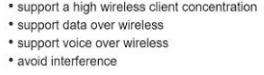
Which design approach should be taken?
A. 5 GHz frequency band with channel bonding, to support 40 MHz channels
B. 5 GHz frequency band without channel bonding, to support 20 MHz channels
C. 5 GHz frequency band with channel bonding, to support 80 MHz channels.
D. 2.4 GHz frequency band without channel bonding, to support 20 MHz channels
Explanation:
The requirement to avoid interference and support a high wireless client concentration directly points to a high-density design strategy. In such environments, the primary goal is maximizing total network capacity and minimizing co-channel interference, rather than maximizing the throughput of a single client.
The 5 GHz band is the only viable choice for this scenario. It offers significantly more spectrum and many more non-overlapping channels than the crowded and interference-prone 2.4 GHz band . This ample spectrum is critical for supporting a high density of clients.
Why Other Options are Incorrect:
A. 40 MHz channels:
Channel bonding reduces the number of available channels, increasing interference in a high-density environment and making it harder to avoid interference.
C. 80 MHz channels:
This is the worst option for high density. It consumes even more spectrum, drastically limiting channel reuse and creating a high-interference environment, which directly conflicts with the requirement to avoid interference.
D. 2.4 GHz band:
The 2.4 GHz band is extremely limited, with only three non-overlapping channels. It suffers from high interference and is unsuitable for high-density client support .
References:
Cisco Meraki best practices recommend 20 MHz channels in high-density environments to maximize the number of available channels and minimize interference .
Cisco's high-density design philosophy emphasizes using the 5 GHz band and narrower channels to support a large number of concurrent clients reliably.
A customer called with a requirement that internal clients must be on different subnets depending on the building they are in. All access points are operating in local mode and will not be modified, and this is a single controller solution. Which design approach creates the desired result?
A. Create AP groups for each desired location, map the correct VLANs to the internal SSID, and add the access points for that location.
B. Create an SSID place it to the desired VLAN under WLANs and configure 802.1x in ISE to assign the correct VLAN based on the SSID from which the client is authenticating
C. Create FlexConnect groups, place the access points in, and set the correct VLAN to SSID mapping based on location.
D. Create mobility anchors for the SSID and on the controller under the internal SSID create a foreign map to the desired VLAN based on location.
Explanation:
The requirement is to place internal clients on different subnets depending on the building they are in, using a single controller with APs in Local Mode. The AP Group feature is specifically designed for this purpose . It allows a single SSID (WLAN) to be mapped to different VLANs on a per-location basis by grouping APs and assigning each group a specific dynamic interface .
For example, all APs in Building 1 can be assigned to the "Students" AP Group, which maps the internal SSID to VLAN 10. APs in Building 2 can be assigned to the "Staff" AP Group, mapping the same SSID to VLAN 20 . When a client connects to the SSID, the controller determines the VLAN based on which AP Group it joined . This solution meets all constraints: it works with Local Mode APs, requires no AP modifications, and uses a single controller.
Why Other Options are Incorrect:
B. Configure 802.1x in ISE to assign VLAN based on SSID: This is incorrect because ISE assigns VLANs based on user identity or attributes, not the building location. The requirement is location-based, and clients in different buildings would get the same VLAN regardless of their physical location .
C. Create FlexConnect groups:
FlexConnect groups are intended for APs in FlexConnect mode at remote branch sites, not for Local Mode APs in a single-controller deployment .
D. Create mobility anchors:
Mobility anchors are used for guest tunneling between controllers in different locations. They are not used to assign VLANs based on AP location within a single controller environment.
References:
Cisco AP Group VLAN configuration guide: AP groups allow a single WLAN to be supported across multiple dynamic interfaces (VLANs) on a controller .
AP Group VLANs are also called "site-specific VLANs," enabling client placement in different interfaces based on the physical AP of association .
An engineer is performing a predictive wireless design for a medical treatment environment, which requires data and voice services. What is the minimum requirement for the design?
A. overlapping -72 dBm coverage from two access points
B. continuous -67 dBm coverage from one access point
C. continuous -72 dBm coverage from one access point
D. overlapping -67 dBm coverage from two access points
Explanation:
In a medical treatment environment where both data and voice services are required, the design must prioritize mission-critical reliability and seamless roaming. Cisco's design guidelines for healthcare environments specifically recommend a minimum of -67 dBm RSSI at the cell edge with overlapping coverage from multiple access points to ensure high availability and support for voice applications .
The -67 dBm threshold is the recommended baseline for achieving a packet error rate of approximately one percent, which requires an SNR of 25 dB or greater . This signal strength is sufficient for maintaining high-quality voice calls and reliable data transmission. The overlapping coverage requirement ensures that as a client device (such as a VoWLAN handset or patient monitor) roams between APs, it can transition seamlessly without call drops or data loss . Multiple APs providing coverage in the same area is a Medical-Grade Network best practice for handling bandwidth, traffic, and failure scenarios .
Why Other Options are Incorrect:
A. overlapping -72 dBm coverage from two access points:
While this includes the critical overlapping design, -72 dBm is too weak for reliable voice services. Voice coverage requires a stronger -67 dBm cell edge to maintain packet error rates at acceptable levels . At -72 dBm, voice quality would likely suffer from dropped packets and poor call clarity.
B. continuous -67 dBm coverage from one access point:
This uses the correct signal strength but lacks coverage redundancy from a second AP. A single AP creates a single point of failure, which is unacceptable in a medical environment where wireless connectivity is critical for patient care and clinical operations . Healthcare networks require overlapping coverage for both reliability and seamless roaming.
C. continuous -72 dBm coverage from one access point:
This option fails on both counts: the signal is too weak for voice (-72 dBm vs. the required -67 dBm), and the single AP approach lacks the necessary redundancy for a medical environment .
References:
Cisco VoWLAN design guidelines recommend -67 dBm minimum signal level and 25 dB SNR for voice quality
Cisco Unified Wireless IP Phone Deployment Guide specifies -67 dBm signal with at least two APs for redundancy
| Page 10 out of 24 Pages |
| 678910111213 |
| 300-425 Practice Test Home |
Real-World Scenario Mastery: Our 300-425 practice exam don't just test definitions. They present you with the same complex, scenario-based problems you'll encounter on the actual exam.
Strategic Weakness Identification: Each practice session reveals exactly where you stand. Discover which domains need more attention, before Designing Cisco Enterprise Wireless Networks (ENWLSD) exam day arrives.
Confidence Through Familiarity: There's no substitute for knowing what to expect. When you've worked through our comprehensive 300-425 practice exam questions pool covering all topics, the real exam feels like just another practice session.
Copyright © All Rights Reserved