
Topic 2, Exam B
When a site-to-site VPN is used, which protocol is responsible for the transport of user data?
A. IKEv2
B. IKEv1
C. IPsec
D. MD5
Explanation:
A site-to-site VPN allows offices in multiple fixed locations to establish secure
connections with each other over a public network such as the Internet. A site-to-site VPN
means that two sites create a VPN tunnel by encrypting and sending data between two
devices. One set of rules for creating a siteto-site VPN is defined by IPsec
What is the expected outcome when an EUI-64 address is generated?
A. The seventh bit of the original MAC address of the interface is inverted
B. The interface ID is configured as a random 64-bit value
C. The characters FE80 are inserted at the beginning of the MAC address of the interface
D. The MAC address of the inteaaaaaaaacrface is used as the interface ID without modification
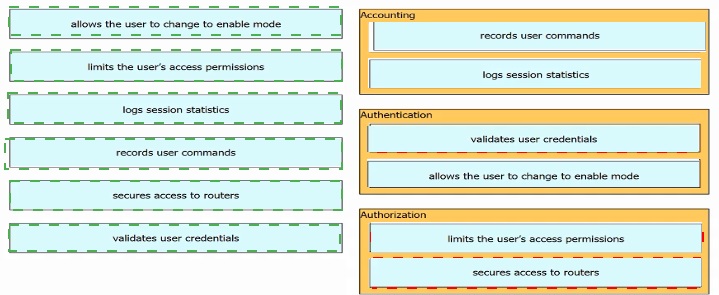
Drag and drop the descriptions of AAA services from the left onto the corresponding services on the right.
What is a function of an endpoint on a network?
A. forwards traffic between VLANs on a network
B. connects server and client devices to a network
C. allows users to record data and transmit to a tile server
D. provides wireless services to users in a building
Explanation:
An endpoint is a host that acts as the source or destination of data traffic
flowing through a network.
When you are at your PC, editing your CV and uploading it to a file server, you are sitting at
an endpoint.
Which two spanning-tree states are bypassed on an interface running PortFast? (Choose two.)
A. disabled
B. listening
C. forwarding
D. learning
E. blocking
Refer to the exhibit.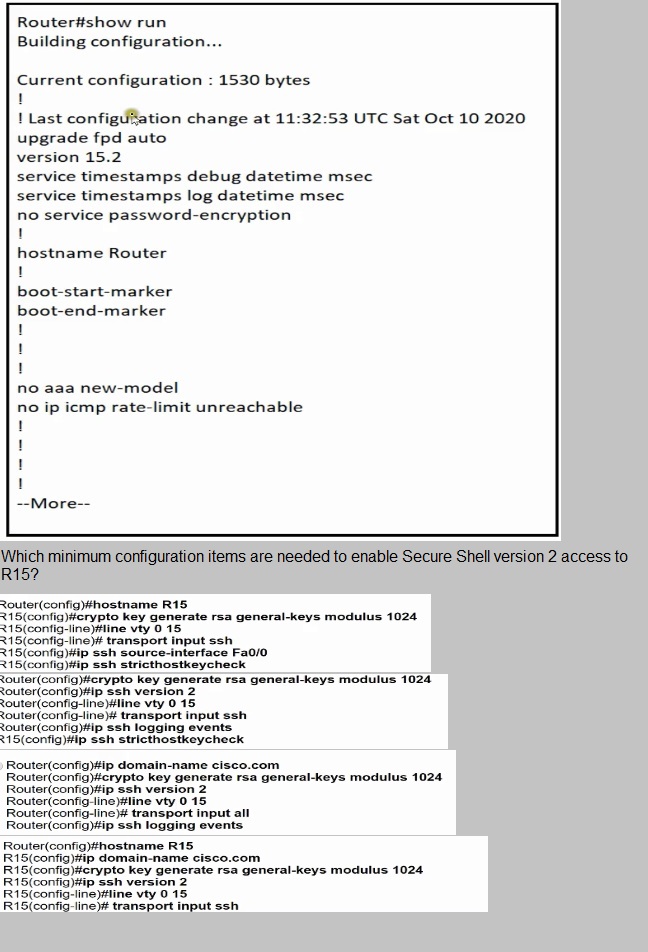
A. Option A
B. Option B
C. Option C
D. Option D
Refer to the exhibit.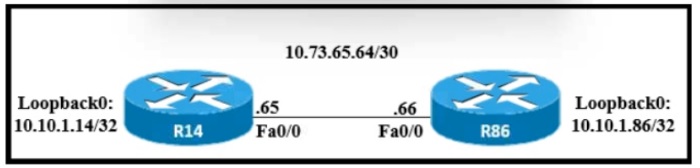
A static route must be configured on R14 to forward traffic for the 172 21 34 0/25 network
that resides on R86 Which command must be used to fulfill the request?
A. ip route 172.21.34.0 255.255.255.192 10.73.65.65
B. ip route 172.21.34.0 255.255.255.192 10.73.65.65
C. ip route 172.21.34.0 255.255.255.0 10.73.65.65
D. ip route 172.21.34.0 255.255.128.0 10.73.65.64
E. ip route 172.21.34.0 255.255.255.128 10.7ac.65.66
Which PoE mode enables powered-device detection and guarantees power when the device is detected?
A. dynamic
B. static
C. static
D. auto
Refer to the exhibit.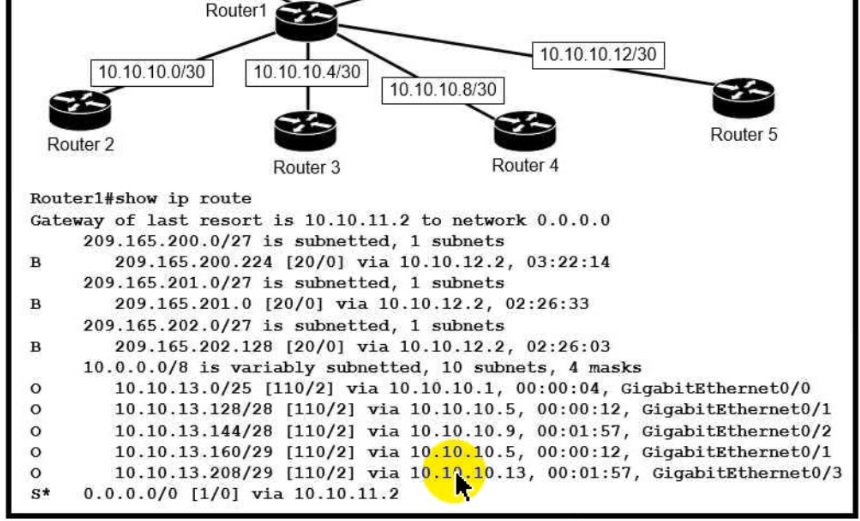
Which next-hop IP address does Routed use for packets destined to host 10 10.13.158?
A. 10.10.10.5
B. 10.10.11.2
C. 10.10.12.2
D. 10.10.10.9
Which protocol is used for secure remote CLI access?
A. HTTPS
B. HTTP
C. Telnet
D. SSH
Which REST method updates an object in the Cisco DNA Center Intent API?
A. CHANGE
B. UPDATE
C. POST
D. PUT
Explanation:
PUT is most-often utilized for **update** capabilities, PUT-ing to a known
resource URI with the request body containing the newly-updated representation of the
original resource.However, PUT can also be used to create a resource in the case where
the resource ID is chosen by the client instead of by the server. In other words, if the PUT
is to a URI that contains the value of a non-existent resource ID. Again, the request body
contains a resource representation. Many feel this is convoluted and confusing.
Consequently, this method of creation should be used sparingly, if at all.Alternatively, use
POST to create new resources and provide the client-defined ID in the body
representation—presumably to a URI that doesn’t include the ID of the resource (see
POST below).On successful update, return 200 (or 204 if not returning any content in the
body) from a PUT. If using PUT for create, return HTTP status 201 on successful creation.
A body in the response is optional—providing one consumes more bandwidth. It is not
necessary to return a link via a Location header in the creation case since the client already
set the resource ID.PUT is not a safe operation, in that it modifies (or creates) state on the
server, but it is idempotent. In other words, if you create or update a resource using PUT
and then make that same call again, the resource is still there and still has the same state
as it did with the first call.If, for instance, calling PUT on a resource increments a counter
within the resource, the call is no longer idempotent. Sometimes that happens and it may
be enough to document that the call is not idempotent. However, it’s recommended to keep
PUT requests idempotent. It is strongly recommended to use POST for non-idempotent
requests.Examples:
https://www.restapitutorial.com/lessons/httpmethods.html
Refer to the exhibit

Users on existing VLAN 100 can reach sites on the Internet. Which action must the
administrator take to establish connectivity to the Internet for users in VLAN 200?
A. Define a NAT pool on the router.
B. Configure static NAT translations for VLAN 200.
C. Configure the ip nat outside command on another interface for VLAN 200.
D. Update the NAT INSIDF RANGFS ACL
| Page 37 out of 100 Pages |
| 222324252627282930313233343536373839404142434445464748495051 |
| 200-301 Practice Test Home |
Real-World Scenario Mastery: Our 200-301 practice exam don't just test definitions. They present you with the same complex, scenario-based problems you'll encounter on the actual exam.
Strategic Weakness Identification: Each practice session reveals exactly where you stand. Discover which domains need more attention, before Cisco Certified Network Associate exam day arrives.
Confidence Through Familiarity: There's no substitute for knowing what to expect. When you've worked through our comprehensive 200-301 practice exam questions pool covering all topics, the real exam feels like just another practice session.
Copyright © All Rights Reserved